
Late nineties, a party back in Canada, early in my career. I had leaned my gear bag against the wall of the booth without checking what was on that wall, and sometime in the first hour I bumped it reaching for something. It hit the main breaker for the venue’s speaker system. The room went silent at about the moment the bass should have dropped on a track I’d been building toward for the previous eight minutes.
The silence lasted about three seconds before I realised what I’d done. I reset the breaker, the system came back, I apologised on the mic in one sentence, and I went back to the music. The owner came to the booth afterward, said it was fine and that they’d secure the breaker panel, and booked me back. I’ve told the story dozens of times because it’s funny now, and because it taught me the thing this piece is about: the recovery matters more than the incident.
Most Failures Fall into Three Kinds
Technical failures in a DJ set come in three broad kinds, each with its own likely causes and best responses. The one most DJs fear is the one preparation reduces most.
Three Kinds of Failure in the Booth
What usually breaks, and what helps
부스에서 일어나는 세 가지 사고
| Kind | Typical example | What helps |
|---|---|---|
| Equipment | A CDJ won’t mount a USB drive, a laptop crashes | Spare drives, spare cable, a backup that can play a track |
| Sound system | Feedback, a dead speaker, bad routing | Know your signal chain, and whose problem it is |
| Human error | A knocked plug, the wrong track, lost sync | A recovery plan instead of a freeze |
The ruleThe first two are mostly solved before doors. The third is solved by how you behave when it happens.
Equipment failure means a CDJ refusing to mount a USB drive, a mixer developing an intermittent connection, or a laptop crashing. The three USB drives I carry to every gig aren’t paranoia; I’ve had a drive fail at a bad moment more than once. A backup audio interface, a spare cable for the connection most likely to cause trouble, a second system that can play a track long enough to fix the first: these cost less than the booking they might save. The hardware is catching up too. AlphaTheta’s CDJ-3000X, announced in September 2025, caches each whole track in the player’s memory, so playback carries on even if a USB drive is pulled out or a connection drops mid song.
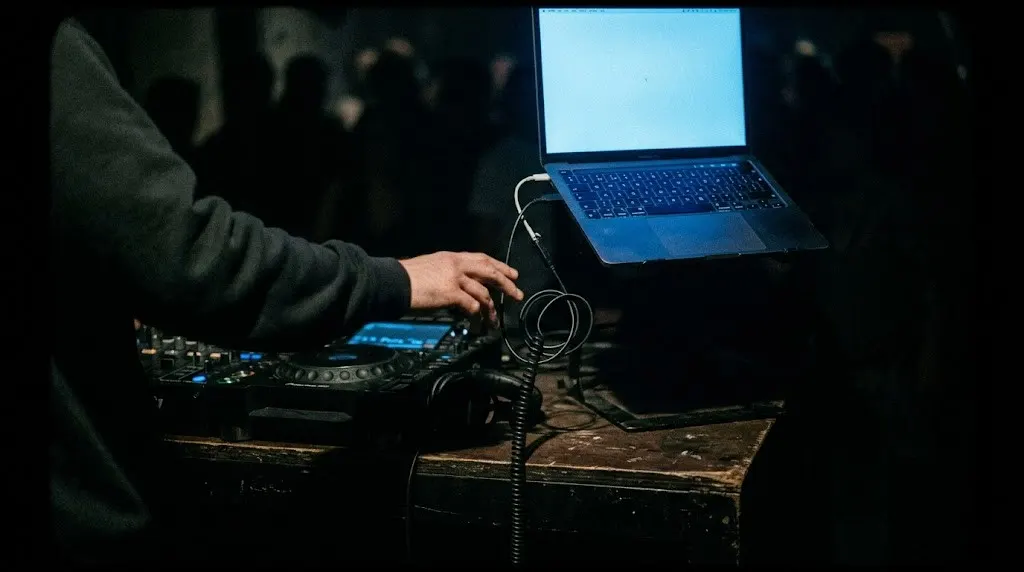
Sound system problems, such as feedback, signal lost to some speakers or routing errors, are usually the sound engineer’s job but can involve you. Knowing how to check your signal chain quickly, where a signal is dropping, and above all whether the problem is yours or the venue’s, saves precious seconds. Human error, knocking equipment, firing the wrong track, losing sync at a visible moment, happens to everyone, and it’s the kind people handle worst, because it involves the ego as well as the practical problem.
The Sound Check Catches Most of It
Most problems that surface during a set could have been found at the sound check, a systematic test of every part of your signal chain in the room where you’ll play. Test each CDJ on its own, the mixer’s channel routing, the headphone cue at different positions, the booth monitor levels and your laptop connection if you use one. Ask the sound engineer to confirm they’re getting a clean signal at the right level for the room. Do it at performance volume, because some faults only show up when the system is properly driven.
Twice I’ve declined to play a venue because the sound check turned up a problem they couldn’t fix before doors. Both times I talked it through with the promoter, explained the fault, and offered either to reschedule or to take a reduced fee if they could fix it before the start. Neither was ideal. Both were better than playing a system with a known fault and pretending it wasn’t there.
Fred Again Showed What a Good Recovery Looks Like
The moment that went around from Fred Again’s Boiler Room set wasn’t a technical failure. It was an accidental pause when an overexcited fan touched the equipment. What stood out was his response: he handled it lightly, reconnected with the crowd rather than retreating into the gear, and got back into the music as if it had just happened rather than as if he were recovering.
He showed a skill that’s harder than it looks, which is telling apart what the crowd is going through and what you’re going through. Inside a technical crisis you feel panic, embarrassment and a strong urge to fix it immediately. From the floor, people feel curiosity, then either sympathy or quiet frustration, depending on how you handle it.
The response that serves the crowd acknowledges the moment without amplifying it: a brief acknowledgment, a light touch of humour if the moment allows, and a return to the music as fast as the problem allows. Visible distress makes the crowd anxious, and silence lets the interruption fill the room.
Grimes and the Recovery That Didn’t Land
Grimes’ Coachella 2024 set drew a lot of discussion, less for the technical difficulties, which happen to everyone, than for a response that seemed to play down a problem the audience was living through. Laughing at a failure can release tension. It can also read as indifference, especially at a big show where people have spent a lot to be there.

The cause is worth knowing. Grimes explained afterward that it was one of the first times she had “outsourced essential things like rekordbox BPMs” and let someone else organise the tracks on her SD card. Most tracks were reading at double their real tempo on the CDJs, which made beatmatching impossible. It’s a strong argument for preparing and checking your own USB or SD card.
Humour that says “I see this, I’m okay, let’s keep going” is different from humour that seems to say “it’s fine, nothing needs to change.” At her next show Grimes acknowledged the set with a self aware joke that landed better, because by then there was something to have moved on from. Reading what the crowd needs in a bad moment is the same skill you use to read what it needs when everything is going well.

Every Failure Is Data
Once the adrenaline has cleared, the failure deserves a proper look. Should the sound check have caught it? Would a backup have prevented it? Was it human error with a specific cause? Was it a venue problem you should have raised with the promoter before agreeing to play?
The temptation is to blame the venue, the equipment or the sound engineer. Sometimes they are responsible. More often the failure was at least partly preventable from your end, and the point of looking back is to find what you’d do differently.
The best DJs I know keep a clear mental library of their worst moments, not as a source of shame but as a reference for how they prepare. The thing that went wrong in Seoul in 2015 is why I carry a specific cable I’ve never needed since but check every time I pack my DJ bag. The near disaster at a festival in 2018 is why I arrive at venues with more time to spare than seems strictly necessary. The failures teach, if you let them.
Frequently Asked Questions
How Should a DJ Handle Technical Problems During a Live Set?
Acknowledge the moment briefly and genuinely, without amplifying it. Use light humour if it fits, but don’t use humour as a substitute for fixing the problem. Get back to the music as quickly as the technical situation allows. The crowd’s experience is shaped more by how you respond than by the failure itself.
What Technical Issues Should DJs Prepare for at Every Gig?
USB drive failures, so carry two or three. Signal chain interruptions, so know how to find where a signal is dropping. Equipment compatibility issues. Power cuts, so know where the breaker is before you need it. And human error, so have a recovery plan rather than a freeze when something goes wrong in front of a crowd.
How Important Is the Sound Check?
Very. Most technical problems that surface during a set could have been found in a systematic sound check. Test every part of your signal chain at performance volume, not just at quiet test levels, and ask the sound engineer to confirm they’re getting a clean signal. A thorough sound check is performance insurance.
Should DJs Use Humour When Something Goes Wrong?
Sometimes, with care. Humour can release tension and show confidence, which helps a crowd stay with you during a problem. But it should come with a real effort to fix the situation, not replace it. Crowds feel the difference between “I see this, let’s keep going together” and “this isn’t a big deal”, even if they can’t say why.
Further Reading
- Wikipedia: what a soundcheck is and why it prevents problems on the night
- Wikipedia: Boiler Room, the broadcaster where live DJ sets are streamed unedited
- Wikipedia: Fred Again and his rise through live and streamed sets
- Wikipedia: Grimes, including her 2024 Coachella DJ set
- Wikipedia: Coachella, the California festival where the Grimes set took place
- The DJ bag guide
Sources
AlphaTheta, announcing the CDJ-3000X, September 2025
Rova, Fred Again’s response when a fan cut the music at Boiler Room
Billboard, Grimes apologises after Coachella 2024
Exclaim, Grimes on what went wrong at Coachella, April 2024
Billboard Canada, Grimes at Coachella’s second weekend
Written from Seoul, by someone who has been in the booth for more than twenty years. More on the site, or book a DJ.
Stay in the Loop
New writing on DJ culture, electronic music, and the Seoul underground, delivered when it matters.
More From The DJ Diaries



Play with the history
Four tools built from the same research as this site.