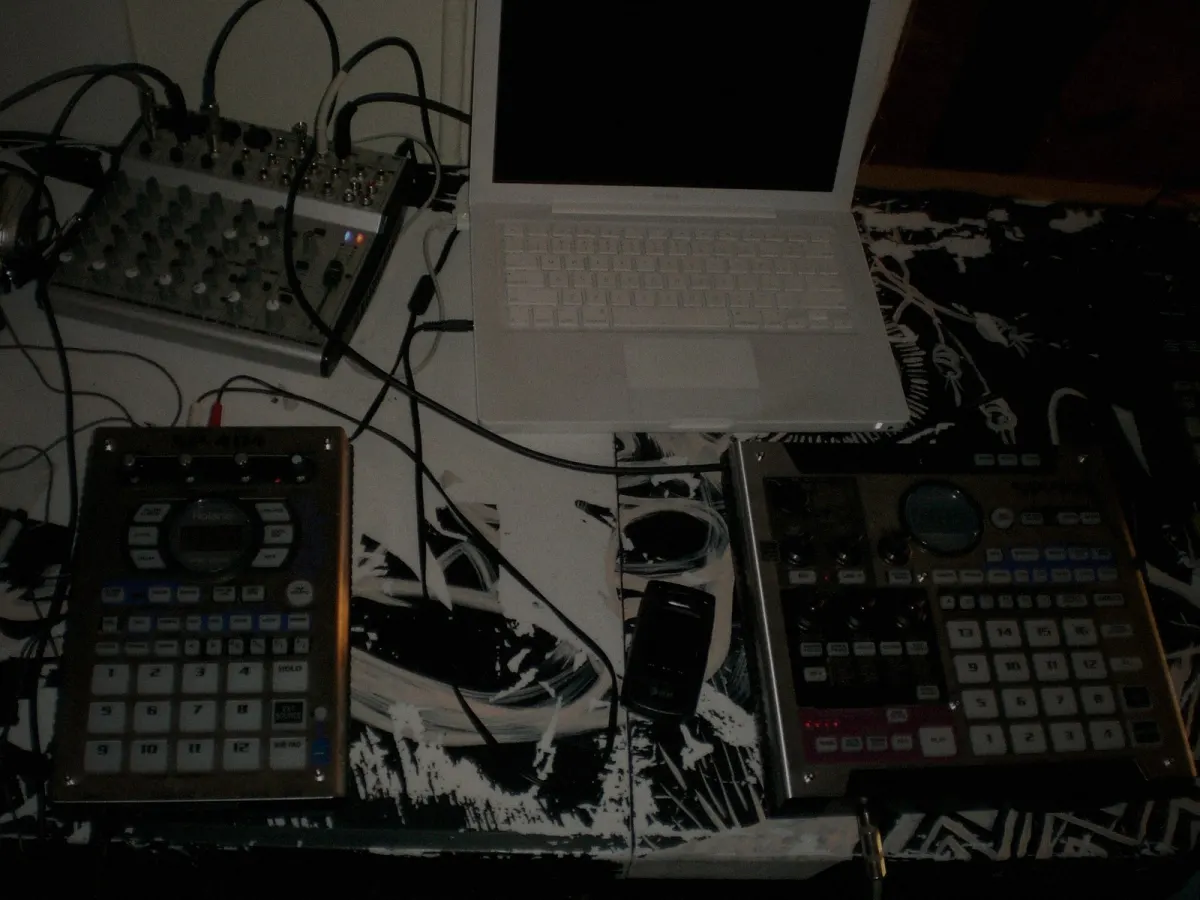
A vocal off a record, a chord stumbled onto halfway through a bar set, and the sampler on the table beside the mixer has already caught it. Skip Back Sampling holds the last 40 seconds of whatever you just played. Resample it, run it through the vinyl simulator, and there’s a loop that didn’t exist when the night started.
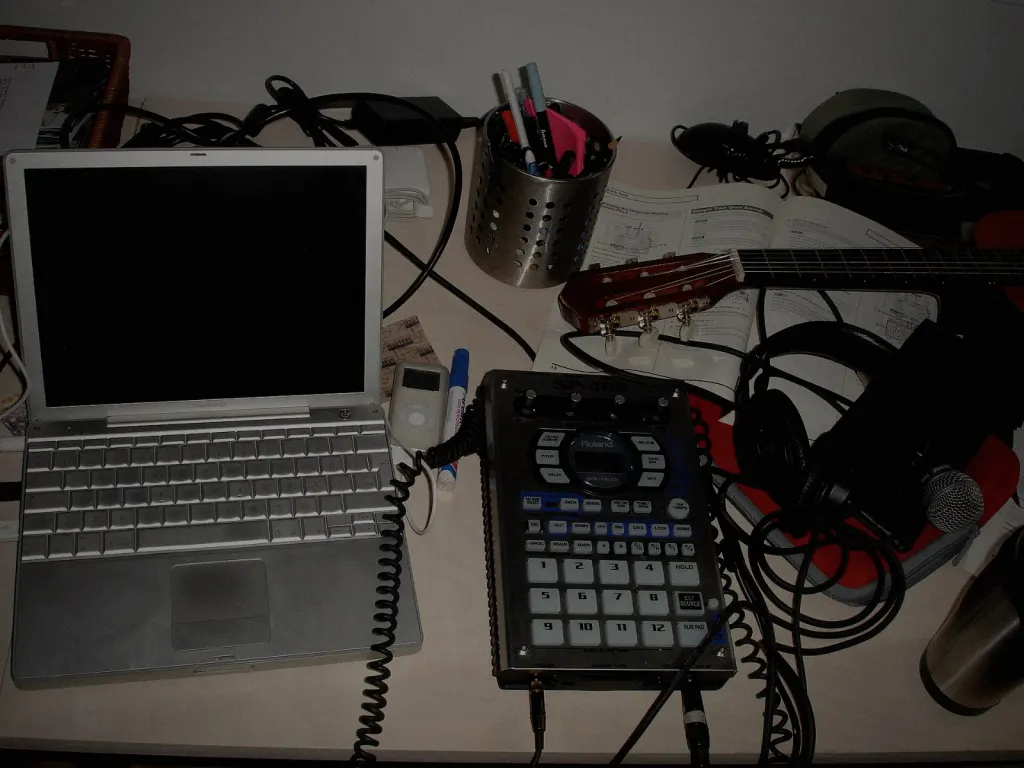
That box began life in 2005 as a modest live tool. The Roland SP-404’s limits became its aesthetic, and the machine that was supposed to be basic became iconic, almost entirely without Roland’s help. Its story is the clearest modern case for character over specification, and it has ended up back where it started: on a table in the booth.
Roland Built a Modest Box for the Stage
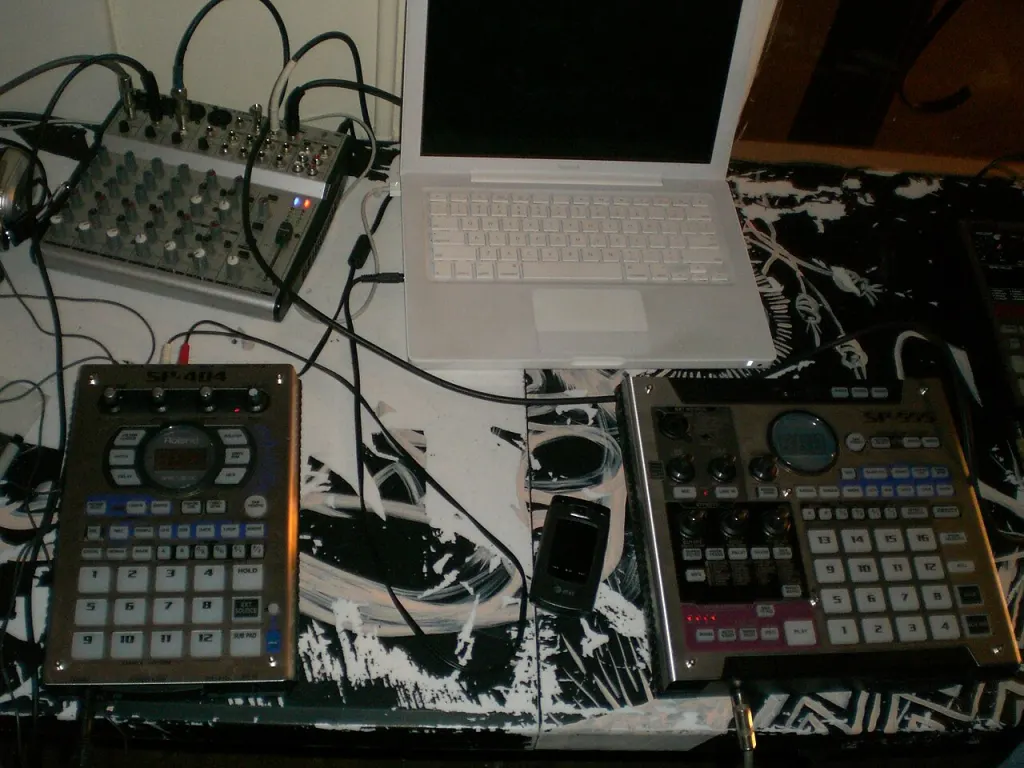
The Roland SP-404 arrived in 2005 as a portable sampler for performers: 12 rubber pads, a small LCD, a handful of onboard effects and famously modest memory. It ran on batteries, took a microphone and cost a fraction of what the studio standard Akai MPCs sold for. The design brief was a live trigger box, something to fire loops and stabs from a stage table.
Roland SP-404
A modest live box that the wrong users turned into a whole sound
- Type
- Portable sampler
- Launched
- 2005. Then SX 2009, A 2017, MKII 2021
- Changed
- The lo fi hip hop sound, from Low End Theory in Los Angeles
- Family
- Follows the Boss SP-303 that Madlib and J Dilla made famous
- Today
- Firmware 5.50, April 2026
The machinesTen instruments on The DJ Diaries, from 1970 to 2006, drawn to scale. Tap a dot to read its story.
Nobody at Roland was pitching it as a main production instrument, because on paper it clearly wasn’t one. It followed the Boss SP-303 that Madlib and J Dilla made famous, and it looked like a sensible, slightly cheaper box for the same job.
The Wrong Users Turned Its Limits into a Sound
By 2010 the machine had a cult following it was never designed for, centred on the emerging lo fi hip hop community, first in the Los Angeles beat scene around the Low End Theory club night. The limitations read like a list of reasons to buy something else: constrained sample time, no real overdubbing workflow, a converter chain that roughened everything passing through it, and the vinyl sim and compressor effects that smeared audio in a way no plugin quite copied. Lo fi producers heard all of that as a feature set.
The genre’s whole aesthetic, tape hiss, crackle and rolled off highs, rejected studio polish for something that sounded homemade and human, a descendant of the 1990s do it yourself ethos. The SP-404 became its badge. J Dilla’s Donuts era mythology hung over the format, even though the popular account of that album credits its predecessor, the Boss SP-303. YouTube beat channels racked up millions of views of fingers on those 12 pads, and the beat tape revival made the machine a rite of passage. By its twentieth birthday the cult had gone official: for 404 Day in April 2025, Roland ran events across five continents, from Los Angeles and Atlanta to Tokyo, Mumbai and São Paulo, and Berklee College of Music had launched its first SP-404MKII course.
Roland Learned to Follow
Roland never fixed the machine. Successive revisions, through the SP-404SX to 2021’s SP-404MKII, carefully kept its imperfections while upgrading around them. The MKII added modern storage, a better screen and deep effects, and sold out repeatedly, because Roland finally understood that sometimes the market for a machine is the misuse of it.
From the SP-303 to the MKII
Each model kept the rough edges and upgraded around them
SP-303에서 MKII까지
| Year | Model | What changed |
|---|---|---|
| Before 2005 | Boss SP-303 | The box Madlib and J Dilla made famous |
| 2005 | SP-404 | 12 pads, batteries, a mic input, modest memory |
| 2009 | SP-404SX | The revision that kept the sound |
| 2017 | SP-404A | Another update, same character |
| 2021 | SP-404MKII | Modern storage, better screen, deep effects |
| April 2025 | Firmware 5.00 | Skip Back in DJ Mode; Serato DJ Lite, Pro and Studio |
| April 2026 | Firmware 5.50 | Side chain compression, exFAT SDXC cards |
The ruleRoland’s smartest move was what it left alone.
The TB-303 story had already taught the company that lesson, the exact pattern of acid house and of every tool the culture bent to its own purposes. The line runs SP-404 (2005), SP-404SX (2009), SP-404A (2017) and SP-404MKII (2021), and every step kept the sound people had fallen for.
The bigger point reaches past the beat scene. In a production world of unlimited tracks and perfect converters, a generation chose a box that fights back, because the fighting is audible and the audible becomes identity. Every DJ who carries one to a bar gig for live resampling, every producer running a set through the vinyl sim, is making the argument the lo fi kids made: texture is a musical decision, not a defect. The software revolution made music making frictionless, and the SP-404’s second life is the vote for friction.
The SP-404MKII Is a DJ Tool Now
Roland has kept adding DJ features to the MKII, and they’re the ones working DJs use. The SP-404MKII now has a DJ Mode that mixes two audio files or patterns, with eight cue points per sample and adjustable fader curves, and it works natively with Serato DJ Lite. Skip Back Sampling captures up to the last 40 seconds of whatever you just played. The unit runs on USB-C, a mobile battery or six AA batteries, which matters more in a bar than any spec sheet suggests.
Roland is still updating it. Firmware 5.00 in April 2025 put Skip Back Sampling inside DJ Mode and turned the MKII into a ready mapped controller for Serato DJ Lite, Serato DJ Pro (a paid upgrade from Serato) and Serato Studio, and version 5.50 in April 2026 added side chain compression and support for exFAT SDXC cards.
Skip Back is the feature I’d build a bar set around. In a small room, that live texture is what separates a selector from a playlist. Restraint matters here too. One captured loop, played for sixteen bars, lands harder than a stream of effects, and a room forgives a rough edge when it can hear the idea.
The aesthetic has crossed onto the dancefloor as well. Lo fi house took the rolled off highs and tape hiss of the lo fi beat scene and put a four to the floor kick under them.
The Catch: It Fights Back in the Booth Too
The character that made the SP-404 famous can bite on a club system. Gain staging is where it goes wrong. The compressor and the lo fi effects add level, and a return that sounded fine in headphones can push the master into the red. I wrote about volume discipline in the booth, and it applies twice over to anything with a compressor inside.
The simplest booth setup puts the SP on the mixer’s send and return, so it works as an effects unit on any channel. The send copies part of a channel’s signal out to the SP, and the return brings the processed sound back into the mixer, so the original track keeps playing even if the effect misbehaves. My piece on the DJM channel strip covers that loop. Keep the return low, bring it up by ear, and watch the master meter, not the headphones.
At about 1.1 kilograms, the MKII earns a place in my bag guide for smaller gigs, next to the headphones and the backup USB stick.
Frequently Asked Questions
What is the Roland SP-404?
The Roland SP-404 is a portable sampler that arrived in 2005 with 12 rubber pads, a small LCD, onboard effects and famously modest memory. It ran on batteries, took a microphone and cost a fraction of an Akai MPC. Roland designed it as a live trigger box for firing loops and stabs from a stage table, not as a main production instrument.
Why is the SP-404 so popular with lo fi hip hop producers?
Lo fi producers heard its limits as a feature set. Its constrained sample time, rough converter chain, and vinyl sim and compressor effects smeared audio in a way no plugin quite copied. That suited a genre built on tape hiss, crackle and rolled off highs, and by 2010 the machine had a cult following, first in the Los Angeles beat scene around the Low End Theory club night, years before lo fi hip hop became a YouTube genre.
What is the difference between the SP-404, SP-404SX and SP-404MKII?
The SP-404 arrived in 2005, the SP-404SX in 2009, the SP-404A in 2017 and the SP-404MKII in 2021. Each revision kept the original’s imperfections while upgrading around them. The MKII added modern storage, a better screen and deep effects, then a DJ Mode, Serato DJ Lite support and Skip Back Sampling through firmware updates.
Is the SP-404 worth it when software can do more?
For producers and DJs who want character, yes. A generation with unlimited tracks and perfect converters chose a box that fights back, because that friction is audible and becomes identity. DJs still carry one to bar gigs for live resampling. The pad workflow itself descends from the Akai MPC.
Further Reading
- The Akai MPC: How Hip Hop Built Its Rhythms
- Pioneer DJM Mixers: How a Channel Strip Became an Instrument
- The Dance Music Machines
- The Ultimate DJ Bag Guide
Sources
Roland: SP-404MKII announcement, 2021
Roland: SP-404MKII product page
Roland: SP-404MKII specifications
Roland: SP-404MKII updates and drivers
Serato: SP-404MKII support in Serato DJ and Studio
MusicTech: the SP-404 and a new generation of beatmakers
FACT: 15 samplers that shaped modern music
IASPM Journal (2019), cited here on lo fi aesthetics
Dancecult (2014), cited here on the TB-303 story
Written from Seoul, by someone who has been in the booth for more than twenty years. More on the site, or book a DJ.
Watch and listen: Roland · Roland SP-404MKII in depth demo
Stay in the Loop
New writing on DJ culture, electronic music, and the Seoul underground, delivered when it matters.
More From The DJ Diaries
Play with the history
Four tools built from the same research as this site.