The DJ Diaries · Weekly Report
This Week In Dance Music
Issue 01 · October 14 to 21, 2026
The Week In One Line
Nightlife is being squeezed by permits, crowd plans and falling venue numbers, while artists speak up about their working lives and the industry argues about what counts as a real artist. Eleven stories from fifteen outlets below: five on clubbing, three on artists and three on the industry.
London Study Finds Black Music Events Are Cut Off More Often
A London study says the genre on the flyer changes how likely a night is to be cancelled or restricted.
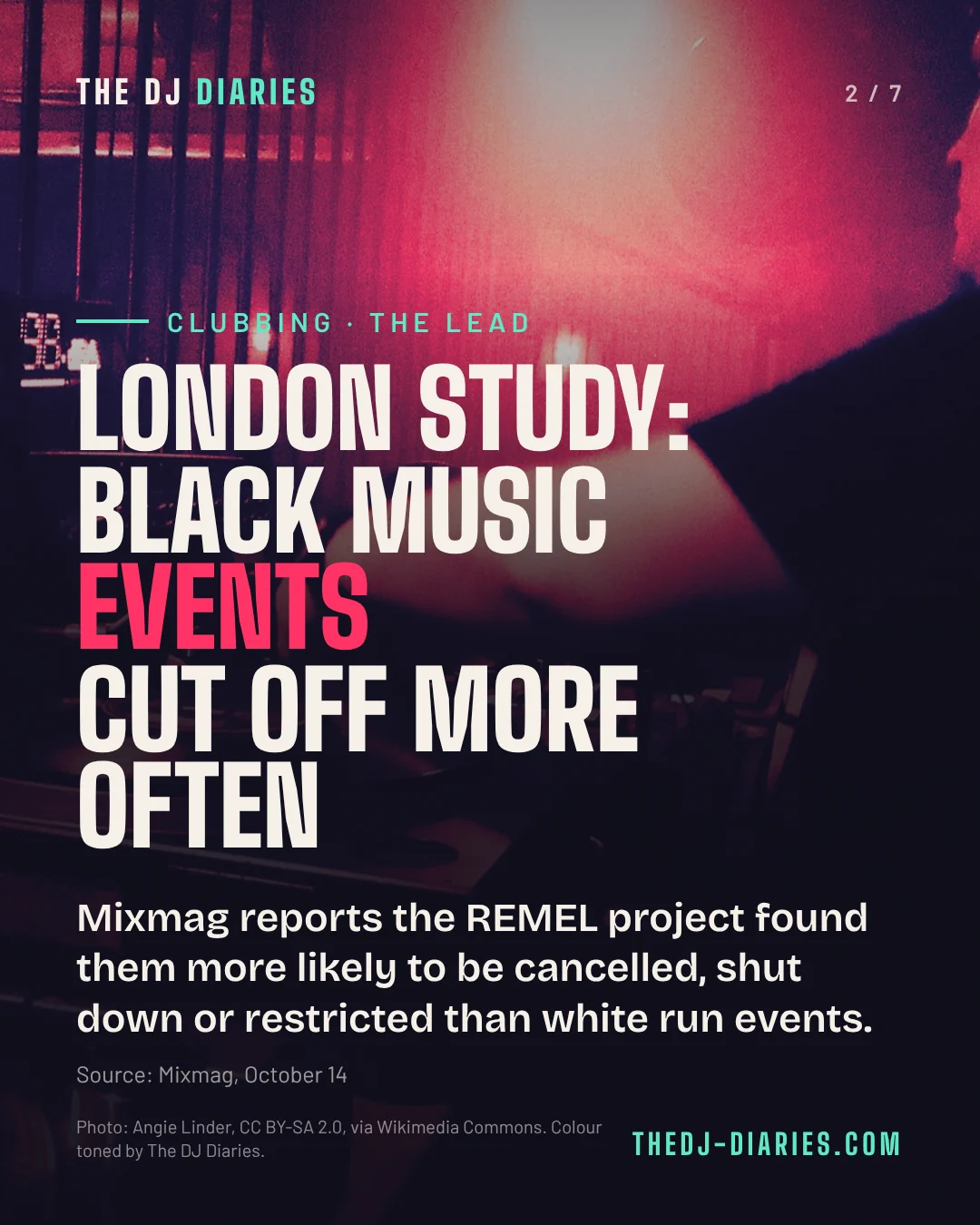
Mixmag reported on October 14 that a research project called REMEL, short for Race Equality In Music Event Licensing, found that Black music events in London are more likely to be cancelled, shut down or restricted than white run events. According to the report, applications for short term event permissions were more likely to be refused in the most diverse boroughs, and afrobeats, dancehall and R&B events were the ones most often labelled higher risk. The researchers estimate that £650 million in investment is at risk over five years, or about £114 million a year, and the findings feed into a London Race Action Plan. These are the study’s own figures as reported by Mixmag. The full report is at Mixmag, and DJ Mag also covered it.
Any promoter who has watched a night get a harder look because of the genre on the flyer will recognise the pattern. The useful takeaway is to keep paperwork, security plans and neighbour relations in order before anyone asks, and to ask a local licensing adviser or a lawyer about the details.
Mapo Eases Renewals For Dance Permitted Restaurants Near Hongdae
Existing dance permitted rooms in Hongdae get an easier renewal, but new ones stay on hold until 2027.
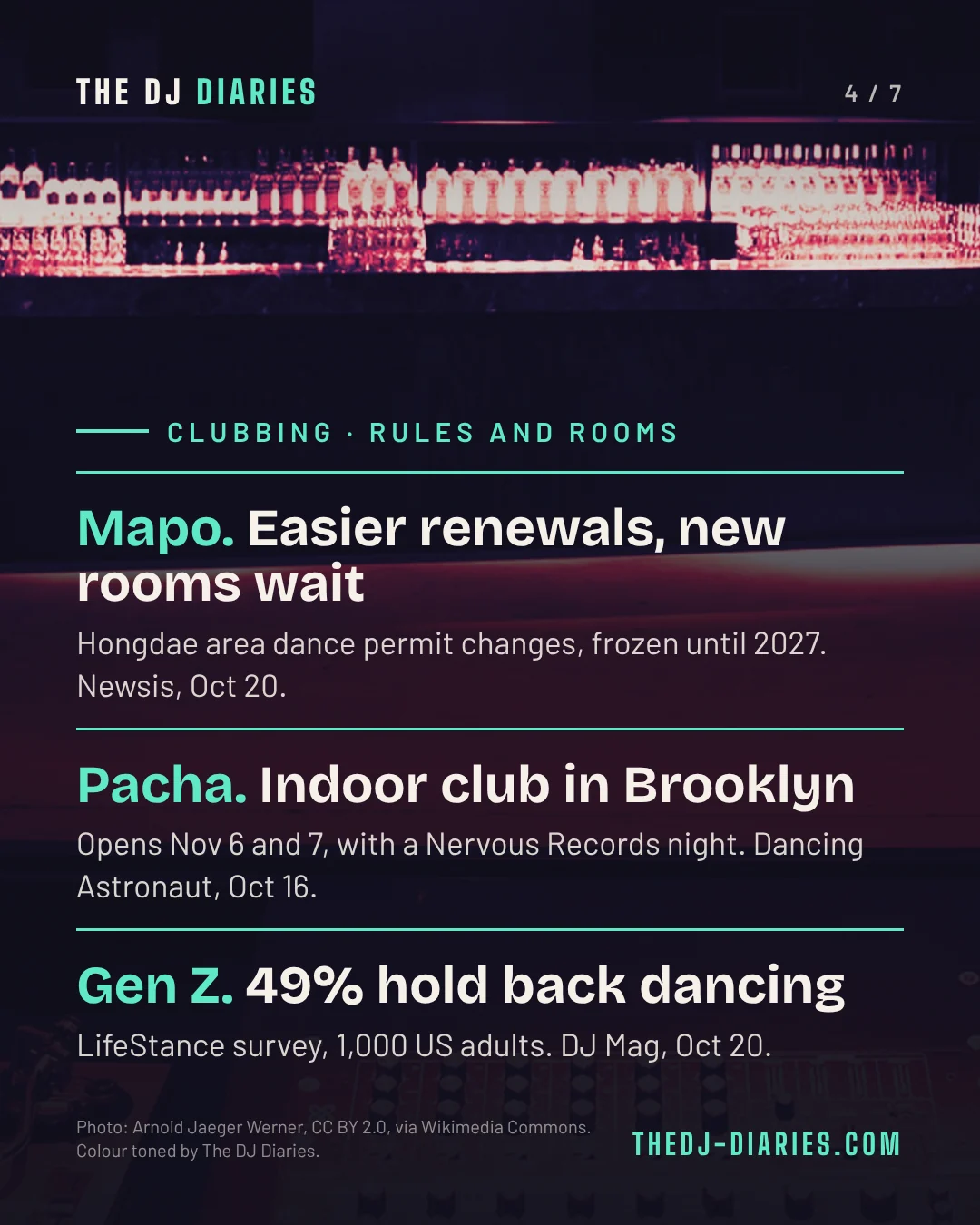
Newsis reported on October 20 that Mapo District (마포구) Council passed an amendment to its ordinance on general restaurants that allow customers to dance, covering the Hongdae (홍대) area. According to Newsis, the designation period goes from two years to three, and certificates that are hard to obtain can be replaced by other inspection documents at renewal. New designations stay limited until January 2, 2027, and the district says it will decide in 2027 after meeting merchant associations. Councillor Heo Timothy (허디모데), a cosponsor, argued the criteria for blocking new entrants look unclear, which is the councillor’s view as reported by Newsis. The original Korean report is at Newsis.
Rules for dancing in restaurants vary by district, and this change helps existing rooms with stability while new ones wait. For a booker, that means fewer new rooms to play in Hongdae until at least 2027. The details belong with the Mapo district office or a lawyer, not this site.
Itaewon Gets About 2,550 People On Duty For Halloween, Hongdae Adds Crowd Staff
Itaewon gets the biggest Halloween operation in the city, with about 2,550 district, police and fire staff on duty, while Hongdae adds 241 trained crowd staff.

Safety News (안전신문) reported on October 21 that Mapo District will run joint safety management in the Hongdae Tourist Special Zone from October 23 until 3 a.m. on November 1, with trained crowd management staff rising to 241, which is 91 more than last year, while public servants on site fall by 201 to 64. The report cites a peak of 110,000 people in the zone at one moment on Halloween last year, and says staffing is heaviest from 11 p.m. on the club street, with nine AI crowd density analysis points in use. Hankook Ilbo (한국일보) reported that Yongsan District (용산구) will put about 2,550 staff from the district, police and fire services into Itaewon (이태원). At national level, Seoul Economic Daily reported on October 20 that the Ministry of the Interior and Safety (행정안전부) named 28 hotspots for a special crowd period from October 23 to November 1. Original reports: Safety News, Hankook Ilbo and Seoul Economic Daily.
October 29 is four years since the Itaewon crowd crush that killed 159 people, and Halloween Saturday, October 31, is still the night when nightlife and public safety meet most directly. The busiest club street hours are exactly when staff will be thickest, so plan door flow, exits and briefings around the official peak, not around your own guest list.
Pacha Opens An Indoor Room In Brooklyn
Pacha is betting on a year round indoor room in New York, not just the summer site.
Dancing Astronaut reported on October 16 that Brooklyn Pacha opens the weekend of November 6 and 7 in the former Great Hall space, with a new sound and lighting system and a deliberately rough warehouse feel. Friday has Loco Dice, Ilario Alicante and HoneyLuv, and Saturday is a Nervous Records anniversary night with Louie Vega, Oscar G and others. The outlet says it follows the open air Pacha New York that opened this summer, giving the brand a summer site and a smaller indoor room for the rest of the year. The full piece is at Dancing Astronaut.
One of the best known club names in the world is betting on a smaller room that runs through the cold months, not only the summer stadium night. For a Seoul promoter, that is a quiet argument that the mid size room is where long term money sits.
Almost Half Of Gen Z Hold Back On The Dancefloor
Fear of being filmed is keeping almost half of Gen Z off the dancefloor.
DJ Mag reported on October 20 on a LifeStance Health survey titled Fear of Going Viral, covering 1,000 US adults. It found that 49 percent of Gen Z hold back from dancing in public, compared with 30 percent of adults overall, and 47 percent of adults blamed phone and wearable cameras. These are survey figures from a US sample, reported by DJ Mag. The write up is at DJ Mag.
The fear is that a bad dance move ends up online. For a DJ, the practical answer is the same one it has always been: a dark room, a clear filming policy at the door and a booth that does not make the crowd feel watched. It is also a reminder that Korea’s debate over dancing in restaurants and live venues is about more than the rulebook.
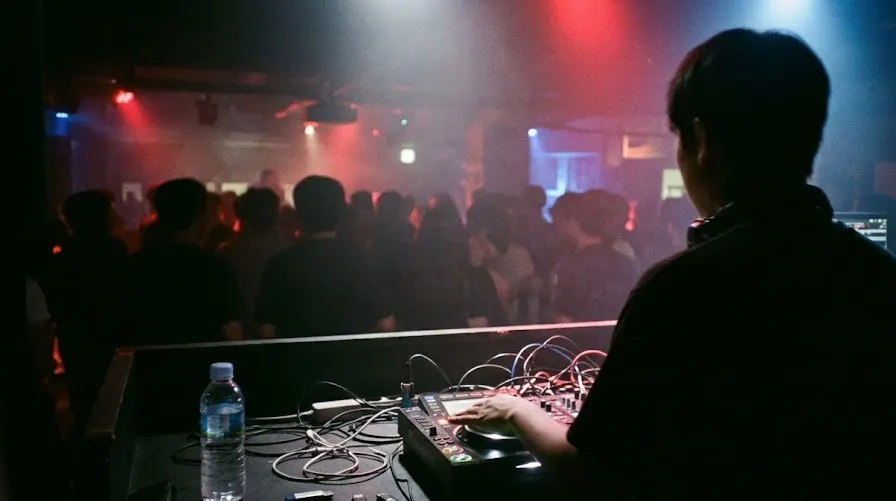
Amelie Lens On Touring While Pregnant
One of techno’s biggest names is touring through pregnancy and talking openly about it.

DJ Mag’s cover interview, by Olivia Stock and published on October 20, finds Amelie Lens six months pregnant and still playing. She describes performing for about 8,000 people at Magazine Open Air in London and for 15,000 at the Ziggo Dome while eight months pregnant with her first child, and she talks about sexism in the scene and cites the METOODJS collective’s “hundreds of testimonies”. Her line on the subject: “I didn’t give up my dreams to have them.” The full interview is at DJ Mag.
It is a rare public account of how a headliner builds a career around family, and promoters and bookers will hear it as a prompt to ask touring artists what they need before they ask. A Seoul DJ planning a family can read it as proof the two are not opposites.
Russian DJ Dropped From ADE After A Message To A Ukrainian DJ
A private message cost a DJ his ADE booking within days.
Dutch Review reported on October 16 that Russian DJ Alexander Komarov was dropped from Amsterdam Dance Event after a private message insulting a Ukrainian DJ surfaced on Reddit. According to the report, he confirmed sending the message to the Dutch paper AD, and he had been due to play an Interplay Records show on October 23. The Netherlands’ honorary consul for Ukraine’s dance music scene, Karel Burger Dirven, called the removal “only the beginning”. These are the outlet’s claims, and he has the right to respond. The report is at Dutch Review.
What an artist says in private can end a booking in public, and festivals and conferences now act in days, not months. For a promoter, a conduct clause in a booking agreement is worth a conversation with a lawyer or an agent.
Roger Sanchez On Owning The Business Side
A house legend says ownership and time outlast any single big night.
Billboard’s 20 Questions interview with house legend Roger Sanchez, by Katie Bain and published on October 16, goes through his 2003 Grammy and his UK number one “Another Chance”, and returns to owning the business side of his career. His line: “the greatest currency you have is your time.” The interview is at Billboard.
A veteran is telling younger DJs that ownership and time, not one big night, are what last. It is a good frame for any DJ in Seoul deciding what to say yes to.

UK Nightlife Loses 350 Outlets In Six Months
The UK keeps losing nightlife venues, and nightclubs are falling fastest.

The Night Time Industries Association (NTIA) said on October 15, using its NielsenIQ and CGA monitor, that the UK saw a net loss of 350 night time economy outlets in the first half of 2026. Since March 2020 the net loss is 867 venues, or 28.7 percent, including 448 nightclubs, down 36.1 percent. The NTIA is lobbying ahead of the October 28 Budget because nightclubs are left out of a targeted business rates relief. These are advocacy figures from the NTIA and have not been independently checked. The release is at the NTIA.
A number that large in a country that invented a lot of club culture is a warning for every city. Falling venue counts show up in Seoul as fewer places to book, so the useful move for a DJ is to support the rooms that still run.
AI Music Gets Labels And Numbers
The platforms are now counting, labelling and filtering AI music at scale.
Spotify said on October 20, in its “One Year In” post, that it took more than 50 million low quality AI tracks out of recommendations this year and removed more than 75 million from the platform, that over 300,000 artists are verified, and that tracks with a high AI probability are ten times more likely to fall under its 1,000 stream royalty threshold. All figures are Spotify’s own. On October 14 YouTube Music announced it is labelling AI generated tracks, according to Mixmag on October 15. Read more at Spotify Newsroom and Mixmag.
The platforms are settling on labels, badges and filters, and the sums they publish show how large the flood is. For a working DJ, the booth rule is simple: know what is in your crate and where it came from.
Amsterdam Dance Event Turns 30 And Puts AI On The Stage
ADE’s 30th edition puts AI at the centre of the industry conversation.
Amsterdam Dance Event runs from October 21 to 25 for its 30th edition. ADE announced on October 19 that ADE Pro now treats music technology as a strategic core, with an AI platforms roundtable that includes leaders from Splice, SoundCloud, NVIDIA, Deezer, Believe and Image-Line, a presentation by Google DeepMind’s Jeff Chang, and a final keynote from Insomniac’s Pasquale Rotella on why rave culture needs its own independent business. This is a programme announcement, not a set of outcomes. The announcement is at ADE, and our own Amsterdam Dance Event guide.
ADE is where the year’s deals and rule changes get talked about first, and this year the loudest topic is AI. Whatever labels and platforms agree there tends to reach Seoul within a season.
On The Radar
Billboard reported on October 19 that Time Warp is launching a label inside Insomniac Music Group, with first releases on November 20. Pollstar reported on October 16 that the US government has sued ticket broker REPS & Co over tickets it alleges were bought with bots, and the claims are allegations only. Music Venue Trust said on October 15 that a pilot with Audoo found only 21 percent of live music in grassroots venues matched registered repertoire. In Korea, Asia Today reported on October 21 that Grand Mint Festival offered full refunds after rain, which is the organiser’s account. The long running dance rule for live venues has had no new official step since Culture Minister Choi Hwi-young (최휘영) pledged on September 17 to push for a revision, and Newneek reports the two month Busan suspension of Obangarde (오방가르드) ends around October 24 or 25, a date we could not confirm in a fresh report. Nastia’s decision to stop accepting US bookings, reported by DJ Mag on October 20, is her own stand and this site takes no side.
The Big Idea

Read together, the week asks who gets to keep a dancefloor open. A London study says the answer depends on what music is playing, Mapo and Yongsan say it depends on the permit and the crowd plan, UK figures say it depends on the budget, and the platforms are deciding whether it depends on a human being at all. For a DJ or promoter in Seoul, the practical question is how many of those doors you have already checked before you open yours.
Every story above links to the outlet that reported it, and each one is worth reading in full. More from Seoul at The DJ Diaries, or book a DJ.
Written from Seoul, by someone who has been in the booth for 25 years. More on the site, or book a DJ.
Research and fact checking for this post used AI. Spotted a wrong detail or date? Get in touch and we will fix it. 잘못된 정보나 날짜가 있으면 알려주세요.
Sources
- Mixmag: Black music events are more likely to be cancelled, shut down or restricted
- DJ Mag: Black live music events disproportionately cancelled, restricted or blocked
- Newsis: Hongdae club renewals eased
- Safety News: Hongdae crowd staff for Halloween
- Hankook Ilbo: Itaewon Halloween plan
- Seoul Economic Daily: 28 Halloween hotspots
- Wikipedia: Seoul Halloween crowd crush
- Dancing Astronaut: Brooklyn Pacha
- DJ Mag: Gen Z avoid dancing
- DJ Mag: Amelie Lens cover interview
- Dutch Review: Russian DJ dropped by ADE
- Billboard: Roger Sanchez 20 Questions
- NTIA: 13 night time economy businesses disappearing every week
- Spotify Newsroom: One Year In
- Mixmag: YouTube Music to tag AI generated tracks
- ADE: Music tech as strategic core of ADE Pro
- Billboard: Time Warp Records
- Pollstar: Feds sue San Diego broker
- Music Venue Trust: Audoo pilot
- Asia Today: Grand Mint Festival refund
- DJ Mag: Nastia cancels US tour dates
- The Korea Times: Gov’t vows to end outdated dance ban
Stay in the Loop
New writing on DJ culture, electronic music, and the Seoul underground, delivered when it matters.
Play with the history
Four tools built from the same research as this site.