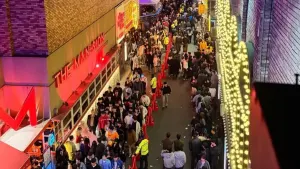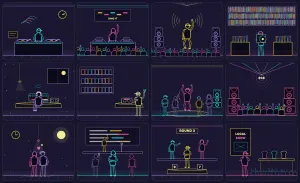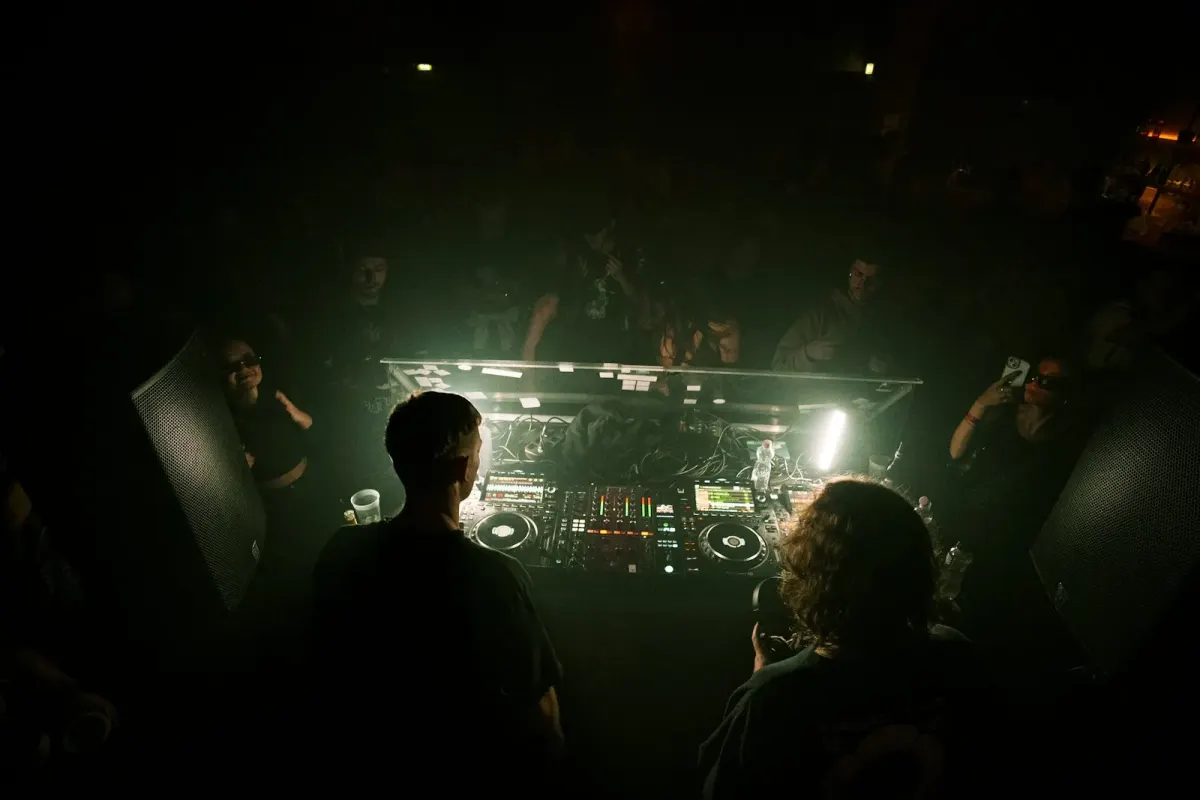
A battery powered rig on the grass of a Han River park (한강공원), no gate, and everyone packed up by sunset. A gallery basement in Seongsu (성수) with an exhibition permit on the wall and a pop up bar by the stairs. A small bar in Haebangchon (해방촌), four to six local selectors playing long sets, and a door of ₩10,000 to 20,000. That’s what a rave looks like in Korea.
South Korea never had the field rave tradition the UK built in the late 1980s. Its underground runs through semi public spaces, rooftops, riversides, gallery basements and rented practice halls, organised by promoters who know which questions not to ask loudly. I’ve played these events for two decades, and the way they work says as much about Seoul as any licensed club does.
Korea Never Needed a Criminal Justice Act
In the UK, rave grew out of illegal mass gatherings in fields and warehouses, carried by pirate radio, and it provoked a specific legal response: the Criminal Justice and Public Order Act 1994, the law that famously targeted music defined by repetitive beats. South Korea never wrote that law because it never needed to. The rules here don’t prohibit a genre. They’re built around event licensing, alcohol service permits, fire code occupancy and neighbourhood noise ordinances. That produces a different underground, one that works in the gaps between permits, at low volume, ending earlier and moving often.
Where the party happens matters. Some districts, Mapo-gu among them, have local ordinances that let general restaurants allow dancing. Most other districts, including Seongdong-gu (Seongsu), Yeongdeungpo-gu (Mullae, 문래) and Jung-gu (Euljiro, 을지로), have no such ordinance. A UK free party defied the state. A Seoul underground event negotiates with a building manager. That’s the root of how Korean club culture developed its own rules.
Korean scholarship has looked closely at the British story. Lee Su-wan’s 2022 paper in 음악논단 (Journal of Music Studies) reads 1980s and 1990s British rave and club culture through Sarah Thornton’s research, and argues that the pleasure of electronic dance music was completed by dancing, mass gatherings and drugs as much as by the music, which is what made it a target for legal sanction.
The nearest thing Korea has had to a protest rave was about dancing itself. The Korea Herald reported that on 5 September 2026 the Jeonju branch of the art collective Urban Strikers held a party billed as the party where you can’t dance, near Jeonju Hanok Village (전주한옥마을). Anyone still dancing after the first ten minutes got a warning sticker and then a spell in a mock jail, a comment on the rules that have seen small live venues suspended over audience dancing.
Those rules finally reached the top of government in 2026. In August, Busan’s Nam-gu ordered the live venue Ovantgarde shut for two months after inspectors saw people dancing during a band’s set, and a petition to change the law went to the National Assembly. On 17 September 2026, Culture, Sports and Tourism Minister Chae Hwi-young pledged to reform the rule, a clause in the Enforcement Decree of the Food Sanitation Act (식품위생법 시행령) that bars general restaurants from letting customers dance. No date for the change has been set.
Haebangchon Is Where Seoul Learned to Throw a Party
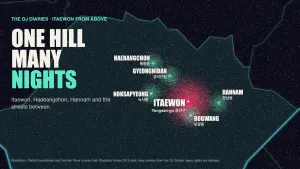
The proving ground for most of this is Haebangchon, HBC to regulars, and the streets around Itaewon. The HBC model is small, regular and cheap. A typical night uses a bar or studio of 60 to 120 capacity, a rented sound system or the house rig, a door of ₩10,000 to 20,000 or free entry with a one drink minimum, and four to six local selectors playing long, unhurried sets. Nobody needs a sponsor. I wrote about the neighbourhood itself in the HBC essay: its cheap rents and expat tolerance made it the one district where a promoter could fail twice and still afford a third try.
Haebangchon Is Seoul Club Goers’ Second Choice
Share of club goers naming each district first
서울 클러버의 두 번째 선택, 해방촌
How to read itWith no big club at all, Haebangchon is the first choice for nearly a quarter of club goers, ahead of Hongdae and Gangnam.
That third try is the whole point. The HBC circuit is where Seoul DJs learn to read a room before anyone pays them properly for it, and it’s where the promoter networks that now feed Cakeshop tier venues were built. Most of the Korean DJs worth knowing in 2026 passed through these rooms years before their names meant anything.
Outside the Bars: Rivers, Rooftops and Warehouses
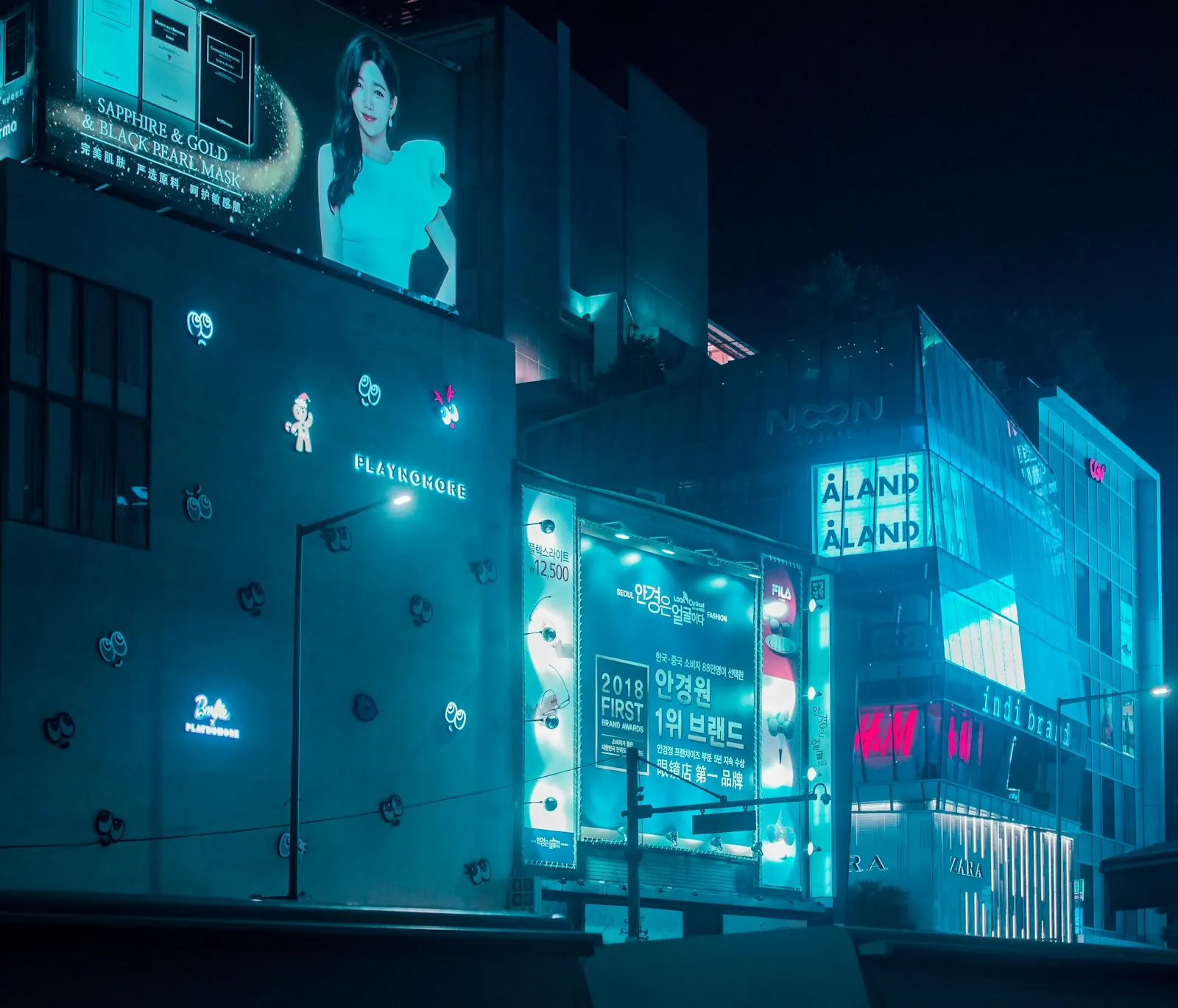
Beyond the bar circuit, the formats repeat year after year. None of it is secret in the UK sense. It’s unadvertised, which is different. Han River parks host semi spontaneous daytime sessions in the warm months on battery powered rigs, technically subject to park noise rules and usually wrapped by sunset. Rooftops in Itaewon and Euljiro run invite list parties in spring and autumn, the Seoul weather window being what it is.
Four Ways Seoul Parties Without a Club
Where each format happens, and what keeps it legal
클럽 밖에서 노는 네 가지 방법
| Format | Where and when | What keeps it going |
|---|---|---|
| Bar night | Haebangchon, all year | 60 to 120 people, a cheap door |
| River session | Han River parks, warm months, daytime | Battery rigs, done by sunset |
| Rooftop | Itaewon and Euljiro, spring and autumn | Invite list |
| Warehouse one off | Seongsu and Mullae, a few a year | Art event permit, licensed pop up bar |
The ruleThe smaller and quieter the format, the longer it lasts. The warehouse nights are the rarest for a reason.
A small number of true warehouse one offs happen each year in industrial pockets like Seongsu and Mullae, usually framed as art events with a licensed pop up bar, because an exhibition permit is easier to hold than a nightlife licence.
If you want to play by the river legally, Seoul runs 22 free busking zones across 11 Han River parks. You apply through the Han River Parks website, sets run between 10am and 8pm for up to three hours, the limits are 65 dB in the daytime and 60 dB from 6pm, and you can bring no more than two speakers.
After COVID, the Clubs Opened Their Off Nights
The relationship between independent promoters and licensed venues turned noticeably more cooperative after 2022. The pandemic years, which I covered in the COVID essay, taught venue owners that empty off nights are more dangerous than unfamiliar promoters. It’s now normal for a Tuesday or Thursday to be handed wholesale to an independent crew: their lineup, their door, their crowd, while the venue keeps the bar. That arrangement quietly legalised half of the underground.
The audience followed. The 2025 nightlife survey found 47 percent of respondents asking for more local bookings rather than imported headliners. The model keeps shifting. After a final week under the BBCB name that ended on 30 May 2026, the Bogwang-ro (보광로) basement of Beton Brut and Concrete Bar became Blank Site, a multi use room for events, rentals and pop ups, with BBCB carrying on as a party once or twice a month.
Djilogue (Hwang Yoo-jun), one of the founders of the techno club vurt. in Hapjeong (합정) in 2014, described the mood well in a September 2025 interview with the Korea JoongAng Daily: the young clubbers in his room look “sick and tired”, and he sees the underground as something long shaped as a protest against the social norms wearing them down.
The Cost of a Scene Built on Trust
The filter that keeps these nights safe also keeps people out. Nobody hands the address to a stranger with no history, and that filter is the security system. It works, but it means a newcomer, a visitor or a shy local can go years without finding the room where their people are. The scene protects itself by being hard to enter.
The legal ground is thin, too. Parties that lean on art permits and park rules can disappear the moment someone complains, and the rules that have seen small live venues suspended over audience dancing haven’t gone away. Lower volume, earlier finishes and constant moving aren’t a style choice. They’re the price of staying open.
What the Korean rave has instead of an anthem is continuity. There’s no acid house summer and no legislation named after it, just fifteen years of small rooms teaching people to dance to unfamiliar music without a headliner to tell them it’s safe. It’s an economy of trust working one permit away from the official one, and that’s the part the UK lost and Seoul, almost by accident, kept.
How to Find These Parties Now
In the UK, pirate radio told you where the party was. Here, messaging apps do. Lineups circulate through Instagram close friends stories, KakaoTalk (카카오톡) group chats and NAVER Band communities, usually 48 to 72 hours before doors. Established promoters also list select events on Resident Advisor’s Seoul guide once a party has proven it can behave.
If you’re visiting and want in, the route is simple. Go to the licensed rooms first, the club map tells you where, talk to people, and let the group chats find you. Keep showing up in the same rooms, and the invitations follow.
Frequently Asked Questions
Are there underground raves in Korea?
Yes, but Korea never had the field rave tradition the UK built in the late 1980s. Its underground runs through semi public spaces such as rooftops, riversides, gallery basements and rented practice halls, plus off nights that licensed clubs hand to independent crews. These events are unadvertised rather than secret, and they tend to run at lower volume, end earlier and move often.
How do you find underground parties in Seoul?
Lineups circulate through Instagram close friends stories, KakaoTalk (카카오톡) group chats and NAVER Band communities, usually 48 to 72 hours before doors. Established promoters also list select events on the Resident Advisor Seoul guide once a party has proven it can behave. For a visitor, the best route is to start in the established rooms on the Seoul club map, talk to people and let the group chats find you.
What is the HBC underground party scene?
HBC is Haebangchon (해방촌), the neighbourhood near Itaewon (이태원) that became the proving ground for small underground events in Seoul. A typical night uses a bar or studio of 60 to 120 capacity, a rented or house sound system, and four to six local selectors playing long, unhurried sets. Cheap rents and expat tolerance made it a district where a promoter could fail twice and still afford a third try.
Where do outdoor raves happen in Seoul?
Han River (한강) parks host semi spontaneous daytime sessions in warm months, on battery powered rigs with no gate, usually wrapped by sunset. Rooftops in Itaewon and Euljiro (을지로) run invite list parties in spring and autumn. A small number of warehouse one offs happen each year in industrial pockets such as Seongsu (성수) and Mullae (문래), usually framed as art events.
Further Reading
- Haebangchon: The Seoul Neighbourhood That Never Fully Slept
- How Korean Club Culture Developed Its Own Rules
- How Seoul’s Club Scene Survived COVID
- Alternatives to Clubbing in Seoul
Sources
Lee Su-wan (이수완), Pleasure in EDM from a cultural studies perspective, 음악논단 vol.48, 2022
Korea Citation Index: journal article on event licensing, alcohol permits and occupancy rules
The Korea Times: No permission to dance, venue closure in Busan leads to petition (25 August 2026)
The Korea Times: Government vows to end outdated dance ban at live music venues (17 September 2026)
Newsis: Han River park noise rules (2018)
Newsis: Djilogue (Hwang Yoo-jun), August 2025
Korea JoongAng Daily: Five hours of techno and burlesque, the Djilogue interview (5 September 2025)
Wikipedia: Criminal Justice and Public Order Act 1994
Written from Seoul, by someone who has been in the booth for more than twenty years. More on the site, or book a DJ.
Follow the rooms: Cakeshop on Instagram
Stay in the Loop
New writing on DJ culture, electronic music, and the Seoul underground, delivered when it matters.
More From The DJ Diaries
Play with the history
Four tools built from the same research as this site.