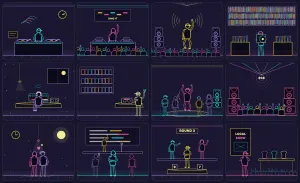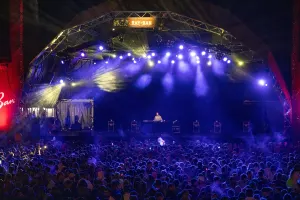
Gerhard Behles and Robert Henke were making minimal techno together as Monolake, on tools they had built themselves in Max, and they wanted a way to improvise with that material on stage. Those tools shaped the first version of Live, which Behles, Henke and developer Bernd Roggendorf built together, and on 30 October 2001 it shipped.
Before Ableton, you needed a studio. After Ableton, you needed a laptop. A quarter century on, even that understates what changed. The software moved music making onto cheap hardware, and in doing so it changed who gets to make music at all, and who gets to finish it.
Live Was Built for the Stage
Ableton Live shipped in October 2001 from a small Berlin company founded in 1999. Behles had set it up with Roggendorf, and Henke, his Monolake partner, was Live’s co creator. They wanted software that behaved like an instrument.
Ableton Live
Software from a small Berlin company, built for the stage, that opened the door to everyone
- Type
- Music software
- Launched
- 30 October 2001. Company founded in 1999 by Gerhard Behles, Robert Henke and Bernd Roggendorf
- Changed
- Who gets to make music
- Today
- Live 12.3, released 27 November 2025
The machinesTen instruments on The DJ Diaries, from 1970 to 2006, drawn to scale. Tap a dot to read its story.
17 countries were selling Live by January 2002, three months after launch, at €349 or US$299.95.
Sources: Ableton press release, January 2002
Traditional DAWs like Pro Tools and Logic were tape machines in digital costume, optimised for recording and arranging on a timeline. Live was built for performance first, and its name was the mission statement. It reached 17 countries within three months, at €349 or US$299.95 at launch, according to Ableton’s January 2002 press release.
Session View Turned Arrangement Into a Performance
The core idea was the Session View: a grid of slots instead of a timeline running left to right. Each slot holds a clip, a loop, a phrase or a one shot, launchable on its own and locked to the master tempo.
The Timeline and the Grid
How a traditional DAW and Live’s Session View think about a song
타임라인과 세션 뷰의 차이
| Question | Timeline DAW | Session View |
|---|---|---|
| Built for | Recording and arranging | Performing |
| Arrangement | Programmed in advance | Played in real time |
| The unit | A track on a timeline | A clip in a slot, launched on the beat |
| Tempo | Each recording at its own speed | Warping makes any audio follow the tempo |
The ruleThe grid made the song something you decide on stage, the way a DJ decides the next record.
Arrangement stopped being something you programmed in advance and became something you performed in real time: improvisation with structure, closer to a DJ’s decision making than to studio engineering. Warping, Live’s elastic time stretching, completed the trick by making any recording obey any tempo.
Together they removed the technical priesthood standing between an idea and its performance. Henke has described the original brief plainly: “The main goal was to build a system that allowed us to improvise with material on stage.”

A Laptop Opened the Door to Everyone
The consequences arrived in waves. Laptop performance became a legitimate format, from experimental sets to the controller scene that grew around Push and its imitators. Bedroom producers stopped needing studios just as distribution stopped needing labels, and the cost of entry fell from the price of studio time to a student discount.
It was the same opening up that made grime possible on cracked copies of FruityLoops in the same years. The kid in a Seoul goshiwon (고시원) with a laptop and headphones has the same tools as any professional, and sometimes better ideas.
A global default emerged, too. Name any genre from the last fifteen years, hyperpop, post IDM experiments or the lofi wave built on SP-404 texture, and its session files are disproportionately .als files. The software’s workflow assumptions quietly became everyone’s workflow assumptions.
The door keeps widening. Live 12.3, released on 25 November 2025, added built in stem separation (in Suite) and Splice’s sample library in the browser, so pulling a vocal, drum or bass part out of an audio clip is now a menu option. Live 12.4 followed in May 2026 as a free update, adding Link Audio, which streams audio from other machines on a local network straight into Live, and a Learn View of guided tutorials in place of the old Help View.
What It Really Changed Was Finishing
The usual claim is that Ableton let anyone make music. The more precise claim is that it let anyone finish music.
It removed the studio as a gatekeeper, but so did several things before it. What Ableton specifically removed was the gap between an idea and an arrangement. Loop based composition meant a person could build something listenable in an afternoon, and finishing is the skill most aspiring producers never develop.
It also blurred performing and producing, which is the change I care about from the booth. A generation now arrives that doesn’t separate a set from a track, and the good ones play things that couldn’t exist any other way.
Abundance Has a Cost
There’s another column in the ledger. Default instruments and workflow habits produce a recognisable sameness; the Live preset sound is a real thing, and the loop grid can trap arrangements in eight bar thinking. Software that makes everything possible also makes everything optional, and the result is a lot of music that’s technically flawless and says nothing. Constraint used to do editorial work for free. Now you have to supply it yourself, and most people don’t.
When everyone owns the means of production, attention becomes the scarce thing, which is the economy labels now exist to solve. Those are the problems of abundance, though, and abundance was the point. Live made the attempt universal, and the attempt is where every scene begins.
Frequently Asked Questions
What’s Ableton Live?
Ableton Live is music software released on 30 October 2001 by a Berlin company that Gerhard Behles founded with Bernd Roggendorf in 1999, with Robert Henke as co creator. Traditional DAWs such as Pro Tools and Logic were built for recording and arranging on a timeline. Live was designed for performance first, and its name was the mission statement.
What’s Session View in Ableton Live?
Session View is Ableton Live’s grid of slots, each holding a clip, loop, phrase or one shot that can be launched on its own and locked to the master tempo. It turned arrangement into something performed in real time rather than programmed in advance. Combined with warping, which makes any recording obey any tempo, it made the software behave like an instrument.
How did Ableton Live change music production?
Mainly by closing the distance between an idea and a finished arrangement. Loop based composition let producers build something listenable quickly, which made finishing tracks achievable for people without studio access. It opened music making to bedroom producers, and laptop performers and the controller scene around Push grew from it. It also merged performance and production.
What are the downsides of Ableton Live?
The main one is sameness, since default instruments and workflow habits produce a recognisable preset sound. The loop grid can also trap arrangements in eight bar thinking. When everyone owns the means of production, attention becomes the scarce resource, which is the problem record labels now exist to solve.
Further Reading on The DJ Diaries
- Dance Music Machines: Play the Step Sequencer
- Native Instruments Traktor: The Software That Split the DJ World
- The Akai MPC: How Hip Hop Built Its Rhythms
- The Roland SP-404
Sources
MusicRadar, The story of Ableton Live at 20
Vice, interview with Gerhard Behles and Robert Henke
Ableton press release, January 2002
Ableton manual, Audio clips, tempo and warping
Sound On Sound, Ableton Live review
Mark J. Butler, Playing with Something That Runs, Oxford University Press
Popular Music (Cambridge University Press), journal article on performing and producing
Red Bull Music Academy Daily, on FruityLoops
Ableton, Live 12.3 is coming November 25 (November 2025)
Synthtopia, Ableton Live 12.4 available now (May 2026)
Written from Seoul, by someone who has been in the booth for more than twenty years. More on the site, or book a DJ.
Stay in the Loop
New writing on DJ culture, electronic music, and the Seoul underground, delivered when it matters.
More From The DJ Diaries

Play with the history
Four tools built from the same research as this site.