The first time I red lined a mixer in front of three hundred people, the sound engineer walked into the booth during the breakdown, reached over my hands and brought the master down four decibels without making eye contact. He didn’t say a word for the rest of the night. He didn’t have to. I spent the cab ride home replaying it, and how obvious it must have sounded to everyone in the room with working ears, which was everybody.
That was years ago, in a basement room that has since been turned into something more profitable. I’ve had maybe two similar lessons since, both smaller, both from engineers who were gentler than they needed to be. More than twenty years in the booth has taught me that a big part of the job is not making the sound system sound worse than it wants to. Red on the meter makes a room harsher, tires people out and costs you bookings.
Red Means Clipped, Not Louder
Pushing your channels into the red clips the sound. Clipping is what happens when your signal goes past the headroom the circuit can handle. Instead of a waveform with rounded peaks, you get one with its top sliced off. You hear it as distortion, as a loss of punch, and as a harsh edge on the top end that wears down the ears of anyone who stays in the room for more than an hour.
Where Your Levels Should Sit
Louder is not red. Red is clipping, and the room hears it before you do
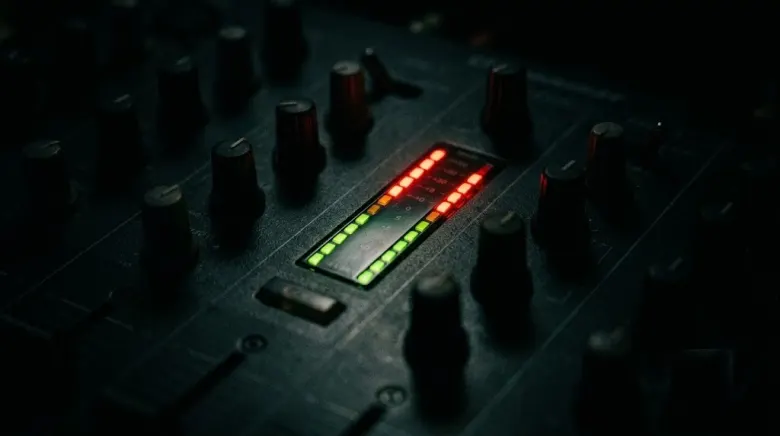
Where to sitChannels in the green, amber on the loudest transients, red only on rare peaks you are not holding. The scale is illustrative: check the meter on the mixer in front of you.
Before every transition0 of 5 done
Loudness targets. Streaming turns loud masters down to its target, so a red lined file gains nothing. Spotify asks for true peaks below -1 dBTP. Track runs from -30 to 0 LUFS.
0 VU = +4 dBu the professional reference level, about 1.228 volts. In digital, the EBU alignment puts 0 dBu at -18 dBFS.
Sources: Spotify for Artists · EBU R128 · Sound On Sound
The crowd doesn’t know why the sound feels wrong. They just know they want to be somewhere else. Red lined sound is the audio version of fluorescent lighting: always brighter than what came before, and always more tiring to stand under. By the time the floor has thinned, you’ve already paid for a choice you made at the mixer forty minutes earlier.
The Room Pays for It Later
There’s a long term cost too. The Hearing Health Foundation has long warned that cumulative exposure to loud sound causes permanent noise induced hearing loss, and the risk rises the louder the sound and the longer you stay in it. If you plan to DJ for decades, and I do, protecting your own hearing and your audience’s is part of mixing well.
More Koreans Are Being Treated for Hearing Loss
Change in people treated for hearing loss, 2019 to 2023
난청 진료 인원, 2019년 대비 2023년
How to read itAbout 800,000 people were treated in 2023. The fastest rise was among people in their twenties, the age of most club crowds.
It’s a real worry here. The number of people treated for hearing loss in Korea rose 23 percent between 2019 and 2023, to about 800,000, and patients in their twenties were up 46 percent, according to national treatment data reported by Segye Ilbo in March 2025 (Korean). The people on your floor are exactly the age group losing hearing fastest.
There’s a number worth carrying into the booth. The World Health Organization’s 2022 Global Standard for Safe Listening at Venues and Events recommends a maximum average of 100 decibels, measured over 15 minutes. Our guide to hearing safety in nightlife has more on what that means for a long night.
Loud Feels Good for Thirty Seconds
To be fair to the DJs who run hot, the crowd sometimes cheers when the sound is clipping. A loud, distorted kick can feel exciting for half a minute, and in a packed room that reaction is hard to argue with. Perceived loudness and real enjoyment aren’t the same thing, though. Fatigue arrives later, and by the time the floor thins, the DJ usually blames the track rather than the gain structure.
Chasing that first cheer into the red is borrowing against the second half of your set. The cheer is real. So is the room that empties an hour later, and only one of them gets talked about by the promoter the next day.
Engineers Remember Who Ran Hot
A good sound system in a decent club is a serious investment, the kind of figure most DJs would rather not think about. Blowing a driver because you ran the mixer hot is a cost problem for the venue, and it soon becomes a booking problem for you.
The venues that survive in competitive markets are the ones with consistently good sound. The DJs who get booked at those venues are the ones the engineers recommend, and the engineers recommend the DJs who don’t make them reach into the booth during a breakdown. It’s a simple loop, and it runs both ways.
I’ve watched this decide bookings in Seoul for two decades, and on the nights I’ve played back home in Canada. Engineers talk to each other across venues. A reputation for pushing gear too hard travels faster than you’d expect, and it’s hard to walk back. It’s part of how reputation works in this industry: the technical staff are part of the network that decides who gets called.
Fix the Files Before You Touch the Trim
A big reason newer DJs push their trims too high is that their files are quieter than they should be. Rip something from YouTube at a low bitrate and it has less perceived loudness than a properly mastered release, so the gain knob is the first thing you reach for. That road ends badly for the mixer and for the floor.
The fix is upstream. Buy music from stores that deliver properly mastered files. Building a serious library from good sources is unglamorous work, but when the source sits where it should, the mixer doesn’t need heroic gain staging to sound right. Most DJ software can also normalise your library to a consistent loudness, which solves the problem at source.
It’s why I keep pointing new DJs toward music spending before gear spending. A midrange mixer with clean files sounds markedly better than a flagship mixer with badly encoded ones. The reverse isn’t true.
How to Stay Out of the Red Tonight
Most modern mixers want the incoming signal peaking just below zero on the channel meter: green, with amber on the loudest transients, and red only on rare peaks you’re not holding. If a channel lives in the amber and keeps touching red, you’re too hot. Pull the trim down two or three decibels and let the rest of the chain do its work. The real amplification happens between the mixer and the speakers, and engineers build their systems to have clean headroom at the mixer so they can control total gain at the amps.
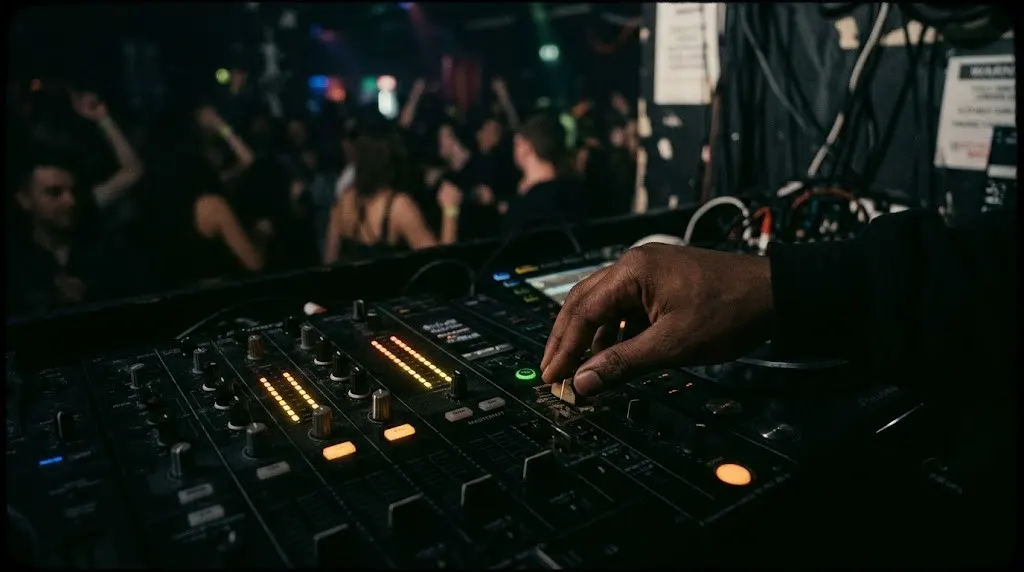
On unfamiliar gear, the first five minutes are when you find the sweet spot. Check the trims and master before your first track plays; trims around twelve o’clock is a safe start unless the engineer says otherwise. If the last DJ left the master at plus six and the trims maxed out, take thirty seconds to reset. Then watch the output meter all night, not only between tracks. It’s the one signal that tells you what’s going into the amplifier.
Use your EQs to make room rather than to make tracks louder. Cutting the low mids on an incoming track so the outgoing kick can breathe gives the same net volume with far more impact. Boosting EQs to get over the previous record is how DJs end up with every channel at plus three, the master at plus two, and a sound that feels congested.
Say hello to the sound engineer and ask what this room needs. Some systems benefit from a slight trim below 60 hertz, and some rooms have standing waves the engineer has already compensated for. The conversation takes thirty seconds and saves an hour of quiet damage. And if you catch yourself reaching for the master to make things louder, stop and pull a fader down instead. If you’ve been running hot for a while, your reference has drifted: listen to a well recorded DJ mix at a sensible volume for an hour and let your ears reset before your next session.
Frequently Asked Questions
What does red lining mean on a DJ mixer?
It means pushing a signal past the mixer’s headroom so the peaks get clipped off. The meter lights red because the circuit is being overdriven. The result is distortion that sounds harsh and tiring on the floor, however energetic the room feels in the moment. What sounds exciting for thirty seconds creates ear fatigue over an hour.
Is it ever okay to let a channel briefly touch the red?
Brief, isolated peaks touching red on a channel meter are usually fine on modern digital mixers with generous headroom. Sustained red on a channel isn’t. Anything that stays in the red on the master output means you’re clipping the system, and the distortion will be audible and damaging.
How do I tell if the previous DJ left the gear set wrong?
Check the channel trims and master before your first track plays. Trims around twelve o’clock are a safe start on unfamiliar gear unless the engineer says otherwise. If the master is at plus six and the trims are maxed, reset them before you start.
How does poor volume control affect my bookings?
More directly than most DJs think. Sound engineers and technical staff talk to each other and to promoters, and a reputation for running gear hot travels across a scene quickly, partly because the damage is expensive. The engineers who protect the equipment are also the ones who recommend reliable DJs.
Further Reading on The DJ Diaries
- Sound Advice: Hearing Safety in Nightlife
- Sound Systems and the Dancefloor
- Your Guide to DJ Music Downloads
- How to Get Booked
Sources
Sound On Sound, What exactly is headroom, and why is it important?
NIDCD, Noise induced hearing loss
Segye Ilbo, hearing loss treatment figures, March 2025 (Korean)
Pioneer DJ support, TRIM, channel fader and MASTER LEVEL
Spotify for Artists, Loudness normalization
EBU R128 loudness recommendation
Sound On Sound, Interfacing analogue and digital equipment
Written from Seoul, by someone who has been in the booth for more than twenty years. More on the site, or book a DJ.
Stay in the Loop
New writing on DJ culture, electronic music, and the Seoul underground, delivered when it matters.
More From The DJ Diaries



Play with the history
Four tools built from the same research as this site.