Sometimes you can tell from the doorway. On a good sound system, the DJ playing WAV or properly encoded 320 files sounds full, and the one who pulled tracks from some corner of the internet doesn’t. The bottom end is thin, and the highs turn harsh as the volume comes up. It’s funny how obvious it is once you’ve heard it a few times.
Buying music has been part of my life since I was a kid, through vinyl, cassette, CD, the early MP3 stores and every download and subscription service since. After more than twenty years of buying for club sets, one thing I’m sure of is that the quality of what you play matters more than the gear you play it on. Bad files on great CDJs still sound bad. Buy lossless where you can, never play anything under 256kbps at a real gig, and spend most of your budget where your genre lives: Beatport for breadth, Traxsource for underground house, Bandcamp for the tracks nobody else has.
Bad Files Sound Worse on a Good System
Play a compressed MP3 through a club system that’s doing its job and the damage is audible in ways your headphones hide. The high frequencies, hi hats, percussion detail and the air around sounds, are where MP3 compression does the most harm, and they’re also where a room’s ability to place sound in space lives. A 128kbps MP3 in a good room sounds thin and slightly smeared; a properly encoded 320kbps file is much better, and a lossless file at CD quality or above is better still.
File Quality, Ranked for the Booth
What each format sounds like on a proper club system
클럽 사운드 시스템에서 음원 품질 비교
| Format | On a good system | At a paid gig |
|---|---|---|
| 128kbps MP3 | Thin and slightly smeared | Never |
| 256kbps MP3 | The lowest you can get away with | Only in a pinch |
| 320kbps MP3 | Much better, if properly encoded | Fine when lossless isn’t sold |
| WAV, AIFF, FLAC | Full detail, nothing removed | First choice |
The ruleThe price gap between 320 and lossless is small on most stores. The sound gap on a big system isn’t.
Beginners underestimate this because their reference is headphones, and headphones are forgiving. The drivers sit close to the ear, the listening space is controlled, and the brain fills in what’s missing in a way it can’t from across a room. A sound system filling three hundred square metres of floor is a different world, and every flaw in the source gets amplified instead of masked.
So buy lossless wherever you can and 320kbps when lossless isn’t on offer, and don’t play anything below 256kbps at a serious gig. On most download stores the price difference between 320 and lossless is small. On a good system the difference in sound is not.
Download Everything You Play
I download every track I play, then sort it by key, by genre and sometimes by vibe. I don’t stream in the booth, and I want every file on my stick to be one I chose and checked. Everybody has had the moment of finding out that a track they thought was a 320 file wasn’t, which is why I find it hard to trust tracks other people give me unless they’re WAVs.
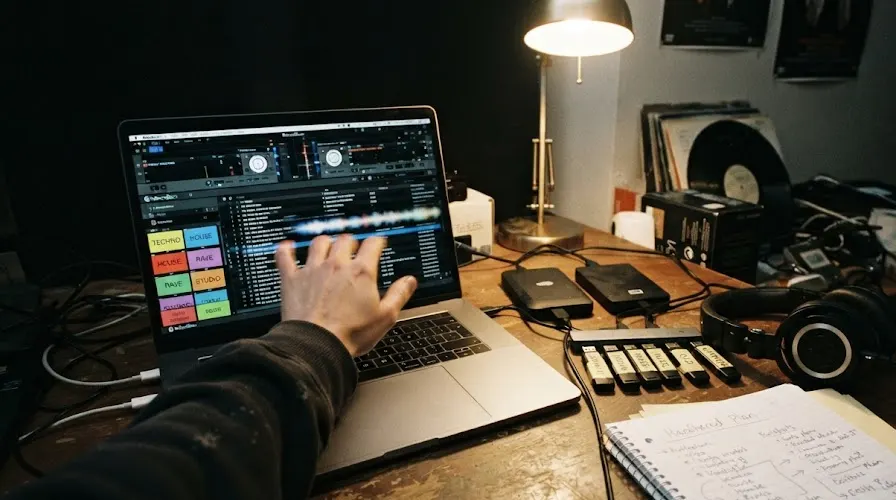
Where you buy matters less than what you buy and how you organise it. Ten thousand tracks with no real order are less useful than two thousand you know deeply and can find under pressure. Rekordbox and other DJ software handle the technical side, BPM, key and waveforms, but the curation is yours. Build playlists or crates around the way you think when you’re building a set. If energy and mood come before tempo in your head, sort by energy and mood; if genre comes first, sort by genre. The right system is the one you’ll keep up and that finds things fast.
Update it before every gig. A library that doesn’t include what you found last month is already out of date. Music sourcing, library work and set planning are where most of the job happens, and if you want the wider argument about what streaming does to how DJs find music, Lost in the Stream is worth reading alongside this.
Beatport Is the Default, Not the Whole Answer
Beatport is where most electronic DJs spend most of their music budget, and for good reasons. The catalogue runs deep across the club genres, its integration with Pioneer’s Rekordbox and with Serato, Traktor and the other major platforms is well developed, and the charts, imperfect as they are as a guide to quality, show you what’s moving in your genre. The limitation is that Beatport reflects a specific commercial market. Its charts and recommendations favour what already sells to its existing users, which skews toward the mainstream end of most genres. If you play the underground end of house or techno, you’ll need to supplement it.
The Download Stores, Side by Side
What each one is best for, and what changed by October 2026
DJ 음원 구매처 한눈에 보기
| Store | Best for | Worth knowing in 2026 |
|---|---|---|
| Beatport | Broad electronic catalogue, built into DJ software | Tracks from $1.49 to $2.49; lossless about $0.75 extra |
| Traxsource | Underground, deep, Afro and soulful house, disco edits | Labels releases Human-Made or AI-Assisted since 1 July 2026 |
| Juno | Breadth across genres, including drum and bass and hip hop | Download store closed June 2026; vinyl still sold |
| Bandcamp | Independent artists and small labels | Most of the money goes to the label or artist |
| Bleep | Experimental, ambient and left field electronic | For the edges of club music |
The ruleMost working DJs use two or three stores, not one.
As of October 2026, Beatport’s pricing page lists $1.49 for catalogue tracks, $1.69 for new releases and $2.49 for exclusives, with lossless formats about $0.75 extra. The streaming subscriptions run from about $11 to $30 a month; the tiers that work inside DJ software start at around $16, the Professional tier adds an offline locker of up to 1,000 tracks, and none of them include download credits. The end of month sales regularly take 10 to 30 percent off, which adds up if you buy often.
Traxsource Is Where the Underground Lives
Traxsource gets a bigger share of my budget than its size would suggest, partly because it’s better curated for the music I play and partly because I still find tracks there I haven’t seen anywhere else, often enough to count on it. Its focus on underground house and techno, deep house, Afro house, soulful house and disco edits means fewer releases but a much better ratio of good music to noise. For house DJs, it’s the store to learn first after Beatport.
The genre tags and filters are excellent too. I can find soulful deep house from the last six months at 120 BPM in A minor faster on Traxsource than almost anywhere else, and that kind of precision is useful when you’re building a set. Since 1 July 2026 it has also labelled releases as Human-Made or AI-Assisted and removes fully AI generated tracks, as DJ Mag reported, which makes it easier to know what you’re paying for.
Bandcamp and Bleep Have the Tracks Nobody Else Has
Bandcamp is where I find music that doesn’t fit anywhere else: artists who release on their own, labels with small, focused catalogues, producers working at the edges of genres. You download in the format you choose, often lossless, at whatever price the artist or label sets. Its economics favour the artist more clearly than any other major store: a much higher share of the price goes straight to the label or artist. Bandcamp Friday, which waived Bandcamp’s revenue share on set Fridays from the start of the pandemic, made that case more plainly than anything the bigger stores have done, and Bandcamp Fridays return in 2026.
It’s the place for the tracks that are specifically yours, the ones you found by digging rather than by reading charts, although most of my own buying still happens on Beatport and Traxsource.
Bleep is a store built on the idea that its customers have unusual taste and are looking for what the mainstream stores don’t carry. The catalogue leans toward experimental, ambient, post club and left field electronic music, the stuff that sits between club culture and listening culture and works in both. If you play in that territory, or want to know what’s happening at the edges of your genre, it’s essential. If you play commercial house or mainstream techno, it’s probably peripheral. Know which you are.
Stores Close, Streams Drop Out, Files Stay
Juno Download was the all rounder. It launched in 2006, a decade after the Juno record shop, and built a catalogue that ran well beyond electronic music into drum and bass, hip hop, indie and genres Beatport and Traxsource barely touch. Browsing it felt more like a well run record shop than a search engine. Then in June 2026 it closed after about twenty years. Juno’s vinyl store is still running, so it’s still worth a visit for physical releases.
The lesson is to back up every purchase locally, because the store you bought it from may not be there next year. Digital DJ Tips made the same point when Juno shut. Streaming has the same weakness in a different form. Beatport Streaming inside Rekordbox is convenient, but it needs a steady connection and brings variables you don’t want to manage during a live set, and its terms of use are worth reading before you rely on a streamed track at a paid gig.
To be fair to streaming, it’s a good way to discover music, and Rekordbox’s own guide explains how it works inside the software most booths run. Use it to find tracks. Buy the ones you’ll play.
How to Buy for a Gig Now
Pick two or three stores that match your genre and learn their filters properly. Buy lossless where it’s sold and 320kbps where it isn’t, and check every file before it goes near a USB stick. Keep a backup of everything you own, on a drive that isn’t the one you gig with.
Before each gig, add what you bought that month, tag it the way you think about a set, and export to a stick you’ve tested. Use streaming for discovery and Bandcamp for the tracks that make your sets yours. The money you spend on properly sourced, properly mastered music is the money that shows up most on the floor.
Frequently Asked Questions
What’s the best music download site for DJs?
It depends on your genre. Beatport is the broadest store for electronic music and works inside most DJ software. Traxsource is better curated for underground house. Bandcamp is best for independent artists and small labels, and Bleep for left field electronic music. Juno Download closed in June 2026. Most working DJs use two or three stores rather than one.
What file format should DJs download music in?
Lossless formats, WAV, AIFF or FLAC at CD quality or above, are the best choice for files you’ll play at gigs, because a good sound system reveals detail that compression removes. A 320kbps MP3 is acceptable when lossless isn’t sold. Don’t play files below 256kbps at a paid gig.
Is it worth paying for music when you can stream it?
For music you’ll play at gigs, yes. Streaming needs a reliable connection you can’t count on in a club, and a streamed track can change or disappear. Bought files are yours, stored locally and play reliably. Use streaming to discover music and buy what you’ll play, and back up every purchase, as Juno Download’s closure in June 2026 showed.
How do you organise a DJ music library?
Sort it the way you think when you’re building a set. If energy and mood come first, organise by energy and mood; if genre comes first, organise by genre. Let DJ software analyse BPM and key, but do the curation yourself, and update the library before every gig.
Further Reading
- Beatport vs Bandcamp: The Battle for Electronic Music Sales
- Lost in the Stream
- DJ Controllers vs CDJs
- Digital DJ Tips: The Best Music Streaming Services for DJs in 2026, with tier by tier prices
- Beatport: Terms of Use for Beatport Streaming
- rekordbox: Introducing Beatport Streaming
- Wikipedia: Beatport
- Wikipedia: Bandcamp and how it pays artists and labels
- Wikipedia: how MP3 compression works and what it removes
- Wikipedia: FLAC, the lossless audio format
Sources
rekordbox, plans and integrations
Digital DJ Tips, The best music streaming services for DJs in 2026
MusicTech, Traxsource labels identify human made and AI assisted music, 2026
DJ Mag, Traxsource to label music as Human-Made or AI-Assisted, 2026
MusicTech, Juno Download closes, June 2026
Digital DJ Tips, Juno Download shuts down after 20 years, June 2026
NPR, Bandcamp will forfeit its share of sales this Friday, March 2020
Variety, Bandcamp waiving its share of sales, 2020
Bandcamp Daily, Bandcamp Fridays return in 2026, December 2025
Billboard, Bleep.com merges with Warpmart
Beatport, Terms of use for Beatport Streaming
rekordbox, Introducing Beatport Streaming
Written from Seoul, by someone who has been in the booth for more than twenty years. More on the site, or book a DJ.
Stay in the Loop
New writing on DJ culture, electronic music, and the Seoul underground, delivered when it matters.
More From The DJ Diaries
Play with the history
Four tools built from the same research as this site.