Before Cakeshop, Seoul wasn’t part of the international underground circuit’s conversation. After it, the conversation couldn’t happen without Seoul in it. That’s a large claim for a basement, so let me lay out the evidence.
Cakeshop at a glance
- Opened: 22 September 2012, in the basement at 134 Itaewon-ro, Yongsan-gu, near the Noksapyeong end of the strip. A small room, listed at under 200.
- Run by: owner and director Samuel (Sam) Swanson, with joint owner Nevin Hendrickson.
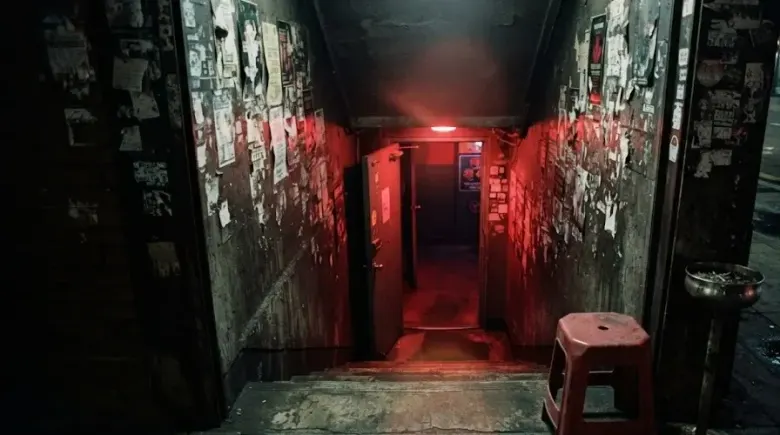
- Two lives: the original room from 2012, and a rebuilt room of concrete, steel and dark red light that reopened in 2020.
- Known for: booking the global underground early, from UK bass and club music to techno, and Boiler Room’s first Korean party in 2016.
- Label: Carousel Records, from 2021.
- Hours, per its Instagram: Thursday, Friday and Saturday, 10pm until late. Table bookings by direct message.
- Follow: @cakeshopseoul and Resident Advisor.
A Basement With No Obvious Advantages
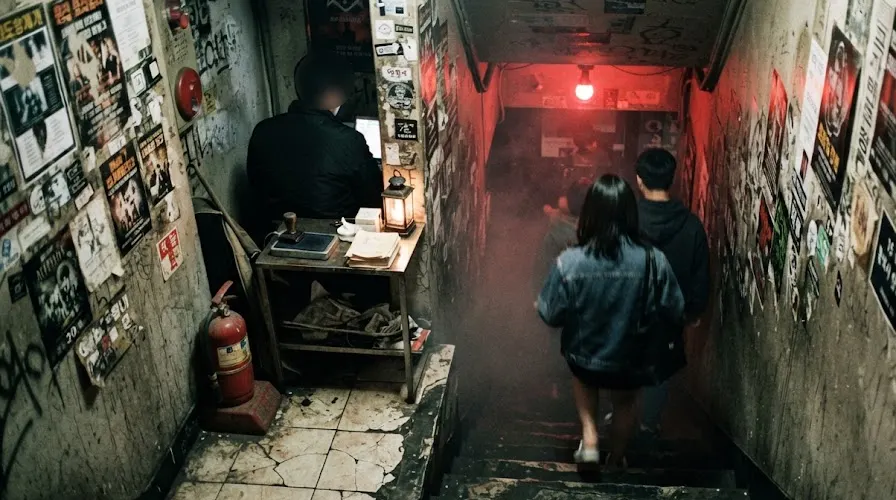
The room isn’t large. Resident Advisor lists it at 200 people, a single low ceilinged floor at the bottom of a staircase off the Itaewon main drag. There’s no view, no terrace, no VIP architecture, and for most of its life not much of a sign. Nothing about the physical space explains why the club that has occupied it since 2012 became the most influential electronic music venue in South Korea’s history. Rooms like it exist in every city. What made this one different was a booking policy that treated Seoul as a peer of London and Berlin before anyone else did.
Two Lives in One Basement
Cakeshop opened in 2012 in a basement at 134 Itaewon-ro, under a restaurant near the Noksapyeong end of the strip. The first listings on Resident Advisor date from November 2012, with Daniel Wang among the first guests, and early visitors remember a frosted pink neon sign over the door. The idea came out of Multi Seoul, a small creative collective, and one of the people who built it is still running it: Samuel Swanson, Sam, the owner and director, who books the room and later took on A&R for the club’s own label. Nevin Hendrickson is his business partner.
The room has had two lives. The first ran from 2012 to the end of the decade. The second began with a grand reopening in January 2020, Krystal Klear on the bill, in a rebuilt space of exposed concrete, steel and dark red light. The logo and the look changed along the way too. Weeks after the reopening the pandemic shut the doors, and the new room had to wait until 2022 to find its crowd.
Two Lives in One Basement
Cakeshop from its first listing in November 2012 to its first tour in 2026, drawn to scale
케이크샵의 두 번의 삶, 2012년부터 2026년까지
- Nov 2012Opens under a restaurant near Noksapyeong. Daniel Wang among the first guests, a frosted pink neon sign over the door.
- Feb 2013Jackmaster. The booking sheet starts to read like Fabric and Tresor.
- Dec 2014Hyperdub’s tenth birthday with Kode9 and DJ Spinn.
- Aug 2016Boiler Room films its first Korean party here.
- Jan 2020Grand reopening in a rebuilt room of concrete, steel and red light, Krystal Klear on the bill. Weeks later the pandemic shuts the doors.
- Mar 2021While dark, the team launches Carousel Records with a compilation, 8 Years of Cakeshop.
- 2022The crowd comes back. The room then survives the Itaewon downturn after October 29.
- Summer 2026First tour under the Cakeshop name: Gwangju, Busan, Daegu, Paju and Jeju.
What the shape showsThe second life began with almost two years of silence. A low cost base and a crowd that treated the room as infrastructure kept it alive through both.
CRSL 001 the first Carousel Records release, 8 Years of Cakeshop, out 12 March 2021 with DJ Lag, DJ Python, Jubilee and Mobilegirl among its artists.
Sources: Resident Advisor · Mixmag
The Programming Thesis
Cakeshop’s founders bet that Seoul could support the same underground names that were playing Fabric, Tresor, and Berghain, not watered-down versions of them. Through the mid-2010s the booking sheet read like a wire transfer from the global circuit: UK bass and grime acts, Night Slugs and Fade to Mind affiliates, footwork and club music pioneers, experimental techno that no commercial Korean venue would touch. The club paid international fees for artists with no Korean radio presence and trusted a crowd to show up. The crowd showed up. You can trace the venue’s event history on its Resident Advisor page, and the pattern is consistent: depth over recognisability, every month, for over a decade.
That consistency did the thing that one-off festivals can’t do. It changed what touring artists expected Seoul to be. Once Cakeshop appeared on the same tour schedules as the serious European rooms, the city stopped being an exotic extra date and became a circuit stop, and that status spilled over to every other Seoul venue trying to book internationally. I covered the wider district history in Itaewon After Dark. Cakeshop is the hinge of that story.
The early calendar shows it. Jackmaster in February 2013. Scratcha DVA in May 2014, and Hyperdub’s tenth birthday with Kode9 and DJ Spinn that December. Jacques Greene in 2015, Red Bull Music Academy nights in early 2016, DJ Lag with the Gqom Oh! crew that November, Benji B in 2017. In August 2016 Boiler Room filmed its first Korean party there, and later called Cakeshop Seoul’s flagship club for international dance music.
The Local Pipeline
The imported names were the headline, but the residents were the point. Cakeshop ran on a core of local selectors who played the opening and closing hours around the internationals, and that booth time built a generation. A meaningful share of the Korean DJs worth knowing in 2026 either held a residency there or played their first significant set on that system. This is the residency model working as designed: the club’s identity is the people who play it weekly, not the logo on the flyer.
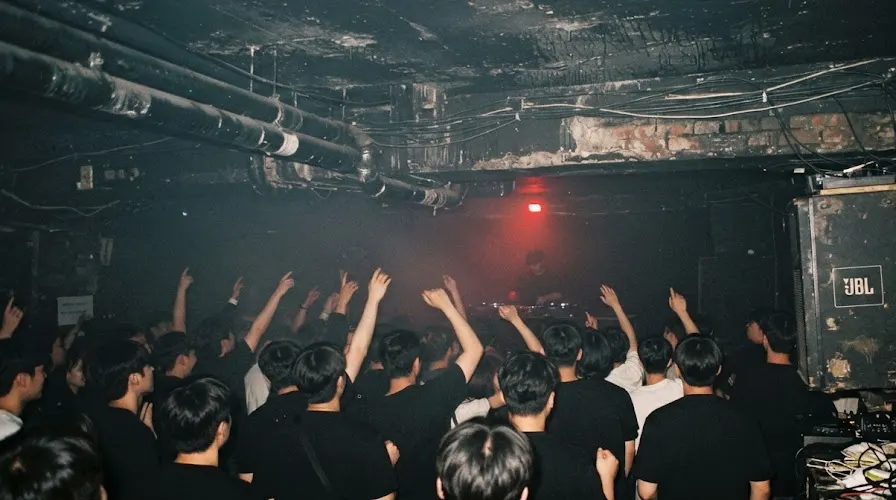
VISLA Magazine (비슬라) caught one branch of that pipeline in April 2024: HARDPURE (하드퓨어, Hadeupyueo), a party label run by two friends with Cakeshop as its home base, one of whom, Xing Xing, holds a Cakeshop residency. One of the pair told VISLA that Cakeshop was the first club they set foot in in Seoul, and that most of their most memorable experiences began there.
The door policy mattered too. Cakeshop was never selective in the Berghain sense, but it filtered by intent: cheap entry, no table service, no dress theatre, a room where the only status available was knowing the music. In Seoul’s nightlife economy, which runs heavily on bottle service uptown, that was a radical position. It taught a Korean audience that club culture could run on different rules.
Cakeshop was building on an older Seoul pattern. Ahn Young-ra’s 2009 study in 영상문화 (Visual Culture) found that once hip hop made Hongdae club culture mainstream, electronic clubs grew up inside the scene as a reaction, and the paper describes the two as collective release on one side and dreamlike personal immersion on the other.
Surviving the Hard Years
The venue’s resilience is part of the legacy. It survived the Itaewon downturn after the 2022 Halloween tragedy, when the district’s foot traffic collapsed for months, and it survived the pandemic closures before that, a period I documented in the COVID essay. Venues with far larger capital cushions closed in both windows. The room was dark from 2020 to 2022, and the team used the time to launch Carousel Records in March 2021 with a compilation called 8 Years of Cakeshop. When the doors opened again the crowd came back, partly because the cost base was low and partly because its audience treated it as infrastructure rather than entertainment.
What It Means in 2026
Today the club sits at the centre of a district map that finally has depth around it, Pistil and the smaller Itaewon rooms, the unlicensed circuit it feeds and draws from, and a Hongdae scene running its own parallel story, all of which I lay out in Seoul’s club map. Its influence is now structural: the standard it set for programming is the standard Seoul venues are measured against, by touring agents and by the crowd. One basement, one booking policy, held long enough to move a whole city’s centre of gravity. In the summer of 2026 it took its name on the road for the first time, a tour of Gwangju, Busan, Daegu, Paju and Jeju, a measure of how far one Itaewon basement now reaches.
한국어 요약
케이크샵, 왜 중요한가
이태원 케이크샵 (Cakeshop)은 한국 일렉트로닉 음악 역사에서 가장 영향력 있는 클럽으로 꼽힙니다. 공간이 아니라 섭외 방식이 그 이유입니다.
- 어디: 용산구 이태원로 134 지하, 2012년부터 운영해 온 약 200명 규모의 단층 클럽입니다.
- 왜 중요한가: 런던 Fabric, 베를린 Tresor와 Berghain에서 공연하는 언더그라운드 아티스트를 같은 기준으로 섭외해 서울을 해외 투어의 정규 도시로 만들었습니다.
- 음악: UK 베이스, 그라임, 풋워크 등 언더그라운드 일렉트로닉 음악을 중심으로 프로그램을 짭니다.
- 방문 팁: 주말에는 자정 무렵 가득 차니 일찍 도착하세요.
잘못된 정보나 바뀐 날짜를 발견하셨나요? 연락 주시면 확인 후 바로 고치겠습니다. 현장에서 보고 들은 이야기도 언제나 환영합니다.
Frequently Asked Questions
What’s Cakeshop in Seoul?
Cakeshop is an underground electronic music club in a basement at 134 Itaewon-ro, Yongsan-gu, operating since 2012. It holds about 200 people on a single low ceilinged floor, with no view, no terrace and no VIP architecture. Its booking policy, not its room, made it the most influential electronic music venue in South Korea’s history.
Why is Cakeshop so important to Seoul’s club scene?
Cakeshop matters because it booked the same underground artists playing Fabric, Tresor and Berghain and treated Seoul as a peer of London and Berlin. Through the mid-2010s it paid international fees for acts with no Korean radio presence and trusted a crowd to show up. That consistency turned Seoul from an exotic add-on date into a regular stop on international touring schedules.
What kind of music does Cakeshop play?
Cakeshop programmes underground electronic music, historically UK bass and grime, Night Slugs and Fade to Mind affiliates, footwork and club music pioneers, and experimental techno. The pattern has been depth over recognisability every month for over a decade. Local resident selectors play the opening and closing hours around the international guests.
Is Cakeshop in Itaewon still open?
Cakeshop is open in 2026, after a pandemic closure from 2020 to 2022 and the Itaewon (이태원) downturn after the 2022 Halloween tragedy. A low cost base and an audience that treated it as infrastructure carried it through years when larger venues closed. It now sits at the centre of a district that includes Pistil and other smaller rooms, as laid out in this map of Seoul clubs.
한국어 요약
케이크샵(Cakeshop)은 2012년 이태원로 134 지하에서 문을 연 언더그라운드 클럽입니다. 대표이자 디렉터인 새뮤얼 스완슨(Sam)과 공동 대표 네빈 헨드릭슨이 운영하며, 2020년 1월 새 공간으로 재개장해 두 번째 시대를 열었습니다. 스크림, 잭마스터, 코드나인 같은 해외 아티스트를 일찍부터 소개했고, 2016년에는 한국 첫 보일러룸 파티가 이곳에서 열렸습니다. 2021년 자체 레이블 캐러셀 레코드를 시작했고, 2026년 여름에는 첫 국내 투어를 열었습니다.
잘못된 정보나 날짜를 발견하시면 연락해 주세요.
Sources
- Resident Advisor: Cakeshop, venue page and event archive
- Crack Magazine: Cakeshop is the Seoul club championing global dance music scenes
- Boiler Room: Seoul, Boiler Room x Cakeshop (10 August 2016)
- Resident Advisor News: Cakeshop launches Carousel Records (2021)
- Mixmag Asia: Cakeshop announces its first South Korea tour (May 2026)
- Amsterdam Dance Event: Samuel Swanson
- Maekan: Seoul’s musical oasis, Cakeshop and Contra (2017)
- VISLA Magazine (비슬라): HARDPURE, new energy in the Itaewon club scene (19 April 2024)
- Ahn Young-ra (안영라), Club Culture as Cultural Text: Hongdae club culture, 영상문화 no.14, 2009
Written from Seoul, by someone who has been in the booth for more than twenty years. More on the site, or book a DJ.
Follow the rooms: Cakeshop on Instagram · Soap on Instagram · Pistil on Instagram
Stay in the Loop
New writing on DJ culture, electronic music, and the Seoul underground, delivered when it matters.
More From The DJ Diaries


Play with the history
Four tools built from the same research as this site.