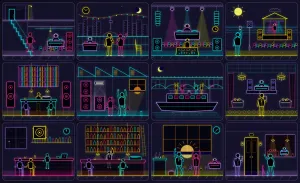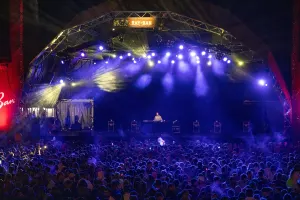
Somewhere in Seoul tonight a DJ is cutting two copies of the same record back and forth, a circle is opening on a wooden floor, and someone at the bar is explaining which soul record the hook came from. They all came for hip hop. They came for different reasons.
Take the quiz first
What kind of hip hop head are you?
Thirty six quick questions, most of them not even about music. You get one of twelve hip hop types, the rooms and records that suit it, and a card to send your crew so they can compare.
10 minutesNo sign upEnglish or 한국어A card to share
Already know your result? Scroll on and find it below.
The Hip Hop Head quiz sorts people into twelve types in four families. The Hands live behind the decks and on the mic. The Diggers care where the sound came from. The Floor is in the body, in a circle, a jumping crowd or a slow two step. The Word listens for what is being said and who said it first.
Most of the thirty six questions are about how you behave around music rather than what is on your phone: what you keep, where you stand, what you would do with a microphone handed to you without warning. Six hidden traits do the scoring, the same six behind every DJ Diaries quiz.
None of the types are tied to a Seoul venue or a named Korean artist. The scene here is better described by the people in it, so the quiz suggests rather than names. Below are the twelve.
The Turntablist
Two decks, one mixer, and hours nobody else will ever see. You treat the turntables as an instrument, and you tend to judge a DJ by their hands before their playlist. People like you have spent months alone with a battle record, a crossfader and the same two bars, chasing a flare or a crab until it sits clean on the beat. You know the lineage, from Grandmaster Flash working breaks back and forth by hand to the routines at the DMC World DJ Championships, and you know how much work hides inside six seconds of a good one. Most of the room will never see that work. You are fine with that.
You like a booth where the decks are level, the needles are fresh and nobody is leaning on the table. You tend to arrive with a short routine you have drilled until it bores you and dazzles everyone else, then fold it into a set at the exact moment it will land. Battles, showcases and any slot where the DJ is the act are where you shine. A long night of requests can wear on you, though you are often better at it than you admit, because clean hands make clean blends too.
At your best: Your hands do things most DJs cannot, cleanly and on the beat. The blind spot: you can end up playing for the three other DJs in the room and forget the two hundred people who came to dance.
Rooms worth the trip: DMC World DJ Championships in London, Scratch DJ Academy in New York and Amoeba Music in Los Angeles. Read the full Turntablist result.
The Open Format
Three songs in four minutes, and the whole room singing the hook. You read a room faster than almost anyone in it. Where other DJs walk in with a plan, you tend to walk in with a feeling and a very large bag, and within ten minutes you know whether tonight wants throwbacks, R&B, the biggest song of the week or all three in a row. You blend hip hop with whatever the floor is asking for, you cut on the hook rather than the outro, and you measure a set by how many people sang along. People underestimate how much listening that takes. You do not.
You like a busy room, a crowd that came to have fun and a booth close enough to see faces. You tend to play short, three songs in four minutes when the energy calls for it, and you are happy to drop a song from fifteen years ago between two new ones if the room will scream for it. Bar nights, birthdays, weddings and big rooms on a Saturday are your territory, and you are often the DJ a promoter calls when the headliner cancels, because you can save almost any night.
At your best: You can read a room in ten minutes and keep it singing for four hours. The blind spot: you can lean on the guaranteed record so often that you forget to show people something they did not know they wanted.
Rooms worth the trip: LIV in Miami, XS in Las Vegas and Rebel in Toronto. Read the full Open Format result.
The Hypeman
You are the reason the second verse hit harder than the first. You feed on a crowd and give it back louder. Mic in hand or not, you tend to be the one who starts the call and response, who gets the back of the room to put their hands up and who pulls people off the wall when the DJ drops the record they came for. You understand something old and important about hip hop: a party is built by the people in it, and a voice in the right place at the right moment can make the second verse hit harder than the first. You do not wait for permission to make a night better.
You like rooms with some energy already in them and a DJ who leaves you space. You tend to know the songs well enough to hit every ad lib, to drop out just before the line the whole floor wants to shout and to sense when a crowd needs a push and when it needs a breather. Big nights, festival stages, birthday parties that turn into legends and any show where the artist needs a second voice are where you shine. You are often the reason people remember a night as the best one.
At your best: You can turn a crowd that is watching into a crowd that is taking part. The blind spot: you can fill every quiet moment, even the ones the music needed to keep quiet.
Rooms worth the trip: Rolling Loud in Miami, Essence Festival in New Orleans and Apollo Theater in New York. Read the full Hypeman result.
The Crate Digger
You know the record the break came from, and the one before that. For you a beat is a puzzle with an answer in a dusty bin somewhere. You tend to hear a loop and immediately want to know what it was before it was a loop: which soul record, which jazz session, which library album recorded for television and then forgotten. People like you can lose an entire Saturday to a basement record shop and come out happy with three records and a story. Boom bap still sounds like home, because it is the sound of somebody else doing exactly what you love.
You like record fairs, bins with no labels on the dividers and shop owners who will play you something from behind the counter. You tend to keep notes, in your head or on paper, about who sampled what, and you are often the person a producer asks when they need a break nobody else has. In a club you prefer a DJ who digs, a set where the original and the flip sit side by side. Long sets, small rooms and nights built for people who listen are where you shine.
At your best: You can trace a sample back two or three records and tell the story of every step. The blind spot: you can treat newer sounds as less serious simply because nobody found them in a crate.
Rooms worth the trip: Amoeba Music in Los Angeles, Sonic Boom in Toronto and Academy Records in New York. Read the full Crate Digger result.
The Beat Tape Producer
Head nodding, not dancing, and a folder of loops nobody has heard. You make beats at home, late, on headphones, and you tend to care more about how a loop feels than how loud it is. Swing, dust, the slight drag on a snare and the space between the kick and everything else are your real subjects. People like you can sit with eight bars for an hour, nudging a hi hat until it leans the right way, and still call it a good night. You have a folder of loops nobody has heard, and you are in no particular rush to change that.
You like rooms where people nod rather than jump, a sound system with a warm low end and a crowd that came to listen. You tend to hear the line running from J Dilla and the producers who learned from him through to the beat scenes in Los Angeles and online, and you know that one sampler can be a whole band. Beat showcases, late listening sessions and the corner of a party where the DJ plays instrumentals are where you shine. You are often happiest when nobody is looking at you at all.
At your best: You have a feel for swing and space that most people only notice when it is missing. The blind spot: you can keep your best work in a folder forever, waiting for a perfect moment that never comes.
Rooms worth the trip: Dilla Day Detroit in Detroit, The Lot Radio in New York and The Do Over in Los Angeles. Read the full Beat Tape Producer result.
The Mixtape Archivist
You still have the tape, the radio rip and the version they cleared later. You keep the history straight. Mixtapes, radio freestyles, the early version before the sample was cleared and the year a record actually came out are your territory, and you tend to remember them better than some of the people who made them. People like you have a shelf, a hard drive or a shoebox that is quietly a museum. You know hip hop grew up passed hand to hand, on tapes copied from tapes, and you know how easily that kind of history gets lost or retold wrong.
You like listening sessions, documentary screenings and a DJ who plays the original instead of the remaster. You tend to organise, label and date things other people simply enjoy, and you are often the friend people text at midnight to settle an argument about who did it first. When someone gets a fact wrong you will correct them, politely, with a source, and you usually have the tape to prove it. Panels, anniversary shows, archive nights and the long conversation after the party ends are where you shine.
At your best: You remember the details, the year, the version and the context, that make the music make sense. The blind spot: you can correct people at moments when they only wanted to enjoy the song.
Rooms worth the trip: Cornell Hip Hop Collection in Ithaca, Schomburg Center for Research in Black Culture in New York and Under Pressure in Montreal. Read the full Mixtape Archivist result.
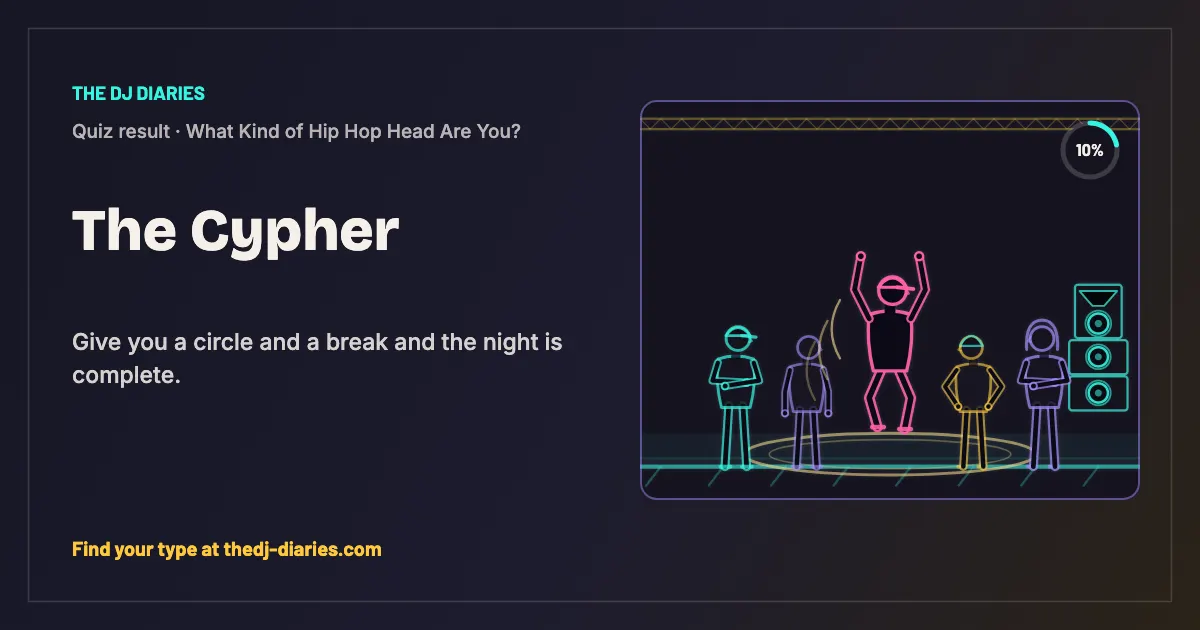
The Cypher
Give you a circle and a break and the night is complete. You dance, and you tend to judge a night by whether there was ever room to. Breaking, popping, locking, house footwork or a style that is simply yours, it all needs the same two things: floor space and a DJ who understands that the break is the point, not a gap between choruses. People like you know the old story of a DJ in the Bronx playing the drum section of a funk record twice so the dancers could go off. You are still dancing to that idea, fifty years later.
You are often the first to open a circle and the last to leave it. You stretch in a corner while others are still ordering drinks, you watch the DJ for the moment the drums open up, and you go in when the energy says so, not when a plan does. You like rooms with a wooden floor, a sound system with real low end, and a crowd that claps for the person in the middle instead of filming them. Practice sessions, jams and battles are where you feel most yourself.
At your best: You can turn an empty patch of floor into the centre of the room in one break. The blind spot: when the DJ skips the breaks, you tend to give up on the whole night a little too early.
Rooms worth the trip: Juste Debout in Paris, Breakin’ Convention in London and Red Bull BC One World Final, which moves to a different city each year. Read the full Cypher result.
The Trap Floor
Bass you feel in your chest and a drop you have been waiting all week for. You go out for the peak, and you are honest about it. You tend to want 808s you feel in your chest, ad libs the whole room shouts back, and that moment when the beat cuts out for one word so the floor can fill the gap. You often know the new songs before your friends do, because you were listening the night they came out. People like you keep hip hop sounding like now, and every DJ who plays to you learns quickly that a quiet five minutes is a very long time.
You arrive with your people, you find the middle of the floor, and you stay close to the speakers. You like a big system, a crowd that jumps on the same beat, and a DJ who trusts the drop instead of talking over it. Festival fields and late rooms at full capacity suit you best, and you measure the night afterward by your voice and your legs. You do not need a history lesson before a song. You need it loud, new and timed right.
At your best: You bring energy that spreads, and a floor tends to lift when you are on it. The blind spot: you can lose patience with anything older than a few years, including the records your favourite songs are built on.
Rooms worth the trip: Rolling Loud in Miami, Wireless Festival in London and Summer Smash in Chicago. Read the full Trap Floor result.
The R&B Late Shift
The night really starts when the tempo drops. You love the slow part, and you will wait for it. You tend to treat the loud hours as the warm up for what you actually came for: late R&B, a two step with the person you came with, and the song everyone pretends not to know the words to until the chorus arrives. People like you understand that a floor is not only for jumping. Some of the best moments in a hip hop night happen at a lower tempo, a little closer together, with the whole room singing softly.
You often hang back during peak time, talking, watching and saving your energy. Then the DJ slows it down and suddenly you are in the middle of the floor. You like warm rooms, a system that is kind to vocals, and a DJ brave enough to drop the tempo at three in the morning. Dinner first, a long night, and a slow jam you have loved since school is your idea of a very good Saturday, and you will remember the song long after you forget the club.
At your best: You know exactly when a room is ready to slow down, and you lead it there. The blind spot: peak time can feel like noise to you, and you may miss the fun your friends are having in it.
Rooms worth the trip: Essence Festival of Culture in New Orleans, Jazz Cafe in London and Apollo Theater in New York. Read the full R&B Late Shift result.
The Lyric Listener
You came to hear what was said, and you heard every word. You came to hear what was said, and you tend to hear all of it. You notice the internal rhyme in the second bar, the nod to a line from three songs back, and the joke the rest of the room missed. People like you stand near the front, not to be seen but to catch the words before the system muddies them. For you a great verse works like a great short story: every word chosen, nothing wasted, and something left over for the second listen.
You are often quiet at shows, and that is not boredom. You are listening. You like rooms with clear sound, artists who rap the full verse instead of leaving it to the backing track, and friends who will argue about a line with you on the walk home. Open mics, poetry nights and album listening sessions suit you, and you will happily read the lyrics again the morning after to check whether you heard them right. A good line can stay with you for a week.
At your best: You catch the line everyone else missed and can explain why it matters. The blind spot: you can undervalue songs built for the body, where the words are not really the point.
Rooms worth the trip: Nuyorican Poets Cafe in New York, Cornell Hip Hop Collection in Ithaca and Danforth Music Hall in Toronto. Read the full Lyric Listener result.
The Battle Judge
Skill is the only thing you will clap for. Skill is the only thing you will clap for, and you tend to mean it. Open mics, rap battles, DJ battles and dance cyphers are where you feel most at home, because in those rooms the craft is out in the open. You can explain why a verse worked, why a rebuttal landed and why a routine scored. People like you are hard to impress on purpose. You are not being cold. You simply know how much work goes into the real thing, and you refuse to cheapen it.
You are often near the front, arms folded, nodding when something is earned. You like rules that everyone understands, judges who explain their decisions, and a crowd honest enough to groan at a weak line. You can recite the history of a battle league and the classic rounds that made its name. A small room with a real stage, a host who keeps time and a clear winner at the end is your kind of night, and you will be arguing about the result on the way home.
At your best: You can explain exactly why something was good, and artists trust your read. The blind spot: you can hold casual fans to battle standards, and that tends to make the room feel smaller.
Rooms worth the trip: King of the Dot in Toronto, DMC World DJ Championships in London and Ultimate Rap League in New York. Read the full Battle Judge result.
The Scene Loyalist
You saw them in a room for sixty people, and you still buy the shirt. You back the local scene, and you tend to do it with your wallet and your feet. You go to the small shows on a Tuesday, buy the shirt at the merch table, share the release the day it comes out and tell your friends to come next time. People like you were in the room for sixty people long before television found the artist, and you are not bitter about it. You are proud. Scenes survive because someone keeps showing up, and that someone is very often you.
You often know the promoter, the sound engineer and the person on the door by name. You like small rooms, early sets by artists nobody has heard of yet, and the feeling of a crowd that knows each other. You keep the flyers, follow the new names and buy tickets before the lineup is fully announced. When an artist you saw early finally plays a big stage, you go, you stand somewhere near the back, and you quietly enjoy having been right.
At your best: You turn up for local artists when it counts, and scenes are built on people like you. The blind spot: loyalty can make you less honest about a show that was not very good.
Rooms worth the trip: Lee’s Palace in Toronto, Fortune Sound Club in Vancouver and Amoeba Music in Los Angeles. Read the full Scene Loyalist result.
Frequently Asked Questions
What Kind Of Hip Hop Head Am I?
One of twelve, decided by six things: how much you plan, whether you serve the room or your own idea, how deep you dig, how fast you want the peak, how social you are and whether you face backwards or forwards. The Hip Hop Head quiz scores all six in about ten minutes.
What Are The Four Families?
The Hands are the Turntablist, the Open Format and the Hypeman. The Diggers are the Crate Digger, the Beat Tape Producer and the Mixtape Archivist. The Floor is the Cypher, the Trap Floor and the R&B Late Shift. The Word is the Lyric Listener, the Battle Judge and the Scene Loyalist.
Which Type Is The Rarest?
The Beat Tape Producer, at about five percent, then the Hypeman at six. The Open Format is the most common at fifteen percent, followed by the Lyric Listener at twelve. Rarity says your answers were unusual, not that they were better.
Why Does The Quiz Not Name Seoul Venues?
Because the people who run Seoul's hip hop rooms know them better than any quiz does, and a list goes out of date fast. Every result suggests the kind of room to look for here, and names a few rooms abroad worth the trip.
Can I Take It In Korean?
Yes. The quiz, every result and the share cards are in English and Korean, and you can switch at any point.
Where To Go Next
Twelve types, no correct answer. For the scored version, take the Hip Hop Head quiz. For the history underneath it, start with the break hip hop was built on, then try the era quiz, which now opens with the Bronx block parties, or Find Your Sound.
Stay in the Loop
New writing on DJ culture, electronic music, and the Seoul underground, delivered when it matters.
More From The DJ Diaries
Play with the history
Four tools built from the same research as this site.