To start DJing in Seoul, book a month of one to one lessons (MIXYOU Academy in Mapo (마포) charges 280,000 won (about US$205) for four 60 minute sessions, and teachers on Soomgo (숨고) average 60,000 won an hour, about US$44), buy or rent AlphaTheta gear through DJ Korea, the official Pioneer DJ importer, and, if you are a student, join a university DJ dongari (동아리), where mentoring is often free. Your first gigs will come from open decks, dongari parties and the people you meet on Seoul dancefloors, not from sending mixes to clubs cold.
This is the Seoul companion to our general How To Start DJing beginner’s guide, which covers skills, practice and library building. Here we stick to what is specific to the city: where to learn, where to buy or rent equipment in Korea, what it costs in won, how the scene lets newcomers in, and how starting here compares with starting in Los Angeles or Tokyo. Prices were checked on 10 November 2026 against each provider’s own page.
Where To Learn DJing In Seoul
Academies
Seoul’s DJ schools are mostly small studios that also teach MIDI production, and they sell lessons by the month. MIXYOU Academy, on the 4th floor of 75 Yanghwa-ro in Mapo-gu (the main road between Hapjeong 합정 and Hongdae 홍대), is a clear example with published prices: 280,000 won (about US$205) a month for four 60 minute basic lessons, 300,000 won (about US$220) for advanced, and 350,000 won (about US$257) for four 90 minute expert sessions. Students get a free practice room they book themselves, which matters more than it sounds, because practice hours on real equipment are what lessons alone cannot give you.
For a sense of what a full group course costs in Korea, Signature DJ Academy publishes its fees: 1,080,000 won (about US$792) for a 16 week group course of weekly 60 minute classes, or 1,400,000 won (about US$1,026) for the private version over the same period. It is in Daegu (대구), not Seoul, but it is one of the few Korean schools that lists a complete price, and it uses Pioneer DJ equipment supplied through DJ Korea.
Private Teachers
Most Seoul DJ teaching happens one to one, booked through marketplaces. Soomgo’s price page for DJing lessons puts the average at 60,000 won (about US$44) an hour and lists more than 2,000 active DJing teachers, from hip hop turntablists to house DJs offering lessons at their own studios. Kmong (크몽) carries similar listings by neighbourhood, including Hongdae and Nonhyeon (논현). Ask any teacher three things before you pay: which players and mixer you will learn on, whether practice time is included, and whether they teach in English if you need it.
A One Off Taster For Visitors
If you are in Seoul for a week and want to try before committing, a 2 hour private beginner class in a working studio near the 108 Stairs in Huam-dong (후암동), Yongsan-gu, is listed on WAUG via GetYourGuide at around US$55 to US$70. You learn beatmatching and transitions and build a short set. It will not make you a DJ, but it will tell you whether you want to become one.
University Dongari: The Free Route In
If you study at a Seoul university, the dongari (student club) is the best deal in the city. Mixmag Asia’s March 2026 feature calls them the hidden incubator of the Seoul scene: groups such as SNAP at Korea University, which runs a structured mentor and mentee system at no cost, and Nuit at Hankuk University of Foreign Studies, alongside EAT, SNoL, VERITAS and MOCIT. Some communities have more than 100 active members. Many have a dongari bang (동아리방), a clubroom equipped with CDJs and headphones, and they host parties under their own names at underground clubs in Itaewon (이태원), typically on Thursdays or Sundays, as well as festival booths and open air campus sets.
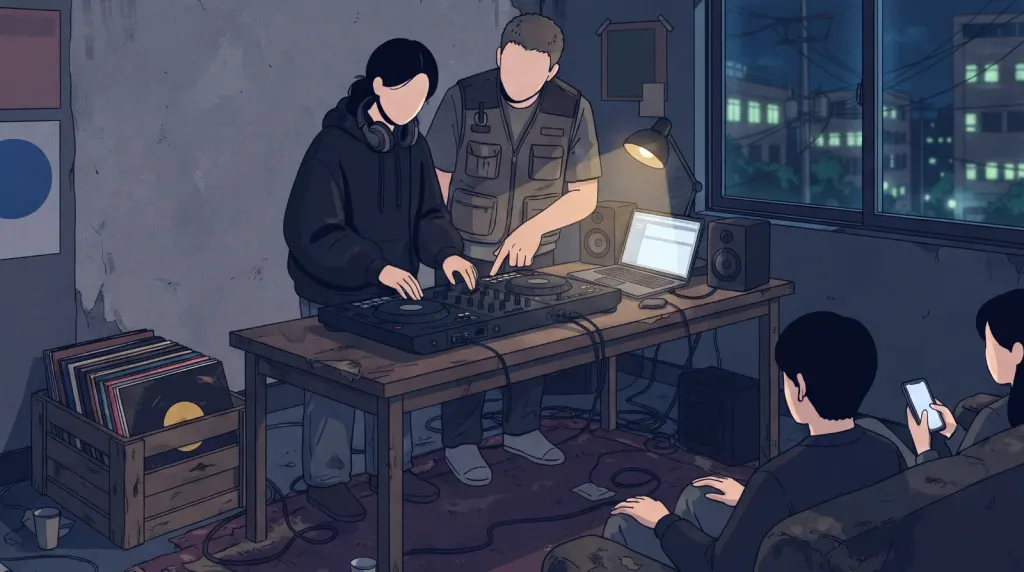
From the booth, this is the part of Seoul’s scene visitors never see and the reason so many young Korean DJs can already play CDJs when they arrive at their first club. If you are an exchange student, ask at your university’s club fair at the start of semester; the worst answer is a waiting list.
Where To Buy Or Rent DJ Gear In Korea
The short answer is DJ Korea for new equipment and rentals, and the second hand apps for bargains. Our DJ equipment guide explains what to buy; this is where to buy it in Korea.
DJ Korea describes itself as the exclusive official importer of Pioneer DJ in Korea, and also carries AIAIAI headphones, Allen & Heath’s Xone mixers and UDG bags. Its showroom is on the 3rd floor of the Living Park section of I’Park Mall (아이파크몰) at Yongsan Station (용산역, Line 1), open 10:30 to 22:00 every day of the year. Buying from the official importer matters in Korea because after sales service runs through its own service centre.
Its online shop listed these prices in November 2026: the AlphaTheta DDJ-FLX2 at 299,000 won (about US$219), the Pioneer DJ DDJ-FLX4 at 660,000 won (about US$484), the DDJ-REV1 at 550,000 won (about US$403), and the CDJ-3000X at 4,990,000 won (about US$3,658) per player, with the DJM-A9 mixer at 4,990,000 won (about US$3,658) and the XDJ-AZ all in one at 5,500,000 won (about US$4,032). DJ Korea also rents club equipment: 150,000 won (about US$110) for a CDJ-3000, 130,000 won (about US$95) for a DJM-900NXS2 and 200,000 won (about US$147) for a DJM-A9, with 30% off for four days and 40% off for a week. The rental page does not state the time unit for those prices, so confirm per day when you call.
For used gear, Bunjang (번개장터) is where Korean DJs sell: a search for “cdj” there returned more than 5,000 listings in November 2026, mixed with accessories and older models. Test anything in person, check the jog wheels and USB ports, and ask for the original box and receipt.
What It Costs To Start DJing In Seoul
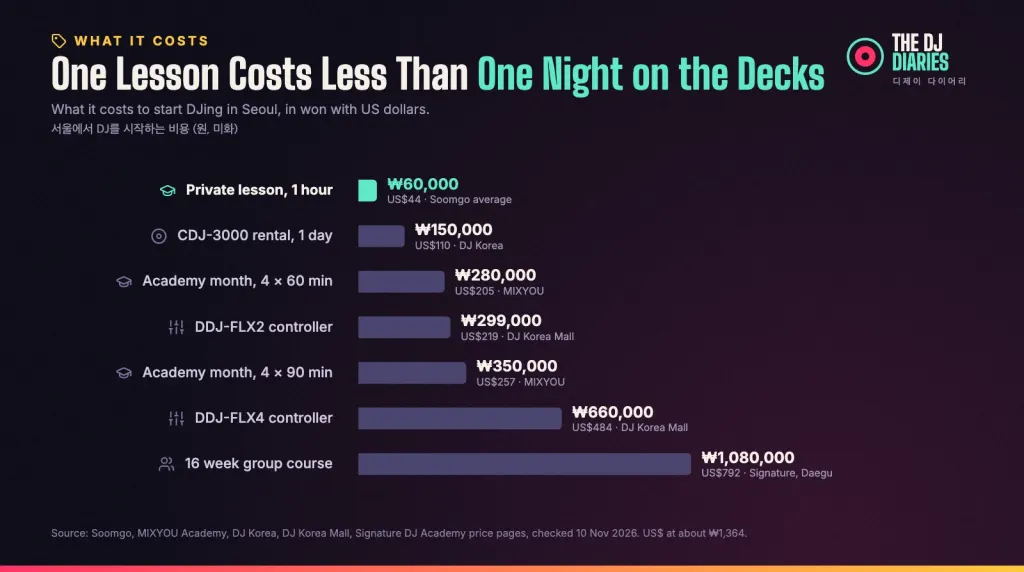
| Item | Price | What You Get | Source |
|---|---|---|---|
| Private lesson (average) | 60,000 won (about US$44) per hour | One to one, teacher’s studio | Soomgo |
| Academy, basic month | 280,000 won (about US$205) | 4 lessons of 60 minutes, free practice room | MIXYOU Academy |
| Academy, expert month | 350,000 won (about US$257) | 4 lessons of 90 minutes | MIXYOU Academy |
| Group course, 16 weeks (Daegu) | 1,080,000 won (about US$792) | 16 weekly classes of 60 minutes | Signature DJ Academy |
| Starter controller, DDJ-FLX2 | 299,000 won (about US$219) | New, official import | DJ Korea Mall |
| Starter controller, DDJ-FLX4 | 660,000 won (about US$484) | New, official import | DJ Korea Mall |
| CDJ-3000 rental | 150,000 won (about US$110) | One unit; confirm rental period | DJ Korea |
| University dongari mentoring | Free (SNAP) | Peer mentoring, clubroom gear | Mixmag Asia |
Prices as of 10 November 2026. A realistic first month for a non student is a basic academy month plus a DDJ-FLX2: 579,000 won (about US$424), with practice included in the academy room.
Open Decks And Your First Gigs
Seoul’s way in is the same as anywhere, with a local accent: be on the dancefloor before you ask for the booth. Open deck nights, where you sign up for a short slot on the house equipment, run in bars around Hongdae, Itaewon and Sinchon (신촌), and they are announced on Instagram rather than listings sites, so follow the bars and the DJs you like. Mule (뮬), the Korean musicians’ board, carries club and open deck DJ recruitment posts, such as an open deck DJ call from a club in Gunpo (군포) just outside Seoul.
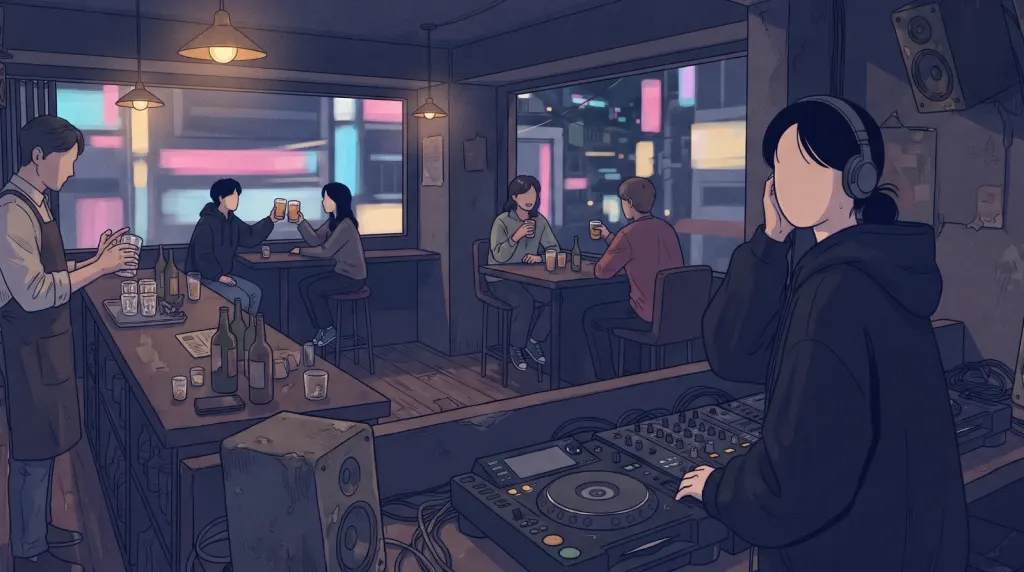
Dongari parties are the second door: they need DJs, the crowd is friendly, and the club staff who work them remember who played well. The third is community radio; Seoul Community Radio is another place where local selectors get heard. Then, when you are ready for clubs, read who gets booked in Seoul before you message anyone, and get to know the rooms through our Hongdae clubs and Itaewon clubs guides. Plan your way home before the set, not after it; our Getting Home Planner covers the night buses and taxis.
One note for foreign residents: whether you can take a fee for a set depends on your visa. Plenty of DJs here play paid gigs without the right visa, and most never get caught. I’ve also known some who did, and one of them lost his career here and was deported. Unlike a lot of countries, Korea checks you on the way out as well as on the way in, so a problem can surface at the airport, with a fine before you leave. Enforcement comes and goes, and you never know what immigration will say on the day. The right move is the proper visa or a sponsor before you take paid work, and the Korea Immigration Service (1345) is the one to ask, not a DJ.
Compare And Contrast: Starting In Korea vs Starting Abroad
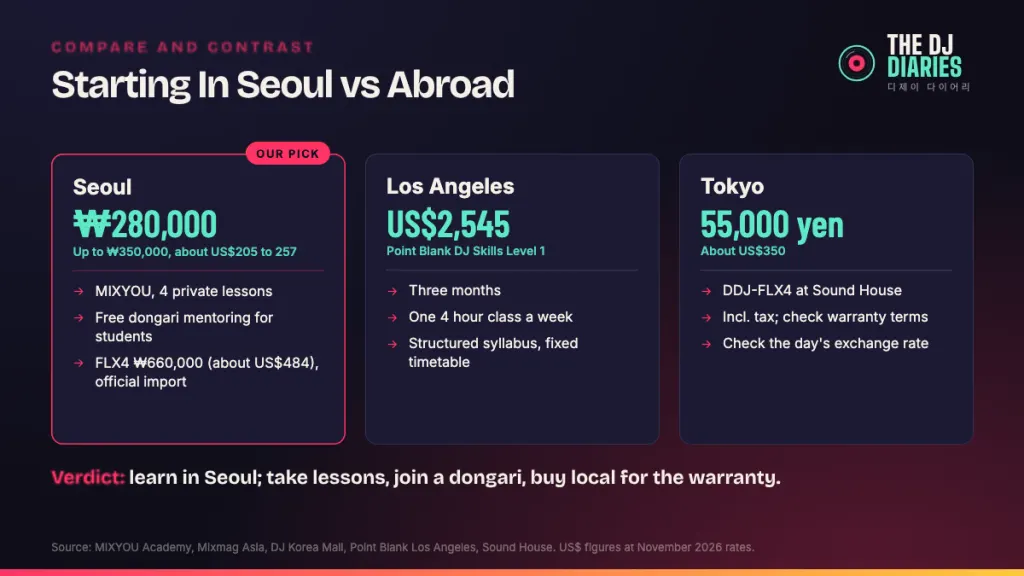
Lessons. Seoul sells lessons by the month, one to one, from small studios: 280,000 won for four hours at MIXYOU. Los Angeles sells courses: Point Blank’s DJ Skills Level 1 costs US$2,545 for three months, with one four hour class a week. Seoul is more flexible and cheaper to try; Los Angeles gives you a structured syllabus and a fixed weekly timetable.
Gear. The same controller is priced differently in each market, so compare before you buy. The DDJ-FLX4 is 660,000 won (about US$484) at DJ Korea (699,000 won in white, about US$512), while Sound House in Japan lists the white DDJ-FLX4-W at 55,000 yen including tax (about US$350); the DDJ-FLX2 is 299,000 won (about US$219) in Korea and US$189 at B&H in New York. Check the day’s exchange rate, then weigh the saving against Korean after sales service, which only the official importer provides.
Community. This is where Seoul wins. The university dongari system gives students free mentoring, a clubroom with CDJs and a ready made crowd, which very few cities offer. The trade off is that the scene is close knit and Korean language heavy, so foreigners who make the effort to show up, say hello and learn a few words get much further than those who wait to be invited.
Verdict: learn in Seoul. Take a month of lessons, buy a FLX2 locally for the warranty, practise in your academy room, and spend the money you saved on going out three nights a week. Buy your second, bigger controller abroad only if you are already passing through Tokyo and the exchange rate makes the saving real.
Frequently Asked Questions
How Much Do DJ Lessons Cost In Seoul?
About 60,000 won an hour (roughly US$44) for a private lesson on average, according to Soomgo, or 280,000 to 350,000 won (about US$205 to US$257) a month for four lessons at an academy such as MIXYOU in Mapo. University dongari such as Korea University’s SNAP mentor members for free.
Where Can I Buy DJ Equipment In Seoul?
DJ Korea, the official Pioneer DJ importer, has a showroom on the 3rd floor of I’Park Mall at Yongsan Station, open 10:30 to 22:00 daily, and an online shop. For used equipment, Korean DJs buy and sell on Bunjang.
Can Foreigners Learn DJing In Seoul In English?
Yes, but ask first. Many private teachers on Soomgo and Kmong will teach in English, and short beginner classes for visitors are sold through booking platforms. Academies teach mainly in Korean, so confirm the language before you pay for a month.
Can I Rent CDJs In Seoul?
Yes. DJ Korea rents a CDJ-3000 for 150,000 won (about US$110) and a DJM-900NXS2 mixer for 130,000 won (about US$95), with discounts for four and seven day rentals. Confirm the rental period and setup fees when you book.
Stay in the Loop
New writing on DJ culture, electronic music, and the Seoul underground, delivered when it matters.
More From The DJ Diaries

Play with the history
Four tools built from the same research as this site.