Every serious club city has one room where the scene talks to itself. In Seoul that room is a bar in Itaewon with cameras in it. Seoul Community Radio, SCR to everyone who has been inside, is a live online station that has been broadcasting the city’s underground since 2016. This is how it started, how it works, and why a DJ who wants to be taken seriously here still needs a slot on it.
How it started: home recordings and a pirate radio idea
SCR was co-founded by Richard Price, a Londoner who grew up on the capital’s pirate stations and moved to Seoul for a corporate job he did not love, together with a friend known as Lee and the DJ BOWLCUT. The idea took shape in early 2016. There was no studio, so the first shows were mixes recorded at home and posted online, with the founders coaxing DJs who had never spoken into a microphone to do a proper radio show. Price has said the point from the start was to be the opposite of commercial radio: a platform for output people could not hear anywhere else, even in clubs.
By its 2016 launch it had a live studio in Itaewon, streaming weeknight shows Monday to Friday. Early takeover shows with London’s Radar Radio and Berlin Community Radio set the pattern that still defines it: import the best of what is coming through Korea, export the best of what is home-grown.
What it is now: a radio station with a bar attached
Today SCR Studio is a hybrid space in Itaewon: a bar you can walk into, with the broadcast booth in a small glass room surrounded by cameras and a green screen. The DJ plays to the handful of people at the bar and to whoever is watching on the stream, which is the part first-timers do not expect. You are the audience and you are also on camera. By its own count the station has hosted more than 600 domestic and visiting artists and runs around 200 residents with regular shows. It picked up a Mixcloud award for best radio station in Asia and the Middle East at its 2017 Online Radio Awards, and in 2025 it took a session slot at SXSW London.
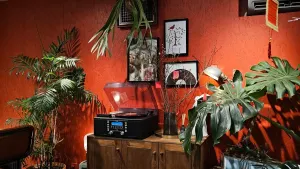
Walking in feels less like a club and more like someone’s front room with better monitors. Stickers, posters from old nights, mismatched furniture, screens showing the live feed. It is unpretentious in a way that Itaewon’s bigger rooms have not always managed, and it is one of the few places in the district where nobody minds if you just sit and listen.
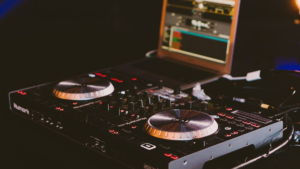
I have played the booth. It is small, the glass is closer than it looks on the stream, and the green screen behind you means the visuals people see at home are not the room you are standing in. You play on the house CDJs and mixer with a microphone on an arm you are expected to use, and the monitor level is set for the broadcast, not for you, so you learn to trust the meters. The bar is three metres away. Someone at it will nod at a record, and that nod and the chat scrolling on the screen are the whole crowd. It changes how you play: fewer big moments, more selection, and you talk between records in a way a club never lets you.
Why it matters to Seoul DJs
A residency at SCR is the closest thing this city has to a weekly apprenticeship. Clubs give you a Friday when you are already known. SCR gives you a recurring hour when you are not, in front of a small live room and an international stream, and it makes you talk. Several of the names in our Korean DJs to know built their audience there before they had a club booking to speak of. For touring DJs it works in reverse: a guest show on SCR is how a visiting artist tells Seoul they have arrived, and how a Seoul promoter checks whether the hype is real. That loop is a big part of how bookings actually happen here.
Mixmag Asia’s feature on university DJ clubs, the dongari (동아리, dongari), lists community radio beside club residencies, private lessons, workshops and new-face nights at clubs as the routes new DJs take into the Seoul scene.
It also documents. When Cakeshop shaped the district and when Soap closed and came back, the SCR archive is where you can hear what the DJs were actually playing. Korean club history has a habit of vanishing when a lease ends. The station is one of the places it does not. SCR knows this first-hand: its original studio on Usadan-ro had to move in 2019 when the block was condemned.
There is a wider reason the station matters. Robert Prey and Seonok Lee’s 2024 study in the International Journal of Communication argues that what they call platform closure arrived earlier and harder in Korea than in the West, pushing independent musicians off streaming services and onto social media, where they compete with content creators. A room where people listen to a whole hour of what someone chose to play is the opposite of that.
SCR and MIXMIXTV, side by side
Seoul has two institutions doing adjacent work, and it is worth being clear about the difference. MIXMIXTV, founded in 2014, is a video archive of one-hour sets shot Boiler Room style, mostly in Seongsu these days, with festivals as its live arm. SCR is a live station with a bar, built on the pirate radio model, where the weekly show is the product. One gives you the tape, the other gives you the reps. Dazed’s 2025 profile credits the station with carrying K-bass and Korean grime and garage MCs abroad, and with community projects such as the JIMJILBANGDAZE sauna raves and a beach festival in Yangyang. The DJs who last in this city tend to have both.
How to listen, and how to visit
- Live stream and archive at seoulcommunityradio.com and on YouTube
- Curated playlists on Apple Music
- Schedule, events and the studio’s opening nights on Instagram
If you are visiting Seoul and want one evening that explains the underground faster than any club can, go on a broadcast night, take a stool at the bar, and watch who walks in. For the wider map, start with going out in Seoul, district by district.
For the pirate radio roots, my piece on how pirate radio built UK club culture covers where stations like this began. I also wrote a history of Itaewon after dark for the neighbourhood around the studio. For the music itself, my piece on the Seoul sound is a good companion to the archive.
Frequently Asked Questions
What is Seoul Community Radio?
Seoul Community Radio, known as SCR, is a live online station that has broadcast the city’s underground music since 2016. It runs from SCR Studio in Itaewon (이태원), a bar you can walk into with the broadcast booth in a small glass room surrounded by cameras. By its own count it has hosted more than 600 domestic and visiting artists and runs around 200 residents with regular shows.
Who founded Seoul Community Radio and how did it start?
SCR was co-founded in early 2016 by Richard Price, a Londoner who grew up on the capital’s pirate stations. His co-founders were a friend known as Lee and the DJ BOWLCUT. There was no studio at first, so the early shows were mixes recorded at home and posted online. Within a year the station had a live studio in Itaewon and was broadcasting live from its own room.
Can you visit the SCR studio in Itaewon?
Yes, SCR Studio is a bar you can walk into, and the DJ plays to the people at the bar as well as to the stream. It feels less like a club and more like a front room with better monitors, and nobody minds if you simply sit and listen. For a visitor, a broadcast night at the bar is one of the fastest ways to understand the Seoul underground.
What is the difference between SCR and MIXMIXTV?
SCR is a live station with a bar, built on the pirate radio model. The weekly show is its product. MIXMIXTV, founded in 2014, is a video archive of one hour sets shot Boiler Room style, mostly in Seongsu (성수), with festivals as its live arm. One gives a DJ the tape and the other gives the reps. The DJs who last in Seoul tend to have both. There is more on the channel in this look at a decade of MIXMIXTV sessions.
Sources
- Mixmag Asia: South Korea’s university DJ dongari, the hidden incubator of Seoul’s dance music scene
- Robert Prey and Seonok Lee, Platform Closure and Creator Creep: What We Can Learn From Korean Indie Musicians, International Journal of Communication 18, 2024
Written from Seoul, by someone who has been in the booth for more than twenty years. More on the site, or book a DJ.
Follow the rooms: Cakeshop on Instagram · Soap on Instagram · MIXMIXTV on Instagram
Stay in the Loop
New writing on DJ culture, electronic music, and the Seoul underground, delivered when it matters.
More From The DJ Diaries

Play with the history
Four tools built from the same research as this site.