There’s a music dabang DJ in Jongno who has been doing the same job since April 1976, in the same format, with the same equipment, for an audience that has almost entirely died out and been replaced by a new one that comes to see the format itself. He is, by the reckoning of most Korean coverage of him, the last working music dabang DJ in the country.
His name is Jang Min-wook. I haven’t met him yet, and I want to be clear about that up front, because this site doesn’t run interviews it hasn’t done. What follows is built from Korean press coverage over the last decade, from the city’s own materials about the venue he works, and from what fifty years of that job would mean to anyone who has done a version of it. When I do sit down with him, I’ll update this piece and say so. Until then, treat it as a careful reading of the public record by someone in the same trade.
The record is remarkable enough on its own.
The Numbers Behind Korea’s Last Music Dabang DJ
He started in April 1976, at around twenty, at a dabang on the outskirts of Guro. The story that comes up in every profile is that the scheduled DJ didn’t turn up and he went into the booth instead. He has never held another job since. That’s fifty years this year.
He owns, by the count given in a Junsungki magazine profile, roughly eighty four thousand LPs. Around eight thousand of them are at the venue where he works. The rest are in a warehouse he rents to hold them. When OhmyNews profiled him as the last analog DJ, the warehouse was the detail that stuck.
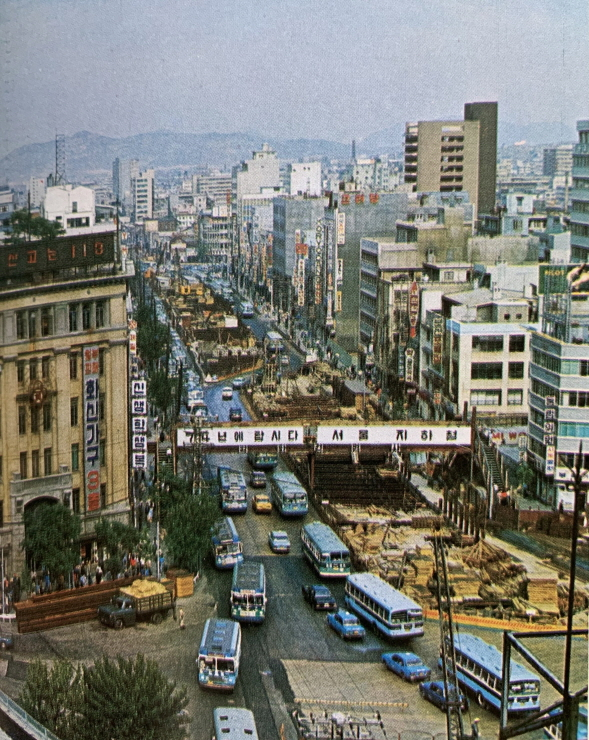
He works weekdays at 청춘1번지, a music dabang about five minutes from exit 1 of Jongno 3-ga station. On Fridays through Sundays he works the recreated 추억의 음악다방 at Donuimun Museum Village, a city run heritage site in Jongno-gu, where the booth holds about five hundred records. The format runs exactly as it did. He’s a director of the Korean Broadcasting DJ Association. He sings and plays saxophone. He’s somewhere around seventy.
And he still dresses for 1976. Long hair, jeans, a hat. The line he gave Junsungki is the best summary of the man anyone has managed: however fast the years have changed, at work at least he keeps his clock set to the seventies.
Jang Min-wook by the numbers
Fifty years in the same booth
| Item | What the article says |
|---|---|
| Started | April 1976, around age twenty, at a dabang on the outskirts of Guro |
| Years in the job | Fifty this year, with no other job since |
| LPs owned | Roughly 84,000, by a Junsungki magazine profile |
| LPs at his weekday venue | Around 8,000, with the rest in a rented warehouse |
| Booth at Donuimun Museum Village | About 500 records, Friday to Sunday |
How to read itThe collection is far bigger than any single booth can hold, which is why most of it sits in a warehouse.
What the Job Was
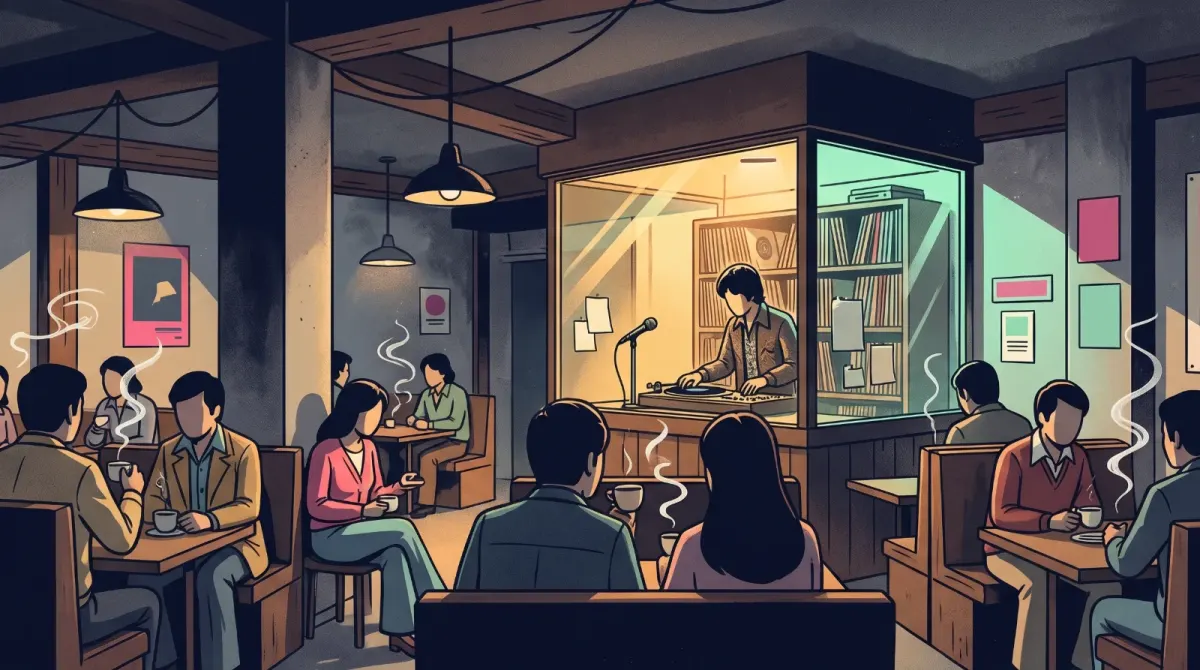
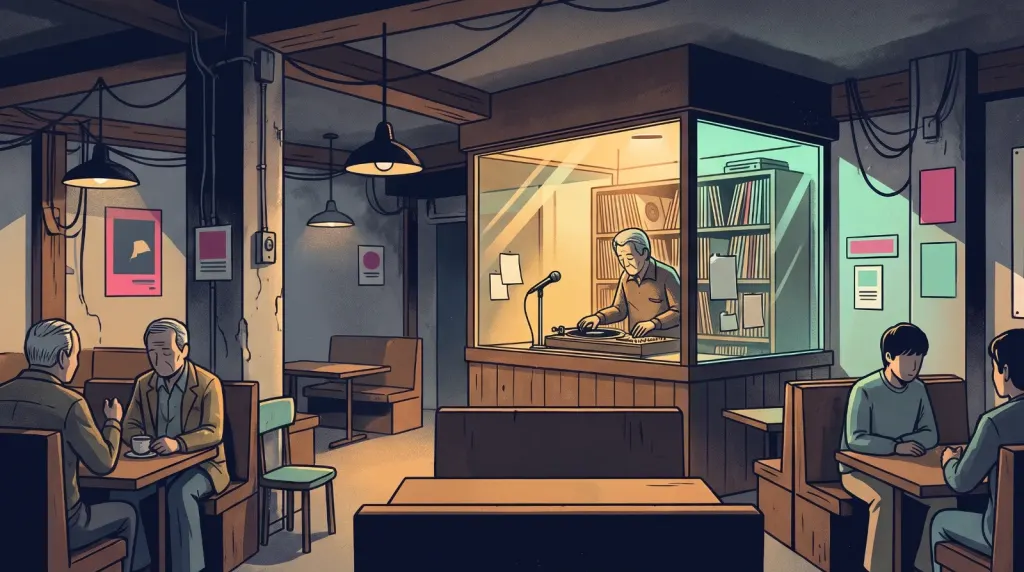
If you’ve only encountered the word dabang as a slightly musty term for an old fashioned coffee shop, the music dabang was something else entirely. From the sixties into the eighties it was the centre of Korean youth culture: a coffee house built around a raised glass booth, a wall of vinyl and a professional DJ taking written requests from the tables.
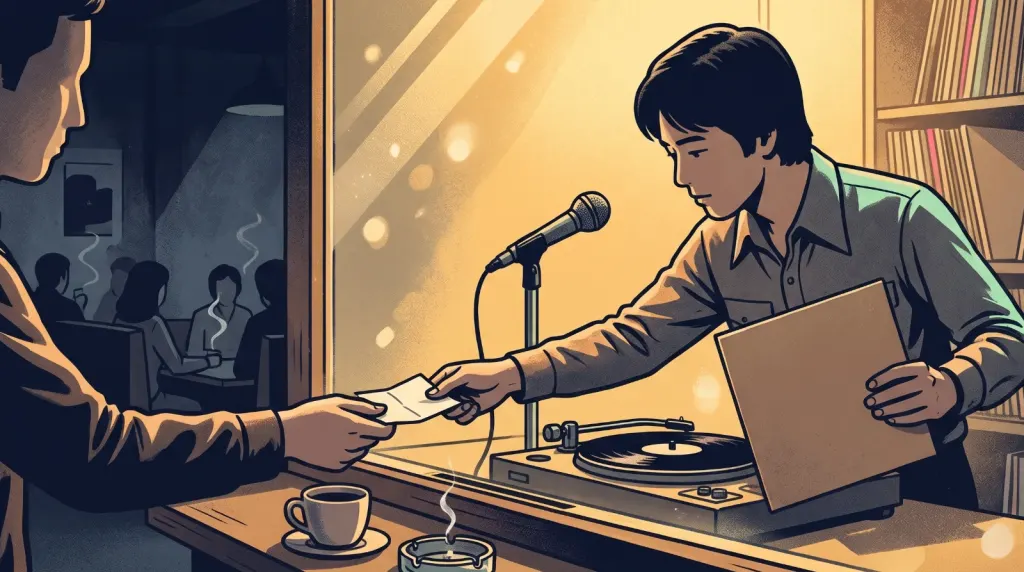
The mechanics, as Jang has described them in Kyunghyang Shinmun and elsewhere: guests wrote a song on a slip of memo paper, and underneath it, often, a story. Who the song was for. What had happened that week. What they couldn’t say out loud to the person sitting across the table. The DJ read the slip, chose when to play it, and answered the story over the microphone, live, to the whole room.
Inside the Booth
He describes the role as one person doing four jobs at once: producer, engineer, writer and announcer. It’s an accurate job description, and one I recognise. The hardware has changed. Reading a room in real time and deciding what it needs next hasn’t.
The other half of the job was access. In the seventies, a Korean twenty year old couldn’t simply hear whatever they wanted. Imports were scarce and expensive, the radio was limited and, for a stretch of that period, officially censored. The dabang DJ’s collection was the archive, and his knowledge of it was the search function. Musicians and composers came into the rooms to see what was moving. The booth had real cultural authority, and the best DJs of the era were followed like radio hosts, with several of them going on to become exactly that.
Why He Is the Last Music Dabang DJ
The format died in stages, and the stages are worth knowing because they explain most of what Seoul’s night looks like now.
Colour television arrived and weakened the room through the eighties. The noraebang arrived and finished it, because it offered the same thing the dabang offered, music as a social event, with the customers doing the performing and no DJ to pay. Franchise coffee culture then took the daytime half of the business and turned coffee into a takeaway product rather than a reason to sit somewhere for three hours. By the nineties, the booths were gone and the DJs had scattered to radio, to the nightclubs of the era, or out of the trade entirely.
Jongno, where Jang still works, is the format’s last habitat for a specific reason. It’s the district Seoul’s older generation kept, the one that didn’t chase the money south of the river in the eighties or west to Hongdae in the nineties. It’s the one place where enough of the original audience still lives, drinks and walks around to sustain a room like this.
Why This Matters to a Scene That Thinks It Started in 2000
Here’s my stake in it, and it’s the reason I want to write about him rather than just link him.
English language coverage of Korean club culture almost always begins around the millennium, with Hongdae basements or the first Itaewon rooms, as though the DJ arrived in this country along with the internet. That’s wrong, and it does the scene a disservice. Korea has had a professional, respected, distinctly Korean DJ tradition since the sixties, with its own etiquette, its own economics and its own relationship to the room. It ran for thirty years before anyone here played a record to make people dance.
The booth I stand in is downstream of the booth he stands in. Same job, louder room, worse coffee. If you want the whole lineage laid out, that’s a separate article. The short version is that Korean club culture didn’t descend from imported rave. It descended from the coffee house.
If You Want to See It
Don’t treat this as a museum trip, but do go while it exists.
The Donuimun Museum Village music dabang is the accessible option: it’s a public, city run heritage site in Jongno-gu that runs on weekends, and the format is intact, meaning you can write a request on a slip and watch it work. Bring a song with a story attached, because that’s the entire point of the machine. It’s wasted if you just ask for something you like.
The weekday room, 청춘1번지 near Jongno 3-ga, is a working business rather than an exhibit, so treat it as somebody’s livelihood. Order properly, and don’t photograph people without asking. If you don’t speak Korean, write the song title clearly and let the record do the talking.
And if you’re a DJ, go with the specific humility of a colleague. There’s a man in that booth with fifty years of Saturday nights in his hands, and a warehouse full of records that he owns outright. That’s more than almost any of us will be able to say.
This article will be updated if and when I get the interview. If you know him, or have a way in, I’d like to hear from you.
FAQ
Who is the last music dabang DJ in Korea?
Jang Min-wook, a DJ working since April 1976, is described in Korean media as the last active analog music dabang DJ. He works weekdays at a Jongno music dabang and weekends at the recreated 추억의 음악다방 in Donuimun Museum Village. He is a director of the Korean Broadcasting DJ Association.
Where can you experience a music dabang in Seoul?
The most accessible is the recreated music dabang at Donuimun Museum Village in Jongno-gu, a city run heritage site where the original format runs on weekends with a live DJ, a vinyl collection and paper song requests. A small number of original style rooms also survive around Jongno, and Seoul’s modern LP bar scene is the format’s direct descendant.
How many records does Jang Min-wook own?
Korean press profiles put the collection at roughly eighty four thousand LPs, with around eight thousand kept at his venue. The remainder is stored in a rented warehouse. It’s one of the largest personal record collections associated with any working DJ anywhere.
What happened to Korea’s music dabang?
They declined through the 1980s as colour television changed how people spent evenings. The noraebang, the private singing room, took over the social function of music based nights out. Franchise cafe culture absorbed the daytime business. By the 1990s the DJ booths had largely disappeared from Korean coffee houses.
Sources, Archives and Listening
Profiles of Jang Min-wook. Kyunghyang Shinmun, December 2021. The fullest account of his career · OhmyNews on the last analog DJ. That has the record collection and the DJ association detail · Junsungki magazine, which has the best material on how the booth actually worked · Cafein cafe culture webzine.
Where to see the format. Donuimun Museum Village music dabang is the official page for the weekend room. Seoul’s own announcement of the venue opening explains what the city built and why. Two broadcast clips show it running: KTV on the revived music dabang and KTV on the 7080 dabang revival.
Old photographs of the dabang era. Search 다방, 음악다방 and 음악감상실 in Seoul History Archive (서울역사아카이브) and Seoul Photo Archive (서울사진아카이브). Seoul Institute, Seoul in Photographs is organised by decade and is the fastest way to see what a Jongno street looked like when he started in 1976. e영상역사관 national archive photography holds the national newsreel photography of the same years.
Picture Credits
- Jongno during Line 1 subway construction, 1971
공유마당, via Wikimedia Commons. Licence: KOGL Type 1. View the original file and its full licence terms. - Present day photographs
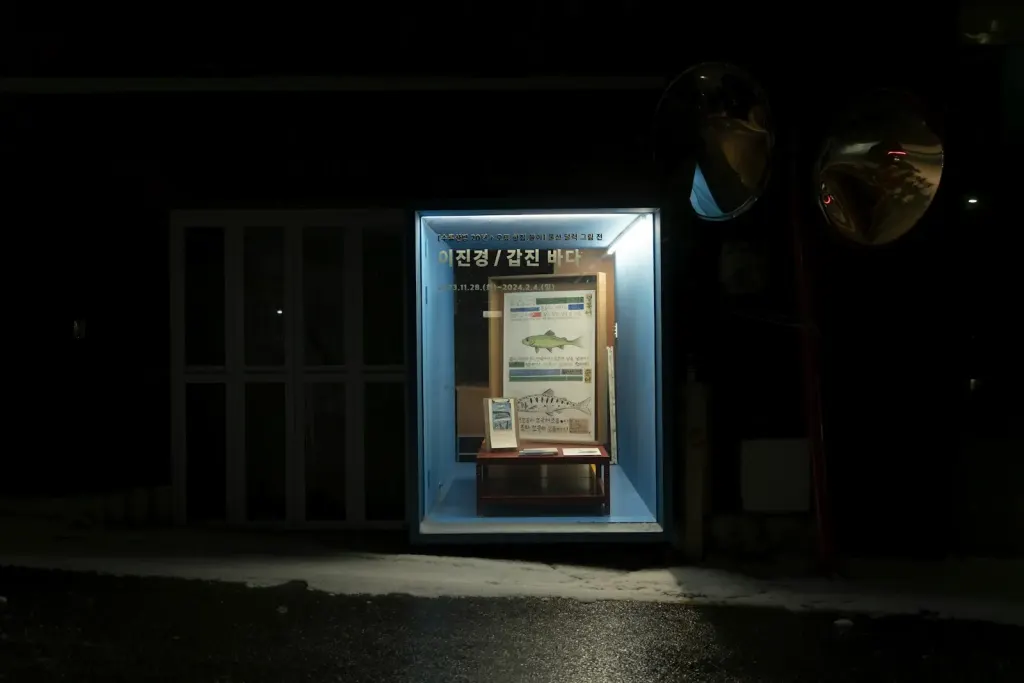
The DJ Diaries.
Historical images on this site are used under the licence stated for each file. KOGL Type 1 is the Korean public sector open licence permitting commercial use and adaptation with attribution; public domain items carry no restriction. If you hold rights in any image here and believe it has been used in error, get in touch and it will be removed.
Written from Seoul, by someone who has been in the booth for more than twenty years. More on the site, or book a DJ.
Stay in the Loop
New writing on DJ culture, electronic music, and the Seoul underground, delivered when it matters.
More From The DJ Diaries
Play with the history
Four tools built from the same research as this site.