Quick Answer: Getting Into Seoul Clubs
Shoes are where most bad nights at a Seoul club door begin. After thirty years of DJing, most of them in this city, I’ve watched plenty of visitors plan the perfect outfit and then walk up to a basement in sandals, and the conversation is usually short. The good news is that the Seoul club dress code is simpler than its reputation. It changes by district and by the kind of room, a few rules are printed right on the listings, and the rest is common sense. Here’s how the door works, what to wear, what gets refused, and the Korean words that help.
한국어 요약
서울 클럽 입장과 복장, 한눈에
2000년대 초반부터 서울에서 디제이로 활동해 온 제가 직접 정리한 서울 클럽 복장 가이드입니다.
입장은 출생 연도 기준이라 2026년에는 2007년생까지 가능하고, 외국인은 여권 실물을 챙겨야 합니다. 복장보다 신분증을 먼저 챙기세요.
잘못된 정보나 바뀐 날짜를 발견하셨나요? 연락 주시면 확인 후 바로 고치겠습니다. 현장에서 보고 들은 이야기도 언제나 환영합니다.
Before You Reach the Door: Age, ID and Cover
Clothes are the second thing a Seoul door checks. The first is your ID, and the rules around it catch more visitors than any dress code does. What follows is door knowledge from the venue side, not legal advice. Where the exact legal position matters to you, ask a Korean lawyer or the government legal information service rather than a DJ. What’s reliable here is what happens at the door and why.

The age rule works on your birth year, not your birthday
Adult status for nightlife lands at nineteen, and the twist is that doors count by birth year. Everyone born in the same year becomes eligible together on 1 January, so in 2026 you need to be born in 2007 or earlier, whatever month your birthday falls in. Korea’s switch to international age in 2023 changed how people count their age in daily life. It didn’t change this. The most common mistake in English guides is saying it did. When a door staffer glances at the year on your card and nothing else, that’s the rule being applied, not a judgment about you.
There’s a better case for the rule than the complaints suggest. A birth year is one glance at one in the morning, and a bright line leaves the person on the door no discretion to use, which is where bias usually lives. Korea sets school years by birth year cohort as well, so a nightlife rule that counted individual birthdays would be the odd one out. What needs fixing is how little English explains it correctly.
What counts as ID
Physical, with a photograph that matches your face. A passport, an alien registration card (외국인등록증, oegugin deungnokjeung), or a Korean ID card or driving licence all work. A photo of your passport on your phone, a photocopy, a student card, an expired card and most foreign driving licences don’t, and the room with the strictest door is usually the room with the most to lose. The risk of letting in someone underage sits with the business, not the customer, which is why the check is repeated at the table in Gangnam and why arguing has never once worked in the twenty years I’ve watched people try. Visitors should carry a passport. Residents should carry the card, not a picture of it.
Outside central Seoul, assume the door is no looser
Enforcement runs locally, so the same national rule can feel different in two cities forty minutes apart on the subway. Suwon (수원), Bucheon (부천), Anyang (안양), Incheon (인천) and Seongnam (성남) each have their own nightlife cores, and the venues there are more embedded in their neighbourhoods, which makes owners more visible and often more cautious. A local crackdown also lands harder where there are fewer rooms to absorb it. Don’t read a relaxed door last month as a promise about this month, and don’t assume Seoul norms travel. Enforcement in Korea is weather rather than climate.
Cover, guest lists and paying by the clock
On listed nights in 2026, most underground rooms in Itaewon and Hongdae charge between 15,000 and 25,000 won at the door, roughly US$11 to 18, with big international bookings reaching 35,000 won (about US$26) and a few weeknights free. Several rooms price by the clock. Cakeshop listed 15,000 won before midnight and 20,000 after (about US$11 and US$15) on a July night (RA), and a second floor room off Itaewon-ro charged 10,000 won before midnight and 15,000 after (about US$7 and US$11) (RA). Cards work at most doors now, but a few small rooms and the odd rave are cash only, so carry some. Guest lists exist, mostly for promoters’ friends and for the big Gangnam rooms, and in the commercial clubs “free entry” often means free for women before a cutoff time and paid after it. Our survey of 343 Seoul clubbers found that 36 percent usually pay nothing at the door and 37 percent pay 10,000 to 20,000 won (about US$7 to 15), which tells you how normal both ends are (Seoul Nightlife Report).
입뺀, and what to do when it happens
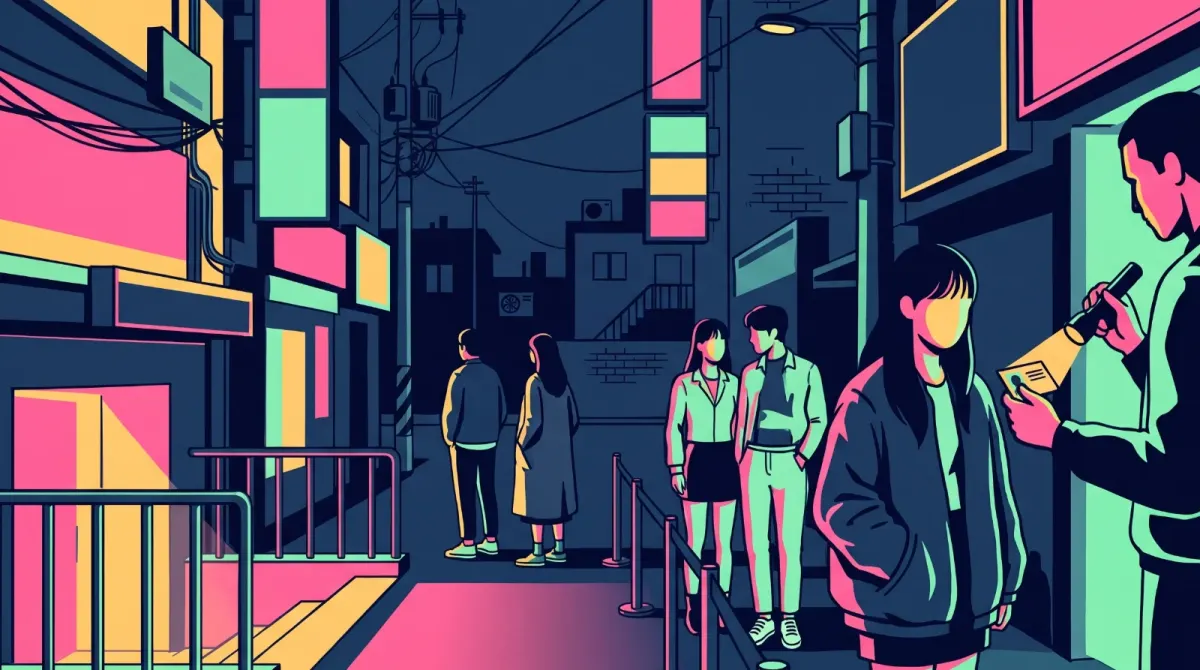
입뺀 (ipppaen) is the slang for being turned away at the door, and it happens for four reasons in roughly this order: no physical ID, the wrong birth year, the wrong shoes, and a room that’s full or has decided it’s full. Gangnam adds a fifth, which is that some big rooms simply select their crowd, and the rules for that selection are never printed. The sensible response to any of them is the same. Don’t argue, because the staffer is protecting an employer from something that can close the room, and go somewhere else, because within ten minutes’ walk in any Seoul nightlife district there’s another door. Itaewon and Hongdae doors are used to passports and foreign cards and process them quickly.
What the Door Is Actually Looking At
The clearest evidence of a Seoul club dress code is what the clubs publish themselves. I went through the Resident Advisor listings for Seoul from June to October 2026, and the same short lines appear again and again. In Hapjeong (합정), vurt. prints ID required, no photos or video, and no slippers or sandals on its listings (RA). A small room in the Itaewon hill lanes lists dress up, no slippers and no inappropriate attire under every party (RA), and a basement near Itaewon adds no flip-flops or slippers to its ID rule (RA). None of the listings I read said anything against jeans or sneakers.
In Gangnam the list gets longer. One Gangnam club promoter’s guest guide, dated June 2026, rules out slippers, flip-flops, Crocs, tracksuits and anything too casual, and says dresses, jeans and neat casual clothes are fine (promoter guest guide). Beyond the printed rules, doors keep some discretion, and I won’t pretend to know how every door decides. What I can say from the booth is that the people who get in easily look like they came to be part of the night, whatever they’re wearing.
By District
Researchers have been measuring this for years. A 2010 study compared club fashion in Hongdae and Gangnam and found that each club subculture carries its own dress code, dance style and genre, with clearly different looks in the two districts (Kim and Lee, 2010). An earlier study of university area clubwear treated clothes as a marker of which scene you belong to (Bae, Kim and Jeong, 2005). That still holds.
In Hongdae, streetwear, sneakers and jeans are normal. The crowd is young and the look is whatever is current on campus. Nobody expects a collar. In Itaewon, anything goes as long as your shoes are closed, and the queer bars and electronic rooms are among the most expressive places in the city to dress up. In Gangnam and Apgujeong, the big commercial rooms expect a sharper look: clean shoes, a proper shirt or a dress, and nothing that looks like gym clothes. Think of the gap between a Saturday on Toronto’s Queen West and one on King West. In Euljiro (을지로), Jongno (종로) and Seongsu (성수) bars, casual is fine almost everywhere. For more on how the districts differ, see Hongdae vs Itaewon vs Gangnam and the neighbourhood guide.
By Room Type
Big commercial clubs playing hip hop, EDM and K-pop edits are where dress matters most. Dress one step sharper than you think you need to, and leave the tracksuit at home. Techno and house basements are the opposite. Black and dark colours are the unofficial uniform because the rooms are dark and hot, but nobody checks your colour at the door. Wear breathable layers and shoes you can stand in until sunrise. The Hongdae and Itaewon guides cover those rooms: Hongdae clubs now and Itaewon clubs now.
Sharper doesn’t mean a suit, though. Leave it at home. A couple of rooms will wave a suit through if you’ve reserved a table and you’re buying bottles, and the hotel clubs and upper-end lounges run on a different crowd altogether. Anywhere else, I wouldn’t be surprised if the door turned you away.
Themed nights are the exception, and they always say so. This summer a Cakeshop party asked for athletic items (RA), a hard techno night in Sinsa (신사) listed an all black code (RA), and a hard rave in Itaewon asked for all black, leather and chains (RA). If there’s no code on the listing, there’s no code. Live clubs and LP bars are the most relaxed of all. Wear what you’d wear to a gig.
One thing isn’t about clothes but belongs here. Many underground rooms ask you not to film. One small Itaewon room asks guests to keep phone use to a minimum and bans flash (RA). Dressing for the room includes putting the phone away.
Expect to Stand
Seating is the part of a Seoul night nobody warns you about.
Shoes Deserve Their Own Section
If you remember one line from this guide, make it closed shoes. Slippers (슬리퍼, seullipeo), sandals and flip-flops (쪼리, jjori) are the single most common refusal printed on Seoul listings, in Hongdae, Itaewon and Gangnam alike. It’s partly about the look and partly about safety. Floors get wet, glass breaks, and a crowded techno floor is a lot of heavy boots in the dark.
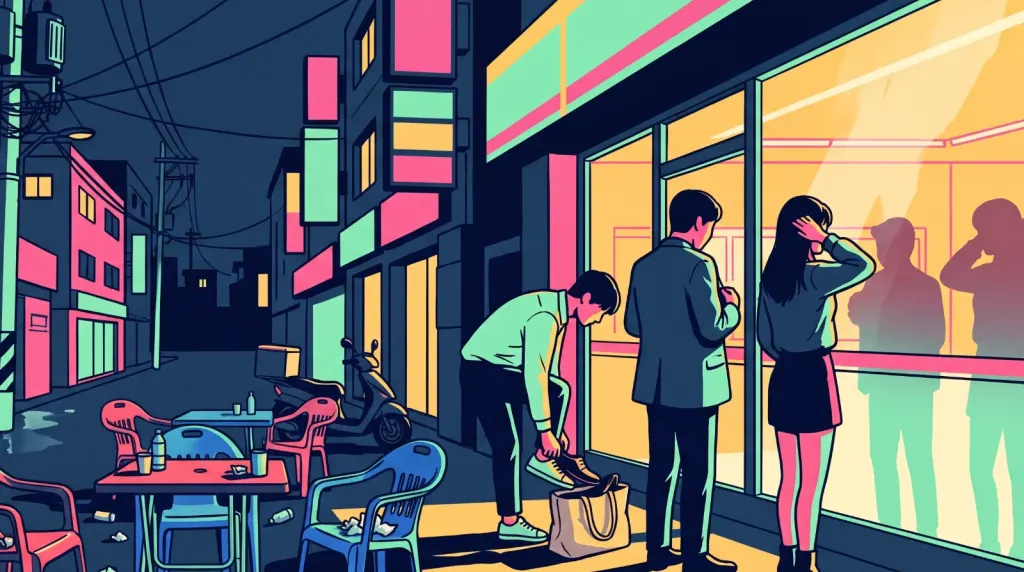
Coming straight from the beach or the Han River in summer? Pack a pair of proper shoes.
Heels are fine, but basements are concrete and the night is long. Most Seoul regulars I know wear the shoes they can dance in for six hours and let the rest of the outfit do the talking. If you’re heading to Gangnam after an afternoon in Hongdae, don’t assume the same trainers work for both. Canadians who have been turned away from a downtown Vancouver club in hiking shoes will know the feeling.
Dressing for the Season
Seoul summers are hot and humid. The rainy season, 장마 (jangma), usually runs from late June to late July or early August, and July is normally the city’s wettest month (The Korea Times). Tropical nights mean a basement can feel like a sauna at 3am. Wear light fabrics, bring a small towel, and pick shoes that can handle a wet street.
Winter is the opposite problem. It’s not Edmonton cold, but January nights are cold enough for a real parka, and small underground rooms often have nowhere proper to hang one. Some bigger events offer paid coat check, and one October event in Dongdaemun lists it at 10,000 won (about US$7) (RA). In a basement, your coat might end up on a hook or in a corner. Layers you can carry, and a jacket you don’t mind folding, work better than a big coat. Spring and autumn are the easy seasons, and September to November is when I think Seoul nights feel best.
Festivals are a separate brief. For Waterbomb and the summer outdoor events, plan for water, sun and walking, and check each festival’s own rules. The Festival Atlas is a good place to start.
A Short Korean Glossary for the Door
These are the words you’re most likely to see on a Korean listing or hear at the door. The full list of 45 is in the Seoul nightlife glossary, and the Seoul nightlife FAQ covers age, cover and timing.
| Korean | Romanisation | Meaning |
|---|---|---|
| 클럽 복장 | keulleop bokjang | club dress, what to wear |
| 드레스코드 | deureseu kodeu | dress code |
| 슬리퍼 금지 | seullipeo geumji | no slippers |
| 쪼리 | jjori | flip-flops |
| 샌들 | saendeul | sandals |
| 츄리닝 | chyurining | tracksuit, sweats |
| 반바지 | banbaji | shorts |
| 부적절한 복장 | bujeokjeolhan bokjang | inappropriate attire |
| 신분증 | sinbunjeung | ID card |
| 여권 | yeogwon | passport |
| 입뺀 | ipppaen | slang for being turned away at the door |
| 물품보관 | mulpum bogwan | bag or coat check |
| 촬영금지 | chwaryeong geumji | no photos or filming |
An Unpopular Opinion: Some Doors Don’t Want You, and That’s Allowed
Here’s the part most guides leave out because it’s uncomfortable. Plenty of venues outside Itaewon select their crowd, and the selection isn’t always about what’s printed on the listing. In Hongdae it’s often age: a room built around a university crowd will find a reason to keep out a group that looks ten years older than the floor. In Gangnam and Apgujeong it’s appearance and attitude, and the people who get waved past the rope are the ones who look like the room’s idea of its own customers. None of this is unique to Seoul. Berghain has made a brand out of it, and doors in New York, Toronto and Ibiza do the same thing with less theatre. Some of us don’t belong in some rooms, by dress, by look or by how we carry ourselves, and the room gets to decide that.
Age sorts a room as much as appearance does, and it has nothing to do with the law. If you were born in the late 1990s, you’re at the upper edge of the Hongdae student crowd, and by your early thirties you’re outside it. Nobody enforces that at the door. You walk in, look around and realise the room isn’t for you. Past your mid twenties, Itaewon and the Mapo rooms skew older and care more about the music, and over thirty I’d point you to Itaewon first. The boundary moves quickly too, because a room that suited you in 2020 may have turned over completely.
So read the door the way the door reads you. Do your research before the night, follow the venue’s own accounts and look at who’s in the photos. Go with a local friend if you have one, because a known face changes the conversation. And if there’s a Gangnam room you really want to be in, the honest route is the one the room is built around: reserve a table and buy a bottle. Premium prices are the signal that you’re serious and want to be there, and the door treats that signal with respect. At rooms that run table service, a group that’s refused can sometimes change the answer by asking at the door whether a table is available, because that turns them from a floor cost into a paying customer. The bottle service guide covers what you’re paying for.
Be aware of what a venue wants from you, too. It’s not uncommon for a commercial club to invite women in free, sometimes with drinks, and turn their male friends away at the same door. That’s a business decision about the room’s ratio, not a judgment on anyone, and it’s worth knowing before you plan a mixed group’s night around one address. If you want to avoid the pain, Itaewon is your best bet for not being turned away, and it still happens there. Choose your battles, look for the rooms that want you in, and if it doesn’t work out, move on to the next venue. There’s always a next venue.
What I Actually Think
Seoul has a reputation for strict doors, and in a few Gangnam rooms that reputation is earned. But most of the city’s best nights happen in rooms where nobody much cares what you wear. Dress for the music you’re going to hear and the district you’re going to be in, and you’ll be fine. The door is the start of the night, not the point of it.
Frequently Asked Questions
Can I wear sneakers to a club in Seoul?
Yes, in most places. Clean sneakers are normal in Hongdae, Itaewon and the underground techno and house rooms.
Can I wear shorts or sandals to a Seoul club?
Sandals and flip-flops are refused at many clubs, and several list the rule on every event, in summer as well. Plan on closed shoes. Shorts are usually fine in Hongdae and Itaewon in summer, but a Gangnam promoter guide rules out tracksuits and anything too casual, so skip gym shorts there.
What’s the Itaewon club dress code?
Relaxed. Respect for the room matters more than the outfit. Some smaller rooms list dress up on their events, so check the listing.
What does 클럽 복장 mean?
It means club dress, or what to wear to a club. You will also see 드레스코드 (deureseu kodeu) for dress code and 슬리퍼 금지 (seullipeo geumji) for no slippers.
How old do you have to be to get into a club in Seoul?
Nineteen, counted by birth year rather than birthday. In 2026 that means born in 2007 or earlier. The 2023 switch to international age didn’t change the nightlife rule.
What ID do Seoul clubs accept?
A physical passport, alien registration card, or Korean ID card or driving licence. Phone photos, photocopies, student cards and expired documents are refused at almost every door.
Am I too old for Hongdae?
If you’re past your mid twenties, the crowd will feel noticeably younger, though nobody will stop you at the door. Hongdae sits closest to the university population, while Itaewon and the Mapo rooms skew older and lead with the music.
Sources
- Kim Hyun-kyung and Lee In-seong, Club Fashion Style Analysis: Comparing Hongdae and Gangnam, 복식문화연구 18(4), 2010 (KCI)
- Bae Jeong-min, Kim Young-sam and Jeong Heung-suk, A Study on the Club Wear around University, Journal of the Korean Society of Costume 55(2), 2005 (KCI)
- Resident Advisor: vurt. listing with door rules (ID, no photos, no slippers or sandals), September 2026
- Resident Advisor: Itaewon listing with dress up, no slippers, no inappropriate attire, June 2026
- Resident Advisor: basement listing near Itaewon with ID and no flip-flops or slippers, July 2026
- Resident Advisor: Cakeshop listing with an athletic items dress code, July 2026
- Resident Advisor: Sinsa hard techno listing with an all black dress code, August 2026
- Resident Advisor: Itaewon hard rave listing with all black, leather and chains, July 2026
- Resident Advisor: Itaewon listing asking for minimal phone use and no flash, July 2026
- Gangnam club promoter guest guide (dress and ID rules, as of June 2026)
- Resident Advisor: Dongdaemun event listing with paid coat check, October 2026
- The Korea Times: Monsoon shifts north, leaving Korea sweltering, July 2025
- Korea Law Information Center: 청소년 보호법 (Youth Protection Act)
Written from Seoul by The DJ Diaries, in Seoul since 2002 and in the booth for thirty years. More on the site, or book a DJ.
Stay in the Loop
New writing on DJ culture, electronic music, and the Seoul underground, delivered when it matters.
More From The DJ Diaries

Play with the history
Four tools built from the same research as this site.