At twenty past eleven on a Friday, two people are standing at the top of a concrete stairwell in Hapjeong. They’re looking down at a steel door that has never had a sign on it. One of them was told about the room once, by somebody who described it badly. The other is doing the arithmetic everybody in Seoul does at this hour, which is how many hours sit between now and the first train, and whether the answer justifies going down there instead of walking back up to a bar with chairs in it. The stairwell smells of damp and cigarettes. The bass comes through the wall as one low pulse with no detail in it. They’re not choosing a lineup. They’re choosing a room. One of them goes down.
Before you read on
Which venue is actually yours?
It takes a few minutes. No sign up and no email. Every result comes with the reasoning behind it, not just a label.
Get your result, then read the full write up below.
The Venue and Trip quiz works backwards from the usual approach. Most people pick a night out by the lineup and then spend the evening working out that they hate the room, the walk, the door or the hours. This one asks how you travel, how you handle a plan going wrong and what a room has to put up with from you. Then it returns the space that would suit you and the trip that goes with it.
Six hidden axes do the scoring. Control runs from Improvised to Planned. Allegiance runs from Reads Room to Holds Line. Depth runs from Canonical to Dug. Patience runs from Slow Build to Wants Peaks. Social runs from Solitary to Communal. Time runs from Reverent to Futurist. A basement with no sign and a hotel ballroom with a run sheet sit at opposite corners of that map, and the quiz treats both as legitimate answers.
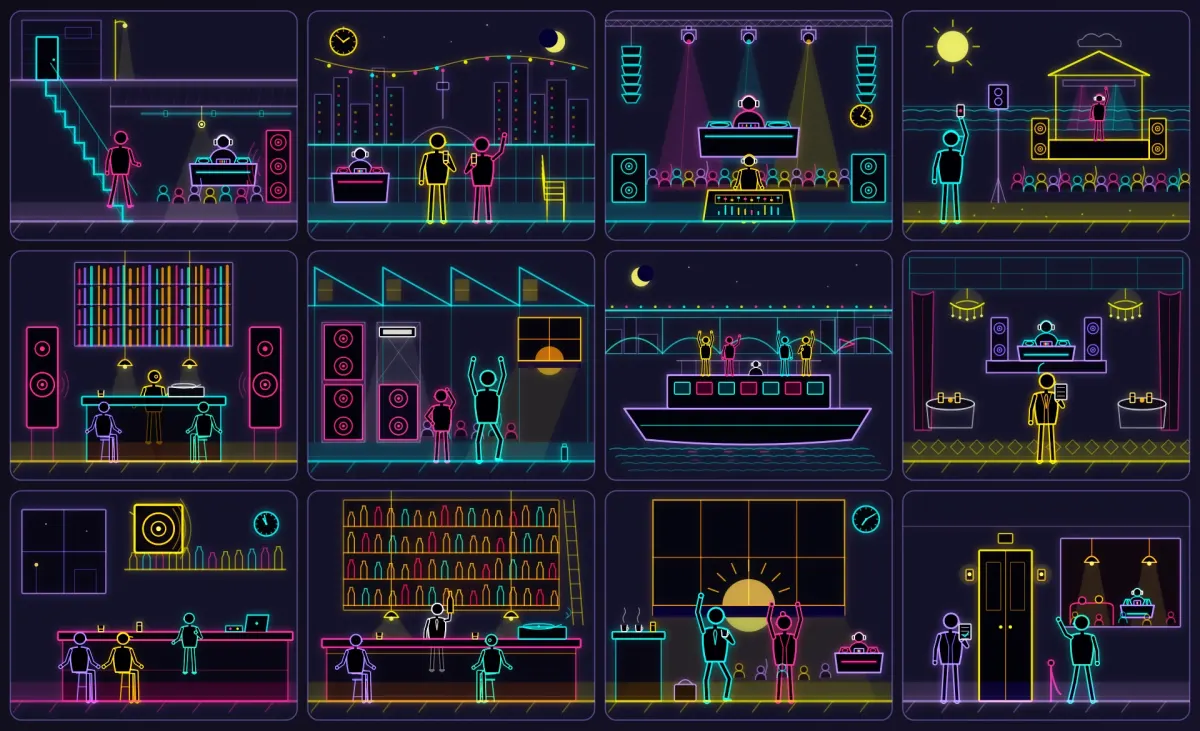
The twelve cover the full range of what counts as going out. A beach stage, a boat on the Han, a listening bar where nobody dances, a members room with a list instead of a queue, a morning rave that finishes before work. Underground and mainstream both appear, and neither is presented as the real thing. Each type comes with a criticism meant to sting a little. What people search for here is types of nightclubs. Below are the twelve.
The Unmarked Stair
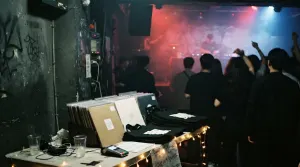
Venues sort into twelve types on six measures: how planned your night is, whether you follow the room or hold a line, how deep the listening goes, how fast you want the payoff, how social you are, and whether you look backwards or forwards. The Unmarked Stair sits at the small, dug, solitary end of that map. It’s a basement down concrete stairs behind a door with nothing written on it, holding somewhere between eighty and a hundred and forty people. The ceiling is low enough that the sub sits in your chest. The bar sells four things.
The trip is one district, six streets, three nights running until the door person nods at you. That takes weeks. A room this small runs on the goodwill of about forty people, and when three of them move away and two have children and one takes a job in another city, the whole thing goes quiet inside a season without anybody announcing it, which is why this type will spend a year insisting that a dead room is only having an off month. You’ll lose whole nights to a bad booking. You stay anyway. Secrecy isn’t a sound system.
How Do You Find A Club With No Sign?
Somebody tells you once and assumes you were listening. The rooms cluster, which helps: the Itaewon hill has several of them inside a ten minute walk. The walk down the hill between two of them is where most of what anybody knows about the city gets handed over. There’s no list to check.
Stereo in Montreal has kept the same room and the same system for decades. Sub Club in Glasgow has stayed a basement just as long, and Bassiani in Tbilisi sits under a football stadium.
Last Call Rooftop
No roof, and a close at two because the neighbours won. It opens while it’s still light. It fills by ten, peaks at half past midnight and is empty by twenty past two with the chairs stacked against the rail. The sound is a compromise, because outdoors always is. Half the crowd is there for each other rather than for the music, and the other half won’t say which half they’re in. The whole thing is built around the fact that it ends, which is what makes the last hour better than it has any right to be.
The trip is short, warm and social, and somebody else in the group booked it. That’s part of the appeal. The drawback is that this room will never hand you the thing that happens at four in the morning. You keep hearing about it secondhand, from people who look considerably worse than you do and had a better night, and you have started to suspect they’re not exaggerating. Rooftops collapse the moment the weather turns. Your way of going out has a season. The curfew does the editing.
Are Rooftop Clubs In Seoul Worth It?
Yes, for four hours, and the curfew is why. Noise rules in residential Yongsan and Hannam mean a rooftop finishes when it’s told to, which pushes everything worth staying for into the ninety minutes before close. The catch is what happens next, because two in the morning falls after the last train and well before the first one, so the queue for a taxi at the bottom of the hill is longer than the queue was at the door.
Hotel rooftop bars along the Han in Yongsan and Yeouido do the open air version with a skyline behind the booth. Summer rooftop parties on the Itaewon and Hannam hill fill by ten and empty by two. Piknic Electronik in Montreal runs the daylight version until the light goes, and Vancouver treats its nine weeks of patio season as an event. Le Bain at The Standard in New York is the format at full scale.
The Four Hundred
Four hundred capacity, a rig specified by somebody who cared, a booth you can work in and an engineer still there at four. The craft is visible here. Big enough that a build has somewhere to go, small enough that the DJ can see the back wall. Doors at eleven, headline at one, lights up at five. Most of the great sets you’ve heard happened in a room this size.
The trip is planned. Tickets bought, one flight, a bill looked up in advance, a hotel you can walk back to. The drawback is that there are nights when the booking is technically excellent, the room is full, the system is doing everything it was built to do, and nothing whatsoever is happening on the floor. You’ll defend the venue anyway, because the venue isn’t the thing that failed. Years go past like that. The rig wasn’t the night.
What Makes A Club Sound Good?
The room first, then the rig, then the booth. A treated four hundred capacity box beats a bigger room with more expensive speakers every time, which is why the same three or four Seoul venues keep coming up in this answer. Winter is the other half of it, because a coat check that moves quickly is a sound decision as much as a service one. A floor full of people holding parkas is a floor nobody dances on.
Coda in Toronto runs to a clear schedule, Smartbar in Chicago has done this properly for decades, and fabric in London gives you three rooms of it.
The Sand Stage
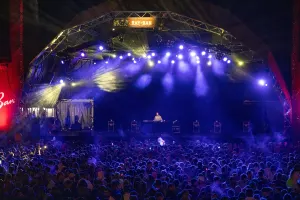
A stage on a beach, which is a room with no walls and therefore no acoustics worth defending. The sound scatters. The wind takes the top end and the sand ruins any attempt to dance properly. Fidelity was never the appeal. It’s daylight, a lot of people, a sea behind the stage and the particular unreality of hearing a kick drum at four in the afternoon.
The trip is a logistics problem you enjoy: a bus, a bag, a wristband, a room booked eight months early. The drawback is that you’re trading almost everything a room can give you for weather and scale, and if festivals are the only way you go out then you have heard most of your favourite artists from ninety metres back, through a delay tower, standing next to somebody filming the entire set on a phone held above their head. Sets get cut short. The sound was compromised before anyone touched a fader. You paid for weather.
Is A Beach Festival Worth The Trip?
Once a summer, and the queue decides it. Wristband exchange, shuttle buses and the walk back to the station are where the hours of a festival weekend go. The difference between a good one and a bad one is logistics rather than lineup. Book the room near the site before the lineup is announced, because the Korean beach towns fill through July whether there’s a festival on or not.
Ultra Korea does scale and daylight. World DJ Festival gives you a bus, a wristband, a field and a long queue you’ll describe for years. The beach stages at Haeundae in Busan put a sea behind the stage. Bass Coast and Shambhala in British Columbia treat discomfort as part of the ticket price, and Movement in Detroit puts the same idea on concrete.
The Listening Room
Thirty seats, one very good pair of speakers, a wall of records and somebody behind the counter who chooses everything. Nobody dances. The lights stay low, the drinks are slow and expensive, and there’s an unspoken ceiling on how loudly you may talk. Seoul has built more of these than almost anywhere, and the good ones are serious. A record gets played all the way through, at the volume it was cut for, and the person who put it on watches the room while it plays.
The trip is quiet and slightly solitary even in company. Two or three places in a night, on foot, home before the last train. The drawback is that this room gives you no chance at all of a floor going off at three in the morning. It also flatters a particular kind of person, because sitting very still in a dark bar with a good record on is easy to mistake for having been somewhere, and a room that won’t let you talk won’t let you be surprised either. Reverence is easy to fake.
What Happens In A Listening Bar?
Records get played in full and nobody dances. Thirty seats or fewer, one person choosing every one of them, and a volume set so that conversation is possible without being the point. In Seoul the format has a practical edge as well as a cultural one, because it lets you go out properly and still be home on the last train, which is the compromise the rest of the city refuses to make.
Kompakt Record Bar in Cheongdam has a serious wall of records and a house rule that the record gets finished. The listening bars of Seongsu and Hannam are strict about volume in exactly the way this type wants. Public Records in New York keeps a floor next door for the nights you admit you want one. Brilliant Corners in London runs the same idea for a bigger crowd, and Tokyo invented the format.
The All Night Warehouse
A big shell of a building with a temporary rig in it, doors at midnight and no fixed end. Concrete, cold air, one toilet block, a queue for water. The room only makes sense across its full length, because the first three hours are deliberately unremarkable and the payoff sits somewhere around six in the morning, once a third of the people have gone home and the ones left have stopped performing for each other. Nothing about it is comfortable. That’s structural.
The trip is one night and two days of recovery you didn’t budget for. The drawback is that the format asks for your entire body and returns something you can’t describe to anybody who wasn’t in the room, which makes you insufferable about it for roughly a week. A long night with a bad crowd is eleven hours standing in a cold building. You’ll still stay. Endurance isn’t taste.
What Time Do Warehouse Parties End?
They end when the room empties, not at a set hour. The trains stop shortly after midnight and start again around half past five, and that gap is the real closing time, because a floor that can’t leave without paying for a taxi tends to stay until it doesn’t have to. A warehouse night is built on exactly that arithmetic.
The old factory districts of Seongsu and Mullae are where the temporary rigs happen. Stereo in Montreal runs on one system and a crowd that arrives at three. Nowadays in New York runs long enough for the arc to finish, and Berghain in Berlin is the reference point for a night measured in hours.
The River Boat
A boat, which is a room you can’t walk out of. Two hundred people, a set departure, a set return, sound bouncing off water and a bridge going past the windows every few minutes. The Han runs these all summer and they’re better than they should be, precisely because nobody can drift off to the next place at half past midnight. The crowd fills earlier. It commits earlier.
The trip is booked, timed and slightly formal, with plans made for afterwards. The drawback is that you’ve paid to remove your own exit, and when a boat is wrong, which happens, you’re on the water for two hours with a hundred and ninety people you didn’t choose, watching the same bridge come round again. Novelty rooms age badly. The second boat is never the first.
Are Han River Boat Parties Any Good?
Better than they sound, for one summer at least. The fixed return time does the work a promoter usually has to do, because everybody boards at once and nobody is holding a second option open in another neighbourhood. Plan the end of the night before you board, since the piers put you a long walk from the main road at the exact hour the taxis are busiest.
Han River party cruises from the Yeouido and Jamsil piers are the format exactly. The riverside pop ups at Ttukseom and Banpo commit early because the last train decides the end. Lake Ontario cruises out of Toronto dock in time for after plans. Boat parties on the Hudson give you Manhattan going past instead of a bridge, and the Thames version has been running for thirty years.
The Ballroom Booking
A hotel ballroom on the third floor, patterned carpet, a ceiling designed for speeches and a rig brought in for the night. Six hundred people, half of them there because their company bought a table. The timings are on a run sheet. The room is judged on whether it ran smoothly rather than on whether anybody was transported, and it’s the most professionally executed nightlife in the country by a distance. Almost nobody writes about it.
The trip is organised by somebody else and comfortable in a way you’ve stopped apologising for. The drawback is that a room like this has no capacity for accident, and accidents are the entire reason people keep going back to worse rooms with worse sound and a queue in the rain. Nothing is left to chance. Nothing goes wrong. Nothing happens.
Why Do Hotel Ballrooms Book DJs?
Because a run sheet still needs somebody who can hit a cue. December is the season, when corporate year end parties take over the ballrooms in Jamsil and Gwanghwamun and the night is judged on whether the speeches finished on time. The hill is the other structural fact, because the big Seoul hotel ballrooms sit above the road, everybody arrives and leaves by car, and six hundred people looking for a taxi at midnight is the reason the run sheet ends when it does.
The Grand Hyatt in Hannam runs a hilltop ballroom with a run sheet and a finish time. The Lotte and Signiel ballrooms carry corporate year end season at full scale. The Fairmont Royal York in Toronto is the Canadian version, the Queen Elizabeth in Montreal does the same job in French, and the Marina Bay Sands ballrooms leave nothing to chance.
One Good Speaker
A neighbourhood bar with forty people in it and one speaker somebody spent real money on. No booth, just a laptop or a small pair of decks at the end of the counter. The volume tops out at conversation plus a bit. Half the room isn’t listening and the other half has been coming for six years. It’s the least glamorous room in this quiz and probably the one you’ll spend the most hours of your life in, because it’s open on a Tuesday.
The trip is a fifteen minute walk. Familiarity gives you what a visitor never gets, which is the staff, the room at every hour of the evening, and the ability to leave at eleven without feeling you wasted the night. The drawback is that nothing will ever astonish you in a room you have been inside four hundred times. Some of what you’re calling loyalty is the fact that going anywhere else in this city means a train, a transfer and a decision about how the night ends taken before the night has started. Loyalty is cheaper than a taxi.
Is A Local Bar Better Than A Club?
For most nights of the year, yes. The room you can reach on foot is the one you’ll use, and no train means no last train, which removes the decision that ruins the final hour of everything else in Seoul. The cost is that walking distance is a very small sample of a city with this many rooms in it.
The neighbourhood record bars in Haebangchon are forty people and a decent box in the corner. The small bars off the main strip in Yeonnam and Mangwon put a laptop at the end of the counter. Bar Raval in Toronto is built on regulars, Montreal runs on corner bars with one serious speaker, and Bar Part Time in San Francisco is the same room with better light.
The Whisky Bar
Twenty seats, most of them at the bar, and a back bar that took somebody a decade to build. A record player at the end of the counter, and a person behind it who will talk about the bottle and the record with equal seriousness and then leave you alone the moment you want them to. Open at seven, closed around two. Nothing in the room is louder than a conversation. This is nightlife at conversation volume, which is still nightlife.
The trip is four bars in one district and a hotel within a short walk of all of them. The drawback is that this room flatters knowledge and rewards staying seated. It’s entirely possible to spend a year in bars like this, learning a great deal about distilleries and pressings and the correct way to serve both, and come out of it having actually gone out about four times. You have priced yourself out of accident. Opinions aren’t a night.
What Is A Seoul Whisky Bar Like?
Small, seated and usually hidden above street level. The Euljiro and Gangnam versions are often up an old building with one slow lift and a hand written sign taped inside it, which filters a crowd as effectively as any door policy does. Once you’re in, the room runs on the bar rather than the floor, and the record player at the end of the counter puts it closer to a listening bar than to a club.
Charles H. at the Four Seasons has a serious back bar and a volume that lets you finish a sentence. The whisky rooms of Hannam and Cheongdam close at two. The old building bars up an Euljiro stairwell will play you a record if you ask. Bar Raval in Toronto treats the counter as the room. The Dead Rabbit in New York treats the bar as a stage, and Bar High Five in Tokyo is the reference point.
The Morning Rave
A floor that opens at six in the morning and closes at ten, because everybody in it has somewhere to be. Coffee and juice at the bar, no alcohol, and a crowd dressed for the office underneath the dancing. Capacity runs a hundred to three hundred, because these happen in cafes, rooftops and rented rooms rather than in clubs. Nobody is wrecked. Everybody is awake, and the energy is real precisely because a hard stop is attached to it.
The trip is a working week with a rave inside it. The drawback is that this format has removed the parts of nightlife that made it nightlife, which is the risk, the strangers, the lost hours and the version of yourself that only exists after midnight, and what’s left is fitness with a soundtrack, which you’ll defend anyway because you feel good on a Tuesday afternoon. Nothing has ever gone wrong.
Is A Morning Rave Actually Fun?
Yes, and the first train explains most of it. Getting to a six in the morning floor in Seoul means the same commute as a normal working day, on the same trains as everybody else, which is why the format caught on here faster than it did anywhere else. You dance for three hours and reach a desk before anyone notices.
The coffee raves in Seongsu are the format Seoul adopted fastest. Morning sessions near the office towers in Hannam and Yeouido are sober by design. Toronto runs downtown morning sessions with a streetcar to the office afterwards, Daybreaker in New York made this a format, and Morning Gloryville took it to London.
The Members Room
A door with no queue, because there’s a list. Sixty to a hundred and twenty people, a room that looks the same every week and is meant to, and prices that exist to keep it small. The DJ is booked for the regulars rather than for the flyer, and plays until the room decides it’s done. Everybody knows the door staff by name and the door staff know everybody, which is the whole mechanism. This is a club in the older sense: people who have agreed to keep seeing each other, with music attached.
The trip is built around introductions, and the visit turns on whether the person you messaged a week out replies. The drawback is that a room this closed is only ever as good as the people already inside it, and a room full of people who all know each other, all work in adjacent industries and all had roughly the same year goes stale in a way an open door never quite manages, which is a strange thing to have paid for, in money or in social capital. Nothing new can reach you. The list keeps things out.
Is A Members Club Worth The Money?
Only if you use it on a weekday. The value is the absence of the queue, and in a city where the good doors in Itaewon and Cheongdam can hold you outside for half an hour in February that’s worth more than it sounds. What you’re buying is a guaranteed average night, which is a real thing to want and a poor thing to want exclusively.
The members lounges of Cheongdam are small, expensive and unmarked. The invitation only rooms in Hannam open on a name rather than a queue. Soho House in Toronto runs the membership model at full scale. Zero Bond in New York is the older meaning of a club, and the members clubs of Mayfair have been doing this for two centuries.
Frequently Asked Questions
What Kind Of Club Should I Go To?
Start from how you travel, not from the lineup. The quiz scores six axes and returns one of twelve rooms, from a basement with no sign to a hotel ballroom with a run sheet, and most people are really choosing between two or three of them. The Sand Stage is built into the quiz as the most common result, at about fourteen percent, which says more about how people are used to going out than about what actually suits them.
What Are The Best Clubs In Seoul For My Type?
It depends which of the twelve you land on, and Seoul has a clear room for each. The Unmarked Stair points at the Hapjeong and Itaewon basements, The Four Hundred at the mid size clubs with a proper rig, The Listening Room at the Seongsu and Hannam audio bars, and The Ballroom Booking at the hotels in Jamsil and Hannam. The neighbourhood guide to going out in Seoul has the geography.
What Is A Listening Bar?
A small bar built around a serious sound system, where records are played in full and nobody dances. Thirty seats, one person choosing the music, and a volume low enough for conversation and high enough that conversation isn’t the point. Seoul has built more of them than almost any other city, and The Listening Room is eight percent of results here.
What Time Do Seoul Clubs Close?
There’s no single closing time, and the trains matter more than the licence does. Rooftops and neighbourhood bars finish around two, club floors in Itaewon and Hongdae commonly run to five or six, and the all night rooms simply stop when the room empties. The last trains go shortly after midnight and the first ones from about half past five, which is the gap most of Seoul nightlife is shaped around.
Is There A Best Venue Type?
No, and a quiz that names one is flattering you. The Sand Stage is built into the quiz as the most common result, at about fourteen percent and Last Call Rooftop the rarest at four, and neither number is a ranking. Every one of the twelve carries a criticism for the same reason: the room that suits you exactly is also the room that hides something from you.
Can You Like More Than One Venue Type?
Yes, and almost everybody does. Every result gives a primary type and two secondaries with percentages, because six axes rarely settle cleanly into one corner. The common pairs are obvious once you see them, such as The Unmarked Stair with The All Night Warehouse, at thirteen and ten percent, or The Whisky Bar with The Listening Room, at five and eight.
Where To Go Next
Twelve rooms, six axes, and no correct answer. A basement with no sign and a carpeted ballroom are both in here on purpose, because most people who claim only one of them is real have spent very little time in the other. For the scored version, take the Venue and Trip quiz.
This is the fourth of five. The DJ types, the clubber types and the eras are already up, and the festivals close it out. Take the venue quiz if you haven’t, then the festival quiz, which asks whether the room you want survives being moved outdoors.
Every archetype across every quiz is collected at The Types, and the rest are at Quizzes. For a night out in Seoul, start with the neighbourhood guide to going out in Seoul.
The DJ Diaries is written by a Canadian DJ living in Seoul. About // Book a DJ
Stay in the Loop
New writing on DJ culture, electronic music, and the Seoul underground, delivered when it matters.
More From The DJ Diaries


Play with the history
Four tools built from the same research as this site.