At half past one on a Saturday in an Itaewon basement, the DJ playing next is standing at the back with a drink she hasn’t touched. She knows her first record. Whether she knows her second is the whole question. Some DJs decided the answer three days ago at their kitchen table. Others will decide it in the four minutes before they touch the mixer, from something in the room that hasn’t happened yet. Both are real ways to do this. Neither is the honest one. Twelve types follow.
Before you read on
Which of the twelve DJs are you?
It takes a few minutes. No sign up and no email. Every result comes with the reasoning behind it.
Get your result, then read the full write up below.
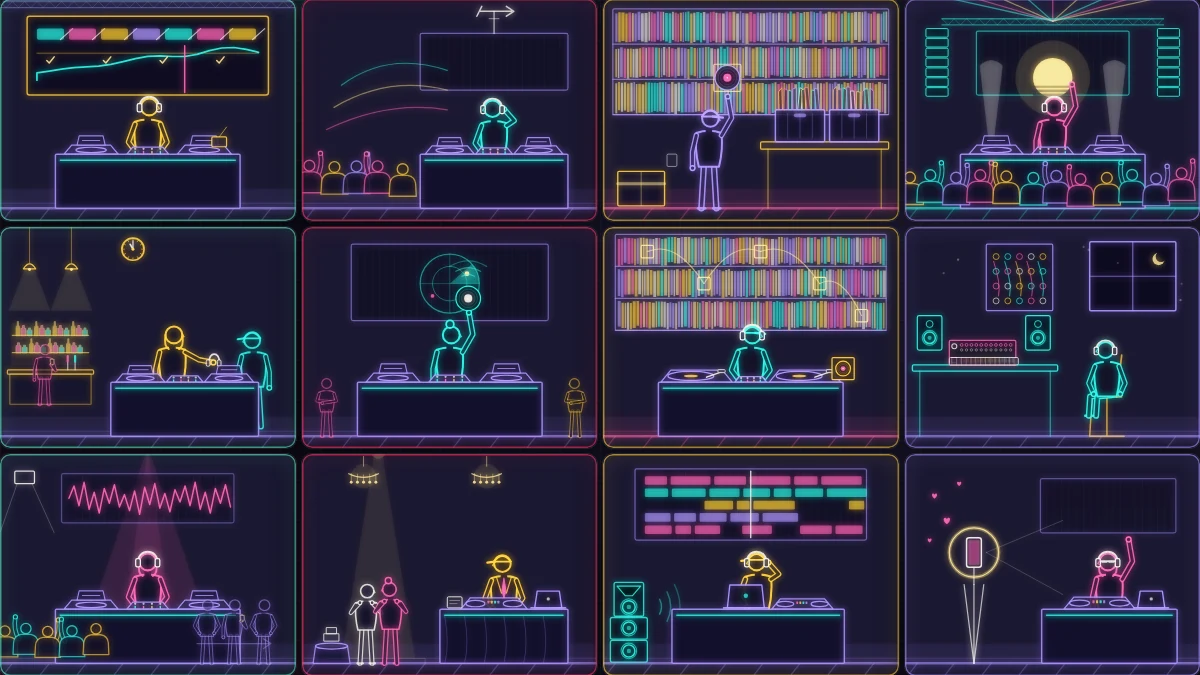
The DJ Type quiz sorts people into twelve archetypes on the basis of behaviour rather than genre. It asks what you do when the CDJ fails, what you notice first walking into a room, who you speak to at the bar and what you quietly refuse to play, because those are the things that separate one DJ from another.
Six hidden axes do the sorting. Control runs from Improvised to Planned. Allegiance runs from Reads Room to Holds Line, which is whether you serve the floor or serve your own idea. Depth runs from Canonical to Dug. Patience runs from Slow Build to Wants Peaks. Social runs from Solitary to Communal. Time runs from Reverent to Futurist. Where those six numbers settle is your result.
None of the twelve is ranked above the others. A wedding DJ working a Jamsil ballroom and a techno resident in an Itaewon basement are both in here, and neither is treated as the real one.
Every type also carries a real criticism, because a description that only flatters you is no use to anybody. The plain question behind this page is what kind of DJ am I. Here’s the answer, twelve ways.
The Blueprint
What kind of DJ you are comes down to six things: how much you plan, whether you serve the floor or your own idea, how deep you dig, how quickly you want the peak, how social you are, and whether you face backwards or forwards. The Blueprint sits at the far planned end of the first one. This is the DJ who doesn’t walk into a room to find out what happens, but to execute something already heard at home. The transitions aren’t lucky. The endings arrive on purpose. When the CDJ fails, the fix was thought about weeks ago, which is why nobody in the room learns it failed.
The cost is that The Blueprint isn’t listening. It checks the room against a model of the room, and when the two disagree it trusts the model. Everybody has watched a Blueprint play the correct record into a floor that moved on ten minutes earlier and stay with it, because moving would mean admitting the plan was wrong.
How Do You Know If You Are The Blueprint?
You wrote the set down. If your last three gigs had a running order that existed before you left the house, and you can still find those files, this is you. In Seoul the tell is smaller than that: a Blueprint knows what time the last Line 6 train goes, because leaving was planned along with everything else. For the record, the last Line 6 trains leave Itaewon at about 00:48 on weekdays and about 23:59 on weekends and holidays; check Kakao Metro on the night, because holiday timetables change.
You find it at Stereo in Montreal, Berghain in Berlin and Bassiani in Tbilisi.
The Weathervane
No plan, and no need for one. The Weathervane starts with whatever the last DJ left in the air and works from there, can feel a room turn about forty seconds before it turns, and has a physical, faintly irritated reaction to a floor being ignored. Promoters like it because it has never once emptied a room, and other DJs envy the fact that it can be handed any slot in any city, with no information, and be fine.
Responsiveness is also a way of never being on the hook. Ask what a Weathervane night sounded like a week later and nobody can tell you, including the Weathervane, because it was assembled out of other people's signals. Years of being extremely good at something that leaves no trace, and one question left unanswered: what would this DJ play if nobody reacted at all.
What Does A Weathervane Actually Prepare?
Almost nothing, and that’s the skill rather than the laziness. Itaewon rewards it more than most cities do, because the hill delivers a different crowd every ninety minutes and a room that was Korean office workers at eleven is half tourists by one.
Its rooms are the ones that change under you. Coda in Toronto hands you nothing and expects you to cope. Sub Club in Glasgow tells you what it wants in real time. fabric in London gives you three rooms of people who arrived from somewhere else.
The Digger
The set is the receipt. The real work happened alone, over months, in listings and back catalogues and with one seller in Busan who ships slowly. The Digger owns records that about forty people worldwide own, knows why each of them matters, and isn’t remotely interested in whether the floor knows. The crate is the argument.
The cost is that rarity has become a value judgement. The Digger has played a worse record over a better one because the better one was obvious, then told itself the room deserved the challenge, which is a flattering way of saying it wanted credit. Rarity isn’t quality. Depth isn’t a substitute for a set that goes somewhere, and there are nights when the crate was more interesting than the night.
Is Digging Still Worth It In 2026?
Yes, but not for the reason most Diggers give. The value is the sequencing knowledge that comes with the records, not the scarcity. A Sunday afternoon spent in the remaining Hongdae record shops teaches you what an hour of algorithmic recommendations can’t, which is what a record was made to sit next to.
Nowadays in New York has a floor that wants what you found. Marble Bar in Detroit treats the crate as the argument. Panorama Bar in Berlin is where a record forty people own stops six hundred.
The Closer
Built for the hour everyone else is scared of. The Closer wants the peak and isn’t embarrassed about it, has a physical instinct for the moment a room is ready, and no patience at all for the twenty minutes before it. Big, known, unimprovable records, placed with real precision at the exact point the floor will take them. Most of the DJs who sneer at it can’t do it.
What The Closer is worse at is the part with no reward in it. Warm up rooms bore it and it shows within three records, so this type takes the slots that flatter it and avoids the ones that would teach it something. The warm up teaches. It also spends big too early, so the night peaks at ninety minutes and has nowhere left to stand.
What Time Does A Closer Actually Want?
Two in the morning, and in Seoul that’s a real constraint rather than a preference. The trains have stopped, so nobody in the room is leaving for another three hours whatever you play, and that’s the only crowd a Closer fully trusts.
Coda in Toronto wants to be lifted and doesn’t care how. Womb in Tokyo was designed for this moment. Bassiani in Tbilisi meets the peak halfway.
The Glue
The type that would rather the night was good than that it was. The Glue takes the warm up and means it, and knows who is at the bar, who is having a bad month, which promoter is about to lose money and which door person hasn’t eaten. It will hand the booth over at the moment things get good and still be there at close. Scenes are held together by about four people per city, and this is usually one of them.
The uncomfortable part is that being useful is easier than being exposed. The Glue has turned down slots it wanted by pre emptively offering them to somebody else, then felt aggrieved about it later, which is unfair to the person who took them. Generosity that quietly keeps score isn’t generosity. At some point the scene moves on, because it was never given anything with a name on it to remember. Nobody knows to say thanks.
Why Does Every Scene Need A Glue?
Because somebody has to do the work that has no name on it. In Seoul you can identify The Glue at about four in the morning, in the convenience store outside the club, buying food for the door staff with their own money.
Smartbar in Chicago is built on residents rather than headliners. Sub Club in Glasgow would notice if you were missing. Stereo in Montreal only works because a few people keep showing up early and staying late.
The Antenna
Hears things early and is right often enough that people have stopped arguing. Half the bag is unreleased, sent by producers who trust these ears, and it gets played into rooms that aren’t quite ready on the correct assumption that they will be. The Antenna has been the first DJ in its city to play four or five records that later became normal. Nobody remembers that, which is fine, because it had already moved on.
The failure mode is that novelty is a much lower bar than quality. A record being new resolves an argument in this DJ's head that a record being good would have to actually win. Things get discarded at eight weeks that deserved a year, there’s no canon to fall back on when the new material is thin, and floors have been made to work quite hard for tracks that were interesting rather than finished, sent over at two in the morning by a producer who hasn’t slept, played at four to a room that was ready for something else entirely and would have told you so if anybody had asked.
How Early Is Too Early?
About two years, which is roughly the gap between a Seoul Community Radio broadcast and the same record turning up in a Gangnam club. An Antenna who is consistently further ahead than that isn’t early, it’s playing to itself.
Nowadays in New York has already heard the next thing. Elsewhere has rooms of different sizes, so a record too early for one has somewhere else to go. fabric in London expects something it can’t name.
The Long Memory
Nothing in the bag is unattached. The Long Memory knows the label, the year, the room a record was made for and the three records it’s arguing with, and that knowledge changes the sequencing, not just the small talk. It’s patient, and will spend fifty minutes setting up something that pays off once, in front of four people who were following it, which is either the purest thing anyone does in this job or an elaborate way of playing to nobody, and The Long Memory has never been fully sure which.
The problem is that history has become an argument that can’t be lost. When something new fails to move this DJ, it reaches for lineage instead of for a reason. A twenty year old record isn’t automatically better than a twenty week old one, only safer. There are younger DJs in the same city doing something The Long Memory has never bothered to understand, and it has described them in terms that were about protecting its own position. Age isn’t an argument.
Does Knowing The History Make You A Better DJ?
Only where it changes the running order. The Euljiro listening bars are the test, because there you’re twenty seats from people who can hear whether the sequence is an argument or a lecture, and the printing district outside stays open later than the bar does.
A listening bar in Euljiro gives you twenty seats and a system where a fifty minute setup pays off for the four people following it. Smartbar in Chicago knows where every record came from. Marble Bar in Detroit treats history as a live thing rather than a museum.
The Bunker
A rare result. One of the most prepared people in any room and one of the least present. The work happens alone, at home, over long stretches, on equipment this DJ has opinions about, and it’s aimed at where the music is going rather than where it has been. Alone, mostly. It’s patient to an unreasonable degree, will sit on an idea for a year, doesn’t want the drink afterwards and has never posted about a gig.
Music is made of rooms, and this type keeps trying to do it without them. It’s demonstrably better than DJs getting four times the work, and it has decided that this is a comment on the scene rather than on itself, which is convenient and half true. One cost of refusing the social part is that the people who could use what this DJ does have no way of finding out it exists. The work stays in the room.
Can A Bunker Build A Career Without The Scene?
Rarely, and Seoul makes it harder than most cities. Bookings here move through the residents and the promoters who drink together in Hapjeong after close, and a DJ who goes straight home is invisible to that whole channel however good the sets are.
A Detroit warehouse afterhours keeps the DJ off the poster. Berghain makes disinterest read as discipline.
The Hard Left
The other rare one. Complete improvisation with no concessions, which is a combination most people can’t hold, because improvising usually comes with a desire to please. Not here. The Hard Left arrives with no order, decides everything live, and what it decides is frequently the opposite of what the floor is asking for. When it lands, it’s the best thing anyone in that room hears all year, and everyone present knows it.
When it doesn’t land, and it often doesn’t, there’s no mechanism for noticing in time. This DJ has read a room correctly, disliked what it read, gone the other way on principle, then explained afterwards that they weren’t ready. Sometimes that’s true. Often it was bored and made that the room's problem. Boredom isn’t integrity. It’s also hard to book twice, and it has spent years calling that a compliment.
Where Can A Hard Left Actually Play?
Rooms small enough that a bad twenty minutes costs the promoter nothing. Seoul has more of these than its reputation suggests, because a basement holding eighty people can afford a risk that a Gangnam room holding eight hundred can’t.
Elsewhere in New York treats a hard turn as the reason people came. Nowadays runs long enough for a wrong turn to become the right one.
The Function
Weddings, corporate year end parties, hotel bars, a brand launch in a Seongsu warehouse where nobody looks at the booth. The Function is the most employed DJ in the quiz and the least written about. The client sends a list, a don’t play list and a running order with speeches in it, and all three get delivered to the minute, on a system somebody else specified. The first dance is the job, the last hour is the reward, and the payment lands before you leave. Nobody claps. Nobody has to.
The cost is that this DJ has stopped having taste in public. Twenty years of playing the record the brief asked for leaves you unsure what you would play if nobody was paying, and the last open floor at midnight got played safe out of habit and called professionalism. There’s a quiet contempt for club DJs earning a fifth as much, and a quieter envy that somebody remembers them. The invoice clears either way.
Does The Function Make More Money Than Club DJs?
Considerably, and in Seoul the gap is widest in December, when corporate year end season books out the Jamsil and Gwanghwamun ballrooms and a single night pays what a month of club residencies does. Conference work adds a second season: by the Union of International Associations count, Seoul hosted the third most international meetings of any city in 2025, after Vienna and Brussels (SBS Biz, Korean).
Charles H. in Gwanghwamun is a hotel bar with a brief, a dress code and a bill. The Signiel Seoul ballrooms in Jamsil are where corporate year end season lives. Pop ups in Seongsu warehouses make the client the audience. Elsewhere: the Fairmont Royal York in Toronto, a wedding in Montreal's Old Port, a Las Vegas pool party where the rider is followed to the letter.
The Producer Behind the Decks
This DJ makes records, and the set is where it finds out whether they work. Most of what gets played is its own, half of it unfinished, and it’s listening to the low end of its own bounce rather than to the room. The sets have a coherence nobody else can fake, because every record was made by the same pair of ears. When the material is good, the room hears something it won’t hear anywhere else for a year. That’s not nothing.
The problem is treating six hundred people as a monitoring environment. The new version, then the other new version, and the floor sits through an A and B test it didn’t agree to. This type stopped buying other people's records, so the sets have no argument except its own, and a thin patch in the studio is a thin patch on the floor. It’s also the DJ most likely to call a flat room a good test.
Should Producers DJ Their Own Material?
Yes, in the right room, and the constraint in Seoul is architectural rather than artistic. Most home studios here are apartments with neighbours, so the first time a producer hears their own low end properly is on a club system, which is exactly why the set becomes the test.
Nowadays books producers as DJs on purpose. Womb in Tokyo was tuned by people who make records, for people who make records.
The Content DJ
The camera is set before the monitor is. This DJ knows where the light falls, which side of the mixer reads better in a vertical frame, and exactly which sixty seconds of the next two hours will be the post. It’s real skill and it pays, in followers that become bookings that become flights. It’s also the reason a nineteen year old in Daegu heard the record at all. The audience is bigger than any club in Seoul, and it’s watching from a bus on the way to work, at four times speed, with the sound off.
The cost is that the room has become an extra. A transition gets restarted because the first take wasn’t clean. The drop that clips well beats the record that would have worked. The set ends on the moment the camera wanted. When a video doesn’t land, this DJ feels it more than any room going flat, which shows where the audience is. The floor became the set dressing.
Is Being A Content DJ A Real Career?
It’s the most reliable one in the quiz, and Seoul is unusually good at it. A Hannam rooftop puts the whole skyline behind the booth for free, which is a production value that costs five figures anywhere else, and it’s why so many Korean DJ clips look like they had a budget.
A Hannam rooftop puts the skyline behind the booth. Rebel in Toronto looks the same on a phone as from the floor. Omnia in Las Vegas admits the clip is the product.
Which Type Actually Gets Respect
Twelve types, and the scene doesn’t weigh them equally. It pretends to. Everyone says a good DJ is a good DJ, and then everyone goes on booking the same three kinds of person for the rooms that pay.
Here’s what’s going on, after more than twenty years of watching it from inside the booth. Technical knowledge counts, but only when it’s in service of something. A Long Memory who can trace a record back through four reissues is valuable because that knowledge shapes what comes next, not because the knowledge itself is impressive. The same person reciting the lineage at the bar while the floor thins out isn’t doing the job.
Production credits count, but only when the records sound like someone. A Producer Behind the Decks with two tracks that sound like nobody else gets further than one with forty that sound like everybody else. Follower counts matter least of all, and every promoter I know says so privately and books on them anyway, because a full room is a full room.
What sits above all of it is hard to say without sounding like a fortune cookie, so I’ll say it plainly. DJing is a service job. You’re not the point. The room is the point. The types that last are the ones whose decisions all face outward, at the floor, at the night, at the person who came alone and needs a reason to stay. The types that struggle are the ones whose decisions face inward, at their own collection, their own reputation, their own feed.
None of the twelve is disqualified by this. A Bunker can be entirely outward facing inside a room of forty people. A Content DJ can be pointed at the floor and at the camera at once, and the good ones are. Type matters less than which direction your decisions face.
Frequently Asked Questions
What Kind Of DJ Am I?
You’re one of twelve behavioural types, and which one depends on six things: how much you plan, whether you serve the floor or your own idea, how deep you dig, how fast you want the peak, how social you are and whether you face backwards or forwards. Genre doesn’t come into it. The DJ Type quiz scores all six in thirty six questions.
How Many Types Of DJ Are There?
Twelve in this system, sorted on six hidden axes rather than on the two or four most personality quizzes use. Twelve is enough to separate a wedding DJ from a warm up resident without producing sixteen results that read the same.
Is There A Best DJ Type?
No, and any quiz that gives you one is selling flattery. The Function earns the most, The Antenna is right the earliest, The Glue holds the scene together and The Hard Left produces the single best night of the year and four bad ones. Each of the twelve carries a real criticism here for that reason.
What Is The Rarest DJ Type?
The Bunker and The Hard Left, each landing under eight percent of results, because both require holding two traits that usually cancel each other out. The Weathervane is the most common at around fourteen percent.
Can You Be More Than One DJ Type?
Yes, and most people are. Every result gives a primary type and two secondaries with percentages, because six axes rarely settle cleanly into one corner. Reading your two secondaries is usually more useful than reading your primary.
Do DJ Types Change Over Time?
They do, and the usual direction is from improvised toward planned as the bookings get bigger and the cost of a bad night rises. Diggers become Long Memories. Weathervanes become Blueprints once somebody is paying for a flight.
Where To Go Next
Twelve types, six axes, no correct answer. Most people read two or three of these and recognise themselves in the criticism before the compliment, which is how it was built. For the version that scores you, take the DJ Type quiz. Thirty six questions, most of them not about music.
There are four more of these, one a week. The clubber quiz asks the same six questions of the person on the floor rather than the person behind the decks. The era quiz puts you somewhere between the Paradise Garage and the algorithm. The venue quiz works out the room you actually want, and the festival quiz works out whether you belong at the main stage or in the trees. Same six axes, four different rooms.
The full archetype directory for every quiz lives at The Types, and the rest are at Quizzes. For a night out here, the neighbourhood guide to going out in Seoul says how to get there.
The DJ Diaries is written by a Canadian DJ living in Seoul. About // Book a DJ
Stay in the Loop
New writing on DJ culture, electronic music, and the Seoul underground, delivered when it matters.
More From The DJ Diaries



Play with the history
Four tools built from the same research as this site.