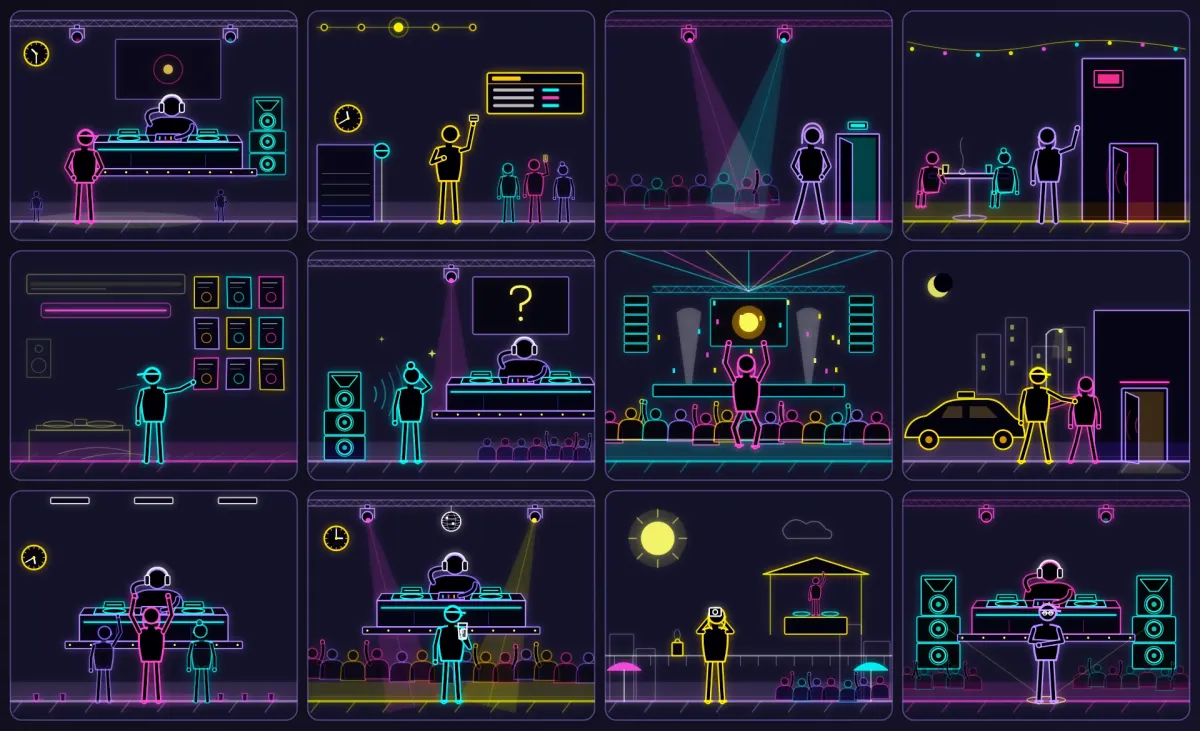
At half past midnight on a Saturday in an Itaewon basement, two people come down the same stairs about forty seconds apart. The first has four friends behind her, the set times screenshotted, and a plan for where everybody eats afterwards. The second told nobody he was coming, won’t speak to anyone before the lights come up, and has already found the spot by the left stack where the sound is honest. They will be in the same room for five hours. Only one has anything to lose. That’s the whole quiz.
Before you read on
Which of the twelve clubbers are you?
It takes a few minutes. No sign up and no email. Every result comes with the reasoning behind it.
Get your result, then read the full write up below.
The Clubber Type quiz sorts people by behaviour in a room they didn’t build: how they arrive, where they stand, who they came with, when they leave and what they’re there for. Twelve results, and none of them is the flattering one.
Six hidden axes carry the scoring. Control runs from Improvised to Planned, which here is the difference between turning up and running the evening. Allegiance runs from Reads Room to Holds Line. Depth runs from Canonical to Dug. Patience runs from Slow Build to Wants Peaks, meaning whether you came for the arc or the drop. Social runs from Solitary to Communal. Time runs from Reverent to Futurist.
The twelve aren’t a hierarchy, and they’re not a taste test. Somebody at the front of a Gangnam main room and somebody sitting quietly in an Euljiro record bar can score close together, because the quiz is measuring conduct rather than genre. The sober clubber, the day party regular and the fifty year old who never stopped are all in here. So are the people who arrive at one and go straight to the front.
Each type gets a compliment and a criticism, and the criticism is the useful half. What people search for is types of clubbers, or which kind of clubber am I. Below are the twelve, with the kinds of rooms where each one makes the most sense.
The Early Shift
Clubbers sort into twelve types on six measures: how much you plan the night, whether you follow the room or your own line, how deep your listening goes, how fast you want the payoff, how social you are, and whether you face backwards or forwards. The Early Shift is the type that arrives when the doors open and the floor is still eight people wide. It likes hearing a room get built one record at a time and has real respect for whoever is doing the building. By the time the night is officially good, it has already had the best two hours of it.
The cost is being gone before anything is at stake. This type holds firm opinions about nights it only saw the first half of, and has called sets overrated that it didn’t stay for. There’s also some self flattery in leaving early, a way of standing above the part everyone else came for, and it has described a floor as shallow at an hour when the floor was still forty people who hadn’t finished their first drink. Leaving early isn’t taste.
What Time Should You Get To A Club?
Earlier than you think, and in Seoul earlier is unusually cheap, because the subway is still running when the doors open and the first hour asks nothing of you except the cover. A room tells the truth about itself before it’s full. Bring a passport or other photo ID even at doors: Korean clubs admit adults only. Korean rooms fill late even by club standards, so the first two hours are empty rather than merely quiet, and you can hear the system, the residents and the booking policy in one go.
Coda in Toronto books its openers seriously, and Smartbar in Chicago hands the early set to somebody who has been building that floor for years.
Who to bring, if you’re The Early Shift
Go out with
They’re on the floor at eleven too, and they leave the minute it stops being good, so nobody has to negotiate the exit.
Date night
You arrive at doors, they stay for the lights, and between you the whole night gets heard. Agree on the handover time in advance.
Maybe not the same night
By the time they walk in at one, you’re putting your coat on. Nobody is wrong, you’re simply attending two different nights.
Your trip
Toronto and The Air House
Coda books its openers seriously, and The Air House on Nami Island added forest runs in 2026, which may be the most Early Shift sentence in the Festival Atlas.
Keep going
The DJ quiz might show whether you would be the one building the room you like arriving to.
Not sure this is you? The Clubber Type quiz takes a few minutes, and the result comes with your own pairings to compare with a friend.
The Human Itinerary
Holds the tickets, the set times, the last train and the name of the second place. Left alone the group wouldn’t get out of the first bar, and this type knows it. Not bossy about it, just unable to watch a plan die of indecision. Nights happen because The Human Itinerary makes them happen, and nobody says thanks.
The problem is managing the night instead of being in it. This is the person checking the time during the best record of the evening. There’s also a kind of control in it that it would never call control, because when somebody changes the plan it registers as a small betrayal, which is a lot to ask of people who only wanted to go dancing. The plan isn’t the night.
Why Does Every Group Need A Planner?
Because somebody has to decide before midnight. In Seoul that’s a real deadline rather than a preference, since the last train goes at around that hour, and a group that hasn’t chosen by half past eleven has quietly chosen to stay out until the first train. It’s also the person who knows that Hongdae to Itaewon after the trains stop is a taxi at surge, not a walk. The fallback is Seoul’s N-numbered owl buses (Korean), 14 routes running 23:10 to 06:00 for a ₩2,500 base fare, though none stops at Itaewon Station itself, so check Naver Map or Kakao Map before relying on one. The planner is the person who says that out loud.
Stereo in Montreal depends on somebody having thought about water and the way home, and Nowadays in New York has enough moving parts that a group without a planner spends the evening in the garden.
Who to bring, if you’re The Human Itinerary
Go out with
Two planners, one calendar. They already know the last train, so for once the phone can stay in your pocket during the best record.
Date night
You handle the tickets and the timing, they handle the part where you both lose it at the front. It’s the only way you’ll reach a peak without checking the time.
Maybe not the same night
You made a group chat. The Ghost has already left, alone, without reading it. Nobody did anything wrong, you’ll just never stand at the same meeting point.
Your trip
New York and Amsterdam Dance Event
Nowadays runs indoor and outdoor from day into night, and ADE fits more than 1,000 events into five days. Somebody has to hold that plan, and it was always going to be you.
Keep going
The venue and trip quiz can work out where the next itinerary should actually go.
Not sure this is you? The Clubber Type quiz takes a few minutes, and the result comes with your own pairings to compare with a friend.
The Ghost
Goes out alone far more often than it admits. No arrival photo, no plan to meet anybody, no goodbye. Not unfriendly in the room. It will nod at people all night, but the night is a private thing and everyone else is weather inside it.
What that protects against is compromise. What it costs is other people. The Ghost has built a way of going out where nobody can let it down, because nobody was expected. That reads as independence and is sometimes just avoidance. The scenes it says it cares about are made out of precisely the obligations it keeps sliding out of. Independence isn’t the word.
Is It Weird To Go Clubbing Alone?
No, and in most rooms nobody registers it at all. The walk up the Itaewon hill from the station does half the work, because everybody arrives strung out in ones and twos regardless of who they came with, so by the door there’s no such thing as a solo arrival. Seoul helps as well, because eating alone and drinking alone stopped being remarkable here years ago. The room sorts itself out in a minute.
Berghain in Berlin is the one club on earth where going alone is closer to the rule than the exception, and Stereo in Montreal has a crowd too far inside the music to notice.
Who to bring, if you’re The Ghost
Go out with
They also arrive without an entourage and never ask for a recap afterwards. A nod across the floor at midnight counts as a great night together.
Date night
Stand near the speaker and let them tell you what the room used to be. You get company without a schedule, and they finally get someone who hears the whole story.
Maybe not the same night
They want a meeting point, a group photo and a text when you get home. You want none of those things, and they will worry about you all night, kindly.
Your trip
Berlin and Awakenings
Berlin is the city where arriving alone is closer to the rule, and Awakenings books almost nothing but techno, so the crowd is too busy listening to notice who came alone.
Keep going
The venue and trip quiz may name the room you would happily walk into alone.
Not sure this is you? The Clubber Type quiz takes a few minutes, and the result comes with your own pairings to compare with a friend.
The Outside Table
Half the night happens by the door, on the stairs, at the table where people cycle through. This type knows everyone, introduces everyone, and the reason it came out is sitting on those steps rather than standing on the floor. Rooms are better when it’s in them and people mean it when they say so.
But it talks through music it would love if it actually heard it. It has been outside for the best forty minutes of more than one night. It also treats the floor as background for a conversation, which is a fine way to live and an unfair thing to do to a room somebody spent months booking, paid a deposit on and filled with a sound system that four people are now standing in front of with their backs to it. The floor isn’t background.
Is It Rude To Talk During A DJ Set?
Not outside the room, which is where this belongs anyway. Seoul solves it better than most cities, because there’s a convenience store within sight of almost every venue, with plastic stools on the pavement. In Hongdae the pavement outside is busier than some of the rooms. The queue there at three in the morning is its own event. Inside, in front of the stacks, it’s rude.
The garden at Nowadays in New York is the best conversation space in the city, and Club der Visionaere in Berlin was built for people who came to talk with music nearby.
Who to bring, if you’re The Outside Table
Go out with
They will follow you out to the stairs and stay an hour without once asking about the headliner. The easiest night either of you’ll have.
Date night
A day party at a volume where you can hear each other, in good light, finished before anyone gets tired. You get the conversation, they get home by ten.
Maybe not the same night
You want to introduce them to six people. They came specifically to meet nobody. Wave from the stairs and let them drift back inside.
Your trip
Berlin and Glastonbury Festival
Club der Visionaere is a canal deck for people who came to talk with music nearby, and at Glastonbury the dance areas are corners of a roughly 900 acre site, so the best conversations happen walking between them.
Keep going
The venue and trip quiz can tell you which room has the best stairs for your kind of night.
Not sure this is you? The Clubber Type quiz takes a few minutes, and the result comes with your own pairings to compare with a friend.
The Long Memory
Can date a venue by its floor. Remembers the night it changed hands, who left, what closed and what took the space, and carries all of it around without being asked. When somebody talks about a room as though it appeared last year, this type feels the gap and usually fills it.
It uses the past as a way of not having to be impressed by the present. That makes it tiring company for anyone who arrived later. Part of what it’s defending isn’t the history at all, it’s the version of itself that was there, and those two things are worth different amounts to everybody else. The past can’t lose.
Why Do Clubs Close So Quickly In Seoul?
Rent, mostly, and short leases underneath it. Seoul rebuilds a block faster than anybody writes down what was on it. A basement in Hapjeong can be a club for six years and a coffee shop by the following spring, with no plaque, no archive and nothing left but the people who stood on that floor, which is why a type that remembers is doing unpaid infrastructure work rather than showing off. Somebody has to hold the receipts.
The older bars in Euljiro are the closest Seoul gets to rooms that remember. Smartbar in Chicago has been open since 1982 in the city that started the thing, and Sub Club in Glasgow has spent nearly four decades in one basement.
Who to bring, if you’re The Long Memory
Go out with
They were there for most of the eras you like to explain, so nobody needs the backstory and the two of you can simply argue about the dates.
Date night
They listen, they don’t interrupt, and they never ask what the room is called now. You get to tell the whole history, and they get company that doesn’t want a group photo.
Maybe not the same night
You want to tell them what this room was in 2012. They want the drop, right now, at the front. The history can wait for brunch.
Your trip
Chicago and Movement
Smartbar has been open since 1982 in the city that started house, and Movement began in 2000 as a free festival on the Detroit riverfront with Carl Craig as artistic director. A lineage trip, the only kind you take.
Keep going
The era quiz can tell you which decade you’re really defending, and it might surprise you.
Not sure this is you? The Clubber Type quiz takes a few minutes, and the result comes with your own pairings to compare with a friend.
The First Listen
Goes out to be surprised. Takes an unknown lineup over a safe one, a first show over a return, a room it has never been inside over the one that reliably works. Familiarity reads as a slow leak, and this type tends to move before it starts.
The cost is never staying anywhere long enough to belong to it. Scenes get built by the people who came back on the boring weeks. The First Listen is always somewhere newer when that work is being done. There’s also a quiet snobbery in going cold on something at exactly the point other people find it. Novelty wears out first.
How Do You Find New Clubs And Parties?
Follow buildings rather than brands. The printing district in Euljiro is the clearest example, because the workshops shut in the early evening and something opens behind the same shutter a few hours later. Seongsu does the same thing at warehouse scale. The address you were given last year isn’t the address anybody is using now. Ask who is renting, not who is playing.
The pop up spaces in Seongsu change every season, which is the only pace this type finds tolerable. Elsewhere in New York moves faster than its own crowd, and Womb in Tokyo rotates first Japan dates on a serious system.
Who to bring, if you’re The First Listen
Go out with
They will come to the unknown lineup with you and stay sharp enough to remember the name of the opener you’re about to become obsessed with.
Date night
You both hate a repeat, so every date is a first: a new coffee rave, a new rooftop, a new neighbourhood. You bring the find, they bring the plan.
Maybe not the same night
They have booked the same reliable room four months running. You would rather gamble on a warehouse with no name. Wish each other well at the station.
Your trip
Tbilisi and Sónar
Tbilisi built its scene in about a decade, and Sónar has programmed forward looking A/V shows and experimental live sets since 1994, so something on the bill will be new even to you.
Not sure this is you? The Clubber Type quiz takes a few minutes, and the result comes with your own pairings to compare with a friend.
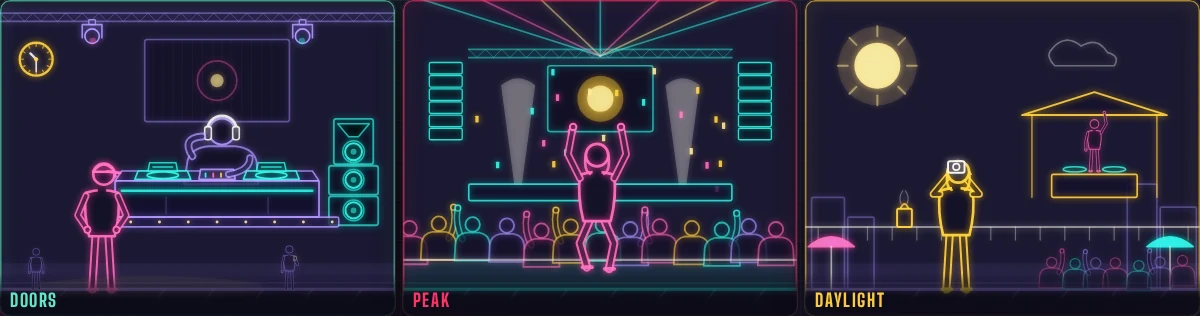
The Peak Hunter
Didn’t come for the first three hours. Arrives when the room is already going and goes straight to the front. It wants the part everyone will describe afterwards, and is honest that the warm up is somebody else's hobby. When a peak lands, it lands harder because of people like this, because the commitment is total.
The trouble is that a peak needs the hours that got skipped, and this type keeps asking rooms for a payoff it didn’t sit through. It’s also easier to satisfy than it would ever admit. The biggest moment usually wins with The Peak Hunter, and the biggest moment is often the most obvious thing in the set. The obvious record wins.
What Time Does A Club Actually Get Good?
About an hour after the trains stop. That’s the hour the crowd turns over in Seoul: everybody who was going to leave has gone, everybody still inside has accepted that they’re here until morning, and the resident can finally stop programming for people with somewhere to be. In Itaewon you can watch it happen on the street outside, one wave leaving for the taxis and another still arriving. The room gets simpler after that.
Stereo in Montreal makes a peak physical and runs long enough that arriving at four still gets you one, and Womb in Tokyo designed its main floor for the drop.
Who to bring, if you’re The Peak Hunter
Go out with
They get the tickets and time the arrival so you walk in exactly as the room starts to go. You bring the commitment, they bring the schedule, and nobody misses the drop.
Date night
They find the night nobody has heard of yet, and you make sure it gets its moment. It works best when they pick the room and you pick the hour.
Maybe not the same night
They’re putting their coat on at the exact moment you walk in. You’re both right about the night, just about different halves of it.
Your trip
London and Tomorrowland
Room One at fabric at three in the morning is a summit, and Tomorrowland is mainstage at its core, more than a dozen stages and a crowd from over 200 countries all waiting for the same moment.
Not sure this is you? The Clubber Type quiz takes a few minutes, and the result comes with your own pairings to compare with a friend.
The Willing Passenger
Rarely picks the night. Somebody asks, this type says yes, and it’s good company from the door to the taxi home. It doesn’t need the lineup explained and doesn’t need the room to be important. What it wants is to be near the people it likes while something loud is happening.
The criticism is that it has outsourced its taste and then complains about where it ends up. A hundred nights in, it couldn’t say what it wants from one. On the day the people who organise everything stop organising, it will simply not go out. Yes isn’t a preference.
Is It Bad To Never Choose Where You Go Out?
Not bad, but worth testing once. Hongdae makes the test cheap, because four or five rooms sit within a few minutes of each other on foot, so picking wrong costs you one drink and a short walk rather than an evening. The same experiment in Gangnam costs a cover charge and a queue. Go somewhere nobody invited you to.
A bar crawl through four small rooms in Hongdae suits somebody happy wherever the group lands. Coda in Toronto is a friendly floor where the person who chose the night was right, and Sisyphos in Berlin sprawls so widely that following your friends is the only sensible way through it.
Who to bring, if you’re The Willing Passenger
Go out with
They know everyone on the stairs and will introduce you to all of them. A lovely night, and you won’t have to decide a single thing.
Date night
They plan the whole afternoon, you say yes to all of it, and you’re both home before the night crowd leaves the house. A good arrangement.
Maybe not the same night
They want you there at doors, clear headed, listening to the warm up. You wanted to come after dinner with your friends. Brunch is where the two of you work.
Your trip
Toronto and Igloofest
Coda is a friendly floor with a good system, and Igloofest fills the Old Port of Montreal in January. Somebody else can buy the tickets, and all you need to bring is a retro ski suit.
Keep going
Find Your Sound might tell you what you would choose if nobody chose for you.
Not sure this is you? The Clubber Type quiz takes a few minutes, and the result comes with your own pairings to compare with a friend.
The Last Twenty
Stays. Not out of stamina as a personality trait, but because the last hour is a different room: fewer people, much less performance, and somebody behind the decks who can finally play the thing they’ve been building toward all night. Most of the best records of this type's life were played to under a hundred people.
What it won’t admit is that some of this is difficulty leaving. It has sat through closing sets that weren’t worth it, out of a superstition that the moment arrives ten minutes after you go, and it has watched the lights come up on a floor of nine people, three of whom worked there, two of whom were only waiting for the same first train, and told itself afterwards that this had been the real night rather than the last one available. The people who left at two aren’t lesser clubbers. They have Sundays, which this type gave up defending a long time ago. Stamina isn’t commitment.
Is The Last Hour Of A Club Night Worth Staying For?
Often, and in Seoul the arithmetic helps. Once the trains have stopped, the cheapest way home is to wait for the first one at around half past five, so the floor thins down to people who decided to be there rather than people who were stranded. A taxi out of Itaewon at four is the part of the night nobody budgeted for. That’s a better room than it sounds.
Stereo in Montreal runs into the next afternoon, and Marble Bar in Detroit belongs to the people who never left.
Who to bring, if you’re The Last Twenty
Go out with
Same taste for small late rooms, and they know everyone behind the bar. They will leave at four, and they won’t judge you for staying.
Date night
They arrive at doors, you stay for the lights, and together you hear the whole night. The handover works best at around three.
Maybe not the same night
They came for the biggest moment of the night and leave once it passes. You came for the forty people still standing after it. Hug at the coat check.
Your trip
Montreal and TOR Festival
Stereo runs into the next afternoon, so the last twenty is a real crowd there. TOR is one stage of Korean DJs at a forest campsite in Anseong, and nobody has to find a last train.
Keep going
The DJ quiz can tell you which closing set you would play to the people who stayed.
Not sure this is you? The Clubber Type quiz takes a few minutes, and the result comes with your own pairings to compare with a friend.
The Sober Clubber
On the floor at three with a glass of water, having a better night than most of the people around it. Some of that was a choice and some of it wasn’t, and either way this type stopped explaining years ago. It hears the mix, the room turning, the moment the set finds its idea, with nothing in between. It leaves when the night stops being good rather than when the drinks stop working, and it’s usually the first to notice which of those has happened.
The cost is being slightly outside the thing it came for. A room at four in the morning runs on a shared looseness, and this type is watching it rather than in it, which shades into judging more often than it admits, because the distance between noticing that somebody has had too much and deciding what that says about them is about half a second wide and nobody in the room is keeping the receipts. It keeps a quiet tally of everyone else's worst hour. And because it has never needed anybody to get it home, it underrates how much of a scene is people doing exactly that for each other. Clarity isn’t fairness.
Can You Enjoy Clubbing Without Drinking?
Yes, and Seoul is a good city to test it in. The December year end season in Korea makes the point better than any club does, because the company dinners run on rounds nobody opts out of. Anyone who has sat through one holding a glass of water already knows how to stay in a room without matching it. A club is easier than an office party.
Nowadays in New York takes non alcoholic drinks seriously, and Womb in Tokyo is in a city where a sober night out needs no explanation.
Who to bring, if you’re The Sober Clubber
Go out with
They drag you to a lineup nobody knows, and you make sure the two of you remember every detail of it. The most reliable witnesses in the city.
Date night
Two people who came for the sound and need no checking on. Four hours at the speaker, one shared look at the right record, and that counts as romance.
Maybe not the same night
They came for the people and the second round, you came for the mix. You’ll notice their fourth drink, and they will notice you noticing.
Your trip
Tokyo and MUTEK
Womb has a system worth all of your attention, in a city where a sober night out needs no reason, and MUTEK in Montreal draws a listening crowd as much as a dancing one.
Not sure this is you? The Clubber Type quiz takes a few minutes, and the result comes with your own pairings to compare with a friend.
The Daylight Shift
Goes out in the afternoon. Day parties, rooftop sets, the coffee rave that starts at seven and finishes before the first meeting. This type hasn’t seen the inside of a club at three in the morning in years and feels nothing resembling loss about it. The music is the same music, heard with the lights on, followed by sleep.
What it loses is the part that only happens late. Rooms change after midnight, the performance drops out of people, and the record a DJ has held for four hours gets played to whoever stayed. Deciding that part isn’t worth the Sunday is fair. Saying the night crowd is doing it wrong is a different claim. A lot of the daylight is about being seen doing it, in good light, with a camera nearby. Convenience isn’t virtue.
Are Day Parties Better Than Night Clubs?
Different, and the difference is mostly logistics. An afternoon event by the Han river finishes while the Seoul subway is still running, which removes the single decision that shapes every night out in this city. The daytime rooms here are river parks and Seongsu rooftops rather than basements. A crowd that never has to make that choice behaves differently from one that already has. Nobody there is committed to anything.
The coffee raves in Seongsu are this type's entire scene. Nodeul Island runs outdoor daytime events on the Han with the city behind them, one of several alternatives to clubbing in Seoul. Piknic Electronik in Montreal is Sunday afternoon in a park by the river, and Nowadays runs outdoor Sunday sessions you can leave before the indoor floor gets going.
Who to bring, if you’re The Daylight Shift
Go out with
Two people with a calendar, one plan and a bedtime. On the rooftop at two, in bed by eleven, and nothing you wanted was missed.
Date night
You pick the day party, they say yes and mean it, and nobody has to see three in the morning. An easy afternoon with someone easy to be around.
Maybe not the same night
Their night starts roughly when yours ends, in a dark room you would never photograph. If you pass on the subway, a nod covers it.
Your trip
Montreal and Kappa FuturFestival
Piknic Electronik is Sunday afternoon in a park by the river, and Kappa FuturFestival runs noon to midnight in a former Fiat ironworks in Turin, which is your whole philosophy with a bigger sound system.
Not sure this is you? The Clubber Type quiz takes a few minutes, and the result comes with your own pairings to compare with a friend.
The Veteran
Fifty plus, still going, and right about most of it. Has watched three scenes rise, peak and get sold, and turns up for the thing itself rather than the memory of it. Arrives early, knows the door staff by name and is known back, stands where the sound is, and leaves before the room gets stupid. Younger people ask its opinion and then find out it was right, which annoys them, fairly.
The cost is that being right has started to do the job curiosity used to. This type has a settled view of what a good room is and rarely lets a new one argue with it. The staff who greet it by name are also, quietly, a way of never being a stranger anywhere. There’s a version of it that goes early because that’s when the room is best, and a version that goes early because that’s when the room is its own, and it has stopped checking which one turned up. Experience is only evidence.
Do People Still Go Clubbing In Their Fifties?
Constantly, and here the reason is partly architectural. Apartment walls in Seoul are thin enough that nobody hears a record properly at home at any age. A club stays the only room in Seoul where the low end is allowed to exist at the volume it was made for. That doesn’t expire at forty.
The record bars in Euljiro offer a drink at conversation volume before or instead of the club. Smartbar in Chicago is older than most of its patrons, and Stereo in Montreal has outlived every trend since the nineties.
Who to bring, if you’re The Veteran
Go out with
They stay later than you, but they want the same small room and the same unhurried records. You leave at four, and they tell you the next day what happened after.
Date night
You both like the room before it gets stupid, and you both leave when it does. Dinner, doors, the best two hours, and home at a civilised time.
Maybe not the same night
You know everyone at the door and want to say hello. They came to be known by nobody. A nod is plenty, and they will quietly appreciate it.
Your trip
Glasgow and Fuji Rock Festival
Sub Club has held a crowd in one basement for nearly four decades, where fifty on the floor is unremarkable, and the founder of Fuji Rock has said he wants to see three generations of one family there together.
Not sure this is you? The Clubber Type quiz takes a few minutes, and the result comes with your own pairings to compare with a friend.
Why A Room Needs More Than One Type
The twelve are ingredients, and a night is made or ruined by the mix rather than by any single type in it.
Rooms that are all Peak Hunters and Human Itineraries are exhausting. Everyone arrives at the same time for the same forty minutes, everyone films the same moment, and the room empties at once and leaves the closing DJ playing to the bar staff. I’ve had that slot in Hongdae more times than I want to count.
Rooms that are all First Listens and Long Memories are the opposite problem. Nobody dances, because everybody is assessing. The floor turns into a listening bar that happens to have a soundsystem, the DJ can feel it, and the DJ starts playing to the four people at the front who are nodding, which finishes the night off entirely.
The rooms that work have a spread. A few Early Shifts to give the opener something to build on. A Willing Passenger or two who will follow anything anywhere. At least one Ghost, who speaks to nobody and somehow makes the room feel like it has a centre. A Veteran near the back who has seen this before and isn’t impressed, which keeps everyone honest. And enough Sober Clubbers and Outside Tables that the night has somewhere to go when it gets to be too much.
This is also why your own type matters less than you think. You’re one ingredient. What you actually control is which room you take yourself to, and whether the mix in it is one you make better or one you make worse.
Frequently Asked Questions
What Kind Of Clubber Am I?
You’re one of twelve behavioural types, and which one you get depends on six things: how much you plan the night, whether you follow the room or your own line, how deep your listening goes, how fast you want the payoff, how social you are and whether you face backwards or forwards. Taste doesn’t come into it. Somebody who only listens to house and somebody who only listens to drum and bass can land on the same result. The quiz is watching what they do at the door, on the floor and at four in the morning, not what’s on their phone. The Clubber Type quiz scores all six.
What Are The Different Types Of Clubbers?
Twelve, sorted by conduct rather than by music: The Early Shift, The Human Itinerary, The Ghost, The Outside Table, The Long Memory, The First Listen, The Peak Hunter, The Willing Passenger, The Last Twenty, The Sober Clubber, The Daylight Shift and The Veteran. Twelve is enough to keep the person who arrives at one apart from the person who arrives at ten, and to keep both apart from the person who came out to talk on the stairs. Fewer results would flatten all three into one.
Is There A Best Type Of Clubber?
No, and a quiz that told you otherwise would be selling flattery. The Human Itinerary makes the night happen and misses it, The Peak Hunter commits completely to the two hours it turned up for, The Sober Clubber remembers everything and forgives less, and The Willing Passenger is the person everybody actually wants to go out with. Each of the twelve gets a real criticism here for exactly that reason. Being common isn’t a failing and being rare isn’t an achievement.
What Is The Rarest Clubber Type?
Three tie at five percent of results: The Human Itinerary, The Outside Table and The Last Twenty. All three sit at an extreme of one axis while refusing to move on another, which is a harder combination to hold than it sounds. The most common result is The Sober Clubber at fourteen percent, with The Willing Passenger close behind at twelve, and The Long Memory and The Peak Hunter tied at eleven. Rarity here is a fact about the scoring.
Can You Be More Than One Type Of Clubber?
Yes, and almost everybody is. Every result gives you a primary type and two secondaries with percentages, because six axes rarely settle cleanly into one corner. The same person can be a Human Itinerary on a Friday in Hongdae with six friends and a Ghost on a Wednesday in Itaewon on their own, and both readings are honest. The secondaries are usually the more interesting half of the result.
Do Clubber Types Change Over Time?
They do, and the direction is fairly predictable. Peak Hunters become Early Shifts once the Sunday starts costing something real, Last Twenties become Daylight Shifts, and Ghosts turn into Veterans by the simple mechanism of being recognised at the door often enough. The First Listen is the type most likely to still be itself in ten years, because chasing the new thing is a habit rather than a stage. Nobody moves toward wanting the peak.
Where To Go Next
Twelve types, six axes, and no correct answer. Most people land somewhere they half expected and get told something they didn’t want to hear, which is the point of building it this way. For the scored version, take the Clubber Type quiz.
This is the second of five. The DJ types came first, the same six axes read from behind the decks instead of in front of them. The eras, the venues and the festivals follow, and all three quizzes are already live: era, venue, festival. Nobody lands in the same corner twice.
Every archetype across every quiz is collected at The Types, and the rest of them are at Quizzes. For a night out here, the neighbourhood guide to going out in Seoul covers how to get there and what to expect at the door.
The DJ Diaries is written by a Canadian DJ living in Seoul. About // Book a DJ
Stay in the Loop
New writing on DJ culture, electronic music, and the Seoul underground, delivered when it matters.
More From The DJ Diaries



Play with the history
Four tools built from the same research as this site.