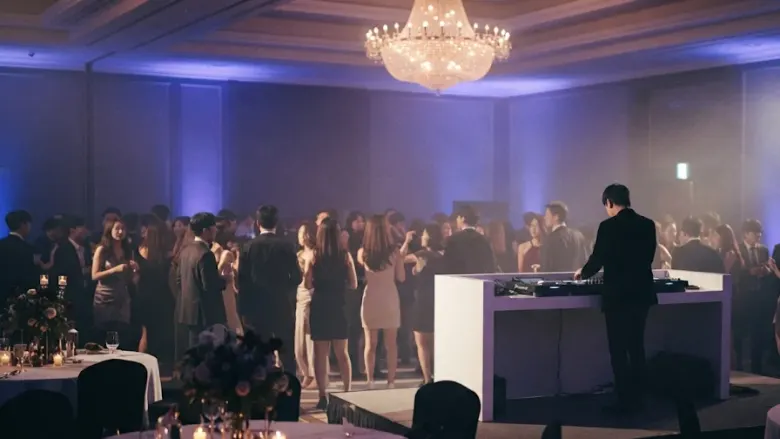
The 송년회 (songnyeonhoe) is the Korean version of the office holiday party, and in Seoul it makes December the busiest stretch of the events calendar. Companies, teams and alumni groups all want a room, a dinner and something good to happen after the dinner, and most of them want it on the same four or five Fridays. That crunch is the whole story of this checklist. The parties that go well are the ones planned early, with the night mapped out before anyone picked a single song.
What follows is the checklist we’d hand to anyone organizing one: the order to do things in, the questions to ask the venue, and the small details that decide whether people leave talking about the night or about the last train. If you’re weighing up a DJ specifically, our guide to hiring a DJ for a 송년회 covers that side in more depth.
한국어 요약
회사 송년회, 이렇게 준비하세요
서울에서 회사 송년회를 준비하는 담당자를 위한 체크리스트입니다. 날짜, 장소, 진행 순서, 음악, 귀가까지 순서대로 정리했습니다.
- 날짜 먼저: 12월 금요일과 토요일은 장소, DJ, MC, 음향팀이 가장 먼저 마감됩니다. 예산이 정해지면 날짜부터 잡으세요. 평일 저녁은 선택의 폭이 훨씬 넓습니다.
- 장소 확인: 음량 제한, 음악 종료 시간, 설치 가능 시간, 그리고 DJ가 연결할 수 있는 음향 시스템인지 계약 전에 확인하세요.
- 진행 순서: 식사, 대표 인사와 시상, 건배사, 경품 추첨, 그리고 댄스 타임으로 넘어가는 순간까지 미리 계획하세요.
- 마이크 담당: 누가 순서를 진행할지 정하고, 외국인 직원이나 손님이 있다면 한국어와 영어 진행을 준비하세요.
- 음악: 신입부터 임원까지 함께 즐길 수 있도록 식사 중에는 익숙한 곡, 이후에는 90년대와 2000년대 가요, 디스코, 캐럴로 천천히 분위기를 올립니다.
- 귀가: 막차 시간을 확인한 뒤 종료 시간을 정하세요. 연말에는 택시 잡기가 어렵고 심야 할증도 붙습니다.
연말 날짜는 빠르게 마감되니 서둘러 문의해 주세요.
잘못된 정보나 바뀐 날짜를 발견하셨나요? 연락 주시면 확인 후 바로 고치겠습니다. 현장에서 보고 들은 이야기도 언제나 환영합니다.
The short version
Lock the date first, then the room, then the people who make the noise. Map the night in phases before you choose any music. Decide who owns the microphone and the running order. Check the sound rules with the venue in writing. Plan how everyone gets home before the night starts, not at midnight. Everything below is those five ideas in more detail.
The checklist in five steps
Book the date sooner rather than later
December weekends go first. Hotel ballrooms, restaurant buyouts and private party rooms start filling at the end of October, and the DJs, MCs and sound teams who do this work well get booked by the same companies year after year. By the time most organizers start asking around in late November, the choice is whatever’s left.
If your team can be flexible, a weeknight is the easiest win. A Tuesday or Wednesday 송년회 has more rooms, more choice of people and more relaxed vendors. If it has to be a Friday, hold the date with the venue and your entertainment as soon as the budget is approved, even if the details come later. A held date with a few open questions beats a perfect plan with nowhere to put it.
When 송년회 dates fill up
Choose a room that’s allowed to be a party
Most 송년회 rooms in Seoul are one of four things: a hotel ballroom, a restaurant or bar buyout, a rented event space or rooftop, or a lounge booked for a private night. Each one has a different idea of how loud the night can get. Before you sign, ask the venue whether there’s a volume limit and who enforces it, what time the music has to stop, when your vendors can get in to set up, and whether the room’s own sound system is something a DJ can actually plug into.
Those answers matter more than the decor. A beautiful restaurant with a hard 10 p.m. music cutoff and ceiling speakers meant for background jazz isn’t a dance floor, however good the playlist. Winter rooftops look great in photos and feel cold in practice, so ask about heaters, cover and where the gear stays dry.
Ask the venue before you sign
Map the night in phases
Every good 송년회 has the same bones, whatever the size. There’s arrival and dinner, when music sits underneath conversation. There’s the formal part: the speech from the CEO or team lead, awards, the 건배사 (geonbaesa), the toast someone always gets volunteered for, and often a lucky draw. Then there’s the turn, the moment the room decides whether it’s going home or staying to dance. And there’s the ending, which is either planned or a mess.
Write those phases down with rough times before you talk to anyone about music. The turn is the part most organizers forget to plan, and it’s where a night is won or lost. If the lucky draw ends and the lights stay bright while staff clear tables for twenty minutes, half the room reaches for their coats. If the music lifts straight out of the last prize, the lights drop and the floor is already open, people stay.
A sample running order
Decide who owns the microphone
Speeches, toasts and prizes need one person running them, and that person needs to be talking to whoever controls the music. At smaller parties that’s often the DJ. At bigger ones there’s an MC, sometimes two if the room is Korean and English. Either way, agree before the night who calls each segment, how many wireless microphones you need, and who has the final say on timing when the CEO’s speech runs long. It always runs long.
If your room is mixed, Korean staff with international colleagues or clients, settle the language question up front. A bilingual MC, or a DJ who can carry announcements in both languages, keeps half the room from drifting off during the formal part. Our piece on corporate events in Seoul goes deeper into running a mixed room.
Music for everyone from the intern to the chairman
A company party isn’t a club night. In a club, people chose the music by choosing the club. At a 송년회, nobody did. The room might run from people in their early twenties to senior management, Korean pop fans next to people who only know the Christmas songs, and the job is finding what they share.
In practice that usually means familiar songs during dinner, nothing that fights conversation, then a slow build once the formal part is over. Korean pop throwbacks from the 1990s and 2000s, disco and Motown, and a few Christmas songs used with restraint tend to bring the generations onto the same floor. Send whoever’s playing a short list of songs the boss loves and a do not play list. Both get used.
Sound and gear: the quiet checklist
Most technical problems at a 송년회 come from things nobody asked about. Check whether the sound system can run on its own power circuit or shares one with the kitchen. Know where the speakers will go, and that they won’t block the stage or the exits. Get at least two wireless microphones plus a spare, with fresh batteries. Ask for an input for any video or slideshow, and test it before guests arrive. Agree on the volume for dinner and the volume for dancing in advance, so nobody’s arguing with the venue manager at 9:30.
Tick these off before the night
Plan how everyone gets home
Late December nights in Seoul run into the last train problem fast. The subway stops not long after midnight, and on the busiest nights of the year taxis near the big districts are hard to find, with the late night surcharge on top. If your party ends at 11, people relax. If it ends at midnight with no plan, a third of your team will slip out at 11:20 anyway.
Check the last trains from your venue before you set an end time. Our Getting Home Planner shows last trains and night buses for the main districts. Put the end time and the nearest station in the invitation, and if the budget allows, arrange taxis or a shuttle for the people who live furthest out.
What to put in your first email
Whether you’re writing to a venue, a DJ or an MC, the same details get you a fast and accurate answer: the date and a backup date, the venue or the area you’re considering, the number of guests, the start and end times, the language mix in the room, what the venue already provides, and what the night should feel like by the end. One honest line about the crowd does more than a long list of genres. If you want to know what moves the cost of that answer, our guide to what decides the price of a DJ breaks it down.
Frequently Asked Questions
When should we start planning a company 송년회 in Seoul?
Start in October if you can, and hold the date by early November at the latest. December Fridays and Saturdays are the first dates to go for venues, DJs, MCs and sound teams. Weeknights leave more choice later in the season.
How long should a 송년회 run?
Most run three to four hours. That’s long enough for dinner, the formal part and an hour or more of dancing, and short enough that people can still catch the last train home.
Do we need a DJ, or will a playlist do?
A playlist can carry dinner. It can’t run the speeches, adjust when the lucky draw runs late or read when the room is ready to dance. Our guide to hiring a DJ for a 송년회 covers what a DJ adds.
What’s a 건배사 (geonbaesa)?
A 건배사 is the short toast given before everyone drinks together, usually by a senior person or whoever the room volunteers. At a 송년회 it’s often a call and response, and it deserves a moment of quiet and a microphone that works.
If you’re planning one this December and want a second pair of eyes on the running order, we’re happy to help with the date, the room and the music.
Written from Seoul, by someone who has been in the booth for 25 years. More on the site, or book a DJ.
Stay in the Loop
New writing on DJ culture, electronic music, and the Seoul underground, delivered when it matters.
More From The DJ Diaries

Play with the history
Four tools built from the same research as this site.