Planning the whole night, not just the music? Our 송년회 planning checklist covers the date, the room, the speeches and getting everyone home.
The short answer: a corporate event isn’t a club night with a dress code. The brief is different, the risk is different, and the skill you’re paying for is restraint. Most corporate bookings go wrong because somebody hired a club DJ and expected them to read a boardroom.
I’ve played company parties, brand launches, conferences and year-end dinners across Seoul for two decades, alongside the club work. The two jobs share equipment and share almost nothing else.
What makes a corporate event different
In a club, the crowd chose the music before they arrived. They bought a ticket for a sound. Your job is to take them somewhere.
At a corporate event, nobody chose the music. They came because of work. The room contains your CEO, your newest hire, your most important client and somebody who would rather be at home. The DJ’s job isn’t to express themselves. It’s to make a mixed, semi-obligated room feel comfortable, and then, if the night earns it, to let it become fun.
That inversion is the whole craft, and it’s why a brilliant club DJ can be a poor corporate one. Playing quieter, more familiar, more patiently is harder than playing loud.
Good brief, bad brief
A bad brief
“We want good vibes, something everyone likes, nothing too cheesy but keep it fun.” Every word of that is unfalsifiable. Two people reading it will picture different nights, and one of them will be disappointed.
A good brief
“120 guests, average age mid-thirties, mixed Korean and international. Drinks and networking 6 to 7:30, background only, people must be able to talk. Awards and speeches 7:30 to 8:15, we need walk-on music and a cut-off cue. After 8:30 it becomes a party and we would like it to actually go. Our CEO hates loud brass. Last year the room emptied at 9 and we would like to fix that.”
That brief tells a DJ everything: three distinct phases, a volume rule, a named constraint, and a defined failure from last year to solve. Any competent operator can build a night from it.
The parts of the night people underestimate
- The first ninety minutes. Everyone plans the party and nobody plans the arrival. This is when guests decide what kind of event this is. Get it wrong, loud or oddly silent, and you spend the rest of the night recovering.
- Speeches. Microphone, levels, walk-on, walk-off, and a plan for the laptop that won’t connect. The music side of a speech block is small and the risk is large.
- The transition into the party. The hardest ten minutes of any corporate night. Push too early and the floor is empty and everyone notices; too late and people have started leaving.
- Bilingual rooms. In Seoul this is normal and it’s rarely planned. Announcements, and the music itself, land differently across a mixed room. It should be decided in advance, not improvised.
- The exit. Nights need an ending. Letting a party trail off is a choice, and usually the wrong one.
What professionalism looks like
It looks like arriving early enough to be boring, dressing to match the room, carrying redundant equipment, taking direction from one named person, having the volume conversation before it becomes an argument, and leaving the venue exactly as it was found.
It also looks like being told no. If your brand has lines it won’t cross, songs, artists, language, tell your DJ early and in writing. Marketing, HR and leadership often have views here and they surface late. Ask them before the run sheet is locked, not after.
And it looks like insurance, invoices and a contract that names the overtime rate. Unglamorous, and it’s what separates a supplier from a guy with speakers.
Timing: when to book
For year-end season in Seoul, which is the busiest window in the Korean calendar, the good operators are gone months ahead. For everything else, aim for at least three months, and expect that the closer you get to the date, the more you pay for less choice. If your date is fixed and important, book it first and fill in the details later.
How a corporate night is set up
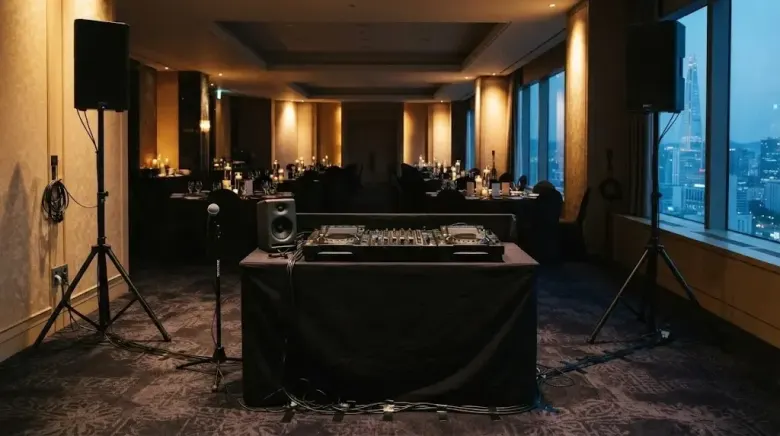
I arrive early enough that the room is ready before your first guest and nobody sees a cable being taped. The setup is deliberately small: two CDJs, a mixer, one low monitor and a wireless microphone on a stand that doesn’t look like a DJ booth, because at a corporate event the booth shouldn’t be the stage. For the gear-minded: the current flagship player is AlphaTheta’s CDJ-3000X, released on 9 September 2025 as the first player under the AlphaTheta name after the Pioneer DJ brand, with built-in Wi-Fi so rekordbox can connect without a LAN cable. If the venue’s system is built for speech, and most hotel function rooms are, a discreet pair of powered speakers goes where the sightlines want them, not where the socket is. Levels for dinner, for the speeches and for the party are agreed with you in advance, and one named person can change them on the night.
What you get
- Dinner, speeches and party carried by one person, so the joins are invisible.
- A venue check before the night, so a bad sound system is a solved problem rather than a surprise.
- The running order in writing a week out.
- The exit planned, so the night ends because it should.
How we work
This applies across cultures as much as across companies. A good part of my corporate work is for international organisations operating in Seoul, or Korean companies hosting visiting clients, and those rooms need someone comfortable moving between both. If your programme includes a foreign performer, check the paperwork early: under the Performance Act, a public performance with even one foreign performer needs a prior recommendation from the Korea Media Rating Board (영상물등급위원회), with penalties of up to three years in prison or a 30 million won fine. About 99 percent of applications are approved, and on 1 October 2026 Seoul asked the government to replace the review with a simple notification for low-risk shows. That’s a planning question, not a playlist question, and it’s worth raising in your first email.
For most corporate events it’s me: one point of contact from the first email to load-out. For multi-room or larger productions I bring in DJs I’ve worked with for years, and I remain responsible for the night. You’re never handed to an account manager, and you always know who is going to be standing behind the decks.
If you’re planning something in Seoul, send me the details. If you’re still comparing suppliers, start with the questions worth asking any DJ.
Frequently Asked Questions
How is a corporate event DJ different from a club DJ?
A corporate event DJ plays for a room that didn’t choose the music, while a club DJ plays for people who bought a ticket for a sound. The corporate crowd mixes a CEO, new hires, important clients and people who would rather be at home. The job is to make that room comfortable first and let it become fun only if the night earns it.
How far in advance should I book a DJ for a corporate event in Seoul?
For most corporate events in Seoul, book a DJ at least three months ahead. Year end season is the busiest window in the Korean calendar, and the good operators are gone months in advance. If the date is fixed and important, secure the DJ first and settle the details later.
What should a corporate DJ brief include?
A good corporate DJ brief gives the guest count, the age and language mix, and the phases of the night with times. It should set volume rules, such as background only during networking, and flag cues like walk on music for speeches. Named constraints and a specific failure from last year help most, because they give the DJ something concrete to solve.
What equipment does a DJ bring to a corporate event?
A typical corporate DJ setup is deliberately small: two CDJs, a mixer, one low monitor and a wireless microphone on a discreet stand. If the venue system is built for speech, as most hotel function rooms are, a pair of powered speakers is added where the sightlines want them. Levels for dinner, speeches and party are agreed in advance with one named contact. Other checks worth making are covered in what to ask before booking a DJ.
Further Reading
- Wikipedia: hoesik, the Korean tradition of after work company gatherings
- Wikipedia: the mobile DJ, who works private and corporate events rather than clubs
- Wikipedia: event management and how corporate events are planned
- Wikipedia: how a sound reinforcement system is set up for speeches and music
Written from Seoul, by someone who has been in the booth for more than twenty years. More on the site, or book a DJ.
Stay in the Loop
New writing on DJ culture, electronic music, and the Seoul underground, delivered when it matters.
More From The DJ Diaries

Play with the history
Four tools built from the same research as this site.