A note on what this is. I didn’t live through the golden era of the music dabang. It peaked before I ever landed in Korea. But I did catch the tail end of its habits, because when I arrived in 2002 the request slip was still alive in Seoul. Everything here comes from Korean press coverage, from the people who documented it, and from one working DJ who never stopped doing it. This is research and opinion from someone who has spent more than twenty years in a different kind of booth, looking back at the booth that came before mine.
My family and I went to the music dabang at Donuimun Museum Village, the city-run recreation beside Gyeonghuigung. Then the city closed the whole village at the end of August 2025, dabang included. It was sad to see Seoul do that to one of the last places where you could watch this format working.
The request itself never went away. It just lost the paper. Nobody hands me a slip anymore. They walk up to the booth and show me the song on their phone, typed into a message. Same gesture, same hope that the DJ will play it.
There’s no single request I remember above the rest. What stays with me is how often people get it right. You’d be surprised how many times someone understands what I’m playing and asks for a song that would fit naturally into the set, rather than just shouting for a genre like hip-hop. When that happens, it feels like a conversation with the room, which is what those paper slips were.
If you want to make a request, my advice is simple. Be kind, don’t be rude, and don’t push. I might play it. I might not. And please don’t ask for hip-hop if the DJ isn’t playing hip-hop.
The Slips I Still Saw in 2002
When I first came to Korea in 2002, a lot of listening bars and LP bars, and even a couple of clubs, still ran on request slips. You wrote down what you wanted, the artist and the song, and handed it over. If the DJ had the record, they would try to play it. Some clubs had their own version: you wrote your request and pushed the paper through a little slot by the booth. I remember doing that at Hodgepodge in Hongdae.
It was a small ritual, but it said a lot. The DJ was the person behind the glass who might, if you were lucky and they had it, play your song next.
How a Request Slip Worked
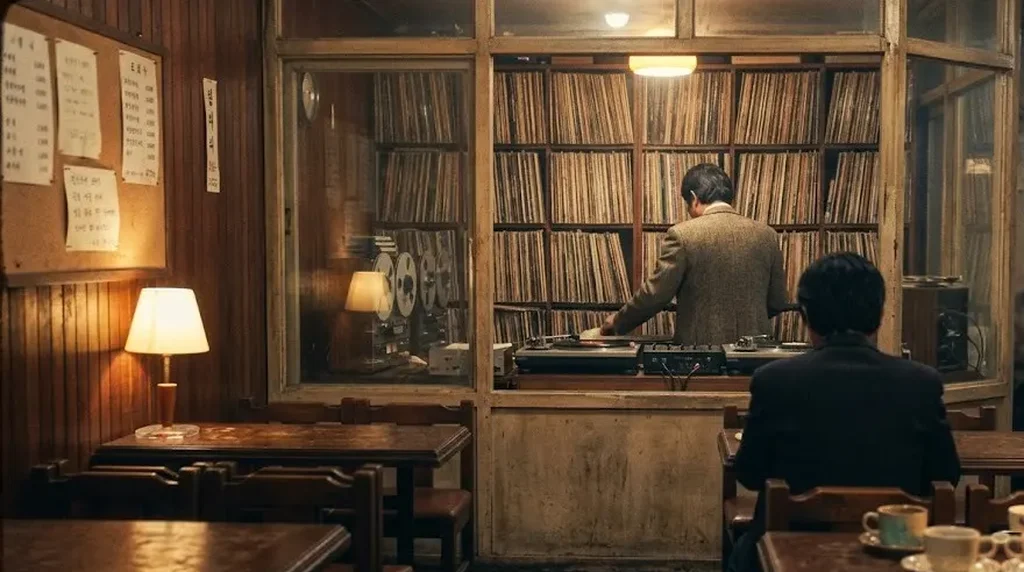
In the classic music dabang of the 1970s and 1980s, every table had memo paper. You wrote the song title, often with a short story or a dedication, and a server carried it to the DJ booth, usually a glass box at the front of the room. The DJ read the best stories aloud between records, which is why so many Koreans of that generation remember the DJ’s voice as much as the music. The Seoul city account of the Donuimun room describes the same routine, kept alive on weekends until 2025.
Go Deeper: Watch, Listen, Read
For anyone who wants to see and hear the format rather than read about it, these are the best places to start.
- Seoul Metropolitan Government on the opening of 추억의 음악다방 (2021): the city’s own account of the Donuimun room, its 500 LPs and DJ Jang Min-wook reading slips from the tables on weekends.
- 전성기 magazine: 44년째 ‘DJ 오빠’ 장민욱 씨의 마이웨이: a Korean profile of the booth DJ who never stopped, and the clearest first-hand account of how a request was handled.
- 동작FM, 추억의 음악다방, episode one (YouTube): a Seoul community station that still reads request slips on air, the nearest thing to hearing the booth today.
- Busan Museum of Modern History webzine on the 1970s and 80s dabang: a reminder that the format was national, with its own stars outside Seoul.
- Seoul Urban Life Museum: Seoul’s Youth and Popular Music (2024): the exhibition record for a show that traced where young Seoul went to hear records, from Jongno and Myeongdong onward.
- Korea Pop Music Museum, Gyeongju: a museum devoted to Korean popular music history, worth the detour to see the records of the era up close.
FAQ
What was a Korean music dabang?
A coffee house built around music, common in Korea from the 1960s through the 1980s, with a professional DJ working from a glass booth full of vinyl. Customers paid for coffee but came for the records, and the DJ played requests submitted on paper slips from the tables. It functioned as the main youth hangout of its era, decades before cafes, clubs or the internet took over those roles.
How did the request slips work?
Each table had memo paper. You wrote a song title, and often a story, a dedication or a message underneath it, and staff carried the slip to the DJ booth. The DJ chose when to play it, and often read or responded to the story over the microphone. Because the whole room heard it, the slip worked as a way to send a message to a specific person nearby without addressing them directly.
Do music dabang still exist in Korea?
A handful survive. Seoul ran a recreated music dabang at Donuimun Museum Village, staffed by a veteran DJ on weekends, until the city closed the whole village at the end of August 2025. A few original style rooms hold on around Jongno, which is now the heartland of retro Seoul. The modern LP bar scene in Seoul is a direct descendant. The request slip itself survives mainly in a few dedicated rooms and on community radio, where 동작FM still reads listeners’ slips on air.
What music was played in Korean music dabang?
A mix of Western pop and rock, which was otherwise hard to hear in Korea at the time, alongside Korean pop of the era, including artists like the Pearl Sisters, Shin Joong-hyun and the folk generation. Part of the dabang DJ’s value was access, since imported records and deep knowledge of foreign music were scarce. The good DJs were followed like radio hosts.
Sources, Archives and Listening
The people and the rooms. Kyunghyang Shinmun on Jang Min-wook, 45 years in the booth · OhmyNews on the last analog DJ · Wonnews retro column on dabang DJs · Donuimun Museum Village music dabang (closed August 2025) · KTV on the revived music dabang · KTV on the 7080 dabang revival
Old photographs of the rooms. Search 다방 or 음악다방 in Seoul Photo Archive (서울사진아카이브) and Seoul History Archive (서울역사아카이브) for coffee house interiors from the sixties onward. e영상역사관 national archive photography for the newsreel-era street photography that shows what the outside of those buildings looked like. Seoul Institute, Seoul in Photographs is the easiest of the three to browse by decade.
The soundtrack. 커피 한잔 by the Pearl Sisters, written by Shin Joong-hyun in 1968, is the dabang record: the 1968 original on Bugs and the song’s background. Play it before you read anything else here.
Picture Credits
- Period recreations
The booth, the slips and the recreated dabang are AI period recreations made for this article, captioned as such. They stand in until the real photographs are shot.
Historical images on this site are used under the licence stated for each file. KOGL Type 1 is the Korean public sector open licence permitting commercial use and adaptation with attribution; public domain items carry no restriction. If you hold rights in any image here and believe it has been used in error, get in touch and it will be removed.
Written from Seoul, by someone who has been in the booth for more than twenty years. More on the site, or book a DJ.
Stay in the Loop
New writing on DJ culture, electronic music, and the Seoul underground, delivered when it matters.
More From The DJ Diaries
Play with the history
Four tools built from the same research as this site.