At about four in the morning on 21 April 2022, roughly seventy hired security workers walked into a beer hall of about six pyeong in Euljiro 3-ga. It was the sixth attempt to evict Eulji OB Bear (을지OB베어), the bar credited with pairing dried pollack and draft beer, and this time it worked. The sign came down, the decades old OB glasses went out onto the street, and the founder’s grandson was left on the pavement, according to Weekly Kyunghyang. If you want a date for when Hipjiro (힙지로), the hip Euljiro of unsigned bars and upstairs rooms, stopped being only a party and became a fight, that morning will do.
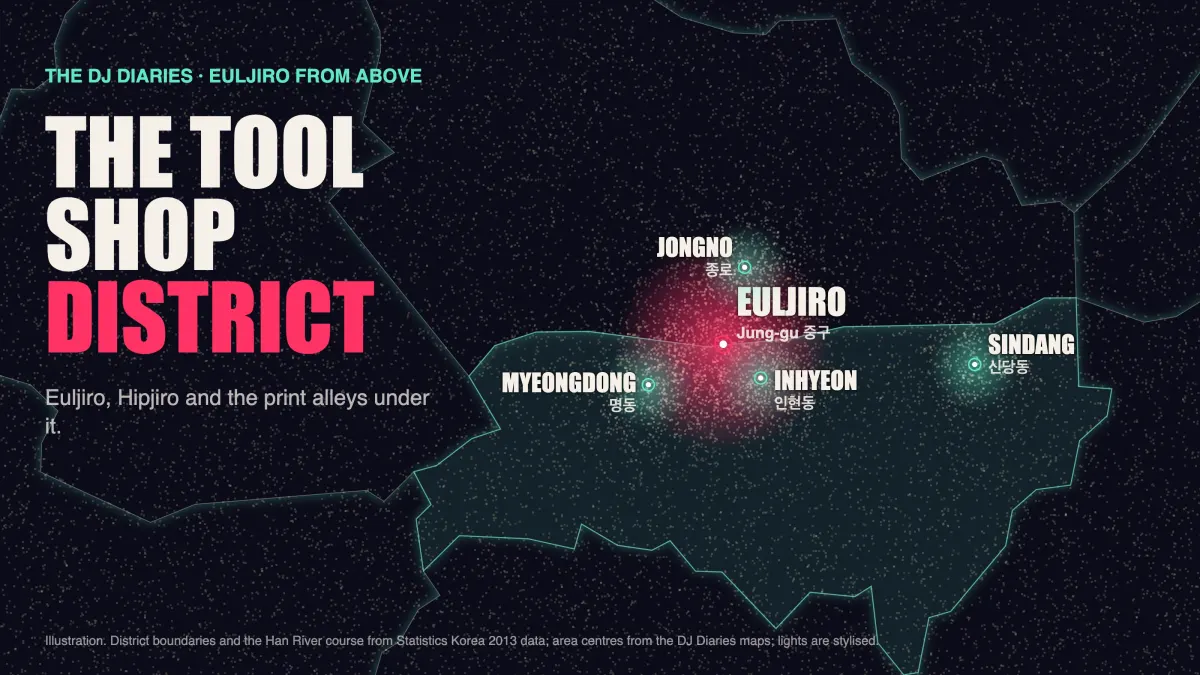
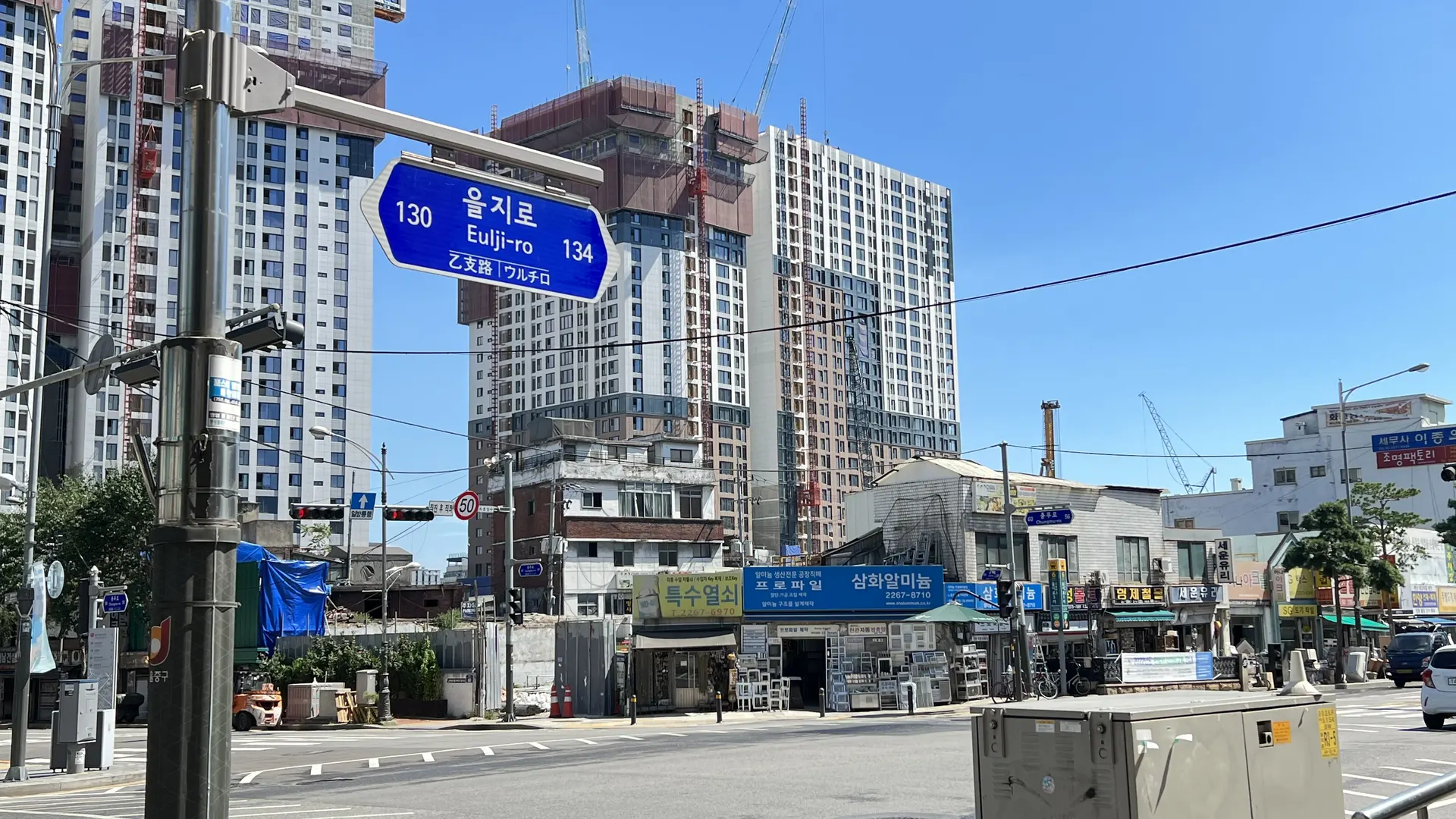
Four years on, Euljiro (을지로) is still busy. The street beer tables are still out, the queues are still long, and the city is planning towers on the old workshop blocks. But a lot of the energy that made the name has moved, some of it a few stops east to Sindang-dong (신당동), and some of it upstairs into quieter listening rooms. This is the longer story of where Hipjiro came from, what it lost, and where it went. Our shorter guide to the district, Euljiro, a.k.a. Hipjiro, has the basics for a first night out.
한국어 요약
힙지로는 어디로 갔나
힙지로는 2010년대 후반 을지로 인쇄 골목 위에 생긴 술집 문화였습니다. 재개발로 2022년 4월 을지OB베어가, 6월에는 을지면옥이 문을 닫았고, 많은 가게가 동쪽 신당동으로 옮겨 갔습니다.
을지OB베어는 2024년 2월 을지로로 돌아왔지만, 종묘 앞 세운4구역 고층 개발을 둘러싼 갈등은 2026년 10월에도 끝나지 않았습니다.
잘못된 정보나 날짜가 있다면 알려 주세요.
How Hipjiro Started: Unsigned Bars Above the Print Shops
Euljiro was never built for going out. The blocks south of Cheonggyecheon were printing, lighting, tile and tool shops, and the printing alley in particular has a long history. Columnist Lee Kwang-pyo (이광표), writing in Kyunghyang in 2023, traced it to the 1910s, when printers set up to make advertising flyers for the cinemas nearby. It grew through the 1960s, took in printers moving over from Jangkyo-dong in the 1980s, and peaked until the mid 1990s. Then the industry shrank, firms left, and the upper floors of old buildings emptied.
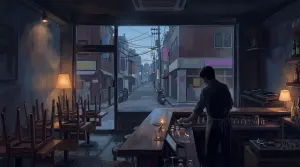
Those empty upper floors are where Hipjiro began. In January 2019 BizHankook walked the alleys around Euljiro 3-ga and found a scene it said had started two or three years earlier and was changing month by month. The people opening rooms were actors, art directors, writers, illustrators, indie musicians, designers and photographers. One shop had ten owners. A theatre actor ran the café Coffee Hanyakbang (커피한약방). Jeong Chan-yu (정찬유), a craft beer distributor, had opened the Seoul Beer Project pub about a month before the reporter arrived, and he described his young customers as enjoying an “Euljiro maze game” (을지로 미로놀이) as they hunted for doors with no signs.
That hunt was the whole format, and the rents were low because the buildings were old and slated for redevelopment. By 2022, Euljiro 3-ga had the second highest monthly sales per square metre of any major district in Seoul, about ₩574,000, behind only Garosu-gil, according to city survey figures reported by Newsis in 2023. An agent told the same reporter that even second and third floor spaces deep in the alleys found tenants who wanted to run cafés and bars.
Lee Kwang-pyo put the uncomfortable part plainly: “힙지로의 본질은 인쇄업의 쇠락에 있다” (the essence of Hipjiro lies in the decline of printing). The bars needed the empty floors, and the empty floors existed because the trade that made the district was dying. The print alleys under Hipjiro are still working, for now, and they are worth a separate walk.
Hipjiro at a glance
From Euljiro print shops to Sindang-dong and back
| When | What happened |
|---|---|
| December 1980 | Eulji OB Bear opens as the first franchise recruited by Dongyang Beer |
| Late 2010s | Hipjiro grows above Euljiro’s print shops; BizHankook walks the alleys in January 2019 |
| April 2022 | Eulji OB Bear is lost to redevelopment (security workers arrive on 21 April) |
| June 2022 | Euljimyeonok closes; much of the scene moves east to Sindang-dong |
| 2022 | Euljiro 3-ga has the second highest monthly sales per square metre in Seoul, about 574,000 won, behind Garosu-gil |
| February 2024 | OB Bear returns to Euljiro, to a bigger room at Chungmuro 49-2 |
| October 2026 | The Sewoon District 4 tower dispute near Jongmyo Shrine is still unsettled |
How to read itRead top to bottom for the order of events. The sales figure comes from city survey numbers reported by Newsis in 2023.
Euljiro and Sindang Nightlife Map: Venues, Streets and What’s On
Here is Euljiro and Sindang as it stands now: the venues, the streets worth knowing and what’s on in the next two weeks. Tap a pin for the sound, the address and directions on Naver or Kakao Map.
Euljiro and Sindang nightlife map
Venues on this map (4)
- The Edge Seoul 디 엣지Bar · 8 Eulji-ro 12-gil네이버 지도 Naver Map카카오맵 Kakao Map
- Jushindang 주신당Bar · 399 Toegye-ro네이버 지도 Naver Map카카오맵 Kakao Map
- Eulji OB Bear 을지OB베어Bar · 49-2 Chungmu-ro네이버 지도 Naver Map카카오맵 Kakao Map
- Gu Seoul 구 서울Cocktail bar · 2F, 82 Majang-ro, Jung-gu (Sindang)네이버 지도 Naver Map카카오맵 Kakao Map
This week in Euljiro · 을지로
Who is playing in Euljiro this week
Tokyo Bedroom Orchestra
Kunst Kabinett Seoul, Euljiro 을지로
ahngae
The Edge Seoul, Euljiro 을지로
The Nogari Alley and the Fight for OB Bear
Long before the upstairs bars, Euljiro had its street beer. Kang Hyo-geun (강효근) opened Eulji OB Bear in December 1980 as the first franchise recruited by Dongyang Beer, the company that became OB, Seoul Shinmun reported. His rules were strict. Weekly Kyunghyang recorded that he wanted beer at 2°C in summer and 4°C in winter, aged three days in the fridge, with the tap line cleaned every day. His daughter, Kang Ho-sin (강호신), took over the bar, and her husband Choi Su-young (최수영) ran it with her, according to BizHankook in 2020. It never expanded, it hired students, and it closed at eleven.
Across the alley stood München Hof (뮌헨호프). Its owner, Jung Gyu-ho (정규호), opened at that spot in 1989 and later chaired the alley’s association of beer halls, Weekly Kyunghyang reported in 2022. When München Hof first opened, the earlier Weekly Kyunghyang piece recorded, its owner asked Kang Hyo-geun whether he could sell beer too, and the two shook hands on it. Jung led the push that won the alley its outdoor service permit from Jung-gu in May 2017, covering about 465 metres of road from 6:30pm for eight hours. Seoul had already named the alley Seoul Future Heritage (서울미래유산) in 2015, and in 2018 the small business ministry listed OB Bear as a century shop (백년가게, baengnyeon gage).
None of that protected the lease. In 2018 the building owner told OB Bear there would be no renewal, an eviction suit followed, and the bar lost at each level. A rival hof group had been expanding across the alley, and its owner’s family had bought into the building, both Weekly Kyunghyang and BizHankook reported. After the April 2022 eviction, supporters held protests and services at the alley crossing for months. München Hof had its own clock: Jung told Weekly Kyunghyang his site sat inside a redevelopment zone and he would have to move, with no guarantee of outdoor tables anywhere else.
Did OB Bear Reopen?
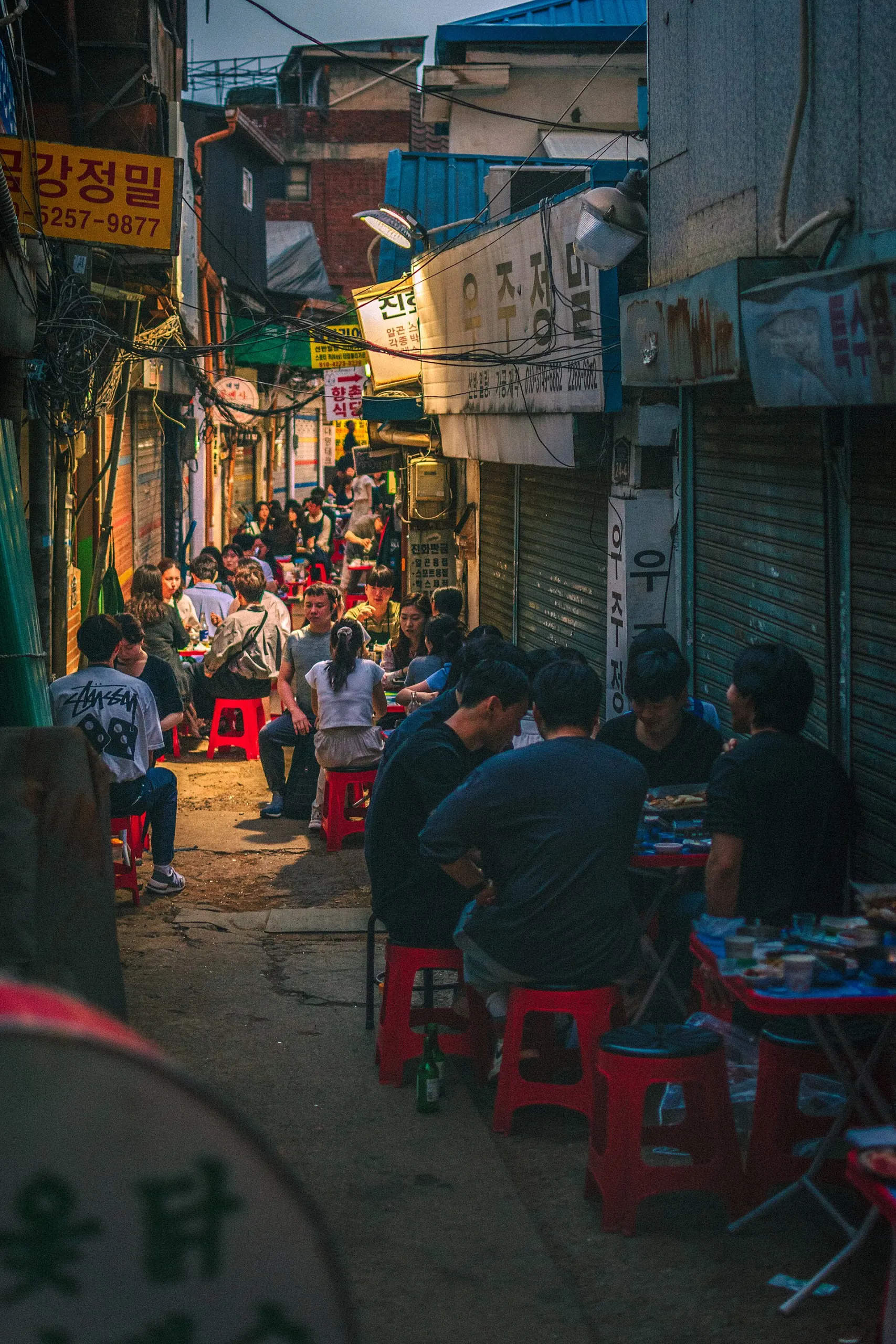
It did. Seoul Shinmun and OhmyNews reported that OB Bear returned to Euljiro in February 2024, to a bigger room at Chungmuro 49-2, with Choi Su-young as its head and Kang Ho-sin running the bar. Namuwiki (나무위키), the crowd edited Korean encyclopedia, lists a spell near Hongik University Station in 2023 under the name 을지OB베어와우 and a later address at Chungmuro 49-2, between exits 9 and 10 of Euljiro 3-ga Station. Choi told Esquire he was cautious about letting a bill go past ₩10,000, and that seeing young people leave the nogari alley made him sad: “노가리 골목 자리가 휑해진 걸 보면 마음이 좀 그래요” (seeing the alley gone empty weighs on me). Check the current address before you go.
Sindang at night, on foot
Bulldozers in the Workshop Quarter: Euljimyeonok, the Tool Street and Sewoon
OB Bear was the loss people photographed, but the bigger change was happening to whole blocks. The noodle house Euljimyeonok (을지면옥), famous for Pyongyang style cold noodles and open for 37 years, lost a round in June 2022 when the Seoul High Court ordered it to hand its buildings to The Center City, the developer of Sewoon zone 3, before a final judgment, Seoul Shinmun reported. The restaurant filed an objection, but the paper expected the buildings to come down.
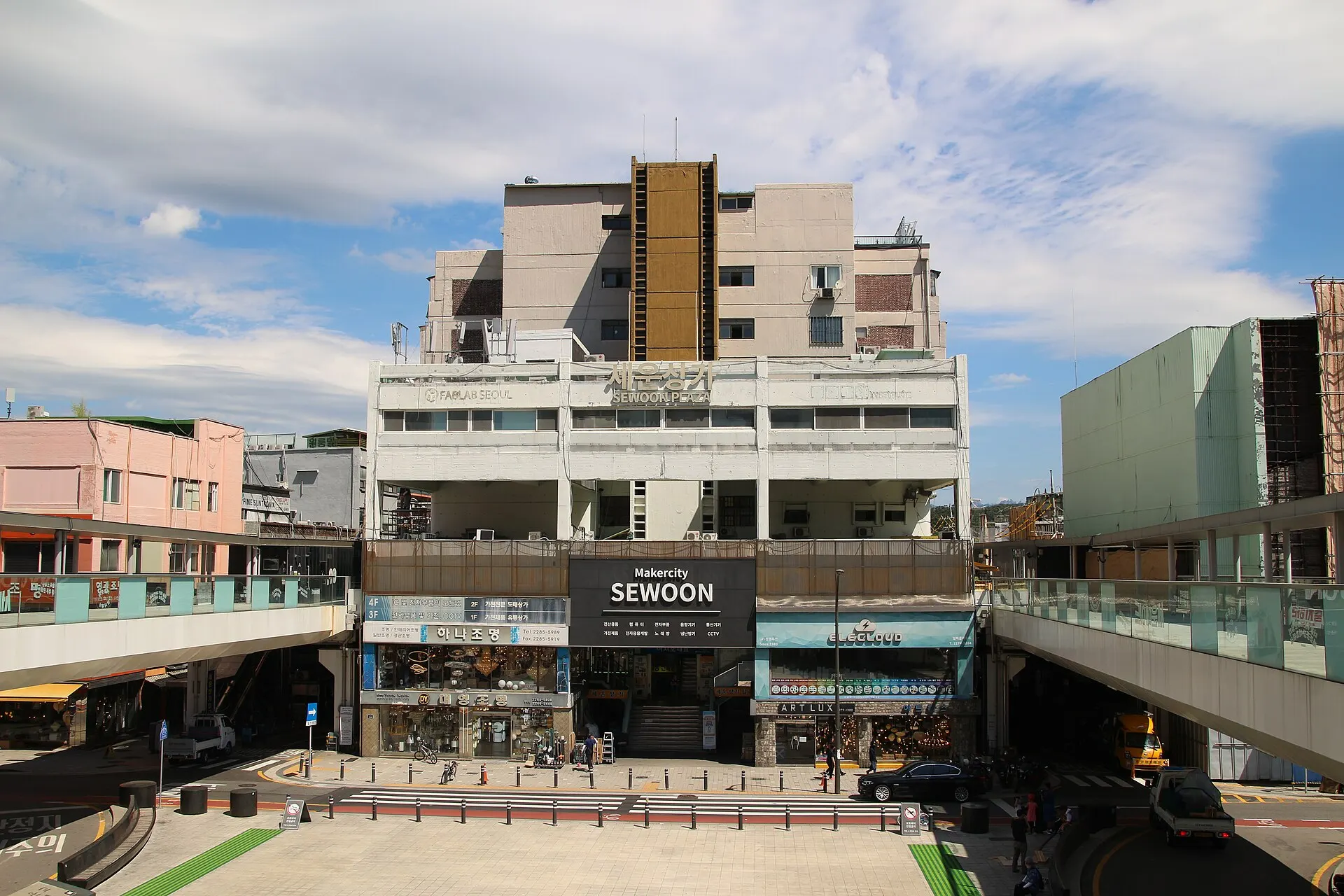
The biggest fight is still unsettled. Seoul has cleared a tower of about 142 metres for Sewoon District 4, across the road from Jongmyo Shrine, and won in the Supreme Court in November 2025, as Kyunghyang reported. UNESCO then asked for the approval to be suspended, according to the JoongAng Daily, and as of October 2026 the national heritage agency was still trying to have it revoked, so nothing has broken ground.
Euljimyeonok served its last bowls on Euljiro on 25 June 2022 after a court ordered the handover, as the JoongAng Daily reported, and the building came down. It reopened in 2024 in Nakwon-dong, in Jongno.
East along Cheonggyecheon, the Ipjeong-dong tool street once worked like one big factory, each shop handling a different process. Redevelopment began there in 2018 and more than 400 businesses closed almost at once, Kyunghyang reported in August 2025. In April 2024 Mayor Oh Se-hoon announced a 33 storey building for the site, and the promised number of public rental shops fell from 110 to 82. Only 15 businesses moved into the temporary buildings. On 17 August 2025, the last technician on the street, Kim Seung-hyun, moved his workshop out. “그래도 여기가 좋았는데” (still, I liked it here), he told the paper.
The new buildings are already arriving. In June 2025 Jung-gu opened Eulji Nuri Center (을지누리센터), an eleven storey public building donated as part of the Euljiro 3-ga District 12 redevelopment, which Kyunghyang headlined as a new block standing tall in Hipjiro.
Sewoon Zone 4 and the Jongmyo Dispute
The largest scheme sits opposite Jongmyo Shrine (종묘), the UNESCO World Heritage royal shrine. Seoul gazetted a plan for Sewoon zone 4 on 30 October 2025 that raised the height limit on the Cheonggyecheon side to about 142 metres, and on 6 November 2025 the Supreme Court ruled that the city’s change to its heritage ordinance was lawful, Financial News reported. A letter from UNESCO’s World Heritage Centre in March 2026 recommended a heritage impact assessment before any approval.
Then local politics stepped in. In June 2026 the incoming Jongno-gu head asked officials to halt the approval, SBS Biz reported, but the outgoing head signed it on 18 June. The Korea Heritage Service asked Seoul to correct the decision, Seoul refused on 6 July, and the agency began routing a request through the culture ministry for the land ministry to revoke the approval, according to Herald Economy. The World Heritage Committee met in Busan that July without a formal decision on Jongmyo, and a heritage committee member told Newsis the matter could return to its agenda. In September the civic group People’s Solidarity for Participatory Democracy said in a statement that a heritage subcommittee had deferred its review in August and that the land minister still had not acted. As of this writing it’s unresolved. The planning law behind it is its own subject, and the heritage agency and the city are the ones to ask.
For anyone who drinks in Euljiro, the point is simpler. The blocks between Jongno and Euljiro that gave the district its texture are being replaced, piece by piece, by buildings that will never rent a third floor to a theatre actor with a turntable.
East to Sindang-dong: Jushindang, Dpin and Nette
While Euljiro fought its landlords, the next wave was opening a few stops east, around the old market streets of Sindang-dong. Esquire Korea went in January 2023 and found a neighbourhood people had started calling Hipdangdong (힙당동). Chef Choi Sang-hyun (최상현) had opened the restaurant Dpin (디핀) in an old building near the market, old outside and modern inside. Next door was Jushindang (주신당), a cocktail bar built around a shrine theme, and by 2020 it had queues forming at sunset. A chicken grill, Eunhwagye (은화계), had opened at the end of 2019. Kim Seong-jin (김성진) chose a spot across from Jungang Market for his natural wine bar Nette (네뜨) because he liked the courtyard in front of the building.
The chef at Dpin asked the obvious question, whether this was a second Euljiro. Esquire’s answer was no. Euljiro mixes old shops and new bars among the workshops, but when the workshops close at night the district empties out. Sindang has a market, shoppers and people who actually live there, and that gives it a different feel. Property agents, the magazine added, compared it more often to Seongsu than to Euljiro, with fashion shops and pop ups following the restaurants.
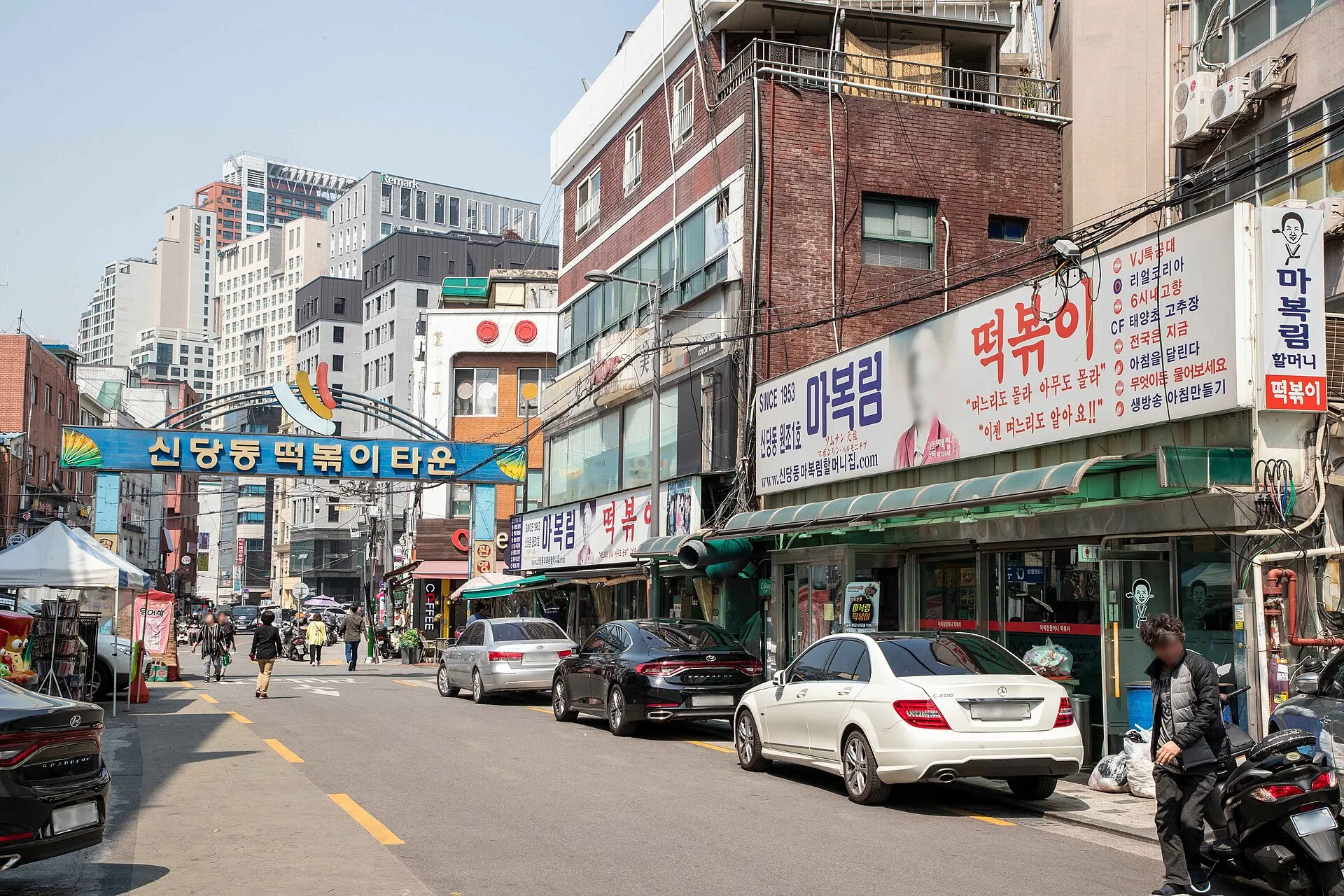
By 2026 Sindang was being written about as a destination in its own right. In July the Seoul Museum of History released a report called 신당동: 神·新·Hip, and Herald Economy and Dong-A Ilbo both used it to tell the neighbourhood’s story. Shamans barred from living inside the city walls once settled outside Gwanghuimun, which is where the old name, written with the character for spirit, came from. After the 1894 Gabo Reforms the character was swapped for the one meaning new. Ma Bok-lim (마복림) started the tteokbokki street in the 1950s. Jang Ji-ho (장지호), who runs Jushindang, told Dong-A that about 40 percent of weekday visitors are foreign, and Herald Economy reported that Westerners have taken a strong interest in the bar’s Korean zodiac concept. On the rice market street, Kwak Hyeon-geol (곽현걸) runs the musical pub Showflix (쇼플릭스) and credits its closeness to Dongdaemun for the foreign crowd.
Anyone who watched Montreal’s scene drift from the Plateau into Mile End knows the pattern. Cheap rooms draw the people who make a place interesting, the crowds follow, and the rents send the next group somewhere else. Sindang got the people who might have opened upstairs in Euljiro five years earlier.
What Is Left in Euljiro: Listening Rooms and Street Beer
Hipjiro didn’t vanish. It changed shape. By 2024 an Esquire writer could say “힙지로” had become something close to a term of mockery, worn down by gimmicks and by rooms passing off sloppiness as cool. But the street beer economy is bigger than ever. On a July 2026 evening Financial News found queues of more than thirty minutes, alleys closed to cars, and beer brands running pop ups in Euljiro, with students saying the fun was finding hidden spots behind old signs.
The rooms that last tend to be the ones built around listening rather than looking. In November 2021 Local Stitch opened a Listening Zone in the eighteenth floor lounge of its Creator Town building on Changgyeonggung-ro, where visitors play LPs on turntables with headphones, HEYPOP reported. The first season, curated by the Tokyo Dabansa team, focused on ALFA Music and ECM, two labels founded in 1969, and it was free with a booking. Down at street level, Marie Claire Korea listed Jeonchuk (전축), a second floor bar on Chungmuro that plays records through a 1970s vintage system. Near Euljiro 4-ga and Bangsan Market, Im Seong-eun (임성은) opened Hell Cafe Music because, as Im told Esquire, a good spot happened to come up at a good price. If records are your reason for going out, our guide to Seoul’s vinyl bars covers the wider city.
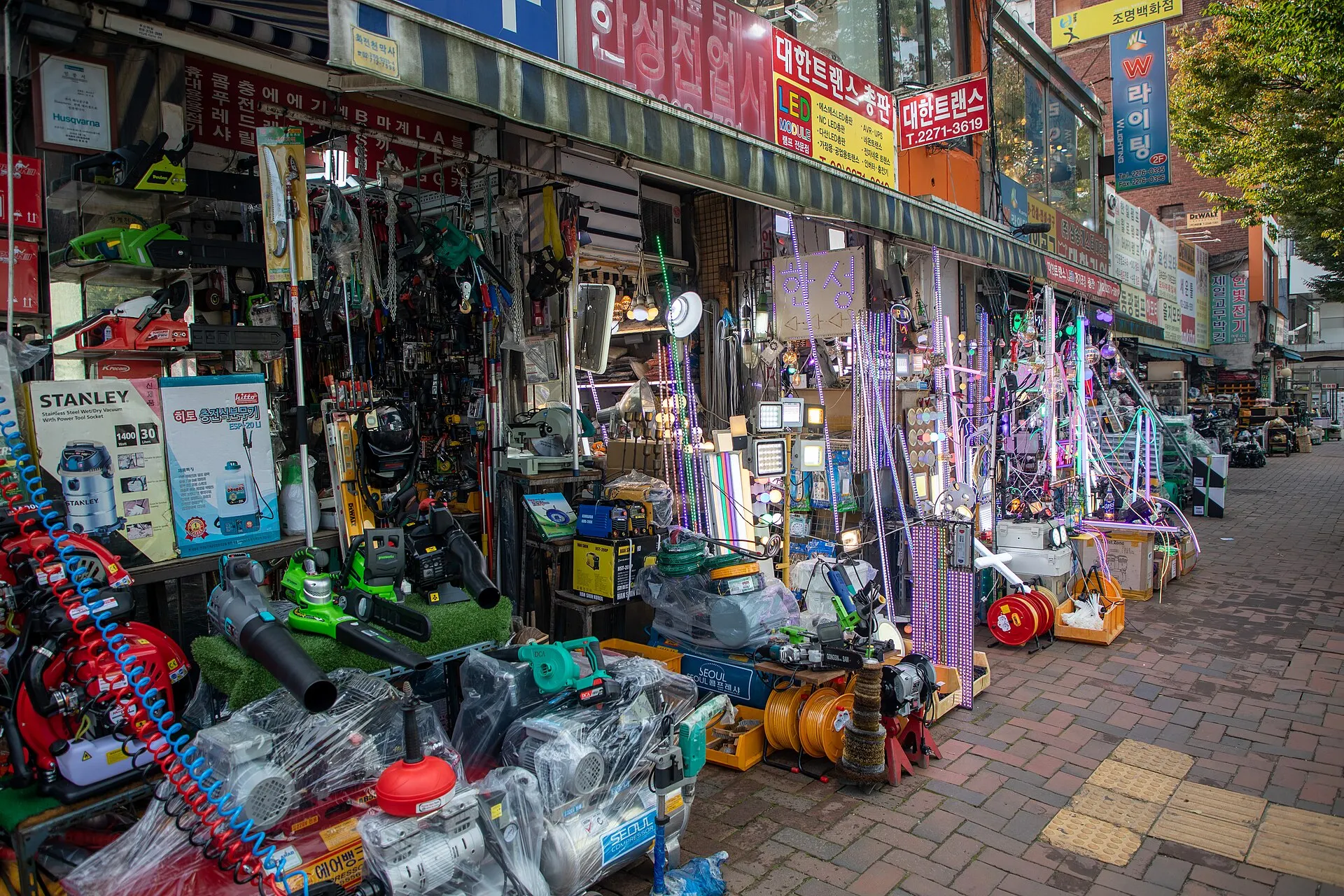
A listening bar needs a small room and no street sign, which is why it still fits here. What the district has lost is the sense that anyone with a small idea could rent a floor and try it. An operator quoted in the same Esquire piece said it has become hard for an individual to do anything in the centre of Euljiro now.
Visiting Euljiro and Sindang-dong Now
For Euljiro, Euljiro 3-ga Station on Lines 2 and 3 puts you between the printing alley and the nogari alley. The alley’s outdoor tables run from 6:30pm under the Jung-gu permit. Go once in daylight too, while the presses are running, and the night will make more sense. Rooms upstairs are small, so a big group should call ahead.
For Sindang-dong, Sindang Station on Lines 2 and 6 is the easy way in, and the bars cluster around Jungang Market, the tteokbokki street and the rice market street. The two stations are three stops apart on Line 2, which makes it a natural two stop night: a beer on a plastic stool in Euljiro, then a cocktail in Sindang. Neither area runs like Itaewon until dawn, so check your last train in our getting home planner before the second round.
If you ran a bar upstairs in Euljiro, or opened one in Sindang when it was still quiet, the contact page is always open.
Frequently Asked Questions
Is Hipjiro over?
Not as a night out. Euljiro’s street beer and bars still draw big crowds, as Financial News found in July 2026. What has faded is the early scene of cheap, unsigned upstairs rooms, as redevelopment takes buildings and rents rise. Much of that energy has moved east to Sindang-dong.
Did Eulji OB Bear reopen after the 2022 eviction?
Yes. Seoul Shinmun and OhmyNews reported that it returned to Euljiro in February 2024, run by Kang Ho-sin, the founder’s daughter, and her husband Choi Su-young. Namuwiki lists an address at Chungmuro 49-2, near Euljiro 3-ga Station. Confirm the current address before visiting.
Where are the bars in Sindang-dong?
Mostly around Jungang Market, the tteokbokki street and the rice market street near Sindang Station. Jushindang, Dpin and the natural wine bar Nette were among the places that put the area on the map from about 2020.
What is happening with Sewoon and Jongmyo?
Seoul raised the height limit for Sewoon zone 4, opposite Jongmyo Shrine, to about 142 metres in 2025, and Jongno-gu approved the plan in June 2026. The Korea Heritage Service and UNESCO want a heritage impact assessment first, and the dispute was still open in September 2026.
Sources and Further Reading
Every fact above comes from the reports below. Korean sources are listed by outlet and Korean title where that helps you find them. Namuwiki is crowd edited and is cited only where noted.
- Weekly Kyunghyang: 을지로 ‘노가리 골목’에 오시라 (2022)
- Weekly Kyunghyang: 힙지로 골목은 ‘만선 특혜 골목’인가 (2022)
- BizHankook: 을지로 3가, 인쇄소 골목과 노가리 골목서 ‘보물찾기’ (2019)
- BizHankook: 40년 노포 ‘을지OB베어’가 사라지면 볼 수 없을 풍경들 (2020)
- Seoul Shinmun: 노가리골목 39년 지킨 ‘을지OB베어’ 사라질 위기 (2019)
- Esquire Korea: 힙지로 열풍이 지나간 이후 을지로에 터를 잡은 6곳의 가게 (2024)
- Namuwiki (crowd edited): 을지OB베어
- Kyunghyang: 이광표, 힙지로의 두 얼굴 (2023)
- Newsis: MZ는 물론 외국인 관광객도 몰려, 더 ‘힙’해진 을지로 (2023)
- Seoul Shinmun: 37년 노포 을지면옥 헐릴 듯 (2022)
- Kyunghyang: 청계천 공구거리, 마지막 남은 기술공의 이삿날 (2025)
- Kyunghyang: 힙지로에 우뚝 선 11층 신축건물 (2025)
- Financial News: 종묘 앞 145m 고층건물, 세계유산 지위 흔들 (2025)
- SBS Biz: 세운4구역 재개발 ‘제동’ (2026)
- Herald Economy: 국가유산청, 종묘 개발 직권 취소 절차 착수 (2026)
- Newsis: 세계유산위 결산, 이젠 종묘가 시험대 (2026)
- People’s Solidarity for Participatory Democracy: statement on Sewoon 4 (2026)
- Esquire Korea: ‘힙당동’이 된 신당동에는 을지로와는 다른 바이브가 흐른다 (2023)
- Herald Economy: ‘힙당동’ 된 신당동 떡볶이거리의 신들린 변신 (2026)
- Dong-A Ilbo via Daum: 무당촌에서 ‘힙당동’ 되기까지 (2026)
- HEYPOP: 을지로에 흐르는 아날로그 감성, Local Stitch Listening Zone (2021)
- Marie Claire Korea: 음악 듣기 좋은 바 4 (2023)
- Financial News: 철공소 옆 감성카페 가고 야장서 한잔 (2026)
- The Korea Times: Seoul city, heritage agency clash over 140m tall building near Jongmyo Shrine (2025-11-04)
- Korea JoongAng Daily: Clash over Seoul’s Jongmyo Shrine pits preservation against urban development
- Seoul Metropolitan Government: 낮에는 인쇄소, 밤에는 ‘힙지로’
- The Korea Times: Decades old pub in Euljiro fades into history (2022-05-06)
- Seoul Shinmun: 을지OB베어, 을지로3가 돌아온다 (2024-02-15)
- OhmyNews: 쫓겨났던 백년가게, ‘을지오비베어’가 을지로에 돌아왔다 (2024-02-16)
- KBS News: 우여곡절 끝 돌아온 을지OB베어 (2024-02-17)
- WikiTree: 백년가게 ‘을지OB베어’ 결국 강제 철거 (2022-04-21)
Written from Seoul by The DJ Diaries, in Seoul since 2002 and in the booth for thirty years. More on the site, or book a DJ.
Stay in the Loop
New writing on DJ culture, electronic music, and the Seoul underground, delivered when it matters.
More From The DJ Diaries
Play with the history
Four tools built from the same research as this site.