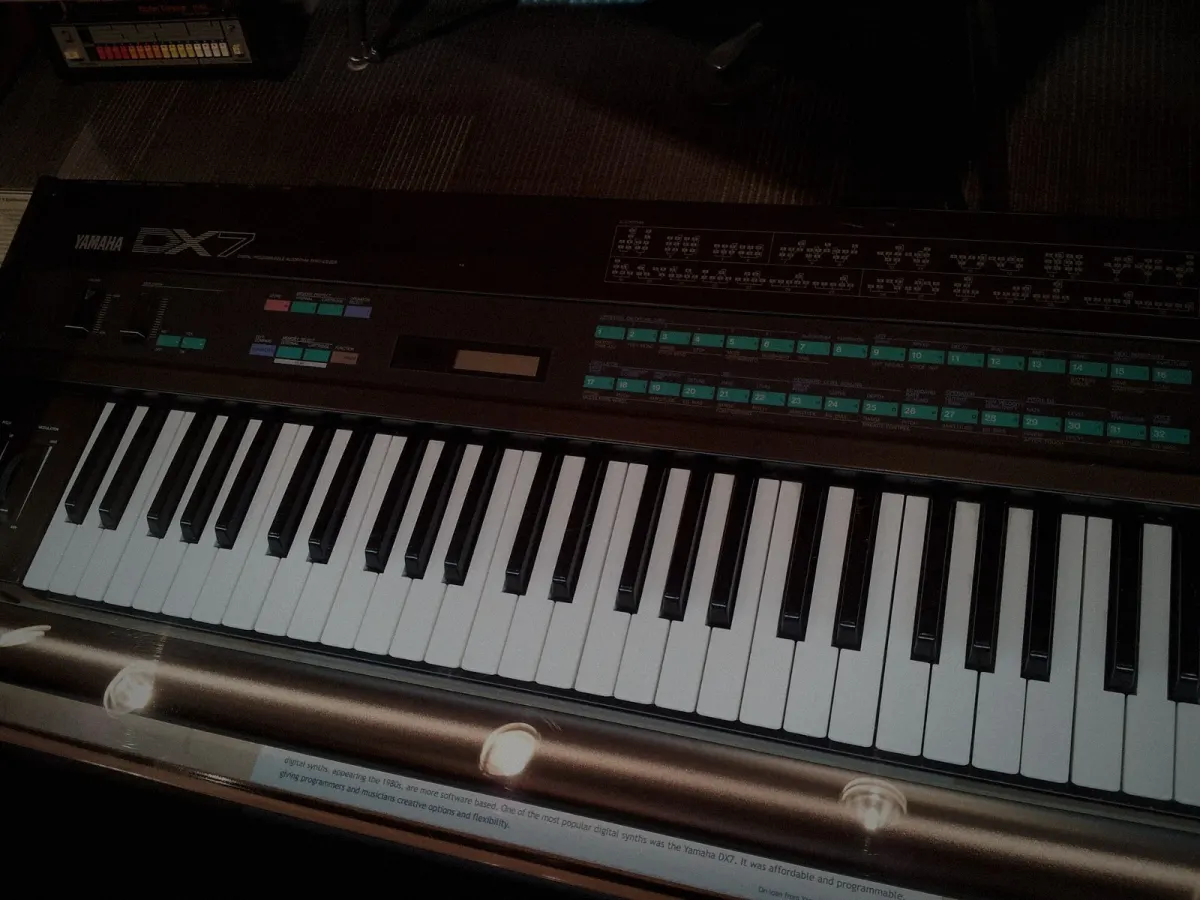
The DX7 didn’t sound like anything that came before it, and for about five years, it was the sound of nearly everything. No instrument owned a decade so completely.
Chowning’s Algorithm Finds a Body
FM synthesis, using one oscillator to modulate the frequency of another, was worked out by John Chowning at Stanford in the late 1960s and licensed to Yamaha when American manufacturers passed. Run the modulator slowly and you get vibrato. Push it up near the carrier’s frequency and you get metallic, glassy, bell-like spectra that voltage-controlled analogue circuits couldn’t produce. The DX7, released in 1983, was the first affordable instrument to put that mathematics in a keyboard: $1,995, sixteen-voice polyphony, MIDI in its first year of existence, and a sound that made every analogue synth in the shop, the Minimoog included, seem suddenly antique. Yamaha sold more than 200,000 units, numbers no professional synthesizer had approached.
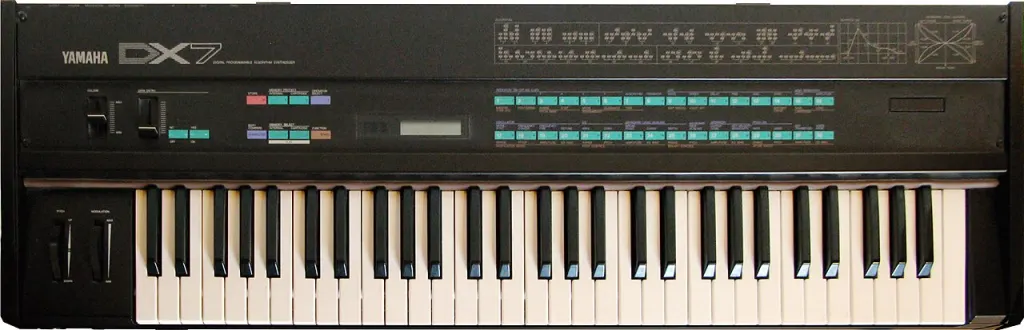
Yamaha DX7
The first affordable keyboard to put FM mathematics under your fingers
- Type
- Digital FM synthesizer
- Launched
- 1983 at $1,995, £1,495 in Britain, ¥248,000 in Japan
- Changed
- Made the sound of the 1980s, bells and BASS 1 included
- Heard on
- 40 percent of US number ones in 1986, by one widely cited count
- Ended
- In production until 1989
The machinesTen instruments on The DJ Diaries, from 1970 to 2006, drawn to scale. Tap a dot to read its story.
The Preset Decade
Programming FM through a membrane panel and a two-line display was famously miserable, so almost nobody did. Instead the world ran on presets, above all E PIANO 1, the electric piano patch that effectively replaced the Rhodes on record. It’s on Whitney Houston ballads, Chicago’s 19, countless quiet-storm and gospel records, and, by one widely cited count, 40 percent of the US Billboard Hot 100 number ones of 1986, and 60 percent of R&B number ones. Add BASS 1 for the solid FM low end, the bells, the flutes, and the marimbas, and you can reconstruct 1983 to 1988 from a single instrument’s factory bank.
The Dance Music Afterlife
Dance music’s relationship with FM outlived the pop era. Techno producers prized FM’s percussive attack and inharmonic clang, Detroit’s second wave ran DX-family bass on foundational records, and the lineage continues through modern FM monsters in every serious rig. The characteristic solid-state DX bass never left UK pirate-era styles, and today’s software FM, finally programmable by humans, powers everything from neurofunk growls to the glassy tops of hyperpop. The sound that once meant polished pop now signals a producer who understands spectra.
What the DX7 Proved
Three lessons. Digital could win on character as well as convenience, a decade before software. Presets are distribution, the way a sound conquers a culture, the same mechanism that later carried stock plugins into chart music. And interfaces decide history: the DX7’s unprogrammability is why analogue came roaring back with knobs-per-function designs like the reissued MS-20. The 1980s didn’t choose FM because it was easy. They chose it because nothing else sounded like the future, and for one decade, it was.
Where FM Lives in 2026
The DX7 sound is easier to own now than at any point since 1983, because most producers never touch the hardware. Dexed, a free plugin released under the GPL v3 licence, is closely modelled on the DX7 and can load original DX7 cartridge banks. That puts E PIANO 1 and BASS 1 one download away. Yamaha still makes FM hardware as well: the reface DX runs a four operator FM engine with variable feedback on every operator, in a keyboard small enough for a backpack. The mathematics Chowning worked out now costs nothing to try.
What does FM do on a dancefloor in 2026? Mostly it shows up in the chords and the top end. That glassy electric piano stab, the E PIANO 1 family of sounds, turns up again and again in deep house and in the 1990s style house that has come back in the last few years. It sits above a kick drum without fighting it, because most of its energy is high and short. On a club system it reads as warmth. The same patch on laptop speakers reads as nostalgia.
The bass is the other story. FM bass has a hard, percussive attack that survives small speakers better than a round analogue sub, which is one reason it lasted in the UK styles mentioned above. In a booth, I notice it when a record holds up on a weak system. A track built on FM bass keeps its outline when the subs aren’t doing their job. My genre and BPM guide shows where those FM heavy styles cluster by tempo.
The lesson of the preset decade holds, with a twist. Presets still conquer cultures, and free plugins now spread them faster than a $1,995 keyboard ever could. What changed is that a producer can finally open a patch and see how it works, which the original membrane panel made almost impossible. That’s the best thing to happen to FM since 1983. I traced the wider pattern in my piece on DJ equipment through the decades: tools that become understandable become useful.
FM is a tool now.
Frequently Asked Questions
What’s FM synthesis on the Yamaha DX7?
FM synthesis uses one oscillator to modulate the frequency of another, and the Yamaha DX7 was the first affordable keyboard built on it. Run the modulator slowly and you get vibrato; push it near the carrier’s frequency and you get metallic, glassy, bell like sounds that analogue circuits couldn’t produce. John Chowning worked out the method at Stanford in the late 1960s and licensed it to Yamaha.
When did the Yamaha DX7 come out and how much did it cost?
The Yamaha DX7 was released in 1983 at $1,995. It offered sixteen voice polyphony and MIDI in the first year MIDI existed. Yamaha sold more than 200,000 units, numbers no professional synthesizer had approached before. Outside the US it sold for £1,495 in Britain and ¥248,000 in Japan, and Yamaha kept it in production until 1989.
What songs used the DX7 electric piano sound?
The DX7 preset E PIANO 1 effectively replaced the Rhodes on record in the 1980s. It’s on Whitney Houston ballads, Chicago’s 19, and countless quiet storm and gospel records. By one widely cited count, it appeared on 40 percent of the US Billboard Hot 100 number ones of 1986.
Is the DX7 used in techno and dance music?
Yes, the DX7 and FM synthesis outlived the pop era in dance music. Techno producers prized its percussive attack and inharmonic clang, and Detroit’s second wave ran DX family bass on foundational records. Today software FM powers everything from neurofunk growls to the glassy tops of hyperpop, a lineage traced in techno from Detroit to the dancefloor.
Written from Seoul, by someone who has been in the booth for more than twenty years. More on the site, or book a DJ.
Watch and listen: Yamaha · The DX7 E.Piano 1 preset
Stay in the Loop
New writing on DJ culture, electronic music, and the Seoul underground, delivered when it matters.
More From The DJ Diaries



Play with the history
Four tools built from the same research as this site.