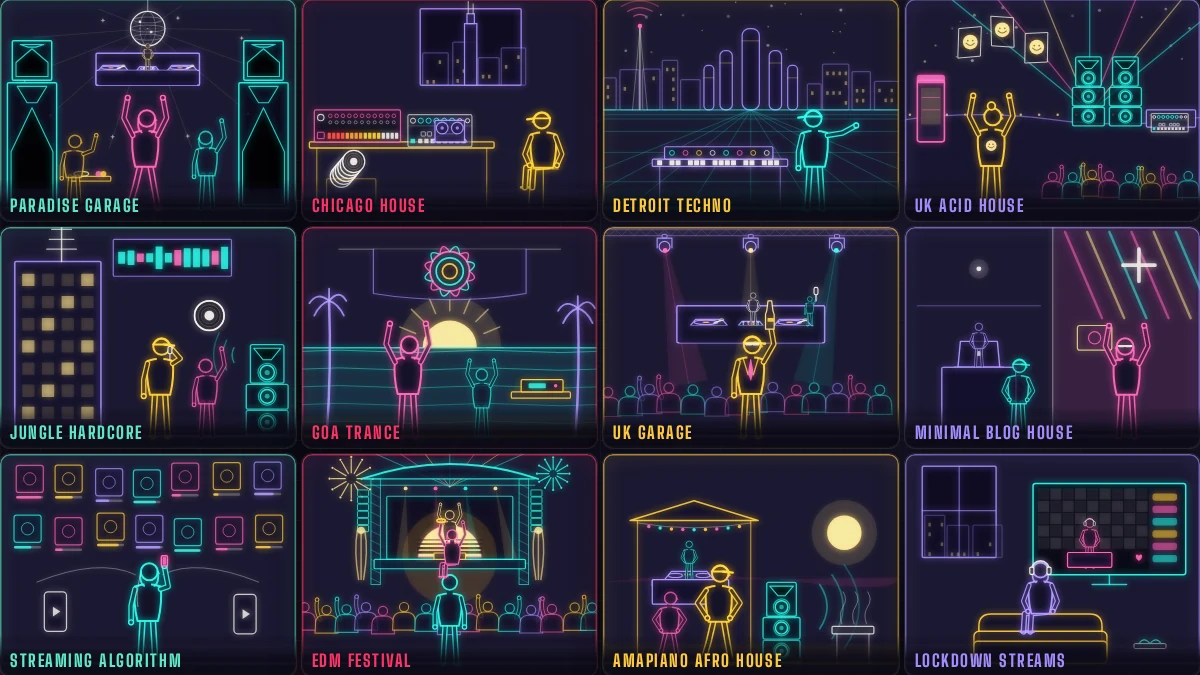
There are, depending on who is counting and how angry they are about it, well over a hundred genres of dance music. People treat that as a problem, proof that the whole thing has splintered into labels nobody needs. I see it the other way. A hundred and seventy six genres is a family that has kept growing for more than eighty years, and once you draw the family lines, the growth has a clear shape.
So we drew them. The Dance Music Tree puts time along the bottom and gives every family its own lane: soul and funk, Latin and Afro, disco, house, techno, synth and industrial, rave, trance, jungle, garage and bass, hip hop, R&B, chill and lo-fi, and pop. Each genre sits at the year it took shape, and a line runs back to the sound it grew out of. Seen that way, the history stops being a list.
What the tree reveals
An alphabetical list of genres is close to useless. Put them on a family tree and patterns jump out that you can’t see any other way:
- The roots are older than the clubs. Cumbia, bossa nova, soul, funk and Jamaican dub sit on the far left, and almost every line on the tree eventually runs back to them.
- Everything branches around 1984 to 1994. In ten years Chicago house, Detroit techno, acid house, breakbeat hardcore, trance, jungle and gabber all appear, and the tempo ceiling shoots past 160, 180 and 200 BPM.
- Hip hop has its own tree inside the tree. From Bronx block parties to boom bap, the Dirty South, Memphis rap, crunk and trap, then drill, cloud rap and rage, and it keeps feeding other families: trip hop, grime, Latin trap, phonk.
- The UK bass family is a tight cluster. UK garage, 2 step, grime, dubstep and UK drill sit close together in time and around 130 to 145 BPM, so close they’re practically neighbours.
- The newest branches grow at the edges. Amapiano, gqom, hyperpop, rage and 3 step show the music doing what it has always done: borrowing from several parents at once, faster than anyone can name it.
Explore all 176
The tree is fully interactive. Drag to explore, pinch or scroll to zoom, and filter by family or by tempo. Tap any genre and the tree lights up everything it came from and everything that came after. A panel opens with its story, what it sounds like, its tempo, the artists to start with and a track to hear. New to all this? Pick one genre you already like, play its suggested track, then tap its parent and play that one. Two or three steps back is usually enough to hear the family resemblance. Solid lines show what a genre grew out of. Dashed lines show other sounds that shaped it, checked against the genre pages on Wikipedia.

The point of counting to 176
People who complain about “too many genres” usually mean they have stopped being able to keep up, which is fair, because nobody can. But every one of those names exists because a specific group of people, in a specific place, needed a word for something they were doing that didn’t have one yet. The genre names are fossils of real scenes. A hundred and seventy six of them is a hundred and seventy six times the music refused to sit still. That’s not fragmentation. That’s a sign of life.
The tree will keep growing. When a new sound finds its name, it gets a place on a branch. The download shops keep naming them too: on 4 April 2025 Beatport added Ambient / Experimental as a standalone genre and split Downtempo out from Organic House.
Want the tempos side by side for mixing? Pair the tree with the BPM guide and plan a blend between any two genres with Tempo Bridge.
Related: The Family Tree of Dance Music · How Fast Is Each Genre? A DJ’s BPM Guide · The Genre Encyclopedia →
Frequently Asked Questions
How many dance music genres are there?
Well over a hundred, depending on who is counting. The Dance Music Tree maps 176 of them in 14 families, from cumbia and soul to amapiano and rage. Each one is placed at the year it took shape and linked to the sounds it grew out of. Every genre name exists because a specific group of people in a specific place needed a word for something that didn’t have one yet.
Are there too many electronic music genres?
No, the large number of genres is a sign of life rather than fragmentation. People who complain about too many genres usually mean they have stopped being able to keep up, which is fair, since nobody can. Genre names are fossils of real scenes, and each one marks a time the music refused to sit still.
Why did dance music genres get so fast in the rave era?
Between roughly 1988 and 1994, the rave era, the tempo ceiling of dance music shot up. Breakbeat hardcore, jungle, gabber and happy hardcore all climbed past 160, 180 and 200 BPM within a few years. On the Dance Music Tree, the tempo filter shows that burst clearly: switch to 150 and up and almost every genre that lights up was born in the early 1990s or grew from one that was.
Which dance music genres have a similar tempo?
UK garage, grime, dubstep and drill form a tight cluster at around 130 to 145 BPM, and house, tech house and afro house share the 118 to 130 range. In the tree, every genre panel has a “Sounds close to” list that shows cousins with a shared root and an overlapping tempo. For tempos side by side, see the BPM guide.
Where do hip hop and lo-fi fit in the dance music family?
Both are in the tree. Hip hop grew from funk and Jamaican sound system culture in the Bronx in 1973 and branched into boom bap, gangsta rap, trap, drill and many more. Lo-fi hip hop sits in the chill family, built on the jazzy loops of producers like J Dilla and Nujabes, next to ambient, trip hop, downtempo and chillwave.
Further Reading
- Wikipedia: a list of electronic music genres
- Wikipedia: beats per minute and how tempo is measured
- Wikipedia: disco, the root system of modern dance music
- Wikipedia: hardcore and the rave era tempo climb
- Wikipedia: hip hop music and its subgenres
Written from Seoul, by someone who has been in the booth for more than twenty years. More on the site, or book a DJ.
Stay in the Loop
New writing on DJ culture, electronic music, and the Seoul underground, delivered when it matters.
More From The DJ Diaries



Play with the history
Four tools built from the same research as this site.