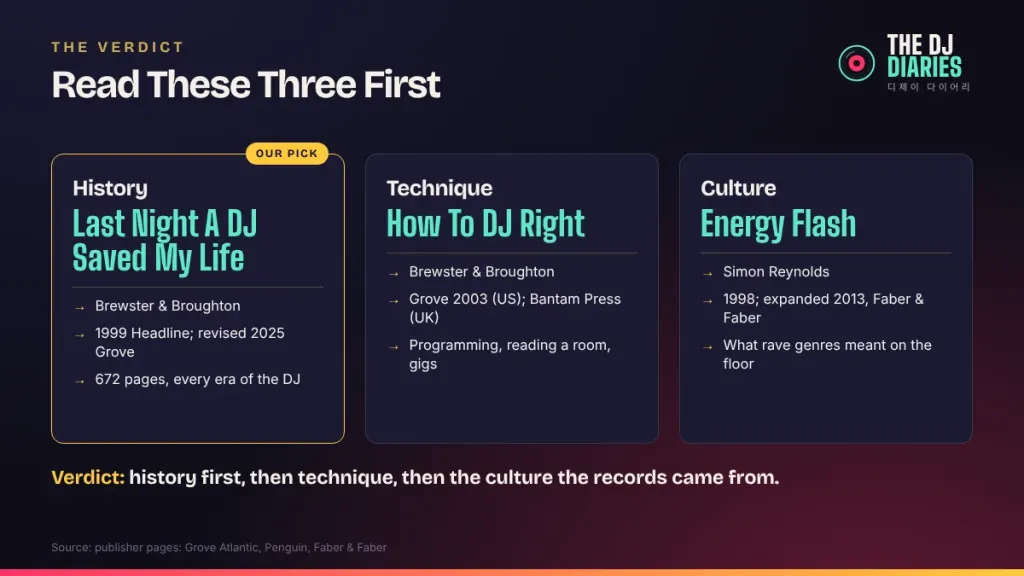
The best DJing books for 2026 are, in order: Last Night A DJ Saved My Life by Bill Brewster and Frank Broughton for history, How To DJ Right by the same pair for technique, and Simon Reynolds’ Energy Flash for the culture the records came from. Read those three first, then pick from the nine below according to what you actually need: mixing skills, the money side, or the story of one city’s scene.
Every book here was checked against its publisher or a library record for author, year and publisher, because DJ reading lists online are full of wrong dates and books that were never written. Nothing on this list is sponsored, and none of the links earn a commission. It is simply the shelf we would hand a new DJ who asked what to read between practice sessions.
Why Read About DJing At All
Because the booth rewards context. Software will tell you a track’s key and tempo; it will not tell you why a disco edit made a Paradise Garage crowd scream in 1979 or why a 128 BPM record empties a Berlin floor at 4am. The DJs who last are the ones who know where their records came from, and the fastest way to learn that is still a book on the train home. If you are at the very start, our How To Start DJing beginner’s guide covers the gear and the first hundred hours; this list is for everything around those hours.

The Ranked List: 12 DJing Books Worth Your Time
1. Last Night A DJ Saved My Life (Bill Brewster And Frank Broughton)
First published by Headline in 1999, and freshly revised by Grove in February 2025 with two new chapters, more on the women DJs who broke the pattern, and a foreword by James Murphy of LCD Soundsystem. At 672 pages in the Grove paperback, it runs from the first radio disc jockeys through Jamaican sound systems, disco, hip hop, house and techno. It is the closest thing the craft has to a family history, and it is the book every other book on this list quietly cites. If you only buy one, buy this. Our own brief history of DJing is the short version.
2. How To DJ Right / How To DJ (Properly) (Bill Brewster And Frank Broughton)
The same authors, published as How To DJ (Properly) by Bantam Press in the UK (the current 304 page paperback is dated November 2006) and as How To DJ Right by Grove Press in the US in 2003. Beatmatching, cutting, programming, buying records, getting gigs and running a party. The gear chapters have dated, since it was written in the vinyl and CD era, but the chapters on reading a room and building a set have not aged a day, and those are the chapters that matter.
3. Energy Flash (Simon Reynolds)
First published in 1998 (the US edition, retitled Generation Ecstasy, followed in 1999), then expanded in 2008 and again in 2013, with the current UK edition from Faber & Faber covering dubstep and the American EDM boom. Reynolds is a critic, not a DJ, and that is the point: he explains what hardcore, jungle, trance and garage meant to the people dancing to them. Read it beside our acid house and Second Summer Of Love piece.
4. Love Saves The Day (Tim Lawrence)
A History Of American Dance Music Culture, 1970-1979, published by Duke University Press in February 2004, 528 pages built on more than 300 interviews. David Mancuso’s Loft, the Sanctuary, the Gallery and the Garage, with discographies at the back that work as a shopping list. The follow up, Life And Death On The New York Dance Floor, 1980-1983 (Duke, September 2016), covers the next chapter.
5. Altered State (Matthew Collin, With John Godfrey)
Serpent’s Tail first published this history of ecstasy culture and acid house in 1997, and White Rabbit reissued it in June 2026 with a new foreword by Kate Hutchinson, which makes it the freshest edition on this list. Where Reynolds writes about sound, Collin writes about police, politics and the Criminal Justice Act. You need both.
6. Techno Rebels (Dan Sicko)
Published in 1999 and revised for Wayne State University Press in 2010 with a foreword by Bill Brewster. The Belleville Three, the Detroit party scene of the 1980s and how the sound crossed to Europe. Short, clear and still the best single book on Detroit. Pair it with our Detroit techno history.
7. Der Klang Der Familie (Felix Denk And Sven Von Thülen)
An oral history of Berlin techno after the Wall fell, first published in German in 2012 and released in English on 9 November 2014, the 25th anniversary of the fall. Tresor, E Werk and the squats, told by the people who were there. Oral histories are the best way to understand how a scene felt, and this is the best of them.
8. Bass, Mids, Tops (Joe Muggs And Brian David Stevens)
An oral history of UK sound system culture from Strange Attractor, released in summer 2019, about 500 pages with portraits by Stevens. Dennis Bovell, Norman Jay, Adrian Sherwood, Skream and Rinse FM all speak. Anyone who plays bass music should read it before they touch the low end of a club EQ; our piece on sound systems and the dancefloor picks up the thread.
9. The Secret DJ (Anonymous)
A memoir by an unnamed, globally booked DJ, published by Faber Social in June 2018. Thirty years from acid house to EDM, with the hotel rooms, the promoters who vanish and the gigs nobody tells you about. It is funny, often bleak and more honest about the job than any interview. A second volume followed from Velocity Press.
10. The Hacienda: How Not To Run A Club (Peter Hook)
Simon & Schuster, 2009, with the UK paperback following in 2010. New Order’s bassist on the Manchester club that lost money for fifteen years and changed British nightlife anyway. It is the best book on the business of venues precisely because it is a list of what went wrong. Our take is in The Haçienda lost money and changed everything.
11. All You Need To Know About The Music Business (Donald S. Passman)
The 11th edition, Simon & Schuster, October 2023, 560 pages. A music lawyer explains contracts, publishing, royalties and streaming money. It is written for artists signed to labels, not club DJs, so skip the touring chapters, but the moment you release a track or an edit you need the publishing section. Our explainer on who gets paid when a record plays is the dance music version.
12. Club Cultures (Sarah Thornton)
Published in 1995, this is the academic one: Thornton’s idea of “subcultural capital” explains why clubbers care so much about being early to a sound and why the press shapes scenes rather than just reporting them. Dense in places, but it will change how you think about your own guest list.
Comparison Table: Who Each Book Is For
| Book | Year And Publisher (Current Edition) | Pages | Who It Is For | What You Learn | Level |
|---|---|---|---|---|---|
| Last Night A DJ Saved My Life | 1999 Headline; revised 2025 Grove | 672 | Every DJ | The full history of the DJ | Beginner |
| How To DJ Right / How To DJ (Properly) | 2003 Grove (US); Bantam Press (UK) | 304 | New DJs | Mixing, programming, getting gigs | Beginner |
| Energy Flash | 1998; expanded 2013 Faber & Faber | Not listed | Anyone playing UK or rave sounds | What each genre meant on the floor | Intermediate |
| Love Saves The Day | 2004 Duke University Press | 528 | House and disco DJs | New York 1970s club culture | Intermediate |
| Altered State | 1997 Serpent’s Tail; reissued 2026 White Rabbit | Not listed | Readers of Energy Flash | Rave politics, policing, the law | Intermediate |
| Techno Rebels | 1999; revised 2010 Wayne State | 176 | Techno DJs | Detroit and the Belleville Three | Beginner |
| Der Klang Der Familie | 2012 German; English 2014 | Not listed | Techno DJs, Berlin visitors | Post Wall Berlin, in witnesses’ words | Beginner |
| Bass, Mids, Tops | 2019 Strange Attractor | About 500 | Bass music DJs | UK sound system lineage | Intermediate |
| The Secret DJ | 2018 Faber Social | Not listed | Working DJs | What the job is really like | All levels |
| The Hacienda | 2009 Simon & Schuster | Not listed | Promoters, residents | How venues lose money | All levels |
| All You Need To Know About The Music Business | 11th ed. 2023 Simon & Schuster | 560 | DJs who release music | Contracts, publishing, royalties | Advanced |
| Club Cultures | 1995 | Not listed | Students, curious readers | Subcultural capital, media and scenes | Advanced |
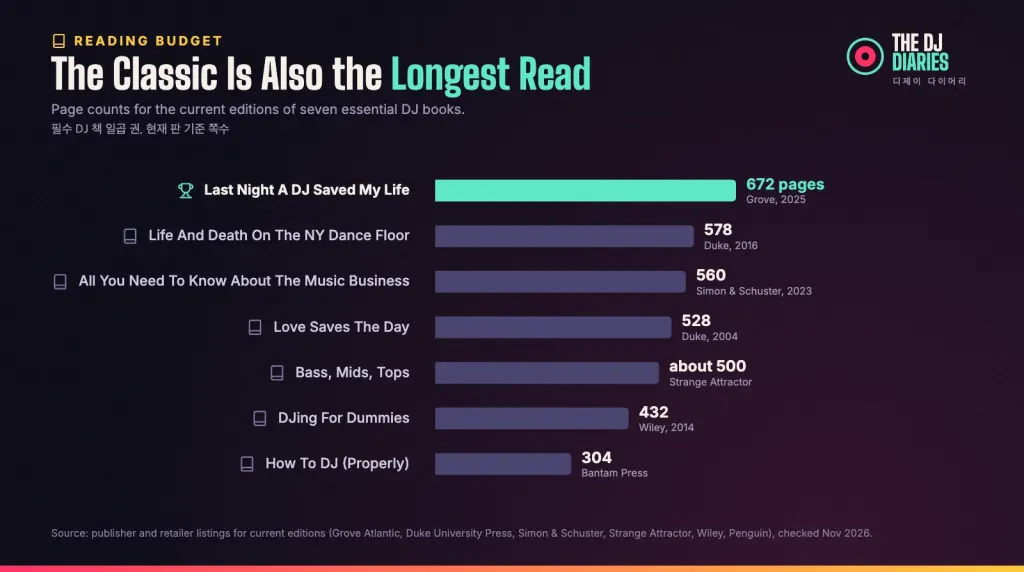
Page counts are given only where the publisher or retailer lists them for the current edition; “Not listed” means we could not confirm one, not that the book is short. For your reading budget, the page numbers in the chart above come from those same listings.
Compare And Contrast: How To DJ Right vs DJing For Dummies
If your shelf has room for one technique book, the choice is usually between Brewster and Broughton and John Steventon’s DJing For Dummies (3rd edition, Wiley, October 2014, 432 pages). Steventon is more current on equipment and more patient with absolute beginners: what each knob does, how to connect a controller, how to set levels. Brewster and Broughton assume you will work out the cables and spend their pages on taste, timing and the crowd.
Verdict: How To DJ Right. Equipment manuals and YouTube now cover the cabling better than any book, while nobody covers the craft of programming a night better than these two. Buy Steventon only if you have never touched a mixer and want a printed manual by your side.
Compare And Contrast: Energy Flash vs Altered State
Both tell the story of British rave from 1988. Reynolds hears it: he writes about the breakbeats, the bass pressure and the drug’s effect on how music was made. Collin watches it: the sound system crews, the motorway convoys, the police operations and the 1994 Criminal Justice Act. Reynolds will make you a better selector because you will understand why the records were built the way they were. Collin will make you a better promoter because you will understand why parties get shut down.

Verdict: Energy Flash first, Altered State second, and the 2026 reissue makes the second an easy buy. Our rave era piece, warehouse to field, sits between the two.
The Verdict: The Three To Read First
Start with Last Night A DJ Saved My Life, because every booth argument you will ever have about what DJing is for is settled somewhere in it. Then How To DJ Right, because its advice on warm up sets and reading a room is the bit beginners skip and headliners never forget. Then Energy Flash, because it teaches you to hear genres as histories rather than tempo ranges. After those three, follow your sound: Lawrence for disco and house, Sicko and Denk for techno, Muggs for anything with a sub bass, Passman the week before you sign anything.
From the booth, one last piece of advice: read with your library open. Every one of these books names records, and the habit of stopping to find and tag them is how a reading list turns into a set. If you want the producer side too, Rick Snoman’s Dance Music Manual (5th edition, Routledge, 2024) is the standard studio text, and our dance music press page lists the magazines and sites worth following once the books run out.
Frequently Asked Questions
What Is The Best Book For Learning To DJ?
How To DJ Right (published in the UK as How To DJ (Properly)) by Bill Brewster and Frank Broughton. It teaches the parts of the craft that do not change with technology: beatmatching by ear, programming a set and reading a crowd. Use the manual for your controller or CDJs for the button by button detail.
Is Last Night A DJ Saved My Life Still Worth Reading In 2026?
Yes. The Grove revision from February 2025 added two new chapters and more on women DJs, so the current edition is the one to buy. Nothing published since has replaced it as the general history of the DJ.
Are There Good Books On The Business Of DJing?
Not many written for club DJs specifically. The Secret DJ is the most honest account of the working life, Peter Hook’s The Hacienda shows how venues lose money, and Donald Passman’s All You Need To Know About The Music Business covers contracts and royalties once you release music. For bookings, our guide on how to get DJ bookings fills the gap.
Should Beginners Read History Books Or Technique Books First?
One of each, side by side. Practise with a technique book on the desk and read history on the commute. Knowing why a record was made changes how you mix it, and the history makes the hours of beatmatching practice feel like they are leading somewhere.
Stay in the Loop
New writing on DJ culture, electronic music, and the Seoul underground, delivered when it matters.
More From The DJ Diaries


Play with the history
Four tools built from the same research as this site.