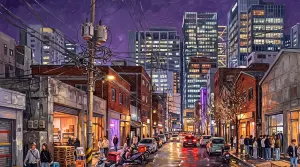
Noraebang (노래방) after noraebang, pubs, a few Korean nightclubs, all under neon, and as far as I could tell I was the only expat on the street. That was Yeongdeungpo (영등포) in my first months there. It was my second home in Korea, and it’s where I live now. It was blue collar back then and felt nothing like the districts I’d been going out in. Not much has changed.
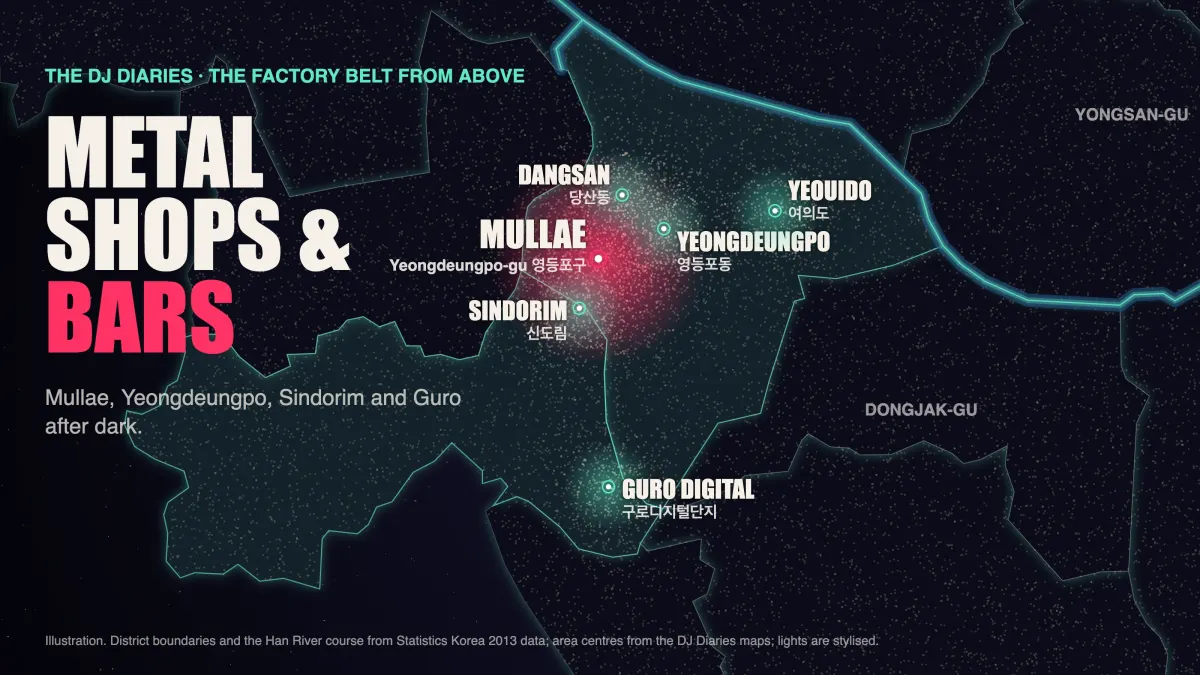
Ask a visitor where Seoul goes out and you’ll get Hongdae, Itaewon, Gangnam. Ask a man in his fifties who spent thirty years on a production line in Guro (구로) and you’ll get a different city, one where the answer was right outside the factory gate, because central Seoul was an hour away on a bus after a ten hour shift. The southwest, Yeongdeungpo, Guro, Mullae (문래) and the blocks around them, holds one of the largest and least documented drinking economies in Korea, and it exists because that’s where the factories were.
I’d send any curious expat out here before I sent them to a third night in Hongdae. This is a guide to it, and to why it looks the way it does.
한국어 요약
공장 지대의 밤: 영등포, 구로, 문래
영등포는 국제적인 밤이 아니라 서민적인 한국식 밤을 원한다면 좋은 동네입니다. 호프, 포차, 고기집, 오래된 바가 빽빽하고, 가격은 홍대나 이태원보다 훨씬 저렴합니다.
일찍 시작해서 일찍 끝나며 영어는 거의 통하지 않습니다. 방문객이 기대하는 클럽이나 라이브 음악 신은 없지만, 바로 옆 문래에서는 철공소 사이에서 와인 한 잔을 즐길 수 있습니다.
잘못된 정보나 날짜가 있다면 알려 주세요.
Seoul Built Its Factories Here First
Yeongdeungpo was Seoul’s industrial district before Gangnam was anything at all, and the reason is plain: flat land next to a railway. Seoul newspapers in the 1920s were already calling it “강남” (Gangnam), south of the river, as Newspost has traced. The Gyeongin railway arrived around 1899 and 1900, and the factories followed: Chosun Leather in 1911, the Gyeongseong Spinning mill (경성방직, Kyungbang) in 1923, whose old office building still stands as a heritage property, and two breweries in 1933 that became OB and Crown. The district office still keeps the old brew kettle in Yeongdeungpo Park.
By 1936 Seoul had absorbed the area as an industrial zone, and it became one of the city’s first formal wards in 1943. More breweries and heavy manufacturing filled in across the decades that followed. For most of the twentieth century, when Koreans said Yeongdeungpo they meant work.
The bigger wave came just south. The Guro export industrial complex opened on 1 April 1967 as Korea’s first inland export zone, with President Park Chung-hee at the ceremony. It started with 2,460 workers. By the end of 1978 it employed about 114,000. Exports passed a hundred million dollars in 1971 and reached 1.87 billion by 1980, something like a tenth of everything the country sold abroad. A hundred and fourteen thousand people, in one place, working shifts.
Why the Southwest Drinks at Seven
The workforce that built Yeongdeungpo, Guro and Mullae nightlife, and what it became
공장이 만든 밤
A hundred and fourteen thousand peopleIn one place, working shifts. The complex opened on 1 April 1967 and by 2015, rebranded as G Valley, held more workers than the factories ever did. Track runs from 0 to 160,000.
Guro complex exports. The peak came in 1988. Track runs from $0 to $4 billion.
About 2,500 to 1,279 metal businesses in Mullae, from the 1990s peak to 2023. Over 90 percent rent their workshops.
Sources: National Archives of Korea · Seoul Shinmun
The Workforce Was Young, Rural and Mostly Women
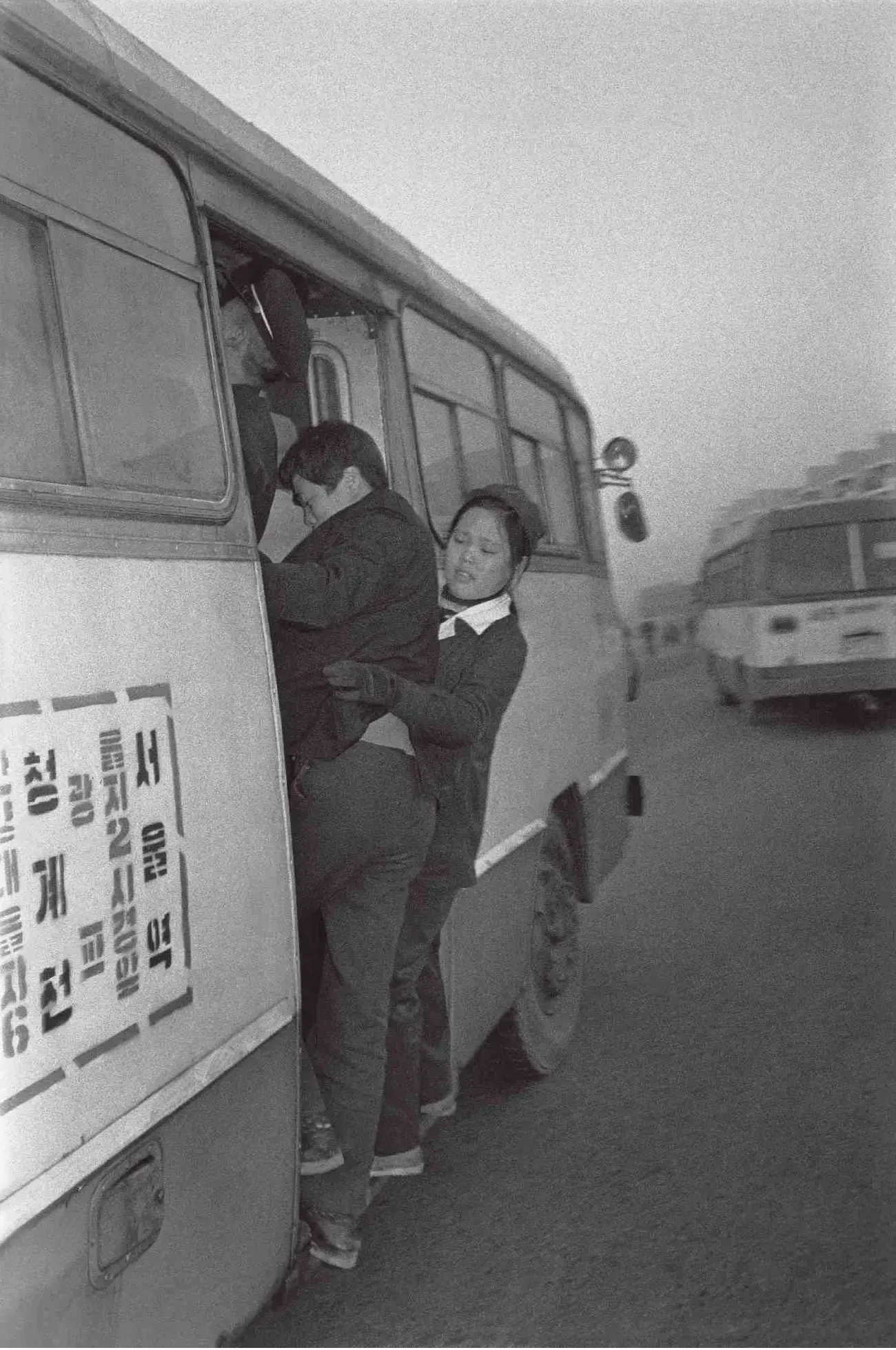
The Guro workforce was overwhelmingly young, rural in origin and female. The women who staffed Korea’s export miracle came from the countryside as teenagers and lived in the honeycomb rooms of Garibong-dong (가리봉동). Those were the 벌집 (beoljip), subdivided buildings where a corridor of tiny rooms shared a single toilet between dozens of people. Average monthly take home pay for a woman on those lines in the early eighties was in the region of 74,000 won.
The hours were brutal. A Kyungbang worker who started at 16 and stayed 43 years told Newsis that for his first twenty years he worked every day of the year, no weekends. In 1979 the women of the Haitai (해태) confectionery plant in Yeongdeungpo won the eight hour day after years of twelve hour shifts and eighteen hour Sundays, a fight recorded by the Korea Democracy Foundation archive. Oh Ki-taek’s (오기택) trot hit “영등포의 밤” (Yeongdeungpo-ui Bam, Yeongdeungpo Night) came out in the mid 1960s, was banned in the 1970s and cleared in 1987. An older resident summed up the era to Kyunghyang: “하루가 괴로웠지, 밤이 무서웠어” (the days were hard, the nights were frightening).
Every Korean over sixty knows this history; most foreigners living here have never heard it. It’s the direct ancestor of the country you’re enjoying now.
Downtown Was an Hour Away, So the Night Came to the Gate
Getting from the southwest into Jongno or Myeongdong in the seventies and eighties meant a long bus ride each way, at the end of a long day, to spend more money in a district built for office workers and students. The subway that makes the trip easy now was still being built. Line 2 was famously designed as a loop to serve the new Gangnam development, and the circle through Guro and Mullae wasn’t finished until 1984.
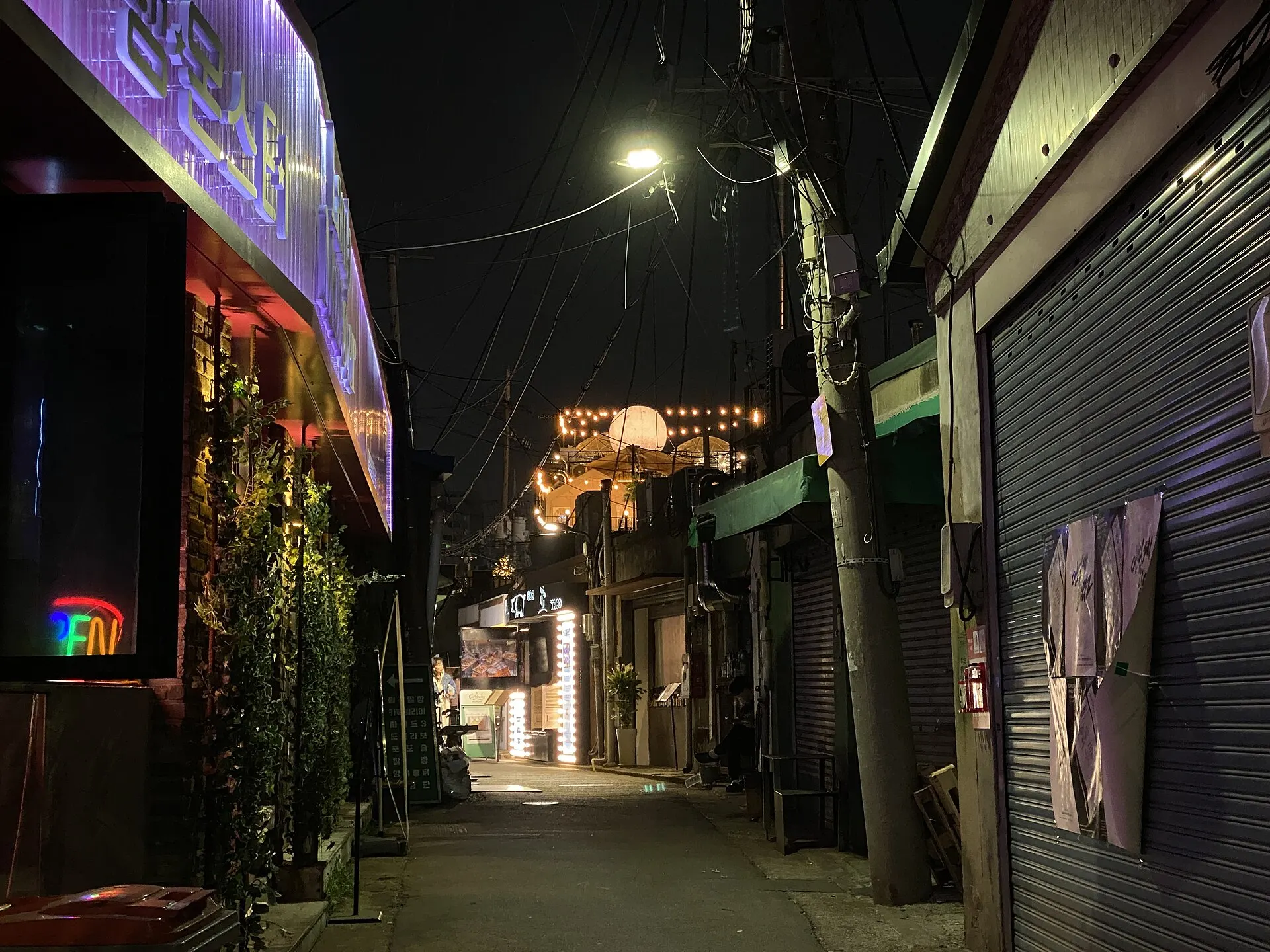
So the southwest built its own night, at working class prices, on a working class schedule, with working class portions. Picture the customer: a little money, no kitchen worth cooking in, a shared room nobody wanted to sit in, and a shift that ended at a fixed hour. That’s the ideal market for cheap food and drink at volume, and the streets filled with hof, pocha, grilled meat, jokbal (족발), gukbap (국밥), standing bars, old style nightclubs and singing rooms. It’s the same pattern a steel town in Ontario produces, so an old Yeongdeungpo hof is legible to anyone from a North American industrial city even if they can’t read a word of the menu.
Over the years I’ve had my share of beers out here with colleagues and friends, and the rhythm never changes. You talk, you drink beer, you eat anju (안주), and there’s always a small dish of chips or Korean snacks the owner puts down for free, which also happens to make you thirsty.
Once a district like that exists it’s extremely durable, because the economics never go away and because the people who drank there in 1985 still drink there with their former colleagues. The factories didn’t close so much as change. Guro’s exports slid through the nineties, and in 2000 the city rebranded the complex as the Seoul Digital Industrial Complex, now called G Valley (G밸리). By 2015 it held nearly ten thousand companies and around 160,000 workers, more than the factories ever employed. The bars around Guro Digital Complex station (구로디지털단지역) now serve software engineers on the street pattern that served machinists, and an IT company’s hoesik (회식) runs the same 1차, 2차, 3차 rounds a factory’s did. There’s a whole article on this site about those rounds.
It also answers the question expats ask constantly: why do parts of Seoul feel so much cheaper than others for the same food and drink? It comes down to which century, and which industry, built the street you’re standing on.
Yeongdeungpo’s Rooms Keep Changing Shape
Not so long ago, Yeongdeungpo had its hofs and pochas, two department stores, Lotte and Shinsegae, and a rougher side at night: a visible homeless population around the station, much like you see around Seoul Station today, and a well known red light district a few steps away. A lot of that toned down as the area gentrified, especially once Times Square (타임스퀘어) arrived. One building near the old rotary tells the whole story.
Hankyoreh recalls the cinema years and calls the nightclub the best known of its kind in the southwest. A 2015 visit found men arriving with the smell of samgyeopsal from company dinners still on them. The live hall opened with Noel Gallagher’s High Flying Birds on the first night.
Seoul’s oldest dancers are a few streets away. In 2013 Money Today counted seven or eight colatecs (콜라텍, kollatek) in Yeongdeungpo, four of them near the market, with about 500 visitors a day paying 500 won to get in. In 2024 a 73 year old regular told Hankook Ilbo, “1,000원만 내고 세 시간씩 춤추는 거야” (a thousand won and three hours of dancing), while the owner described costs far above what came through the door. Across Korea the count fell from 502 in 2019 to 418 in 2023.
A lot of nights still end at Yeongdeungpo Market (영등포시장), where the old vibe hasn’t changed in years. Hobakjip (호박집), in the market’s sundae (순대) alley, has served sundae soup since 1966, and its owner told Newspost she has worked there for more than forty years, feeding the last of the night crowd. The blocks by the station are changing faster: redevelopment plans confirmed in 2021 will replace the last of the old low rise blocks there, including the long standing red light area, with high rise mixed use. Parts of the district you might read about in older guides are gone or going.
Mullae Is Where the Southwest Gets Interesting
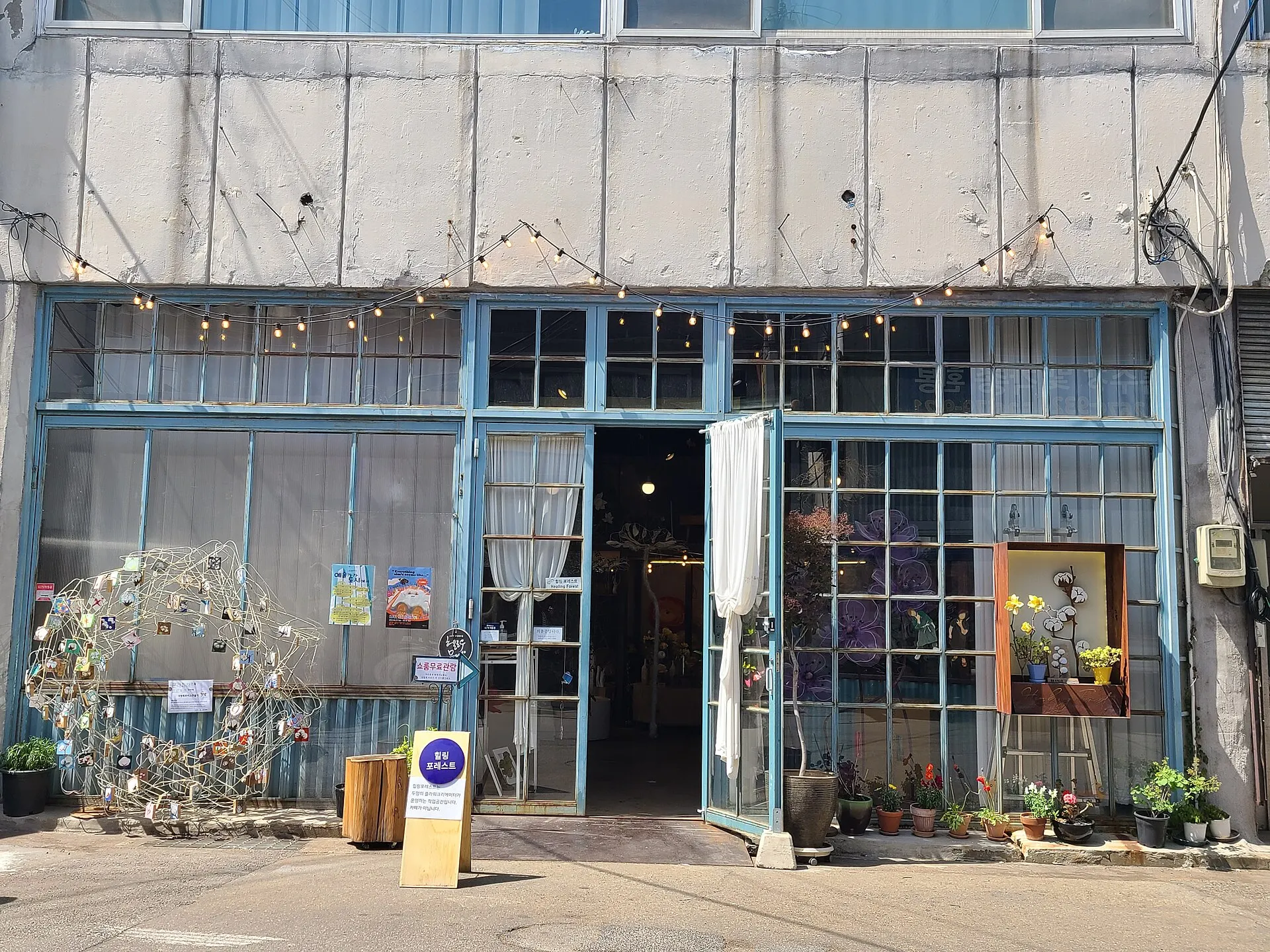
Mullae (문래동, Mullae-dong) is the small grid of streets beside Yeongdeungpo, one stop from Yeongdeungpo-gu Office on Line 2. By day it’s lathes, welding sparks and steel stacked on the pavement. By evening the shutters come down on one side of the lane and the lights come up on the other. It’s where Seoul goes for a drink in a converted workshop before the night moves somewhere else.
The metal came first. Shops pushed out of Cheonggyecheon (청계천) settled here from the 1960s on, as Money Today has traced; machinist Son Gil-bae (손길배) has been here since 1983 and told Herald Biz, “기술은 한 번 내꺼 되면 평생 내꺼야” (once a skill is yours, it’s yours for life). Seoul still counted about 1,350 small workshops in 2020, more than nine in ten in metal or machinery, by the city’s own figures. Artists followed in the 2000s as Hongdae rents climbed. The city opened Mullae Art Factory (문래예술공장) in January 2010, as Seoul Shinmun covered at the time, and by 2015 about 250 artists worked out of roughly 100 studios at about ₩40,000 a pyeong a month, Hankyung reported.
Music found a foothold early. In July 2011 Lowrise opened on a second floor above a metal company, booking DJ Soulscape and bands like 404, and GBN Live House, run by musician Lee Yuying, grew out of a room that opened in 2014. The bars followed: Old Mullae, a craft beer bar in a wooden factory shed listed by the JoongAng Daily, and Vinyl House (비닐하우스), a natural wine bar with more than a hundred bottles, and the rooftop bar Mullae Chinchin (문래친친), both featured in Allure Korea.
Mullae is cool, a great place for wine, drinks and a few little venues. What it doesn’t have now is a room hosting music regularly; when a space does put something on, it’s usually an art show rather than a DJ night. The card data agrees it’s an early evening place. Hankyung MONEY reported in 2026 that more than 70 percent of spending comes from people who live outside Seoul, that Saturday is the busiest day, and that only about 6 percent of sales happen between 10pm and 1am. Spending grew by more than 15 percent a year from 2021 to 2023 and then fell back in 2025. It’s a first stop, not a last one.
The steel workshops between Mullae and Yeongdeungpo picking up galleries, studios and small bars in the gaps is the same sequence that produced Seongsu (성수) a decade earlier. It looks like the industrial edge of almost any North American town, except that here the studios and bars sit between working machine shops.
The Squeeze Is Already On in Mullae
The arts district has a cost, and the metalworkers are paying it. As early as 2016, Seoul& reported metalworkers saying rents had doubled and artists leaving as cafes moved in. In 2019 the Korea Times found rents in Mullae 2-ga and 3-ga had nearly doubled in three years, with landlords planning to turn workshops into cafes and bars as leases ended, while 4-ga stayed industrial. Lee Yuying told the same paper her landlord had tried to double GBN’s rent, and described the neighbourhood as “a community of people who had nowhere else left to go.”
Not everyone is happy about the mix. “Frankly, we find the young people intimidating,” machinist Yu Tae-ho told the Korea Times, and artist Kim Yun-ik, in Mullae since 2009, put it simply: the neighbourhood is a manufacturing space first.
In June 2023 Yeongdeungpo-gu announced a plan to move the district’s 1,279 metal shops out together, as Seoul Shinmun reported. By July 2026, BizHankook found, there was still no site and no support package. For now the lathes and the bar stools share the same lanes, which is exactly why people come, and exactly what won’t last.
How to Do a Night in the Southwest
Orient by Yeongdeungpo station (영등포역): Times Square is the modern anchor, and the older drinking blocks sit around and behind it. Go early. People are drinking at seven because their shift ended at six, so seven or eight is peak, and by midnight the older rooms are winding down, the opposite of Itaewon.
Order food. Every one of these rooms is a food business first, culturally and, as this site has explained, in how it’s registered. Sitting down and ordering only alcohol reads as strange and creates a problem for the owner. Expect no English and bring a translation app. Point at things. Nobody will mind. Some blocks near the station are, or recently were, part of the old red light area now being redeveloped. It’s obvious from its appearance. Walk around it.
For Mullae, walk the workshop alleys in the afternoon while the metal is still being cut and milled at the shop fronts, then stay for a glass of wine when the shutters come down. Every place named here is on the map below, with what’s on over the next two weeks and Naver and Kakao links in each pin.
Mullae and Yeongdeungpo nightlife map
Venues on this map (17)
- MH Live Hall 명화라이브홀Live venue · 30 Beodeunaru-ro네이버 지도 Naver Map카카오맵 Kakao Map
- Bar Bam 바밤Whisky bar · 2F, 872 Gyeongin-ro, Yeongdeungpo-gu네이버 지도 Naver Map카카오맵 Kakao Map
- Mujeonghyeong 무정형Bar · 58-1 Mullae-dong 2-ga, Yeongdeungpo-gu네이버 지도 Naver Map카카오맵 Kakao Map
- Muyeom 무념Bar · 49-21 Mullae-dong 2-ga, Yeongdeungpo-gu네이버 지도 Naver Map카카오맵 Kakao Map
- Platz 플라츠Bar · 14-38 Mullae-dong 2-ga, Yeongdeungpo-gu네이버 지도 Naver Map카카오맵 Kakao Map
- Old Mullae 올드문래Bar · 14-28 Mullae-dong 2-ga, Yeongdeungpo-gu네이버 지도 Naver Map카카오맵 Kakao Map
- Janhyang 잔향Bar · 14-48 Mullae-dong 2-ga, Yeongdeungpo-gu네이버 지도 Naver Map카카오맵 Kakao Map
- Vinyl House 비닐하우스Bar · 54-39 Mullae-dong 3-ga, Yeongdeungpo-gu네이버 지도 Naver Map카카오맵 Kakao Map
- Hyeongje Jogak 형제조각Bar · 58-65 Mullae-dong 3-ga, Yeongdeungpo-gu네이버 지도 Naver Map카카오맵 Kakao Map
- TATD 티에이티디Bar · 3F, 40-2 Mullae-dong 2-ga, Yeongdeungpo-gu네이버 지도 Naver Map카카오맵 Kakao Map
- Mullae Chinchin 문래친친Bar · 2F, 45-8 Mullae-dong 2-ga, Yeongdeungpo-gu네이버 지도 Naver Map카카오맵 Kakao Map
- Como Wine Bar 꼬모 와인바Bar · 11-37 Mullae-dong 4-ga, Yeongdeungpo-gu네이버 지도 Naver Map카카오맵 Kakao Map
- Haebangeum 해방음Listening room or records · 1F, 42-18 Mullae-dong 2-ga, Yeongdeungpo-gu네이버 지도 Naver Map카카오맵 Kakao Map
- Forest Live 숲세권 라이브Live venue · B1, 54-34 Mullae-dong 3-ga, Yeongdeungpo-gu네이버 지도 Naver Map카카오맵 Kakao Map
- GBN Live House 지비엔라이브하우스Live venue · 54-41 Mullae-dong 3-ga, Yeongdeungpo-gu네이버 지도 Naver Map카카오맵 Kakao Map
- Mullae Jazz In 문래재즈인Live venue · B1, 7-1 Mullae-dong 4-ga, Yeongdeungpo-gu네이버 지도 Naver Map카카오맵 Kakao Map
- LAD & Hall 라드앤홀Club · B1, 54-44 Mullae-dong 3-ga, Yeongdeungpo-gu네이버 지도 Naver Map카카오맵 Kakao Map
Go with the right expectation. You won’t find a great room with a great sound system out here. You’ll find the version of Korean nightlife most Koreans over fifty grew up with, in the district that built the country’s export economy, at about half the price of the districts in the guidebooks. Once you’ve seen it, the rest of the city makes a lot more sense.
Frequently Asked Questions
Is Yeongdeungpo good for nightlife?
Yes, if you want the working class Korean version rather than the international one. Yeongdeungpo (영등포) has hof, pocha, grill restaurants and older style bars in real density, at prices well below Hongdae or Itaewon. It starts and finishes early, seven or eight in the evening is peak, and there’s very little English. It doesn’t have a club or live music scene in the sense visitors usually mean.
Why is there so much nightlife around Yeongdeungpo and Guro?
Because that’s where Seoul’s factories were. Yeongdeungpo became the city’s industrial district from the colonial period onward, and the Guro export complex opened in 1967 and employed about 114,000 people by the end of 1978. Getting into central Seoul after a shift meant a long bus ride, and the Line 2 loop through Guro wasn’t finished until 1984, so the southwest built its own cheap, dense drinking economy on site. It outlived the factories.
What was the Guro Industrial Complex?
Korea’s first inland export industrial zone, opened on 1 April 1967 in southwest Seoul. It grew from 2,460 workers to about 114,000 by the end of 1978, mostly young women from rural areas who lived in the honeycomb rooms of Garibong-dong, and at its peak it accounted for roughly a tenth of national exports. In 2000 it became the Seoul Digital Industrial Complex, now called G Valley, which held around 160,000 workers by 2015.
Is Mullae worth visiting?
Yes, for a drink and for anyone interested in how Seoul districts change. Mullae (문래) is a working metal district that has picked up galleries, studios, wine bars and craft beer bars between operating workshops, the same path Seongsu took a decade earlier. Visit in the afternoon to see the workshops, then stay for the bars in the early evening; card data shows only about 6 percent of spending happens after 10pm.
Further Reading
- Why Seoul Drinks Where It Drinks: how every nightlife district was made
- The print alleys under Euljiro
- Going out in Seoul, neighbourhood by neighbourhood
- The night in rounds: how Korean club culture developed its own rules
- Korea.kr on the Guro workers’ living experience hall (순이의 집): a recreated honeycomb house in Gasan-dong, free to visit.
- OhmyNews: walking Gasan-dong from Guro Gongdan to G Valley (2026): a recent Korean walking route through what’s left of the complex.
- Factory Complex (2015): Im Heung-soon’s documentary on Korean women factory workers, winner of the Silver Lion at the 2015 Venice Biennale.
- The Girl Who Wrote Loneliness, Shin Kyung-sook: the autobiographical novel of a teenage worker in the Guro complex, available in English.
- Kyunghyang: 영등포구 문래 창작촌 (2017): a Korean portrait of Mullae, where the smell of iron and the studios share the same alleys.
- Seoul city guide to Mullae Changjakchon: the city’s own introduction to the art village.
Sources
The industry. The National Archives record of the Guro Industrial Complex is the source for the worker and export figures in this article. Pressian on the honeycomb villages and the women who lived in them and Kyunghyang on what the complex left behind are the human side of the same numbers, and the Guro cultural encyclopedia entry on the 벌집 documents the housing itself. Mullae figures in the chart: Seoul Shinmun.
The district. Yeongdeungpo-gu’s own history pages and district history · Opinion News on Yeongdeungpo as the face of Seoul south of the river · the modern industrial heritage of the Gyeongin belt · the surviving Gyeongseong Spinning office building. On the station area redevelopment confirmed in 2021, Asia Economy and Financial News both reported it at the time. For Mullae, the district’s art village page and a walkthrough of the steel and art streets.
Yeongdeungpo after dark and Mullae. Newspost: 영등포, 원조 강남 (Yeongdeungpo history) · Newsis: 경방 영등포공장 노동자 이야기 (2014) · Korea Democracy Foundation: Haitai 8 hour day (1979) · Kyunghyang: 영등포의 밤 (2005) · Hankyoreh via Daum: 명화극장 (2023) · Hankyoreh via Daum: 명화나이트 (2015) · Money Today: 콜라텍 (2013) · Hankook Ilbo: 콜라텍 (2024) · Newspost: 순대골목 호박집 · Lowrise Seoul · Herald Biz: 문래 기술자 (2025) · Korea Times: Machinists, artists and cafe owners in Mullae question coexistence (2019) · JoongAng Daily: Where steel collides with art in Mullae-dong (2025) · Allure Korea: 요즘 그렇게 힙하다는 문래동 (2022) · Hankyung: Mullae artists and rents (2015) · Hankyung MONEY: Mullae spending data (2026) · Seoul city: Mullae small manufacturer cluster (2020) · Seoul Shinmun: Mullae Art Factory opens (2010) · Seoul Shinmun: Plan to relocate Mullae’s metal shops (2023) · Money Today: Mullae’s metalworkers and rents (2025) · BizHankook via Daum: Relocation still stalled (2026) · Seoul&: Mullae rents and artists (2016)
Old photographs. The industrial southwest is one of the most heavily photographed parts of twentieth century Korea, because the state was documenting its own economic miracle. Search 구로공단, 가리봉동, 영등포 and 벌집 in e영상역사관 national archive photography and the National Archives of Korea digital collections for the official record, then the same terms in Seoul Photo Archive (서울사진아카이브) and Seoul Institute, Seoul in Photographs for the street level version. The contrast between the ceremony and the housing tells the story better than any article can. These are archives to browse, not images reproduced here; Korean public sector archives publish under KOGL (공공누리), with the permitted use marked per item.
Written from Seoul, by someone who has been in the booth for more than twenty years. More on the site, or book a DJ.
Stay in the Loop
New writing on DJ culture, electronic music, and the Seoul underground, delivered when it matters.
More From The DJ Diaries
Play with the history
Four tools built from the same research as this site.