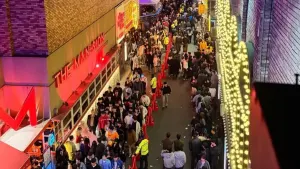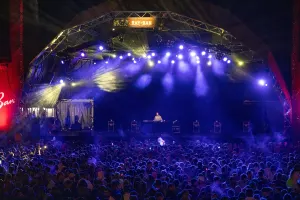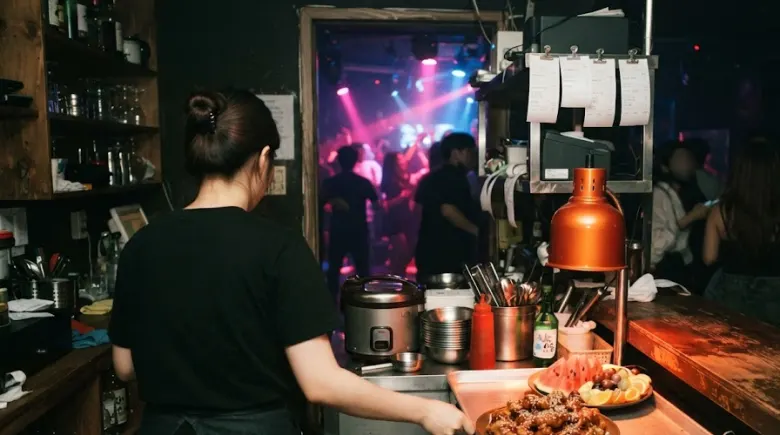
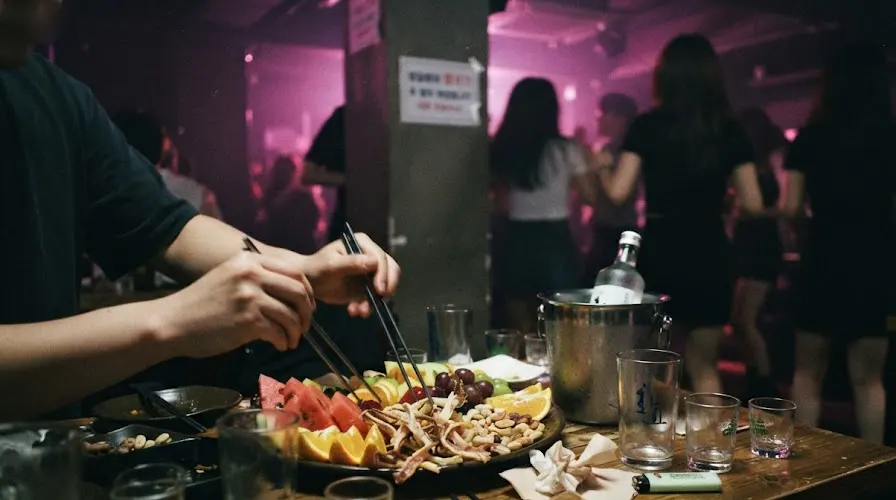
The first time somebody pointed at a small printed sign on a Seoul bar wall and told me it said no dancing, the room was full of people dancing. I assumed it was a joke, or a leftover from an older era. It was neither, and once I understood what that sign was doing, a lot of other things about this city’s nightlife fell into place, starting with the kitchen behind the DJ booth.
Most Seoul music venues aren’t licensed as nightclubs. They’re registered as food businesses, and that one fact explains the kitchen, the sign on the wall and a great deal about why the scene is shaped the way it is. In 2026 the same rule closed a live venue in Busan for sixty days and pushed the culture minister to promise a fix.
What follows is what I’ve seen from inside the rooms and what operators have told me over the years. It isn’t a legal explainer, and I’m not qualified to write one. If you’re opening a venue, you need a Korean lawyer and a licensing agent, not a DJ with opinions. Enforcement is handled locally and varies a great deal, so treat this as scene knowledge rather than rules.
Seoul Music Rooms Are Licensed as Something Else
The thing that took me longest to understand is that a Seoul venue generally isn’t licensed as a nightclub, because that isn’t the box on offer. It’s registered as a food business, and which type it registered as shapes almost everything about how it behaves. Operators talk about this constantly, in shorthand. The distinction that comes up most is between a general restaurant registration, which the overwhelming majority of music venues in this city run on, and the entertainment category that allows a dancefloor.
Every Seoul Room Is Licensed as Something Else
The business registrations that decide whether a room can pour, sing or dance
춤은 허가의 문제입니다
| Registration | Alcohol | Dancing | Who runs on it |
|---|---|---|---|
| General restaurant일반음식점 | Yes | Not permittedunless the district has an ordinance | Most music venues and small clubs in Seoul. The licence is built on food, so the room needs a kitchen. |
| Entertainment bar유흥주점 | Yes | Yes | Big clubs, and also hostess bars and room salons. A heavier cost and regulatory load. |
| Singing practice room | No | Not the point | The classic noraebang, which is why many cannot officially sell you a drink. |
| Singing bar | Yes | Not the point | The pricier singing rooms that openly serve alcohol. |
| Cafe | No | No | Start pouring wine in the evening and it quietly becomes a different business. |
Where dancing is allowedEight districts now let customers dance in general restaurants through local ordinances.
Once you see it in the clubs, you see it on the whole street. The classic noraebang (노래방) holds a singing practice room registration that doesn’t include alcohol, which is why many can’t officially sell you a drink, and why what arrives anyway has a certain discretion about it. The pricier rooms that openly serve alcohol sit in a different registration, usually translated as a singing bar. Same screens, same tambourines, different paperwork, different menus.
The hof (호프) and the pocha (포차) are restaurants through and through, so the dancing question never comes up there. A cafe that starts pouring natural wine in the evening has quietly become a different kind of business. Live music venues have spent years in their own grey zone, because a stage full of performers raises the same questions a dancefloor does. None of this is chaos. It’s a country that regulates its night through food business categories, and a nightlife culture that has learned to fit itself into them.
The Kitchen Keeps the Doors Open
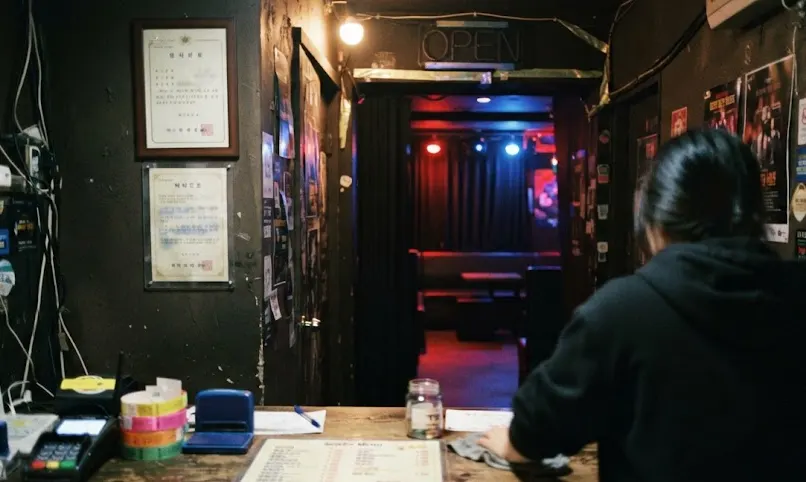
So why does a small techno bar in Itaewon have a working kitchen and a menu of fried things nobody seems to order? Because it’s registered as a restaurant, like most of the rooms you have been to in this city. That category is built around food, and the kitchen is the basis on which the room trades. The menu is the paperwork made physical.
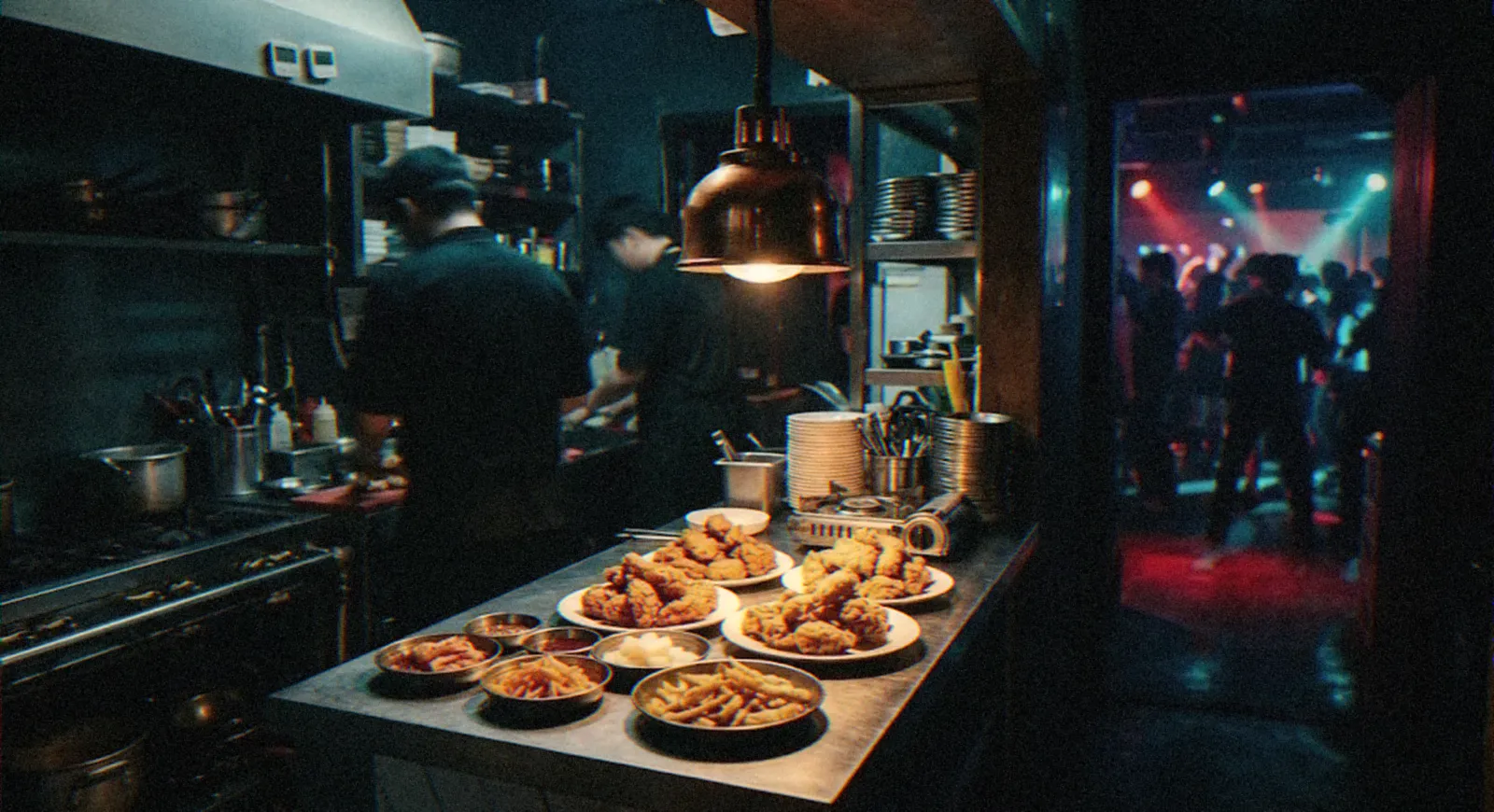
It’s also why Korean bars will often want you to order at least one anju (안주), a food dish, before they keep pouring. Partly that’s real culture, because Korean drinking is properly food led. Partly it’s that a venue selling only alcohol on a restaurant registration has a problem. The fried chicken behind the DJ booth isn’t a quirk. As far as I can tell, it’s what keeps the doors open.
The Sign Is Aimed at Somebody Who Isn’t in the Room
A venue registered as a restaurant isn’t permitted to run a dancefloor, and the business carries that risk, not the customer. The sign is a defence: if an inspector comes, the operator can point at it and argue that dancing wasn’t something the business permitted or encouraged. Whether that lands depends on the inspector, the district and the mood, which is why the sign and the dancefloor share a room without anybody finding it strange. The sign has an audience of one, and that person isn’t there tonight.
The obvious question is why serious venues don’t just move to the category that allows dancing. Operators give me two reasons. The first is money: the entertainment category carries a heavier cost and regulatory load, and for a small room in Mapo the numbers don’t work.
The second matters more, and English coverage of Korean nightlife rarely says it. The category that permits dancing is the same one that covers the hostess bar and room salon trade, because it covers venues that employ entertainment staff. A techno club and a Gangnam (강남) room salon can end up in the same box, carrying that industry’s costs and reputation. Faced with that, a small venue registers as a restaurant, puts in a kitchen, puts up the sign and gets on with it.
Enforcement Is Local, and It Moves
Whatever the national rules say, how hard anyone looks is decided locally, by a district office, the gu office (구청), and it moves with local politics, complaints, incidents and the news cycle. A venue can run the same way for six years and then be inspected, fined and suspended inside a month without changing anything. Yongsan (용산), Mapo (마포) and Gangnam have each behaved differently at different times, and the collapse of the Gangnam megaclub model is partly a story about what happens when that attention arrives all at once.
Mapo went furthest. The district passed an ordinance explicitly allowing dancing in general restaurants in the Hongdae area, which is why Korean papers spent the pandemic years arguing about clubs being curfewed at midnight while rooms registered as restaurants danced until dawn. In March 2023 the district office sent Mapo-gu Council (마포구의회) a bill amending it, tightening the standards for the restaurants it lets customers dance in, with accident prevention given as the reason.
Mapo-gu changed course again in 2026. Newsis reported on 20 October that an amendment passed by the district council in September makes renewal easier for the places it has already designated, while new designations stay on hold until at least January 2027. One councillor who backed the bill still criticised it for favouring existing operators.
Kockiri (코끼리) is the Seoul case the scene watched most closely. Mixmag described the Itaewon venue as Seoul’s only electronic music queer bar, and it shut at the start of January 2026; its Maktoop discussed the dance permit issue behind that with Mixmag Asia. The team kept the community together with a night at Modeci on 20 February, and Kockiri reopened on 5 March 2026 with dguru of Idiotape on the bill and Mogwaa later that week. That was a better outcome than many expected, but a good room with a devoted crowd still lost two months.
In my own experience, warnings are more often about volume than dancing. I’ve been behind the decks when people from the district office, or the police, walked in and asked us to turn it down. Owners and managers also have to complete food hygiene training, which is one more reason so many places always put out side dishes. And what venues tend to do, rather than fight the sign, is put in more tables. What people do at those tables is their business, which is another reason table service and bottles matter so much here.
What the Rules Cost the Scene
Once you see the structure, a lot of Seoul’s character stops looking cultural and starts looking structural. Venues are small because small rooms attract less attention and cost less to lose. Programming is announced late because a low profile is safer, rooms are in basements because basements are quieter and cheaper, and the scene is spread thinly across many little venues because concentration is exposure. It’s also why so much of what happens here happens outside the clubs entirely.
It shows in the money too. Tiger Disco, one of Seoul’s longest running disco DJs, has compared Korea with Japan: Korean clubs hand out so many free guest passes and drink tickets that neither the venue nor the artist ends up properly paid. A venue that can’t advertise loudly, can’t present itself as a club and can’t rely on the door ends up buying its crowd instead.
Then there’s the pressure nobody sees from the floor. Once building owners notice a venue doing well at weekends, they often treat it as a reason to raise the rent, and I know many people this has happened to. There is a commercial lease protection law that limits rises for a while, but it doesn’t protect a room forever, and how it applies to any given lease is a question for a lawyer. The rent rise eats the margin, or makes it impossible to pay back what the venue cost to build.
None of which is a complaint. Seoul has one of the more interesting underground scenes in Asia, and it was built inside these constraints, which is more impressive than building it without them. If you’ve ever wondered why nightlife here feels quietly improvised in a country that’s otherwise extremely well organised, this is my answer: adaptation.
In 2026 the Rule Became a National Story
In August 2026 the argument stopped being an argument. The Korea Times reported that Ovantgarde (오방가르드), a live music venue in Daeyeon-dong (대연동), Nam-gu, Busan, open since 2018, drew a citation after municipal officials said people were dancing during a live performance, which they treated as outside its general restaurant licence. The venue was suspended until 24 October 2026, and the owner disputed the call, saying the audience was standing and reacting to a live band. The Hankook Ilbo (한국일보) put the closure at sixty days, from 26 August to 24 October.
How the No Dancing Rule Became a National Story
From one district’s ordinance to a minister’s promise
춤 금지 규정, 전국 뉴스가 되기까지
Where it standsAs of October 2026 the rule itself has not changed. Not legal advice.
What was new was the response. On 19 August a petition went to the National Assembly asking for clear criteria separating ordinary audience behaviour from the entertainment the rules were written for, and a legal category of its own for small live music venues. Since then the petition has passed twenty thousand signatures, a constitutional challenge has been filed, and the district chief whose own office issued the penalty has publicly asked the National Assembly to fix the law. It’s the first time in my twenty years and more here that the response to a closure has been an attempt to change the category rather than survive inside it.
On 31 August the Minister of Culture, Sports and Tourism, Choi Hwi-young (최휘영), called the situation shameful and wrote on Facebook that dancing in response to indie music “is not a crime”, committing to amend the law or create a new performance venue category. On 17 September he went further and pledged to revise the Food Sanitation Act enforcement decree, the Korea Times reported. I’m not going to predict where it lands.
The Busan case matters to Seoul for two reasons. It confirms this is national, not the Seoul quirk most English coverage has treated it as. And it shows the local weather changing elsewhere: by the Korea Herald’s count, eight districts now allow customers to dance in general restaurants through local ordinances, Gwangjin-gu, Mapo-gu, Seodaemun-gu and Yongsan-gu in Seoul, Busanjin-gu in Busan, Seo-gu and Buk-gu in Gwangju, and Jung-gu in Ulsan. Nam-gu in Busan isn’t on that list. A case that reaches the national press changes the temperature everywhere, because every district office reads the same news.
Other places have rewritten rules like these. Japan amended its entertainment business law in 2015 to let late night venues host dancing legally, and New York City repealed its 1926 Cabaret Law in 2017. As YTN’s explainer notes, both now tell venues apart by staffing, infrastructure and revenue rather than by whether customers dance. Until Korea does the same, if you run a room in Seoul, the gap between what your licence says and what your room does is still there, and it takes one complaint and one visit for it to matter.
Frequently Asked Questions
Why do Korean bars and clubs have no dancing signs?
Because most Seoul music venues are registered as restaurants, and that registration doesn’t cover running a dancefloor. The sign works as a defence, letting an operator tell an inspector that dancing wasn’t something the business permitted or encouraged. How strictly this is treated varies a great deal by district and by year, which is why the sign and the dancefloor sit in the same room.
Why do Seoul clubs have kitchens?
Because the registration most of them hold is built around food, and the kitchen is part of the basis on which the room trades. It isn’t a hospitality decision. It’s also why many Korean bars want you to order anju (안주), a food dish, alongside drinks, which is both real drinking culture and a practical matter for the business.
Is it illegal to dance in a bar in Korea?
It isn’t something that lands on you as a customer. Whatever exposure exists sits with the business, and how seriously it’s treated depends on the district and the moment. In Seoul, Mapo, Yongsan, Seodaemun and Gwangjin allow dancing in restaurants through local ordinances. This is scene observation, not legal advice; anyone running a venue should ask a Korean lawyer or licensing agent.
Has a Korean venue been closed for letting people dance?
Yes. In August 2026 Ovantgarde (오방가르드), a live music venue in Busan, was suspended for sixty days, until 24 October 2026, after officials said people danced during a live show; the owner said the audience was standing and reacting to a band. A petition, a constitutional challenge and a pledge from the culture minister to revise the rule followed. In Seoul, Kockiri closed for two months in early 2026 over a dance permit issue reported by Mixmag, and reopened in March.
Further Reading
- 디에디트: 라이브클럽 오방가르드는 왜 문을 닫아야 했나, a Korean long read on why a 10,000 won ticket venue can’t afford the entertainment licence.
- YTN 와이파일: 춤에도 허가가 필요한가요?, the clearest Korean explainer on how the dancing clause got into restaurant rules.
- HuffPost Korea video on the constitutional challenge, the customers who took the dancing restriction to the Constitutional Court explain why.
- Mixmag Asia on the Ovantgarde suspension, the scene’s response, including a benefit compilation from artists such as Dguru.
- Korea Times: government vows to end the dance ban (September 2026)
- Music Venue Trust, the UK charity that organises grassroots music venues.
- Seoul’s Club Map and Korean DJs to Know in 2026 on The DJ Diaries.
- Which district fits tonight and Sixty years of licences on The DJ Diaries.
Sources
On Kockiri. Mixmag Asia interviewed Maktoop in Who is Maktoop?. Resident Advisor reported both the closure and the reopening, and Mixmag covered it here.
On guest passes and drink tickets. Tiger Disco makes the Korea and Japan comparison in his HereNow interview.
On the venues. The Mixmag Asia clubbing guide to Seoul profiles the rooms and their sound systems. Resident Advisor’s Seoul directory lists them all, and its Seoul guide is the current listings source.
Korean sources on licensing. Herald Economy broke the Mapo ordinance story, 춤 춰도 합법 조례. Hankook Ilbo covered the fairness fight between 유흥주점 clubs and dancing restaurants and district level enforcement, and Segye reported on Hongdae clubs operating outside their registrations as far back as 2016. The Korea University paper has a good piece on live clubs stuck in the same grey zone, and the KCI paper on venue registration covers the restaurant route. Mapo’s primary document is its 2023 amendment bill to Mapo-gu Council.
The 2026 Busan case. The Korea Times (25 August), Hankook Ilbo (31 August), OhmyNews on the petition, HuffPost Korea on the constitutional challenge, The Korea Herald on venues in regulatory limbo (13 September) and The Korea Times on the minister’s pledge (17 September). The other countries: Resident Advisor on Japan and The Fader on New York.
Korean coverage of the rooms. VISLA Magazine profiled Kockiri in its New Nightlife series, and Esquire Korea runs an Itaewon club guide. Korean venues announce late and Instagram is where it happens: Faust, Cakeshop, Modeci, vurt., Volnost, Nyapi, Kockiri and Soap.
Background. Korean law database, Easylaw on food hygiene training, Hankyung on commercial leases and Hankyung on the 2026 licensing debate.
Written from Seoul, by someone who has been in the booth for more than twenty years. More on the site, or book a DJ.
Follow the rooms: Cakeshop on Instagram · Soap on Instagram · Faust on Instagram
Stay in the Loop
New writing on DJ culture, electronic music, and the Seoul underground, delivered when it matters.
More From The DJ Diaries
Play with the history
Four tools built from the same research as this site.