I Was Slow to Take Him Seriously
Updated April 2026 with the latest developments since this post first ran.
That is worth admitting upfront.
The hype surrounding Fred Again arrived so loudly and so fast, the stadium sell-outs, the leaked voice memos on YouTube with hundreds of thousands of views before anyone even released them properly, the word “intimacy” appearing in every single piece written about him, that it was easy to treat him as a moment rather than a musician worth studying. The media attention had that quality that makes you skeptical: too uniform, too breathless, too convinced.
Then I actually sat down and listened to how the records are built.
The technique is specific. Fred Gibson, his real name, before he became Fred Again, takes audio messages, phone calls, fragments of real conversation, and processes them until they become melodic material. The voice becomes the hook. The memory becomes the chord progression. It sounds like a gimmick until you understand how precisely it is calibrated. The way a sentence’s natural rhythm becomes a bassline. The way something that started as grief gets stretched and compressed and filtered until it feels, oddly, like relief.
That is not a gimmick. That is compositional thinking of a high order.
Where He Came From
Before the stadium shows and the Boiler Room set that went viral and the collaboration that sold out Madison Square Garden three nights in a row, Fred Gibson was a behind-the-scenes figure in British music. He learned his craft working with Brian Eno, one of the most influential producers and theorists in the history of recorded music, while still a teenager. He went on to co-write for Ed Sheeran, Stormzy, and a roster of artists that spans pop, grime, and R&B.
That background matters. The musical literacy he developed working in that space, understanding melody, understanding song structure, understanding what makes a vocal land, is audible in everything he does under his own name. He is not a producer who learned to DJ. He is a trained musician who chose electronic music as his primary medium, and the difference is evident.
How the Production Actually Works
The signature approach, and the thing that separates Fred Again from the large majority of producers working in electronic music, is the use of found audio as compositional material. Tracks like “Marea (We’ve Lost Dancing)”, built partly from a voice message from the electronic artist Obongjayar talking about the loss of dancing during lockdown, are not just emotionally affecting because of their subject matter. They work musically because Gibson understands how to find the pitch in a spoken voice, how to loop it at the right moment, how to let the grain of the recording, the ambient noise, the imperfection, become part of the texture rather than something to be cleaned away.
This is closer to the tradition of Steve Reich and tape music than it is to conventional DJ production. The influence of Eno’s ambient approaches is also audible: the patience, the willingness to let something sit and breathe before building. What makes it work as electronic music, as something that works in rooms full of people, is that Gibson understands the architecture of a dancefloor track. He knows when to bring the kick drum back. He knows how long to delay the drop. The emotional sophistication sits on top of a solid structural understanding of what makes people move.
If you want to understand this better, there is a brilliant breakdown of the approach in the Resident Advisor interview with Fred Again from his earlier period that is worth reading in full.
The Live Show and What It Changed
I have written elsewhere about the Chemical Brothers and what their live show did for my understanding of what a DJ performance could aspire to be. Fred Again’s live show operates differently, smaller scale, more intimate in intention even when the room is enormous, but it does something equally specific.
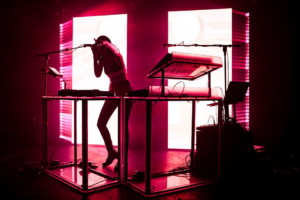
He performs with a Roland SP-404, live piano, and a setup that allows him to genuinely improvise within the structure of a set. This is not improvisation in the sense of randomness, it is improvisation in the jazz sense, working within a set of understood parameters to find something new. Each show is technically different from every other show. That is genuinely unusual in electronic music.
His Boiler Room performance from 2021 became one of the most-watched DJ sets in the platform’s history. What it captured was not just technical skill but visible emotional investment. You could see what the music meant to him as he played it. That kind of transparency, a DJ who is visibly present in the room rather than simply technically operational, is rarer than it should be.
As I write about in my piece on mastering the mix, one of the defining qualities of the best DJ performances is a sense of intention, the feeling that the person behind the decks is making choices in real time for a reason. Fred Again does this more evidently than almost anyone else working at his level.
The B3B Phenomenon
The collaboration with Four Tet and Skrillex as B3B, back-to-back-to-back, became one of the defining stories of contemporary electronic music. Three Madison Square Garden nights. Tickets that sold out before the lineup was announced. Sets that people described less as DJ performances and more as experiences they were not sure how to categorise.
What makes this collaboration interesting from a musical perspective is how different the three of them are. Four Tet’s solo work is defined by restraint, texture, and a kind of patient intelligence. Skrillex built his reputation on maximalism, on bass weight and impact. Fred Again occupies emotional territory that neither of the other two does in quite the same way. In combination, the three of them cover an unusual amount of ground, and the fact that they are genuinely friends who have been in each other’s studios, rather than three names assembled by a booking agency, comes through in the coherence of what they do together.
What to Make of the Hype
The honest answer is that some of the hype is deserved and some of it is the machinery of the music press doing what it always does with an artist who arrives at the right moment.
What is genuinely true is that Fred Again has moved something in electronic music. The emphasis on emotional directness, on music that is explicitly about memory, loss, connection, and the specific texture of being alive at this particular time, is a counter-movement to the abstraction and formal difficulty that had been dominating the most critically respected corners of the genre. He has given an enormous number of people permission to feel things at a rave.
He has also opened up questions about the relationship between private and public in music. The voice messages, the found sounds, these are ethically complicated. Using someone’s private words as compositional material raises questions that go beyond music. To his credit, Gibson appears to take those questions seriously, seeking consent and being transparent about the process.
Whether or not you love the music, the conversation he has generated is useful. And in my experience, having played rooms in Seoul and elsewhere where his tracks work in the most unexpected ways, the music holds up at volume, at 2am, in a room full of people who need something to hold onto.
USB002 and the 2025 Chapter
By the time you read this, the Actual Life series, the work that introduced most people to Fred Again, feels like the beginning of a longer story. The next chapter arrived in late 2025 with USB002, a 12-track project that includes “Talk of the Town” with Sammy Virji and Reggie, and “HARDSTYLE 2” with KETTAMA and Shady Nasty. The USB format, music released via physical USB drives, no streaming announcement, just the object, was itself a statement about how he wants people to engage with his work. Slowly. Intentionally. Without an algorithm deciding what they hear next.
To support the release, he played 10 shows in 10 cities across 10 weeks in autumn 2025, then extended the run with a residency at East End Studios in New York in January 2026 and four nights at Alexandra Palace in London the following month. These were not festival appearances, they were deliberate, focused events. The scale was enormous but the intention was intimate.
His album Ten Days received a Grammy nomination for Best Dance/Electronic Album at the 2026 ceremony. That recognition from the Recording Academy, whatever its limitations as a measure of artistic quality, confirmed that what he has built is not a moment. It is a body of work.
His Influence on What’s Happening Now
If you are a DJ in 2026 trying to understand what the cutting edge of DJ culture looks like, Fred Again is required listening, not to copy his approach but to understand what he revealed about what was missing. His success demonstrated that there is a large audience for electronic music that is emotionally complex, that does not require ironic distance, that takes the idea of connection seriously.
I see this influencing the more interesting rooms in Seoul’s underground scene too, younger DJs who are programming sets with more emotional range, more willingness to let something melancholy sit next to something euphoric, less fear of playing a record that does not immediately deliver. It is a subtle shift but a real one.
For more on how to think about programming a set with this kind of intentionality, my guide to mastering the mix goes into the structural principles. And for context on why this moment in electronic music feels significant, it is worth reading the 1999 post I wrote about the last time the genre felt this alive to a wide audience.
FAQ
What is Fred Again’s real name? His real name is Fred Gibson. He studied under Brian Eno and worked as a songwriter and co-producer for artists including Ed Sheeran and Stormzy before launching his solo career as Fred Again.
What genre does Fred Again make? His music is primarily rooted in UK electronic music, house, UK garage, drum and bass, but filtered through a strong compositional sensibility that draws on ambient, classical, and vocal music. Genre classification is difficult and arguably beside the point.
How did Fred Again become famous? His 2021 Boiler Room performance went viral and introduced him to a global audience. The album series Actual Life, built around real voice messages, field recordings, and fragments of conversation, developed a following that rapidly expanded into mainstream recognition.
Who has Fred Again collaborated with? His most prominent collaborations include back-to-back-to-back shows with Four Tet and Skrillex (B3B), a track and video with Anderson Paak, and live appearances featuring vocalist Joy Anonymous. He has also worked with Flowdan, Swedish House Mafia, and a range of artists across UK and American music.
Written from Seoul, by someone who has been in the booth for 25 years. More on the site, or book a DJ.
Stay in the Loop
New writing on DJ culture, electronic music, and the Seoul underground — delivered when it matters.