People ask me, fairly often, how all of this fits together. Someone hears a Peggy Gou record, likes it, works out it’s “house,” and then immediately hits the wall every newcomer hits: house has children. Deep house, tech house, acid house, garage house, Afro house, soulful house. And those have children too. Within a couple of clicks they’re staring at “liquid neurofunk” wondering how on earth it’s related to disco.
It’s related to disco. Everything here is related to disco, or to funk, or to soul, the three roots that everything electronic grows out of. That’s what the genre arguments always miss: dance music works as a family, not a list of styles. Each sound came from a specific city on a specific night out of specific machines, and it carries the DNA of whatever came before it. So I mapped the whole family.
What the Map Shows
The Dance Music Tree now maps 410 genres in 14 families, each placed at the year it took shape. Five eras are still the easiest way to read it.
Five Eras of Dance Music
From the roots to the digital era
댄스 음악의 다섯 시대
| Era | Years | What arrives |
|---|---|---|
| Roots | Before 1978 | Funk, soul, disco: the source material |
| First wave | 1978 to 1988 | House from Chicago, techno from Detroit, electro, early ambient |
| Rave era | 1988 to 1996 | Acid house, hardcore, jungle, trance |
| Post rave | 1996 to 2008 | Drum and bass splinters; UK garage splits into grime and dubstep; minimal, big beat |
| Digital era | 2008 on | EDM, future bass, footwork, amapiano, hyperpop |
How to read itThe machines arrive in the first wave, and almost everything after 1988 is a branch of acid house or of what it set off.
The newest era is the one still being drawn. Amapiano has crossed out of South Africa into festival circuits around the world, hyperpop came out of the internet, and the Seoul scenes I write about sit on the newest branches too.
Each node connects to the ones that produced it. You can follow a single line, disco → garage house → UK garage → 2 step → grime, and watch a sound mutate across decades and continents without ever fully breaking from its parent.
→ Explore the interactive Dance Music Tree
Why a Tree and Not a List
The connections are the history, and a list hides them. If you’re in Seoul, the quickest way to hear the Korean end of the tree is to compare a K-pop house single with a deep house record from the 1990s; the chords and the steady kick are the family resemblance.
Where the 410 Genres Sit
Number of genres in each family on the tree
장르 가족별 장르 수
How to read itHouse and hip hop hold 55 of the 176 between them. The three roots hold only three genres of their own, but almost every line runs back to them.
Take drum and bass. As a list entry it’s just “fast breakbeat music, about 170 BPM.” As a branch on the tree, it’s what happened when hardcore rave got too fast for its own breakbeats and producers started chopping the Amen break into something more precise. Jungle’s ragga influenced roughness came first, by 1994, and drum and bass proper emerged around 1995 before splitting into the smoother liquid and darker neurofunk strains. You can’t see any of that in a definition. You can see all of it on the map.
It also makes the regional story legible. Techno is Detroit. House is Chicago. Jungle, garage, grime, dubstep and UK bass, that whole dense cluster, is Britain. The tree has Korean branches too, from K-pop and Korean hip hop to K-pop house, because that lineage is still being written, and I’m writing down as much of it as I can.
Where to Start If You’re New
Don’t try to absorb all 176 at once. Start at a node you already like, then walk backwards: follow the lines to its parents until you hit one of the three roots. Do that two or three times and the whole structure clicks into place, because you stop seeing genres and start seeing a single continuous story.
That story is now worth $15.1 billion a year globally, up 7 percent in 2025, according to the IMS Business Report 2025/26. The map starts at disco. That lineage is worth knowing.
Frequently Asked Questions
How are dance music genres related to each other?
Dance music works as a family rather than a list of styles, and every genre traces back to three roots: funk, soul and disco. Each sound came from a specific city on a specific night out of specific machines, and it carries the DNA of what came before it. A single line such as disco to garage house to UK garage to 2 step to grime shows a sound mutating across decades without fully breaking from its parent.
How many dance music genres are there on the family tree?
The Dance Music Tree now maps 410 genres in 14 families. Read by era, it runs from the roots, a first wave from 1978 to 1988, the rave era from 1988 to 1996, post rave from 1996 to 2008, and the digital era from 2008 onward. For a view organised by speed instead, see the guide to how fast each genre is.
Where did house, techno and drum and bass come from?
House came out of Chicago and techno out of Detroit in the first wave of electronic dance music. Drum and bass grew from hardcore rave when it got too fast for its own breakbeats and producers began chopping the Amen break into something more precise. Jungle’s ragga influenced roughness came first, and drum and bass proper then split into the smoother liquid and darker neurofunk strains.
How should a beginner start learning dance music genres?
Start at a genre you already like and walk backwards, following the lines to its parents until you reach one of the three roots. Repeating that two or three times makes the structure click, because you stop seeing separate genres and start seeing one continuous story. Trying to absorb all 410 genres at once is the wrong approach.
Further Reading
- Techno: From Detroit to the Dancefloor
- UK Garage: The Sound That Split Into Everything
- The Genre Encyclopedia
- Every Dance Music Genre, Mapped
- Wikipedia: an overview of electronic dance music
- Wikipedia: funk, one of the three roots of the tree
- Wikipedia: house music and its Chicago origins
- Wikipedia: techno and its Detroit origins
- Wikipedia: drum and bass and its many subgenres
Sources
CNN, amapiano’s origins and spread, February 2022
BBC Culture, the most notorious copyright cases in music history, June 2019
Dancecult: Journal of Electronic Dance Music Culture, vol. 15 no. 1, 2023
Written from Seoul, by someone who has been in the booth for more than twenty years. More on the site, or book a DJ.
Browse the family tree by section: EDM and pop · Global crossover · Trance · Psytrance and goa · Jungle and drum and bass · Revival and fusion · Algorithm and AI era.
Stay in the Loop
New writing on DJ culture, electronic music, and the Seoul underground, delivered when it matters.
More From The DJ Diaries

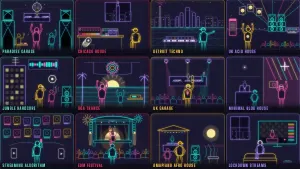
Play with the history
Four tools built from the same research as this site.