On 8 May 2020, Seoul ordered more than 2,100 clubs and bars to close. A few days earlier, during a short window of eased distancing rules, a visitor who had been through several Itaewon (이태원) clubs tested positive, and the cluster that followed grew past two hundred cases nationally. For the next two years, every operator in the city learned to plan a weekend around a government briefing.
Seoul’s clubs didn’t simply pause and pick up where they left off. The pandemic changed who runs the rooms, who stands in them, and how well both sides understand how fragile a dance floor is. Six years on, some of the addresses are the same, but the scene behind them has a different shape.
Seoul Clubs, May 2020 to 2026
The shocks, the rules and the reopenings, drawn to scale
코로나 이후 서울 클럽
| November 2021 | Licensed as an entertainment venue | Licensed as a general restaurant |
|---|---|---|
| Closing time | Midnight | All night |
| Entry | Vaccine pass | Vaccine pass |
| Dancing | Allowed | Only by local ordinance, in eight districts |
The licence gapSame music, same crowd, different paperwork. The split the Hankook Ilbo reported in 2021 is still live in 2026, which is why the culture minister has pledged to change the Food Sanitation Act rules.
- 1May 2020The Itaewon cluster 237 cases by 25 May. Coverage blames a community, and anonymous testing follows
- 22020 or 2021Soap closes its first room It keeps going as a roving party
- 3Nov 2021Living with COVID Clubs close at midnight with vaccine passes. Lounges licensed as restaurants stay open all night
- 418 Apr 2022Distancing ends after 757 days The crowd comes back fast. The staff do not
- 529 Oct 2022The Itaewon crush 159 people die beside the Hamilton Hotel. The district empties for months
- 6Feb 2026Soap reopens 217 Itaewon-ro. Read locally as proof the recovery will last
- 7Aug 2026Ovantgarde suspended A Busan live venue, two months, for audience dancing
Over 2,100 clubs and bars in Seoul were ordered shut on 8 May 2020, after the Itaewon cluster.
12 weeks shut in the capital region, 10 elsewhere, for about 40,000 venues. Clubs reopened in February 2021 with a 10pm close and no dancing.
256 to 0 the National Assembly vote that passed the Itaewon special act on 2 May 2024, 551 days after the crush.
Sources: Korea Herald · YTN · Dailian · Kyunghyang
May 2020 Made Itaewon the Face of Nightlife Risk
Contact tracers linked the May cluster to venues around Homo Hill, the gay bar alley in Itaewon. Some Korean media coverage played up the LGBTQ+ character of the venues, and that turned a public health event into a privacy crisis. People avoided testing for fear of being outed by the tracing system, and health authorities brought in anonymous testing to get the numbers back up.
The damage from that framing has been measured. A 2021 network analysis in The Geographical Journal of Korea (국토지리학회지) by Park Jun-hong, Baek Ji-hye, Lee Ji-na and Chung Hee-sun found that reader comments on the coverage blamed the whole LGBTQ+ community rather than the individuals who were infected, and carried that negative image over to Itaewon itself.
That month made Itaewon the public face of nightlife risk for the rest of the pandemic. The political charge from it has never fully gone away, and it runs through the longer story of the district.
Two Years of Rules Nobody Could Plan Around
What followed was a cycle of closures: full shutdowns, 10pm and midnight curfews, capacity caps (Korean), and at the strangest points, rules that let venues open but banned dancing. Every operator in the city learned the levels of Korea’s distancing system (사회적 거리두기, sahoejeok georideugi) by number, the way promoters normally know set times.
The economics were brutal in a city where commercial rent doesn’t pause. Some venues survived by selling takeout beer and soju over the counter, some by negotiating with landlords, and some by crowdfunding from their own regulars. Others, including rooms with a decade of history, didn’t survive at all, the pattern I write about more generally in why clubs die.
Soap is the clearest Itaewon example. It closed its original room at 132-3 Itaewon in 2021, kept going as a roving party at venues such as Modeci and The Mint Ginza, and only reopened, at 217 Itaewon-ro, on 26 February 2026. For almost five years, one of the district’s anchor crews had no room of its own.
The Licence Gap Never Closed
The rules didn’t land evenly, and the unevenness came down to paperwork. In November 2021, under the first phase of living with COVID (위드 코로나, wideu korona), the Hankook Ilbo (한국일보) reported that clubs and other venues licensed for entertainment were held to a midnight close and vaccine passes. Some lounge bars and hip hop lounges registered as general restaurants stayed open all night, with customers dancing, and owners of licensed clubs called it unfair.
That split still decides where you can dance in Korea. By local ordinance, eight districts, including Yongsan-gu (용산구, Itaewon) and Mapo-gu (마포구, Hongdae), let general restaurants allow dancing. In districts without an ordinance, a single complaint can bring a suspension. It’s the reason so many Seoul clubs have kitchens.
The gap is still live in 2026. In August, Ovantgarde, a live venue in Busan (부산) registered as a general restaurant, was suspended for two months over audience dancing. On 31 August the culture minister, Choi Hwi-young, pledged to change the Food Sanitation Act rules so that live venues can allow dancing. Until that happens, the same music and the same crowd can be legal in one district and a violation in the next.
The Stream Kept the Scene Talking
The live stream set became the partial substitute. Seoul crews were early and disciplined about it, and for a while a laptop camera above a booth was the only stage in the city. It kept selectors sharp and kept communities in touch.
Nobody who played those empty room sets mistook them for the real thing. A dance floor is people in a room together, and two years without one taught everyone what the room had been for.
Korean researchers saw the same shift in Hongdae’s (홍대) live music scene. Kim Hyo-min’s 2022 social network analysis in Culture and Convergence (문화와 융합) found “online” becoming central to Hongdae indie music after COVID, with performers moving between small venues and digital platforms run by public bodies, broadcasters and companies to build hybrid ways of playing live.
Reopening Into a Different City
Distancing ended in April 2022, after 757 days, and the rebound was real but uneven. The crowd came back fast. The staff didn’t, because two years is long enough for sound engineers, door staff and bartenders to build other lives.
Fewer People Ride the Subway After Midnight
Weekday riders after midnight, Seoul Metro
자정 이후 지하철 이용객 감소
How to read itLate night ridership is down 23.7% on the year before the pandemic. Hongik University is the second busiest station after midnight, just behind Gangnam.
Then, on 29 October 2022, the Halloween crowd crush in Itaewon killed 159 people in the alley beside the Hamilton Hotel, a few steps from Exit 1 of Itaewon Station and in the middle of the club district. By August 2026 the official count of victims had risen to 162. It wasn’t a club event, but it happened in nightlife’s postcode, and grief and association emptied the neighbourhood for months.
The district’s slow climb back has shaped foot traffic and booking confidence ever since. The National Assembly passed the Itaewon special act 256 to 0 on 2 May 2024, 551 days after the crush. The Soap reopening in February 2026 reads locally as a sign that Itaewon’s recovery will last.
Three Changes Outlasted the Emergency
First, the relationship between venues and promoters flipped. Owners who once guarded their calendars now hand off nights wholesale to independent crews, the cooperative model I describe in the Korean rave essay, because an empty Tuesday turned out to be more frightening than an unfamiliar promoter.
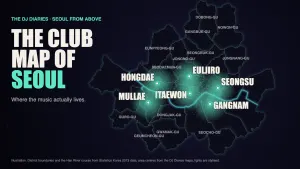
Second, the scene got smaller. The venues that survived best were low cost basements with loyal regulars, not big floors with big overheads. That concentrated Seoul’s underground into the specific rooms mapped in the club map.
Third, the audience split. The mainstream end drifted further toward Korean pop and hip hop for a domestic crowd, while house and techno settled around a committed core, the split I look at in Seoul club culture at a crossroads and which our 2025 survey measured directly.
The people who carried the scene through those years are the same people building it now, and the experience changed how they think about risk, density and what a crowd is. Seoul’s dance floors in 2026 are run by operators who know how fragile the whole arrangement is. It shows, in the good way.
Frequently Asked Questions
How did COVID affect the Seoul club scene?
Seoul’s clubs went through two years of full shutdowns, 10pm and midnight curfews, capacity caps and, at points, rules that let venues open but banned dancing. Some survived on takeout beer and soju (소주), landlord negotiation or crowdfunding from regulars. Others, including rooms with a decade of history, closed for good, and Soap ran as a roving party from 2021 until it reopened in February 2026.
What happened with the Itaewon club outbreak in May 2020?
In early May 2020, during a short window of eased distancing rules, a visitor who had been through several Itaewon (이태원) clubs tested positive. The cluster grew past two hundred cases nationally, and Seoul ordered more than 2,100 clubs and bars to close on 8 May. Coverage that focused on the LGBTQ+ venues involved scared people away from testing, and health authorities introduced anonymous testing in response.
When did Seoul clubs reopen after COVID?
Distancing ended in April 2022, after 757 days. The crowd came back fast, but many staff had moved on to other work. Then the Itaewon crowd crush of 29 October 2022, which was not a club event, emptied the neighbourhood for months.
What changed in Seoul nightlife after the pandemic?
Venue owners began handing whole nights to independent crews, the cooperative model behind the Korean rave. The underground concentrated into low cost basements with loyal regulars. The mainstream drifted toward Korean pop and hip hop for a domestic crowd, while house and techno settled around a committed core. The licence gap between clubs and venues registered as restaurants is still unresolved in 2026.
Further Reading on The DJ Diaries
- Itaewon After Dark: The History of Seoul’s Club District
- Why Seoul Clubs Have Kitchens
- Why Clubs Die
- The Korean Rave: How Underground Events Work Outside the Clubs
- The Seoul Nightlife Report 2025
Sources
The Hankyoreh (한겨레), on the official victim count of the Itaewon crush, August 2026
Written from Seoul, by someone who has been in the booth for more than twenty years. More on the site, or book a DJ.
Follow the rooms: Soap on Instagram
Stay in the Loop
New writing on DJ culture, electronic music, and the Seoul underground, delivered when it matters.
More From The DJ Diaries
Play with the history
Four tools built from the same research as this site.