The usual note, and it matters more than usual here. I’m not a historian, and this isn’t an academic article. It’s a working DJ reading the published history of Korean banned songs and music censorship, including proper Korean scholarship, and connecting it to the rooms I know. Dates and cases below follow the published record. The argument at the end about the coffee house booths is my own, and I flag it as such when we get there.
Here’s the headline fact for anyone new to it. From the early 1960s to 1987, South Korea maintained official lists of songs that couldn’t be broadcast, performed or sold. These were formal lists, administered through state censorship bodies, with stated reasons attached to each title. Hundreds of Korean songs went onto them, along with long rosters of foreign records. The peak came in 1975, under the Park Chung-hee government’s emergency decree period, when a purification campaign swept more than two hundred domestic songs onto the lists in a matter of months, alongside a mass banning of foreign rock, a history OhmyNews has documented at length.
The reasons are where it turns surreal.
Why Korean Banned Songs Were Banned: Cynicism, Decadence, Sighing
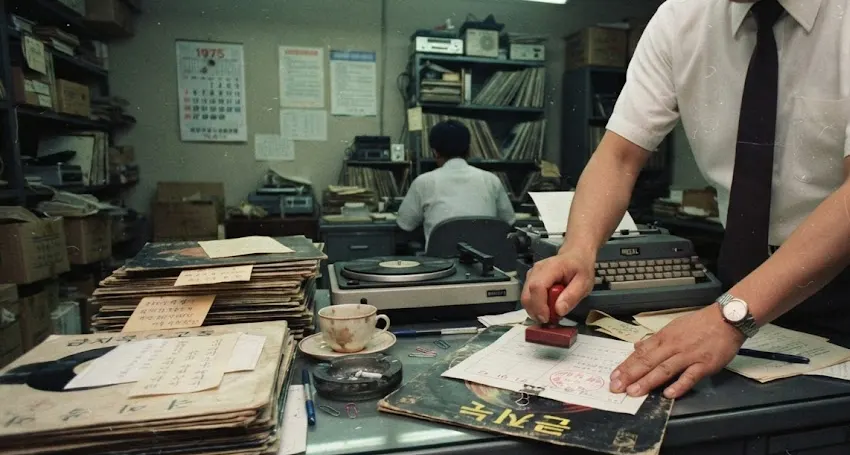
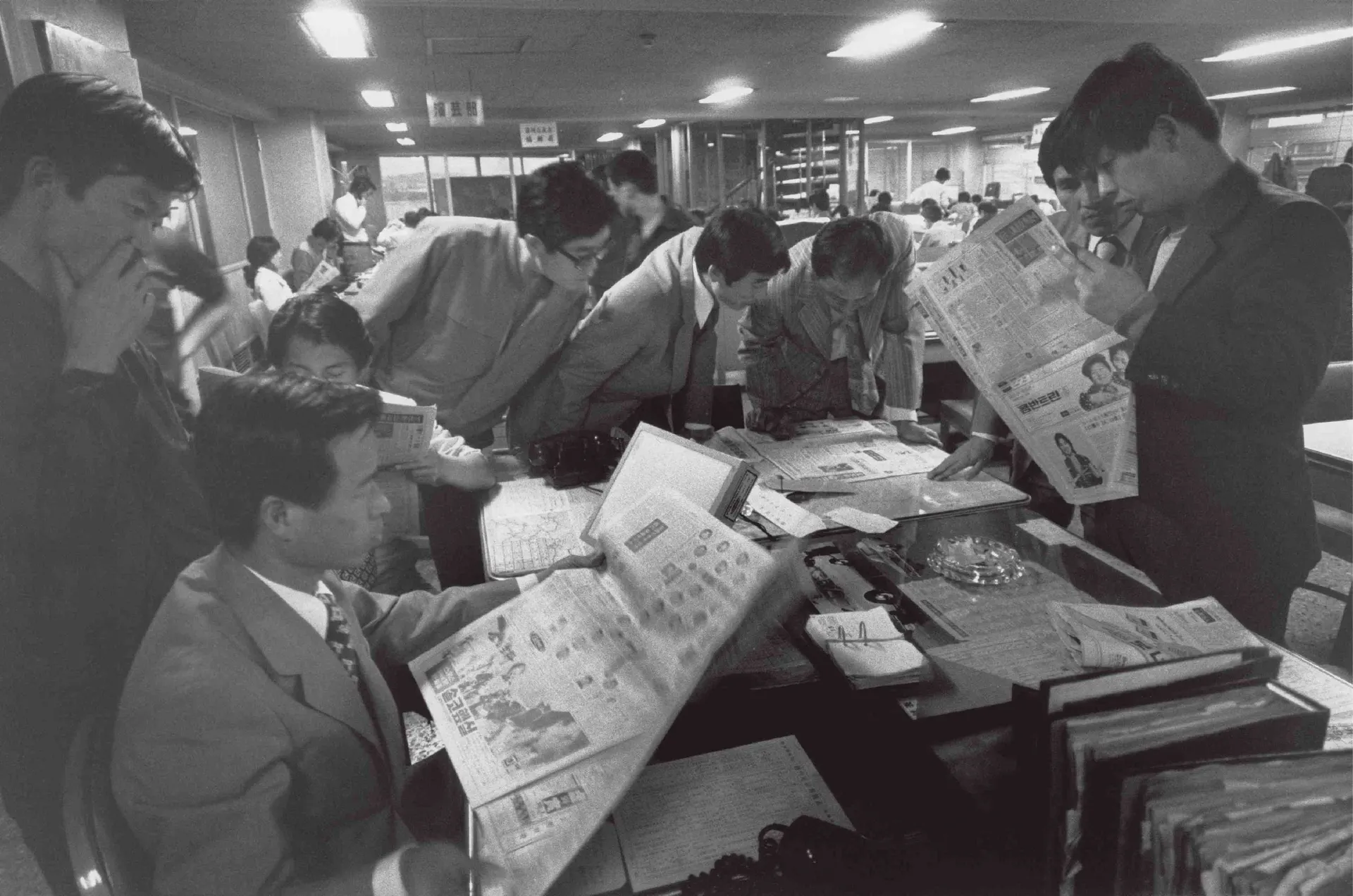
The stated grounds ran from the political to the almost unbelievably petty. Songs went on the lists for negativity, for decadence, for encouraging distrust, for Japanese colour, for defeatism. The canonical examples, which Korean articles on this subject recite the way North Americans recite banned book cases, include some of the best songs this country ever produced.
Kim Chu-ja’s 거짓말이야, It’s a Lie, banned on grounds usually rendered as fostering distrust. Song Chang-sik’s 왜불러, Why Do You Call Me, pulled after it appeared over a scene of students fleeing a police crackdown in a landmark seventies film, with informal speech among the cited problems. 아침이슬, Morning Dew, by Kim Min-gi and sung by Yang Hee-eun. It had won a government song award in 1973 before landing on the banned lists in 1975 once the streets adopted it as an anthem. The lists weren’t consistent, and that was part of their function. When anything can qualify as decadent, everyone self-censors.
And then there’s the case that carries the whole era, and if you only follow one link from this article make it this one.
The Man Who Said No: Shin Joong-hyun
Shin Joong-hyun is the founder of Korean rock, full stop. By the early seventies he was the most influential musician and producer in the country. In 1972 the presidential office asked him to write a song in praise of Park Chung-hee. He refused. What he wrote instead became 아름다운 강산, Beautiful Rivers and Mountains, ten minutes of psychedelic rock in praise of the country rather than its ruler.
The state’s response unfolded over the following years. His hit 미인, arguably the most beloved Korean rock song of its decade, went onto the banned lists in the 1975 sweep. That same year the marijuana crackdown tore through the Korean music world and swept him up with it. By his own account he served time in prison, endured torture, and ended up confined to a psychiatric institution. A performance ban kept him off every stage in the country until after Park’s assassination in 1979. His own summary of that history, given to interviewers decades later, is one of the coldest sentences in rock and roll: God took Park and opted to save me.
The vindication took forty years. In 2010 Fender built him a Custom Shop tribute guitar, the first Asian musician so honoured. The Seattle label Light in the Attic began reissuing his catalogue to international acclaim the following year. The records Korea was once forbidden to hear now sell as classics in the countries the censors were worried about.
June 1987: When the Korean Banned Songs Lists Died
The end came with democratization. In the wake of the June 1987 uprising and the declaration that followed, the censorship apparatus began releasing songs from the lists. The unbannings rolled out through the late eighties in the hundreds, domestic and foreign, a moment Korean pop history archives record as 해금, the unbanning. Morning Dew and Shin Joong-hyun’s catalogue came off officially. The pre-release censorship system itself was later dismantled, with Korean scholarship on the era treating 1987 as the hinge.
This is living memory. The people who bought these records as contraband are in their sixties and seventies now. Every Korean of that generation knows what a 금지곡 is, the way every Canadian of my parents’ generation knows what the War Measures Act was. It’s one of those national experiences that sits underneath the culture without being visible to visitors at all.
My Argument: Follow the Booths
Now the part that’s mine, and I’ll label it clearly. The scholarship on Korean censorship covers broadcasting, publishing and the record industry thoroughly. What it barely touches, as far as I can find in either language, is distribution at room level. Which rooms did a banned record actually get heard in?
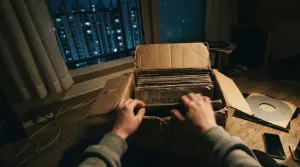
Think about what the bans could reach. Radio playlists, television, legal record pressings, public performance. Now think about what they couldn’t efficiently reach: tens of thousands of privately owned records, sitting in the personal crates of coffee house DJs, played to thirty people at a time in rooms officially selling coffee. The music dabang DJ owned his collection, imported and otherwise. The entire value of his job was playing what the audience couldn’t access elsewhere. The era’s DJs describe exactly that role in the profiles Korean media has run. Busan’s cultural archive credits the Gwangbok-dong dabang DJs with building that city’s pop culture on precisely this function.
The Reasons Given
I’m not claiming the dabang was a resistance movement. I’m not claiming enforcement never reached a coffee house. The same state was checking hair length on the street, and the booths weren’t invisible. What I’m claiming is narrower and, I think, solid: in a country whose official channels the state censored for a generation, a distributed network of small rooms with private record collections and trusted human curators was structurally the leakiest part of the system. Structurally leaky is where culture survives. If you want to know why the DJ came to mean something in Korea, why the booth carried authority here decades before club culture arrived, I believe part of the answer is on the banned lists.
If you were in those rooms in the seventies and eighties and know what got played, my inbox is open. I’d love to be corrected in either direction. This is a piece of the history that deserves to be written down while the people who lived it are still here to write it.
The lineage those booths started runs in an unbroken line to the clubs I work in now. The artists carrying it are in Korean DJs to Know in 2026.
FAQ
Why did South Korea ban songs?
Under the Park Chung-hee and Chun Doo-hwan governments, state censorship bodies maintained lists of songs banned from broadcast, sale and performance, with stated reasons ranging from political subversion to decadence, defeatism and fostering distrust. The largest purge came in 1975 during the emergency decree period, when more than two hundred Korean songs. A long list of foreign rock records were banned in one campaign.
Which famous Korean songs were banned?
The canonical cases include Morning Dew by Kim Min-gi, which the censors banned in 1975 after the streets adopted it, despite the government awarding it a prize two years earlier, Shin Joong-hyun’s Mi-in, Kim Chu-ja’s It’s a Lie. Song Chang-sik’s Why Do You Call Me. Many banned titles are now considered classics of Korean pop and rock.
What happened to Shin Joong-hyun?
After refusing a 1972 request to write a song praising President Park, Korea’s founding rock musician saw his work banned. In the 1975 marijuana crackdown the authorities arrested him, imprisoned him and confined him to a psychiatric institution,. A performance ban held until after Park’s death in 1979. International recognition followed decades later, with a Fender tribute guitar in 2010 and acclaimed reissues on Light in the Attic Records.
When were Korea’s banned songs unbanned?
The dismantling began after the June 1987 democratic uprising, with the censorship authorities releasing hundreds of Korean and foreign songs from the lists through the late 1980s. The pre-release censorship system abolished in the years that followed. In Korean the moment is known as 해금, the unbanning, and Korean scholarship treats 1987 as the turning point.
Sources, Archives and Listening
The scholarship and the record. KCI paper on music prohibition under the Park and Chun governments · National Institute of Korean History on censorship of popular song · OhmyNews on eighteen years of banned pop · Archive K on the 1987 unbanning · the running list of banned songs and stated reasons.
Hear what was banned. 아침이슬, Morning Dew, written by Kim Min-gi and sung by Yang Hee-eun, won a government award in 1973 and was banned in 1975. Shin Joong-hyun’s 미인 went onto the lists the same year; his catalogue is back in print internationally through Light in the Attic. That is the easiest legitimate way to hear the era outside Korea. Kim Chu-ja’s 거짓말이야 and Song Chang-sik’s 왜불러 are on the Korean streaming services.
Photographs of the era. e영상역사관 national archive photography and National Archives of Korea digital collections hold the state’s own photography of the period, including the campaigns that produced the bans. That’s a strange and useful thing to look at directly. Seoul Photo Archive (서울사진아카이브) covers the street level.
Read next: the full lineage from coffee house to club · the last man still doing the job · how the request slips worked · why owning your records still matters
Picture Credits
- Journalists reading the paper, Seoul, May 1974
National Museum of Korean Contemporary History, via Wikimedia Commons. Licence: Public domain. View the original file and its full licence terms.
Historical images on this site are used under the licence stated for each file. KOGL Type 1 is the Korean public sector open licence permitting commercial use and adaptation with attribution; public domain items carry no restriction. If you hold rights in any image here and believe it has been used in error, get in touch and it will be removed.
Written from Seoul, by someone who has been in the booth for more than twenty years. More on the site, or book a DJ.
Stay in the Loop
New writing on DJ culture, electronic music, and the Seoul underground, delivered when it matters.
More From The DJ Diaries
Play with the history
Four tools built from the same research as this site.