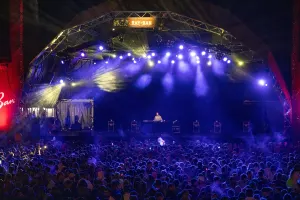
Sell 200 tickets at ₩20,000 and the promoter has ₩4 million at the door before the first record plays. A niche techno producer, meanwhile, needs roughly 100,000 streams to earn what the local DJ on that bill takes home for one night. Hold that exchange rate in your head, because every other number in dance music’s economy follows from it.
Recorded music now pays like a promotional expense. The money in dance music sits in the room: the door, the bar and the fee, and in Seoul the bar is shrinking while DJ pay has barely moved in all my years here. What follows is where each won goes on a club night, worked through with real deals and real numbers, plus why I’d still book the international DJ who loses you money.
Streaming Pays Like a Promotional Expense
Spotify pays rights holders between $0.003 and $0.005 per stream, so a track needs roughly 200,000 to 330,000 streams to generate $1,000. Most tracks on niche electronic labels won’t reach that in their first year. A million stream record, a hit by underground standards, earns $3,000 to $5,000 for its rights holders, and if it went through a label, the artist typically keeps half or less after the split. Distribution only routes through DistroKid or CD Baby keep a bigger share of much less money.
Since April 2024, Spotify has paid nothing at all on tracks with fewer than 1,000 streams in the previous 12 months, as its monetisation rules explain. The streaming economy essay covers how we got here. The practical consequence is that recordings have become business cards for the income that matters.
The Booth Pays the Rent, and Draw Sets the Fee
Performance income runs on a different scale. A local DJ playing a 200 capacity night earns $200 to $500. A regional name with a draw takes $500 to $2,000. Touring internationals with agency representation move into five figures, and the A list occupies the six figure festival tier documented in the superstar DJ essay.
One Night in the Booth Against a Year of Streams
What one DJ set pays at each rung, next to what streaming pays a release
How to read itEach gridline is ten times the last. Follow the gold bars: a hundred thousand streams lands inside a local DJ’s single night, and a million stream hit pays about what a regional name earns in a weekend or two.
$15.1 billion was the value of the global electronic music industry in 2025, up 7%. Publishing grew fastest, at 11%.
$11 billion went from Spotify to the music industry in 2025. About 1,500 artists earned over $1 million and about 13,800 earned at least $100,000, before any splits.
€160 million in club ticket revenue in Ibiza in 2025, up from €150 million.
Sources: IMS Business Report 2026 via Beatportal · Spotify Loud and Clear 2026
The rungs are spaced by draw, not by skill. Promoters pay for the audience you bring, a mechanic explained in the booking ecosystem piece. One good monthly residency out earns a moderately successful release catalogue, which is why every producer you admire is also touring.
Now the local end of that ladder. DJ pay in Seoul has barely moved in all my years here, and if anything it has gone down. Some would point to the cost of everything else, or to people drinking less. Others would say the market is simply saturated: there are so many DJs, and so many of them will play for less money just for the opportunity.
The Bar Is the Biggest Pool, and Seoul’s Is Shrinking
Follow one night’s money and the shape appears. The venue keeps the bar, the biggest and steadiest pool, as festival economics shows at a larger scale. The promoter carries the risk on the ticket margin. The platforms, Spotify and YouTube and ticketing sites charging 10 to 12 percent, take their cut off the top with no exposure at all. Publishing and sync, covered in the publishing essay and the sync piece, quietly pay better per use than streaming ever will. And labels survive on services, not sales: curation, positioning and access to the trust networks that get records played by people who matter.
What Seoul Club Goers Spend on Drinks
Drink budget for a night out, share of respondents
클럽에서 술값, 얼마나 쓸까
How to read itThe most common budget is ₩25,000 to ₩50,000, but the spread is wide, and a few big spenders matter a lot to the bar. The bands in between are left out here. Track runs from 0 to 40 percent.
Korea in 2026 shows the two ends of this economy pulling apart. At the top, HYBE posted record second quarter revenue of 1.45 trillion won (about CAD $1.39 billion). Concert revenue rose 243 percent to 647.7 billion won on the BTS ARIRANG tour, per Music Business Worldwide, and a floor seat for that tour cost 260,000 won, about CAD $250, as the Korea Times reported. Live performance is where the money sits at every rung, and K-pop proves it at a scale no DJ will see.
The club end tells a quieter story. Card data from NH NongHyup Bank (NH농협은행), covering 7.38 million customers, found bar payments down 34 percent between the first half of 2023 and the first half of 2026, and payments after 1am down 43 percent, per Segye Ilbo. I went through that report in why Seoul’s twentysomethings left the bar. If the venue lives on the bar, a night where fewer people drink is a night where the steadiest pool shrinks first. The promoter feels it next, and the DJ fee is set from what’s left. I wrote about where that leaves the rooms in Seoul club culture at a crossroads.
Our own Seoul Nightlife Report found the most common drink budget is 25,000 to 50,000 won a night, chosen by 34.2 percent of the 343 respondents. The spread is wide: 21.9 percent spend under 25,000 won on drinks, while 15.4 percent spend more than 100,000 won. The full survey findings are written up separately.
Ticketing changed too. Revisions to Korea’s Performance Act banning all ticket scalping came into force on 28 August 2026, according to the Korea Herald. How that applies to a particular club night is a question for a lawyer, not for me. For a DJ pricing a gig in Seoul, the practical reference is what rooms pay, and my piece on what it costs to hire a DJ in Seoul covers that from the buyer’s side.
How a Club Night Splits the Money
There are a lot of ways a night can split its money, and over my years promoting I’ve seen most of them. The simplest is the door deal: the promoter keeps the ticket money and the venue keeps the bar. Sell 200 tickets at 20,000 won and the promoter has 4 million won to pay the DJs, the flyers and any extra sound, while the venue lives on drinks.
Who Keeps What on a 200 Ticket Night
Two pools of money, three common deals. Pick a deal to see where the won goes.
클럽 하룻밤, 돈은 어디로 가나
Door dealThe promoter keeps all ₩4,000,000 and pays the DJs, the flyers and any extra sound from it. The venue lives on drinks. The promoter carries the risk of an empty room.
Door splitPromoter and venue share the tickets, here 70/30, often after an agreed amount covers the venue’s costs first. Less risk for the promoter, less upside too.
Bar percentageThe promoter or DJ takes 10 to 20 percent of total bar sales. It pays for bringing a crowd that drinks, which is harder in a Seoul where card payments at bars fell 34 percent in three years.
In a door split, promoter and venue share the ticket sales, say 70/30, often after an agreed amount covers the venue’s costs. With a bar percentage, the promoter or DJ takes a cut of total bar sales, for example 10 to 20 percent, which rewards bringing a crowd that drinks. Regular nights often run a mix, a share of the door plus a share of the bar. And sometimes the venue simply pays the DJ or promoter a flat fee, whatever the turnout.
Playing for exposure? I’ve been fortunate never to really be asked. It’s the most offensive thing you can say to a DJ, and people shouldn’t do it. Some DJs do just want the exposure, and in my opinion that’s what social media is for: get on YouTube and start sharing content and mixes.
The biggest cost of a club night is a balance. You always want to pay the DJs properly, but you also have to cover the other staff, rent, overheads, insurance and the rest. Like any negotiation, the goal is that everyone walks away feeling it worked: you made money, and the DJs, the customers and everyone else had a good time.
Three Nights, Worked Through
To make the margins concrete, here are three typical Seoul scenarios. The inputs come from published figures and my own experience. The totals are illustrative, not anyone’s actual books, and I’ve used about ₩1,380 to the US dollar.
What Three Kinds of Night Leave Behind
Illustrative budgets from the scenarios in this article
세 가지 밤, 남는 돈은 얼마일까
| The night | Money in | Costs | What’s left |
|---|---|---|---|
| Local night, 150 room | ₩2.4M (120 × ₩20,000) | About ₩1.15M | About ₩1.25M to the promoter |
| International guest, 300 room | Up to ₩9M at ₩30,000 a ticket | ₩7.5M to ₩8.5M | Break even near a sell out |
| Wedding or corporate | US average wedding DJ $1,800 | Mostly the DJ’s time | Five to ten times a club set |
The ruleA full local room makes a small profit. An international booking needs a sell out or a shared Asian tour. Private work pays the most.
A local night in a 150 capacity room. A Korean DJ blog that surveys local pay puts the commonly accepted minimum at about ₩100,000 a set, with mainstream Gangnam clubs nearer ₩200,000, and plenty of smaller rooms pay less, or only a bar tab. With 120 paying guests at ₩20,000, the door takes ₩2.4 million. Three local DJs at ₩100,000 to ₩200,000 each cost about ₩450,000. Promotion and design run about ₩200,000, extra sound or lights about ₩300,000, and door staff about ₩200,000. On a door deal the promoter keeps roughly ₩1.25 million, about half the door. If only 50 people pay, the same night loses money.
A mid level international DJ. Say a fee of $3,000, about ₩4.1 million, before the 15 percent agent and 20 percent management commissions Mixmag describes come out of the artist’s side. Add a return flight from Europe at ₩1.5 to ₩2.5 million, two hotel nights with meals and transfers at about ₩600,000, and local support DJs, promotion and extra production at about ₩1.3 million. The total is roughly ₩7.5 to ₩8.5 million. In a 300 capacity room at ₩30,000 a ticket, you need close to a sell out just to break even. Promoters everywhere say the same: Resident Advisor reported bookers having to “completely sell out our shows to make money”, with flights in some regions four to five times what they used to cost.
The way it works in Asia is a tour. The flight is shared across Tokyo, Taipei, Seoul and Bangkok, and every promoter carries a quarter of it. That’s the difference between a loss and a small profit.
A corporate event or a wedding. In the United States, The Knot’s 2025 Real Weddings Study puts the average wedding DJ at $1,800, more than ten times a ₩100,000 to ₩200,000 club set. In my experience in Seoul, corporate events, weddings and private parties generally pay five to ten times what a club night does.
Why I’d Still Book the International DJ Who Loses You Money
International DJs are a different equation, especially in Korea. Unless you’re a festival, you’ll probably lose money. You’re paying for the artist’s playing time and also for flights, hotels and hospitality, and for their team and agents, whether they travel or not. The best you can hope for is to catch them while they’re already on an Asian tour and split the cost, booking a Wednesday, Thursday or Sunday around their Friday or Saturday show somewhere else. The won is still weak by historical standards, around 1,380 to the dollar in September 2026, so any agent or booker reading this should take that into account.
Between roughly 2000 and 2015, Seoul had a steady stream of international DJs, and the who’s who would come through to play a club for one weekend night. You just don’t see that any more. Since COVID it has pretty much dried up, and to see one now you usually go to one of the half dozen international DJ festivals held in Korea each year. Smaller venues like Cakeshop and Soap still bring in DJs from overseas, and more venues need to. I understand why they don’t: the numbers aren’t there.
Even so, mid level international DJs are still worth booking, for the sounds they bring to a city and for what local DJs learn by watching them. The good ones, and their teams, understand that a Seoul date is closer to a promotional stop, and they find smarter ways to make it work.
Corporate work is the other side of the ledger, and it pays better, often five to ten times what a club pays now. It’s a shame it’s that way, but I don’t look down on any DJ who takes that work. DJs have to do what they have to do, and if they enjoy it and the client and the dancefloor enjoy it, do it. I’ve played great corporate events and weddings alongside all the clubs and parties.
Put it together and a working dance music career in 2026 reads like this: recordings for reputation, DJing for rent, publishing for the long term, and merchandise, teaching or production work filling the gaps. It has never been easier to earn something from dance music and never harder to earn everything from one part of it. The artists who handle this well treat the portfolio as the job. The ones who struggle are usually still waiting for one income stream to behave the way it did in a decade they weren’t there for.
Frequently Asked Questions
How much do DJs and producers make from streaming?
Spotify pays rights holders between $0.003 and $0.005 per stream, so a track needs around 200,000 streams to generate $1,000. A million stream record earns $3,000 to $5,000 for its rights holders, and an artist on a label typically keeps half or less after the split. Tracks under 1,000 streams a year earn nothing on Spotify.
How much does a DJ get paid per gig?
A local DJ playing a 200 capacity night earns $200 to $500, and a regional name with a draw takes $500 to $2,000. Touring internationals move into five figures and festival headliners into six. In Seoul the commonly accepted club minimum is about ₩100,000 a set, with mainstream Gangnam clubs nearer ₩200,000.
Where does the money go on a club night?
The venue usually keeps the bar, the biggest and steadiest pool. The promoter carries the risk on the door and pays the DJs from it, and ticketing sites take 10 to 12 percent off the top. Deals vary: door deals, door splits, a percentage of the bar, a mix, or a flat fee.
Can you make a living from dance music in 2026?
Yes, but usually as a portfolio rather than from one income stream: recordings for reputation, DJing for rent, publishing for the long term, and teaching, production or private events filling the gaps. That’s why getting DJ bookings matters so much.
Further Reading
- IMS Electronic Music Business Report 2025/6 (MusicTech): the industry’s own yearly tally, now put at 15.1 billion US dollars.
- Spotify for Artists: track monetisation eligibility: the rule that leaves tracks under 1,000 yearly streams earning nothing.
- Bandcamp: what are Bandcamp’s fees: the clearest published split of any platform, useful for comparing direct sales with streaming.
- Association for Electronic Music: initiatives: the trade body’s work on getting producers paid when DJs play their records.
- Music Ally: Aslice shuts down: DVS1’s attempt to share DJ fees with producers, and why it struggled.
- Korea Herald: Performance Act ticket scalping ban: the August 2026 ticketing change, worth reading before pricing a Seoul event.
- Spotify Loud and Clear: the official breakdown of streaming payouts
- Wikipedia: how music streaming services work
- Wikipedia: DistroKid and distribution only releasing
- Wikipedia: royalty payments and how rights holders are paid
Sources
Spotify for Artists, track monetisation eligibility
Hankyung, HYBE second quarter 2026 results
Music Business Worldwide, BTS ARIRANG powers HYBE to record Q2
Korea Times, K-pop concert ticket prices hit new highs
Segye Ilbo, on the NH Trend+ bar payment data (9 Sep 2026)
Kukmin Ilbo, on the Performance Act scalping ban
Brunch, a Korean DJ blog on local club pay
Mixmag, How sky high DJ fees are crippling dance music
Resident Advisor, promoters on rising touring costs
The Knot, 2025 Real Weddings Study: average cost of a wedding DJ
Hankyung, won to dollar exchange rate, September 2026
Korea Citation Index, journal article cited on the platform cut
Written from Seoul, by someone who has been in the booth for more than twenty years. More on the site, or book a DJ.
Stay in the Loop
New writing on DJ culture, electronic music, and the Seoul underground, delivered when it matters.
More From The DJ Diaries



Play with the history
Four tools built from the same research as this site.