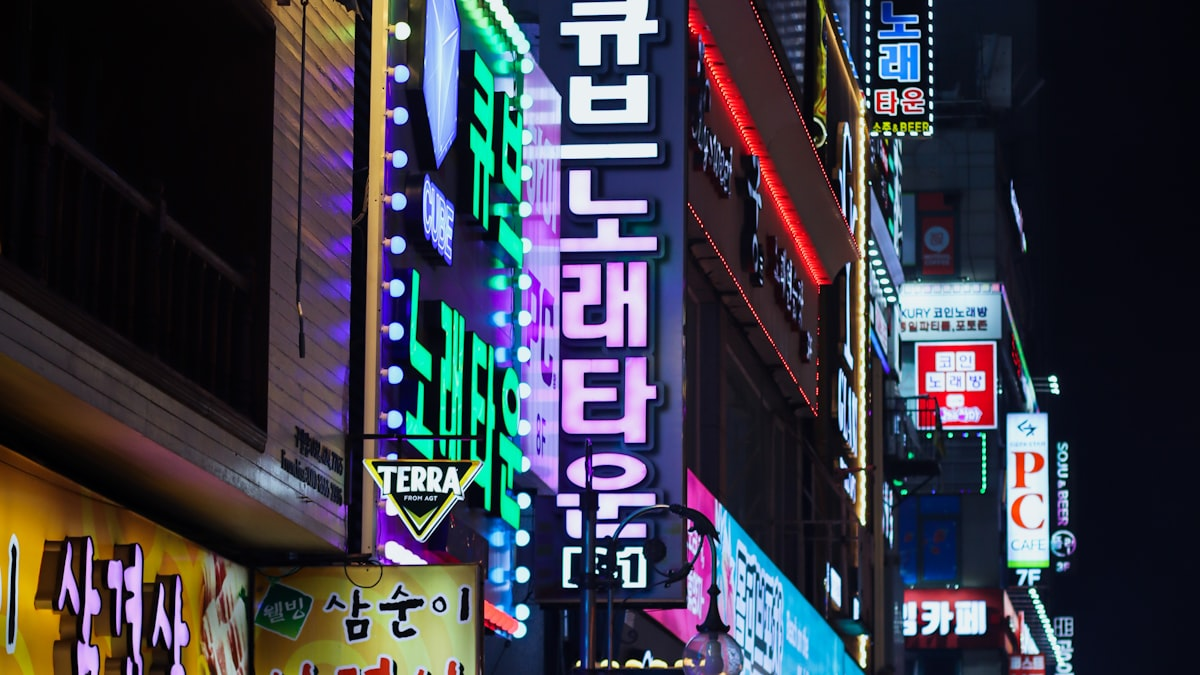
The most internationally recognised Korean DJ wasn’t discovered in Seoul. She built her career in Berlin and came back to Korea with the credibility already established. That explains how Korean electronic music exports talent, and why the names below split so cleanly into two groups: those who left to be heard, and those building the infrastructure so the next generation won’t have to.
The Exports
Peggy Gou grew up in Korea, moved to London at fourteen and went on to Berlin after finishing fashion school. She studied fashion, then DJing. Her first releases arrived in 2016, by 2018 she was on the international festival circuit and releasing on Ninja Tune, and in 2023 It Goes Like Nanana, released on XL Recordings, became a genuine global crossover hit. She’s the most internationally successful Korean DJ and producer in history, and her path ran through Berlin’s club economy, not Seoul’s. I wrote a full profile of that career and what it means for the scene she left and returns to.
KINGMCK has one of the deepest CVs in Seoul and half the city doesn’t know it. A longtime Cakeshop resident and co-founder of the DEADEND collective, he has been releasing and remixing since 2009, including official remixes for SHINee and CL and singles on Kitsuné, won MNET’s DJ tournament, headlined a Boiler Room set, and has played New York, Berlin, Amsterdam, Tokyo and Bangkok. House, techno and hip-hop, moved between without ceremony. His RA page and @kingmck are the places to start.
Yaeji represents the diaspora route: raised between New York and Seoul, she broke out of Brooklyn’s DIY scene in 2017 with a bilingual house sound, Korean and English in the same breath, that nobody had exported before. Park Hye Jin, now LA-based, did something similar from the other coast, half-rapped Korean vocals over stripped house on Ninja Tune. Neither career needed Seoul’s club infrastructure, which is precisely the point: the language and sensibility travelled even when the scene couldn’t carry them.
The Ones Building It at Home
Mogwaa, Gu Wonsub, is the counter-example: Seoul-based, prolific across house, techno, boogie and ambient, releasing internationally while staying rooted in the local circuit. Around him sits a generation that came up through Cakeshop residencies, the HBC bar circuit, and the independent promoter networks: selectors who treat a Tuesday basement set and an international support slot as the same job. The veterans matter here too. The 360 Sounds crew and the first-wave Itaewon selectors kept a scene alive through years when there was no money in it, and today’s bookings stand on that continuity.
Allure Korea (얼루어 코리아) interviewed four more of that generation in August 2023: KICO, CO.KR, OENN and KUGEL. KICO danced professionally for more than ten years before moving to the booth, CO.KR grew up on the 360 Sounds and Deadend crews and plays the music they most want to play at Cakeshop, and KUGEL, a resident at Itaewon’s Tunnel, learned to DJ after an exchange year in Germany.
What the Split Means
For most of two decades, the pattern was one-directional: Korean talent left, got validated abroad, and returned as headliners. That’s bending. The domestic infrastructure, the rooms on the club map, the promoter networks, the audience measured in the 2025 survey asking for more local bookings, can now carry a career’s first act. What it can’t yet do is carry the second act without an overseas detour, the structural gap I examine in Seoul club culture at a crossroads. The names to watch in 2026 are the ones testing whether that detour is still mandatory. The range on display, from stadium-scale house to the most austere techno to bilingual pop crossover, suggests Korean electronic music has far more range than its export history so far shows.
Listening data is starting to show that bend. Asia Economy (아시아경제) reported in July 2026 that Korean artists’ share of the electronic music streamed on Spotify in Korea went from 9.8 to 24.4 percent in six months, and that Spotify was running a playlist of Korean electronic music with 언본사운즈 (Eonbon Saundeujeu, Unborn Sounds), a collective that finds and develops new Korean DJs.
What Changed in 2026
The first half of 2026 answered part of the question this piece ends on. At the Korean Music Awards (한국대중음악상, Hanguk Daejung Eumaksang) in February, KIRARA took Best Electronic Album for her record Kirara. Best Electronic Song went to MELKI for “Body Break”, and MELKI is a former student of KIRARA. A teacher and her student winning both electronic categories in the same year is exactly the home-grown lineage I said was missing. None of it needed Berlin.
The exports kept moving too, on their own terms. Park Hye Jin released her third album, So Much Have Fun, on 23 February, and she wrote, produced, mixed and mastered it herself. That’s total control of the chain, from the first loop to the final loudness. In September, Yaeji opened for Robyn at Barclays Center in Brooklyn, an arena room for a sound built in DIY lofts. Peggy Gou put out “Wo,man” with Ayra Starr in June, a 90s-style house record and her most pop-leaning single so far. It follows “(It Goes Like) Nanana” and the album I Hear You, both released on XL Recordings.
The quietest win was for producers. 250, the NewJeans producer born Lee Ho-hyung, won at Music Awards Japan on 13 June for producing Fujii Kaze’s album Prema. The record took Album of the Year and Best R&B/Contemporary Song.
The Next Generation Is Already in Class
The home-grown side got more specific as well. In March, Mixmag Asia called the university DJ club, the dongari (동아리), the hidden incubator of Seoul dance music. Crews like SNAP at Korea University and Nuit at Hankuk University of Foreign Studies, plus EAT, SNoL, VERITAS and MOCIT, run peer mentoring. Some have more than 100 members, and alumni now hold club residencies. Anyone who came up through a campus radio station in Calgary or Montreal will recognise the model. Seniors teach juniors, the controllers and turntables get shared, and the first steps happen among friends.
The conversation also reached London. Rich from Seoul Community Radio, 7ip7o3 and Jun Kim sat on a SXSW London panel about “K-bass”, as Mixmag Asia’s 2025 A-Z recorded. A London stage wanting a Seoul panel on a Seoul sound is a small data point, but a telling one. I dig into what makes that sound distinct in the Seoul sound essay.
My read of 2026 is that the detour is becoming optional. KIRARA and MELKI won at home. 250 won in Tokyo without leaving the producer’s chair. The dongari feed the rooms on the club map before anyone buys a plane ticket. The second act of a career still tends to happen overseas, as the Asia career path shows, but the first act now has a teacher, a classroom and a trophy.
Watch and Listen
KIRARA live for MIXMIX TV.
Go Deeper: Hear Them for Yourself
Sets, mixes and interviews to hear the names on this list in action.
- Peggy Gou, Boiler Room Streaming From Isolation: a lockdown set that shows the selector behind the pop hits.
- Yaeji, Boiler Room New York DJ set: the Brooklyn DIY sound in its home setting.
- Park Hye Jin, Boiler Room x Weather Paris: her stripped house and half-rapped vocals live, from 2019.
- RA.922: Mogwaa: a Resident Advisor podcast mix from the Seoul producer who never needed to leave.
- KINGMCK on SoundCloud: mixes and releases from the longtime Cakeshop resident.
- CO.KR on Resident Advisor: upcoming dates and past sets, including the Boiler Room Seoul showcase he curated.
- Boiler Room x Cakeshop, Seoul (2016): the broadcast that first put Seoul’s club on Boiler Room.
- The Korea Times on KIRARA’s tenth anniversary: the background to her 2026 Korean Music Awards win.
한국어 요약
지금 알아야 할 한국 DJ
해외에서 이름을 알린 DJ와 서울 부스를 지켜 온 DJ, 그리고 2026년에 상을 받은 새 얼굴까지 정리했습니다.
- 해외에서 가장 유명한 DJ: 페기 구 (Peggy Gou)가 여전히 가장 널리 알려져 있고, 예지 (Yaeji)와 박혜진 (Park Hye Jin)이 그 뒤를 잇습니다.
- 서울 씬을 지켜 온 DJ: KINGMCK와 Mogwaa는 오랜 경력과 깊은 디스코그래피를 가진 서울 클럽 부스의 중심입니다.
- 2026 한국대중음악상: KIRARA가 앨범 《Kirara》로 최우수 일렉트로닉 음반을, 그의 제자였던 MELKI가 〈Body Break〉로 최우수 일렉트로닉 노래를 받았습니다.
- 새로운 세대: 많은 젊은 DJ가 대학 DJ 동아리 (dongari)에서 장비를 함께 쓰며 배우고, 바 레지던시와 커뮤니티 라디오로 경험을 쌓습니다.
잘못된 정보나 바뀐 날짜를 발견하셨나요? 연락 주시면 확인 후 바로 고치겠습니다. 현장에서 보고 들은 이야기도 언제나 환영합니다.
Frequently Asked Questions
Who are the most famous Korean DJs right now?
Peggy Gou is still the best known internationally, with Yaeji and Park Hye Jin close behind in overseas recognition. At home, KINGMCK and Mogwaa have deep catalogues and years in Seoul booths. In 2026, KIRARA and MELKI added Korean Music Awards wins to that picture.
Who won Best Electronic Album at the 2026 Korean Music Awards?
KIRARA won Best Electronic Album for Kirara at the 23rd Korean Music Awards on 26 February 2026. Her former student MELKI won Best Electronic Song for “Body Break”. Hanroro was named Musician of the Year.
How do young Korean DJs learn to DJ?
Many start in university DJ clubs, called dongari, such as SNAP at Korea University and Nuit at HUFS. These clubs share gear, run peer mentoring and send alumni on to club residencies. Others learn through bar residencies and community radio.
Did a Korean producer win at Music Awards Japan?
Yes. 250, best known for his work with NewJeans, won at Music Awards Japan on 13 June 2026 for producing Fujii Kaze’s album Prema. The album took Album of the Year and Best R&B/Contemporary Song.
Sources
- allkpop: Winners of the 2026 23rd Korean Music Awards announced
- Park Hye Jin on X: So Much Have Fun release announcement
- BrooklynVegan: tour news, Yaeji opening for Robyn at Barclays Center
- FEMMUSIC: Peggy Gou and Ayra Starr, “Wo,man”
- Star News Korea: 250 wins at Music Awards Japan for Fujii Kaze’s Prema
- Mixmag Asia: University DJ dongari, the hidden incubator of Seoul’s dance music scene
- Mixmag Asia: 2025 in the bag, an A-Z
- Resident Advisor: KINGMCK artist page
- Allure Korea (얼루어 코리아): four DJs who play their own music (30 August 2023)
- Asia Economy (아시아경제): Korean artists now a quarter of electronic streams in Korea (21 July 2026)
Written from Seoul, by someone who has been in the booth for more than twenty years. More on the site, or book a DJ.
Follow the rooms: Cakeshop on Instagram
Stay in the Loop
New writing on DJ culture, electronic music, and the Seoul underground, delivered when it matters.
More From The DJ Diaries

Play with the history
Four tools built from the same research as this site.
You Might Also Like


Quick answers
Who is the most famous Korean DJ?
Peggy Gou. She was born in Incheon, moved to London at fourteen to study and later settled in Berlin, started releasing in 2016, joined the international festival circuit by 2018 and had a global crossover hit with It Goes Like Nanana in 2023.
Which Korean DJs are known internationally?
Peggy Gou built her reputation in Berlin. Yaeji broke out of Brooklyn's DIY scene in 2017 with a bilingual house sound, and Park Hye Jin, now based in Los Angeles, released her debut album, Before I Die, on Ninja Tune.
Who are the key Seoul-based DJs and producers?
Mogwaa (Gu Wonsub) is the strongest example of a Seoul producer sustaining an international release schedule without relocating, alongside a generation that came up through Cakeshop residencies, the Haebangchon bar circuit and independent promoter networks, plus veterans like the 360 Sounds crew.
Why do so many Korean DJs build careers abroad?
Because Seoul's club economy historically couldn't carry them. Berlin, London and New York offered the infrastructure; the newer Seoul generation is building that infrastructure at home so the next wave won't have to leave.