The best DJing tips for travellers and backpackers come down to one rule: carry your music, not your booth. Pack two USB sticks exported from rekordbox and formatted FAT32, a cloud backup of the same library, good headphones and, if you want to practise on the road, a small bus powered controller such as the 1.2 kg DDJ-FLX2; then check what players the venue has before you arrive, and never take a paid gig abroad without the permission that country requires.
That covers most of what goes wrong. The rest of this guide is the detail: which booth standards you will meet, how the plugs and voltages differ, what airlines let you carry, how to find a set in a city where you know nobody, and what the official immigration pages actually say about being paid to play. From the booth, the pattern is always the same: the DJ who travels light and prepares hard plays; the DJ who brings a laptop with a dead charger and a stick nobody’s CDJs can read watches.
What To Pack: Gear That Survives A Backpack
Start with what the booth cannot give you. Clubs supply players and a mixer; they almost never supply headphones you would want on your head, and they never supply your library. So the core kit is headphones in a hard case, two USB sticks with the same export, an adapter or two, and earplugs. Our DJ bag guide goes item by item; for travel, the points that matter are below.
Bring both USB plug shapes. The AlphaTheta CDJ-3000X has one USB-A port and two USB-C ports, while the older CDJ-3000 and CDJ-2000NXS2 have USB-A (plus USB-B for a computer), according to AlphaTheta’s player comparison. A stick with both connectors, or a small USB-C to USB-A adapter, means you can plug into anything from a 2016 booth to a 2026 one.
If you want to practise between gigs, take a controller that runs on USB bus power so you need no extra mains adapter. The DDJ-FLX2 weighs 1.2 kg at 383 by 208 mm and draws 5 V from your laptop; the larger DDJ-FLX4 weighs 2.1 kg at 482 mm wide and can also run on bus power. For comparison, a single CDJ-3000 weighs 5.5 kg, which is why nobody tours with their own.
Back Up Your Library Twice: USB And Cloud
Treat your library like a passport: one in the bag, one somewhere else. The minimum is two USB sticks exported from rekordbox, carried in different pockets, so a lost bag or a corrupted stick is an inconvenience rather than a cancelled set. Format them FAT32. The CDJ-2000NXS2 manual lists FAT16, FAT32 and HFS+ for USB devices and states that NTFS is not supported, and FAT32 is the one format that every player in that generation and the newer ones read.
The third copy goes in the cloud. rekordbox’s Cloud Library Sync backs up your library to Dropbox or Google Drive; the free plan syncs 20 tracks, rising to 1,000 when you register your DJ hardware. CloudDirectPlay goes further and plays tracks straight from Dropbox on the CDJ-3000X, CDJ-3000, XDJ-AZ, OMNIS-DUO and OPUS-QUAD, but only when that hardware is online. Club Wi-Fi in a basement at 2am is not something to bet a set on, so treat the cloud as your rescue copy, not your main one. If you stream from Spotify or similar in practice, remember our beginner’s guide point: streaming is not a reliable base for paid sets.
Booth Standards You Will Meet Abroad
The honest answer is that there is no published survey of which players clubs have by country, so ask. Message the promoter a week ahead and request the exact player and mixer models, then check them against the table below. In practice, AlphaTheta (Pioneer DJ) players dominate club booths, which is why rekordbox exports are the safe default; our controllers vs CDJs guide explains the ecosystem.
| Player | USB Ports | Cloud Playback | Pro DJ Link | What It Means For You |
|---|---|---|---|---|
| CDJ-3000X | 1 USB-A, 2 USB-C | Dropbox and Google Drive listed by AlphaTheta | Up to 6 units | Newest booths; bring a USB-C option |
| CDJ-3000 | 1 USB-A, 1 USB-B | Dropbox (CloudDirectPlay) | Up to 6 units | The current club standard |
| CDJ-2000NXS2 | 1 USB-A, 1 USB-B | None | Up to 4 players | Still common; FAT32 or HFS+, no NTFS |
| XDJ-1000MK2 | 1 USB-A, 1 USB-B | None | Up to 4 players | Smaller venues and bars; USB only, no discs |
Sources: AlphaTheta player comparison, rekordbox Cloud, CDJ-2000NXS2 manual. Streaming and cloud features exclude some regions.
Power: Plugs And Voltage By Country
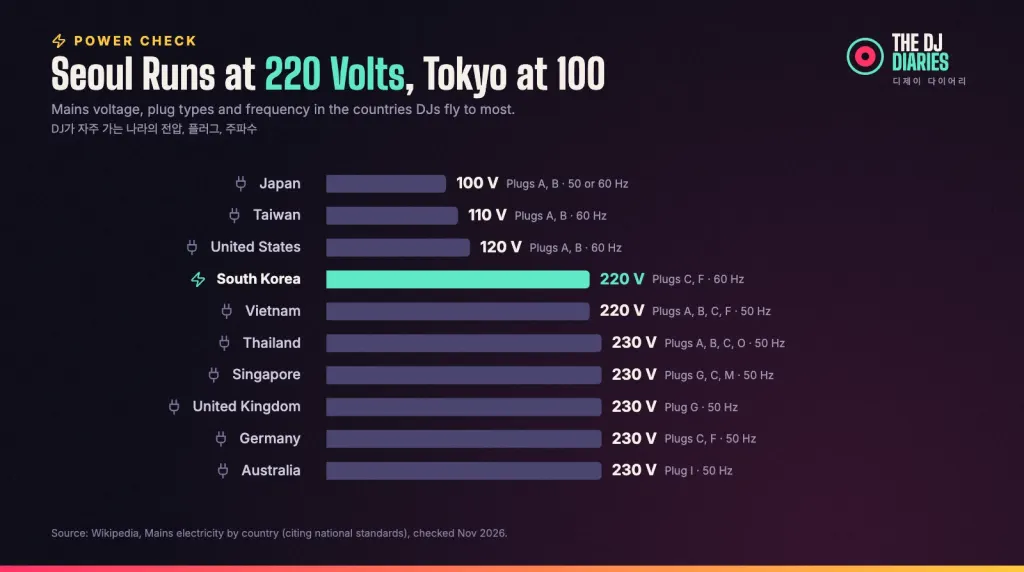
Your laptop charger and controller are the only things you will plug in, so check the rating printed on each adapter before you leave: the small print will say what input range it accepts. Club gear is a different matter; the CDJ-3000, for example, is rated AC 100 to 240 V at 50 or 60 Hz. The table shows what you will find in the wall in the cities DJs travel to most.
| Country | Plug Types | Voltage | Frequency |
|---|---|---|---|
| South Korea | C, F | 220 V | 60 Hz |
| Japan | A, B | 100 V | 50 Hz east, 60 Hz west |
| Taiwan | A, B | 110 V | 60 Hz |
| Thailand | A, B, C, O | 230 V | 50 Hz |
| Vietnam | A, B, C, F | 220 V | 50 Hz |
| Indonesia | C, F | 230 V | 50 Hz |
| Philippines | A, B, C | 230 V | 60 Hz |
| Singapore | G (most common), C, M | 230 V | 50 Hz |
| Australia | I | 230 V | 50 Hz |
| United Kingdom | G | 230 V | 50 Hz |
| Germany, Netherlands, Spain | C, F | 230 V | 50 Hz |
| United States | A, B | 120 V | 60 Hz |
| Mexico | A, B | 120 V or 127 V | 60 Hz |
Source: Mains electricity by country, which cites national standards bodies. Low voltage households (Japan, Taiwan, the US) matter most if you carry anything rated only for 220 to 240 V.
One airport rule catches DJs every season: spare lithium batteries and power banks go in your carry on, never in checked luggage, and the US TSA limit is 100 Wh per rechargeable battery. Many airlines add their own power bank rules, so check your carrier before you fly.
Compare And Contrast: USB Only vs Controller vs Laptop
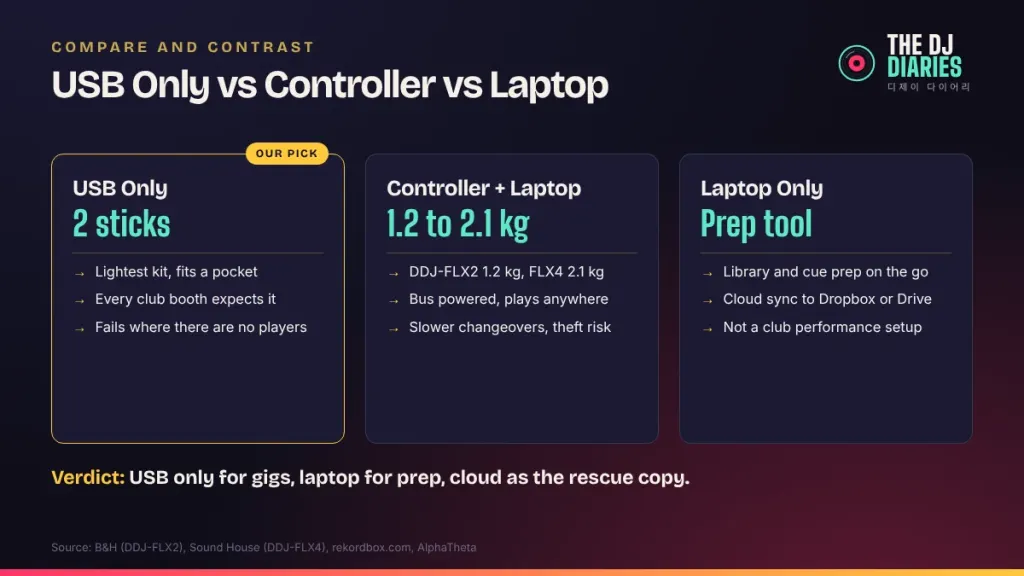
USB only is the lightest kit, just sticks and headphones, and the one every club booth expects. It fails only when the venue has no players, which is common in hostels, beach bars and house parties. A controller plus laptop works anywhere with a table and a socket, and lets you practise in your room, but adds 1.2 to 2.1 kg plus the laptop, a second thing to be stolen, and the time it takes to plug into a strange mixer at changeover. Laptop only, mixing in software with a keyboard, keeps your library and your cue prep with you but is not something you can perform on in a club.
Verdict: for most travellers, USB only for gigs, with a laptop you were bringing anyway for prep and a cloud backup. Add a DDJ-FLX2 only if you will be somewhere long enough to practise or if the bars you are targeting do not have CDJs. If you are a backpacker on a strict weight budget, skip the controller entirely and book an hour in a practice studio when you land.
Finding Gigs Abroad
Bookings abroad come from the same place they come from at home: people who have heard you play. Go out first. Dance to the residents, buy a drink, talk to the DJ after their set, not during it. Community radio stations, record shops and open deck nights are where outsiders get heard; in Seoul, for example, Seoul Community Radio has been a meeting point for local and visiting selectors. Have a 30 to 60 minute mix online and a short bio ready, so that when someone says “send me something” you send a link that night. Our guides on getting DJ bookings and building a DJ career in Asia go deeper on the network side.
Visas And Paid Work: Read The Official Page
Working visas vary by country, and a tourist entry rarely covers being paid to perform. This is not legal advice; check the official immigration page of the country you are visiting, and ask the promoter what they have done for previous foreign DJs. Three examples show how different the rules are. The UK allows visitors to be paid under a Permitted Paid Engagement for up to 30 days if a UK organisation invites them before travel, and lists permit free festivals where performers may be paid. Japan states that a Temporary Visitor “can not become employed” in principle, and places musical performance under the separate Entertainer status of residence. South Korea’s E-6 arts and entertainment visa covers people earning from music and entertainment, and performance cases need a recommendation and a performance plan, according to the Korean Ministry of Foreign Affairs. In the US, performers generally need a petition filed by a US employer or sponsor on USCIS Form I-129.
Playing for free at an open deck is not automatically safe either; rules on unpaid activity differ too. If the promoter offers cash at the door and no paperwork, that is a sign to ask more questions, not fewer.
Insurance For Your Gear
Read your travel insurance before you pack, not after you lose something. Many policies cap what they pay for any single item and exclude equipment used for work, which is exactly what a paid gig makes your headphones and controller. Specialist musical instrument and equipment cover exists for touring musicians and usually suits working DJs better. Whatever you choose, photograph your serial numbers, keep receipts in your email, and never put headphones or a controller in checked luggage. Ear protection belongs in the bag too; our hearing safety guide explains why.
Frequently Asked Questions
Can I DJ Abroad On A Tourist Visa?
Usually not for pay. Each country sets its own rules: the UK has Permitted Paid Engagement for invited professionals, Japan requires Entertainer status for paid performance, and South Korea uses the E-6 visa. Check the official immigration page for your destination; this guide is not legal advice.
What Is The Best DJ Controller For Travelling?
A small bus powered two channel controller. The DDJ-FLX2 weighs 1.2 kg and runs from your laptop’s USB port, so there is no mains adapter to carry. If you mainly play clubs, you may not need a controller at all: two USB sticks and headphones are enough.
What USB Format Do CDJs Need?
FAT32 is the safest. The CDJ-2000NXS2 reads FAT16, FAT32 and HFS+ but not NTFS, and newer players also read FAT32, so a FAT32 stick exported from rekordbox works across the booths you are most likely to meet.
Do I Need A Voltage Converter For DJ Gear?
Check the input rating printed on each adapter. Many laptop chargers accept a wide range, and bus powered controllers draw from the laptop, so a plug adapter is often all you need. Anything rated only for 220 to 240 V needs care in Japan (100 V), Taiwan (110 V) and the US (120 V).
Stay in the Loop
New writing on DJ culture, electronic music, and the Seoul underground, delivered when it matters.
More From The DJ Diaries
Play with the history
Four tools built from the same research as this site.