Walk down Itaewon-ro in 2021 and it felt like a film set after the crew had packed up and gone home. COVID had cleared the street out. A couple of years earlier the Burning Sun scandal had hollowed out Gangnam and sent its clubbers into neighbourhoods they would once have ignored. I’ve been DJing in Seoul since the early 2000s, and I’ve watched this city rebuild its nightlife from scratch at least twice.
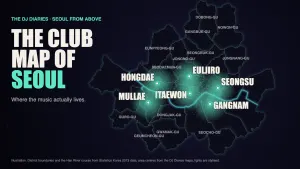
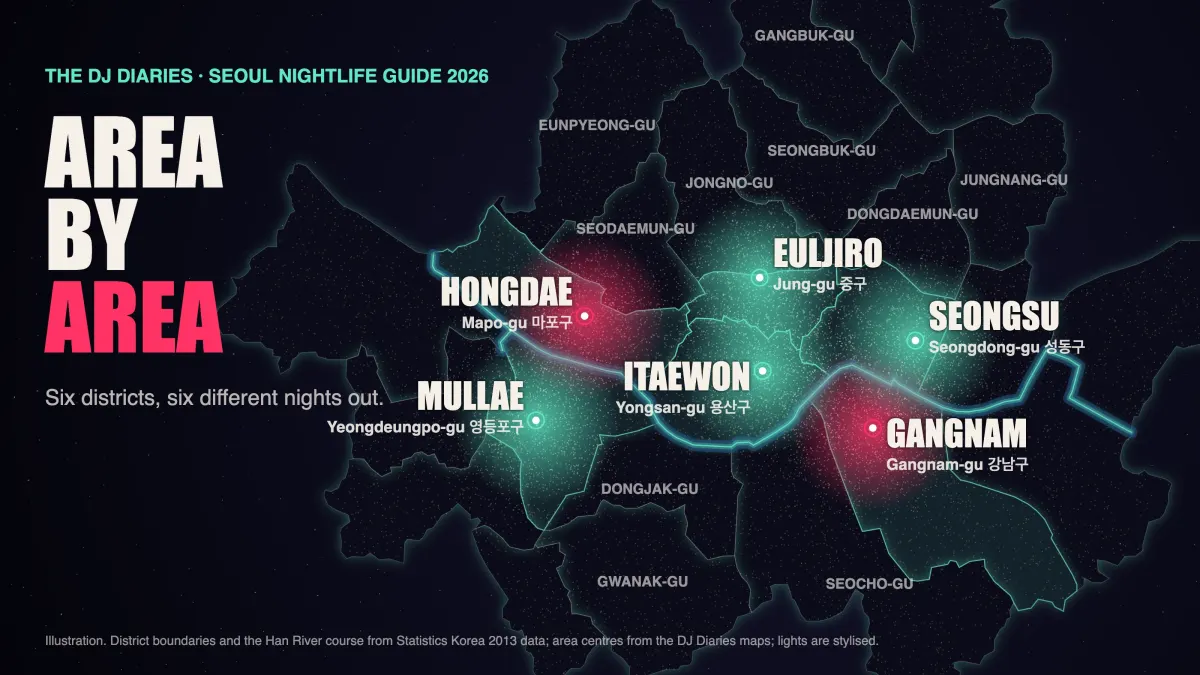
Both times, what came back was more interesting than what it replaced. Seoul doesn’t mourn its old scenes for long. It builds something stranger in the rubble, and it builds it district by district. Going out well here starts with picking the neighbourhood before you pick the club, because Hongdae, Itaewon, Gangnam, Seongsu and Euljiro each do a completely different kind of night.
This guide takes them one at a time, in the same order each time: what the area is for, the rooms worth your night as of October 2026, the smaller neighbourhoods that go with it, and how the night runs.
If you already know what kind of night you want, start with the panel below. Choose a mood and it shows the district that does it best, with door prices, when it gets busy, how you get home, and the rooms that had nights listed when I last checked. Every district is covered in more detail further down.
Choose the kind of night you want and I’ll show you the district that does it best: when it runs, what the door costs, how you get home, and which rooms were open when I last checked.원하는 밤의 분위기를 고르면 그에 맞는 동네를 보여 드립니다. 영업 시간, 입장료, 귀가 방법, 그리고 마지막으로 확인했을 때 문을 연 클럽까지.
Itaewon and Usadan-ro 이태원 · 우사단로
Best for: underground house, techno, disco and bass, international crowd추천: 언더그라운드 하우스, 테크노, 디스코, 베이스. 국제적인 관객
- When시간Doors around 10 or 11pm. Rarely busy before 1am. Weekends run to sunrise and past it.보통 밤 10~11시 오픈. 새벽 1시 전에는 한산한 편. 주말에는 해 뜰 때까지, 그 이후까지도.
- Door입장Most nights ₩15,000 to ₩25,000, often with a drink. Headliners ₩30,000 to ₩35,000. Advance RSVP or tickets are often cheaper. Dress is relaxed.대부분 15,000~25,000원, 음료 포함인 경우가 많음. 해외 헤드라이너는 30,000~35,000원. 사전 예약이나 예매가 더 저렴한 경우가 많음. 복장은 자유로운 편.
- Getting home귀가Itaewon Station is Line 6, which stops around midnight on weekends. After that it’s an N bus or a Kakao T taxi with the late-night surcharge, or you stay for the first train at about 5:30am.이태원역은 6호선, 주말에는 자정 무렵 운행 종료. 이후에는 N버스나 할증이 붙는 카카오T 택시, 아니면 새벽 5시 30분 첫차까지.
- Know this알아 둘 것Usadan-ro is a steep walk up the hill from the station. Around Halloween, expect crowd controls, one-way streets and exit-only routes.우사단로는 역에서 언덕을 꽤 올라가야 함. 핼러윈 즈음에는 인파 관리, 일방통행 동선, 출구 전용 통로가 운영됨.
Cakeshop, Faust, Soap, Nyapi, Hertz (헤르츠), teller, Paper & Shelter, Ring. Sources: Resident Advisor Seoul, Mixmag Asia.출처: Resident Advisor 서울, Mixmag Asia.
Read: 더 읽기: Itaewon After Dark · Hongdae vs Itaewon vs Gangnam
Hongdae and Mapo 홍대 · 마포
Best for: young, loud, cheap nights in every genre, plus a few deep rooms in Hapjeong and Sangsu추천: 젊고 시끄럽고 저렴한 밤, 모든 장르. 합정과 상수에는 딥한 공간도 몇 곳
- When시간Starts earlier than Itaewon. Busy from around 11pm, peaks at midnight to 2am, most big rooms wind down by 4 or 5am.이태원보다 일찍 시작. 밤 11시부터 붐비고 자정~새벽 2시가 절정, 큰 클럽은 새벽 4~5시쯤 마무리.
- Door입장From ₩5,000 to ₩20,000 at student-crowd clubs. ₩15,000 to ₩20,000 at the deeper rooms. Dress is relaxed.학생들이 많은 클럽은 5,000~20,000원. 딥한 공간은 15,000~20,000원. 복장은 자유로운 편.
- Getting home귀가Hongik Univ. Station is Line 2, the Airport Railroad and the Gyeongui line. The peak hits after the last train, so plan for an N bus, a taxi or the first train.홍대입구역은 2호선, 공항철도, 경의중앙선. 절정은 막차 이후이니 N버스, 택시, 첫차 중 하나를 계획할 것.
- Know this알아 둘 것Club streets get very crowded on Friday and Saturday and around Halloween. Real-time crowd signs are posted on the main streets.금요일, 토요일, 핼러윈 즈음 클럽 거리는 매우 붐빔. 큰길에 실시간 혼잡도 전광판이 있음.
MODECi, vurt., Club FF. Sources: Resident Advisor Seoul, Mixmag Asia.출처: Resident Advisor 서울, Mixmag Asia.
Read: 더 읽기: Hongdae vs Itaewon vs Gangnam
Gangnam, Apgujeong and Cheongdam 강남 · 압구정 · 청담
Best for: big rooms, big-room EDM and hard techno, table service, dressing up추천: 큰 클럽, EDM과 하드 테크노, 테이블 서비스, 차려입는 밤
- When시간Late. Doors around 10 or 11pm, busy from 1am, weekends run to morning.늦게 시작. 밤 10~11시 오픈, 새벽 1시부터 붐비고 주말에는 아침까지.
- Door입장Smaller rooms ₩10,000 to ₩15,000. Big clubs cost more, and a table is a separate, much larger spend. Proper shoes, no sportswear. Bring your passport: doors here check hardest.작은 곳은 10,000~15,000원. 큰 클럽은 더 비싸고, 테이블은 훨씬 큰 별도 비용. 구두나 깔끔한 신발, 운동복 불가. 여권 필수, 입장 확인이 가장 까다로운 동네.
- Getting home귀가Gangnam Station and Sinsa are on Line 2, Line 3 and the Sinbundang line. Taxis are easy to find but the late-night surcharge applies, and queues build after 4am.강남역과 신사역은 2호선, 3호선, 신분당선. 택시는 잡기 쉽지만 심야 할증이 붙고 새벽 4시 이후 줄이 길어짐.
- Know this알아 둘 것Door policy here is the strictest in the city and can feel arbitrary. Don’t argue at the door. Try another room.서울에서 입장 기준이 가장 엄격하고 자의적으로 느껴질 수 있음. 문 앞에서 다투지 말고 다른 곳으로.
Lion Super Club, Luka, Lowkey. Source: Resident Advisor Seoul.출처: Resident Advisor 서울.
Read: 더 읽기: The Fall of the Gangnam Megaclub
Seongsu 성수
Best for: hard techno and warehouse-style nights in a former factory district추천: 옛 공장 지대에서 즐기는 하드 테크노와 창고형 파티
- When시간Club nights start late and run to morning. By day the area is cafes and pop-up stores.클럽 파티는 늦게 시작해 아침까지. 낮에는 카페와 팝업스토어 거리.
- Door입장Regular nights ₩15,000 to ₩20,000. Big bookings ₩20,000 in advance, up to ₩45,000 at the door. Buy ahead.일반 파티 15,000~20,000원. 큰 공연은 예매 20,000원부터, 현장은 최대 45,000원. 미리 예매할 것.
- Getting home귀가Seongsu Station is Line 2. After the last train it’s an N bus or a taxi.성수역은 2호선. 막차 이후에는 N버스나 택시.
- Know this알아 둘 것A small scene with one anchor room, so check the lineup before you go.중심이 되는 클럽 한 곳이 있는 작은 씬. 가기 전에 라인업을 확인할 것.
UNDERCITY. Source: Resident Advisor Seoul.출처: Resident Advisor 서울.
Euljiro and Jongno 을지로 · 종로
Best for: bars in old print and tool-shop alleys, listening rooms, a couple of club nights추천: 인쇄소와 공구 골목 사이의 바, 리스닝 바, 몇 곳의 클럽 파티
- When시간Earlier than the club districts. Bars fill from 8pm. Club nights run late.클럽 동네보다 이른 편. 바는 저녁 8시부터 차고, 클럽 파티는 늦게까지.
- Door입장Bars are free to walk into. Club nights around ₩10,000 to ₩15,000.바는 입장료 없음. 클럽 파티는 10,000~15,000원 안팎.
- Getting home귀가Euljiro 3-ga is Lines 2 and 3, the most central of the five areas. Easy to get home before the last train.을지로3가역은 2호선과 3호선, 다섯 곳 중 가장 중심. 막차 전에 귀가하기 쉬움.
- Know this알아 둘 것Popular bars run waiting lists on weekends, and some need a Korean phone number to queue. The print shops are still working on weekdays, so walk them in daylight too.인기 바는 주말에 대기 명단을 운영하고, 일부는 한국 전화번호가 필요. 인쇄소는 평일에 아직 일하니 낮에도 걸어 볼 것.
The Edge Seoul (Euljiro), The Opera (Dongdaemun). Source: Resident Advisor Seoul.출처: Resident Advisor 서울.
Read: 더 읽기: Euljiro, a.k.a. Hipjiro · The Print Alleys Under Hipjiro
Before you go, anywhere어디로 가든, 가기 전에
- Age and ID나이와 신분증
- Entry goes by birth year. In 2026, anyone born in 2007 or earlier can get in. Bring your physical passport (or your ARC if you live here). A photo on your phone won’t do.입장은 출생 연도 기준. 2026년에는 2007년생까지 입장 가능. 여권 실물(거주자는 외국인등록증)을 챙길 것. 휴대폰 사진은 안 됨.
- Last train막차
- Weekdays, last trains leave their terminals around 1am. Saturdays, Sundays and holidays, Line 2 and Lines 5 to 8 stop around midnight. First trains run at about 5:30am. Your station’s last train is earlier, so check Naver Map or KakaoMap.평일 막차는 종점 기준 새벽 1시 무렵. 토요일, 일요일, 공휴일에는 2호선과 5~8호선이 자정 무렵 종료. 첫차는 새벽 5시 30분쯤. 내 역의 막차는 더 이르니 네이버 지도나 카카오맵으로 확인할 것.
- Night buses and taxis심야버스와 택시
- N buses run 11pm to 6am for ₩2,500. Taxis add 20% from 10pm, 40% from 11pm to 2am, and 20% from 2am to 4am.N버스는 밤 11시~새벽 6시, 2,500원. 택시는 밤 10시부터 20%, 밤 11시~새벽 2시 40%, 새벽 2~4시 20% 할증.
- Turned away at the door입장 거부
- It happens, and some cases have involved race or nationality. Korea’s human rights commission has spoken against it, but its rulings aren’t binding. Don’t argue at the door. Go somewhere else, and if you want to report it, contact the National Human Rights Commission of Korea.실제로 일어나며, 인종이나 국적이 이유인 사례도 있었음. 국가인권위원회가 반대 입장을 냈지만 권고에 법적 구속력은 없음. 문 앞에서 다투지 말고 다른 곳으로. 신고하려면 국가인권위원회에 문의할 것.
Checked 9 October 2026. Door prices come from published event listings for September and October 2026. Rooms listed had nights on Resident Advisor or in weekly Seoul listings at that time; it isn’t a recommendation of every room, and venues change fast. Transport: Seoul City (night buses), JoongAng Daily (last trains). Spotted something wrong? Tell me.2026년 10월 9일 확인. 입장료는 2026년 9~10월 공개된 행사 정보 기준. 목록의 클럽은 당시 Resident Advisor나 주간 서울 행사 정보에 파티가 올라온 곳이며, 모든 곳을 추천한다는 뜻은 아닙니다. 클럽 사정은 빨리 바뀝니다. 틀린 정보가 있으면 알려 주세요. 한국어 번역은 원어민 검토 전입니다.
Itaewon Is Still Where the Underground Lives
Itaewon grew up around the US Army base after the Korean War, and that made it the most openly multicultural neighbourhood in Seoul. When I moved here in 2002 it was GI bars, sports bars and juicy bars, and for good music you went to Hongdae. Then B1, a basement lounge in the small alley beside the Hamilton Hotel, filled up with every nationality and every age dancing to house music, with a line down the street. I started playing there in 2006. B1 started Itaewon as a club district. Luv Superlounge, Macaroni Market and Dojo Lounge came next, then Cakeshop and Move around 2012, then Soap. The whole story is in Itaewon After Dark.
Which District Club Goers Choose First
Share naming each district as their first choice
서울 클러버가 가장 먼저 찾는 동네
How to read itItaewon leads by a wide margin, and Haebangchon, just up the slope, is second.
The 2022 crowd crush changed the neighbourhood in ways people are still working through. Foot traffic dropped sharply in the months after October 29, and some businesses that had anchored the area for years quietly closed or moved. What’s there now is smaller and different, but it’s still the district for expats, visitors, queer communities and anyone after something beyond the commercial mainstream. If you’re over 30, or you came to Seoul for the music, Itaewon is the district I’d point you to first.
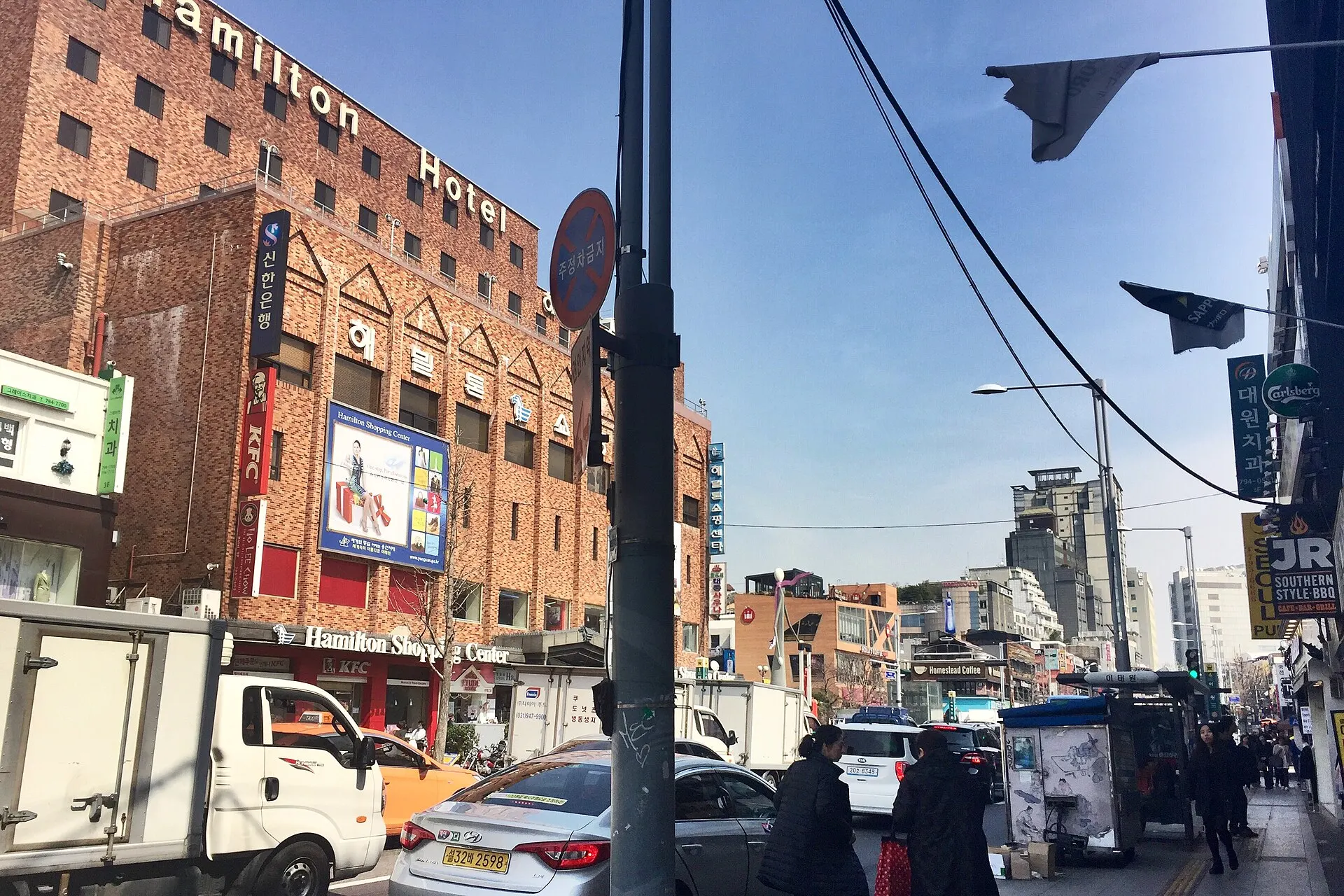
In 2026 the strip has two bookends. Cakeshop (케이크샵) holds the west end, in the basement at 134 Itaewon-ro by Noksapyeong. It has been open since around 2012, holds about 200 people, and is the room that made Seoul a regular stop for touring DJs, booking international house, techno, bass and left field names alongside a deep bench of local residents. Soap holds the east end at B2, 217 Itaewon-ro, toward Hannam-dong. It reopened in that room on 26 February 2026, holds about 300, and still does what it has done since 2017: house and disco one night, bass or hip hop the next, with the same crowd coming to both.
Between them sit two clusters. In the alleys south of the main road, Faust, Pistil and Casa Corona work as one stop. Faust is on the third floor at 7 Bogwang-ro 60-gil, a techno room for about 250 people that has been running its own nights since 2014. Up the hill around Usadan-ro (우사단로), past the mosque, are the smaller curated rooms. Teller (텔러) is a basement at 39 Usadan-ro, mostly Fridays and Saturdays from 11pm to 6am. Kockiri (코끼리), run by Maktoop on the fourth floor at 46 Usadan-ro, is open most nights from Wednesday to Sunday and mixes DJ nights with talks and listening sessions. Nyapi (냐피), on the third floor at 187 Itaewon-ro, opened in August 2022 and books a wide mix of local crews and touring DJs.
Two more rooms round out the circuit. Volnost on Itaewon-ro has been open since April 2017, with a bar on the first floor, music only on the second, and a Martin Audio rig that punches well above the size of the room. Paper and Hertz (헤르츠) also had nights listed this autumn. Behind the Hamilton, on Itaewon-ro 27ga-gil, Glam (글램라운지) and Prost (프로스트) are where a lot of nights start. Both grew out of the B1 family.
Timing matters more here than anywhere. Itaewon clubs don’t peak until well after midnight, often closer to 1am, and if you arrive at 10pm you’ll be standing in a room at about a fifth of capacity wondering what the fuss is about. The better move is to start up the hill in Gyeongnidan (경리단길) or Haebangchon (해방촌). Bartenders who trained abroad opened bars there because the rents made sense and the customers were curious, so the whisky lists are serious and the Korean spirits are worth trying. Eat properly, have a couple of drinks, then walk down to the main strip once the night has built up underneath you. Resident Advisor’s Seoul guide keeps the listings for rooms like Faust current.
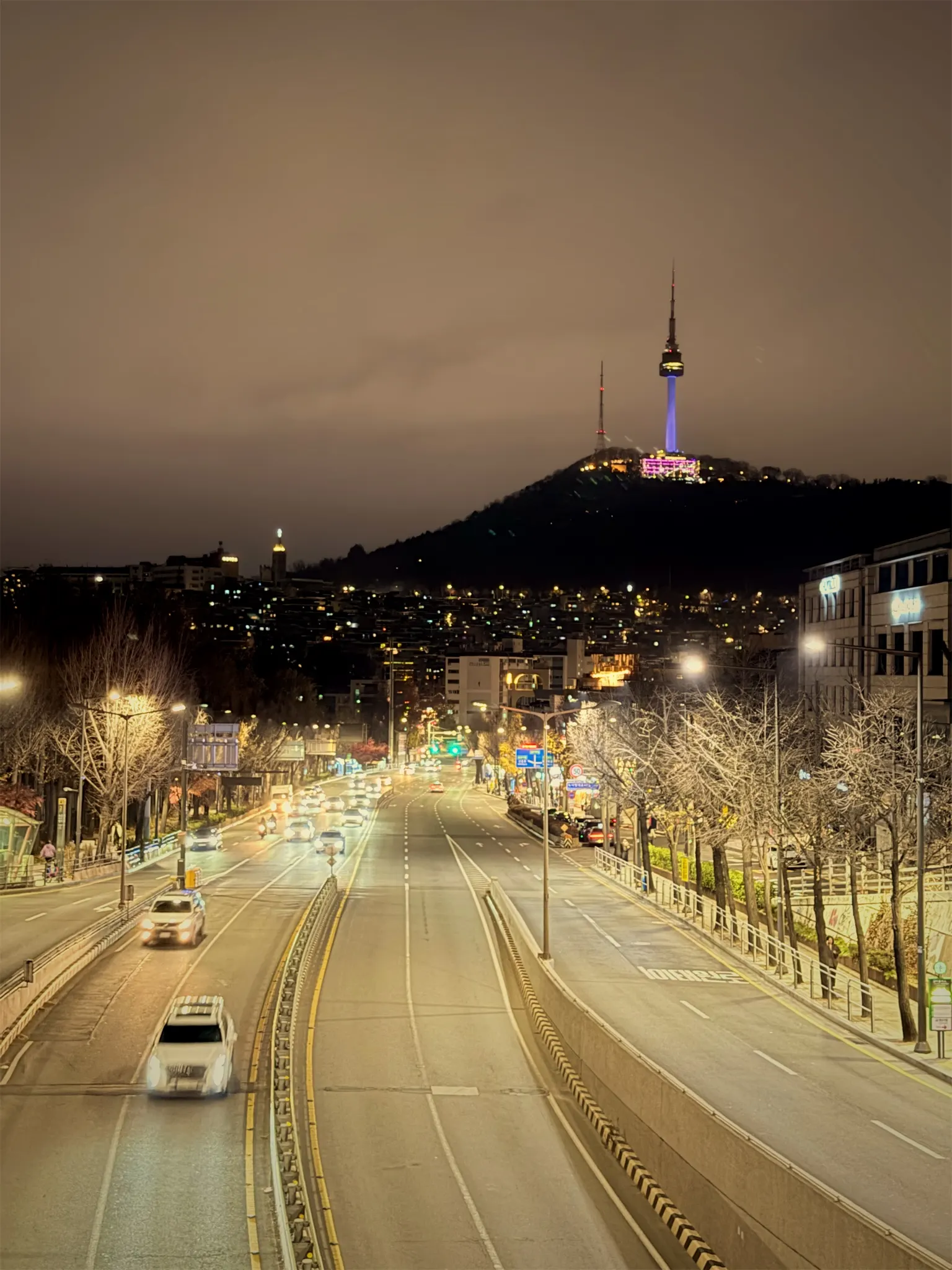
Hongdae Is Young and Loud, With a Few Rooms Worth Finding
Hongdae takes its name from Hongik University, and the neighbourhood grew up around the university’s art and design programmes. In the 1990s, when Korea’s indie and underground music scenes needed somewhere to exist outside the mainstream, this is where they landed. Rents were cheap, landlords were tolerant, and the alleys were just disorganised enough for small clubs and rehearsal rooms to survive without much attention.
Today it’s one of the most densely packed nightlife zones in Asia. Between midnight and 4am on a Friday the streets look like New Year’s Eve in other cities, every single week. Buskers take the main roads and dance teams take the parks. But most of the strip is now Korean pop, chart pop and hip hop bars aimed at university students and young tourists, and since COVID the area has moved away from the underground while Itaewon kept it alive in smaller rooms. The names on the strip change often, so pick by the lineup rather than the sign. If you’re over 30, don’t bother with the strip; go straight to the rooms below.
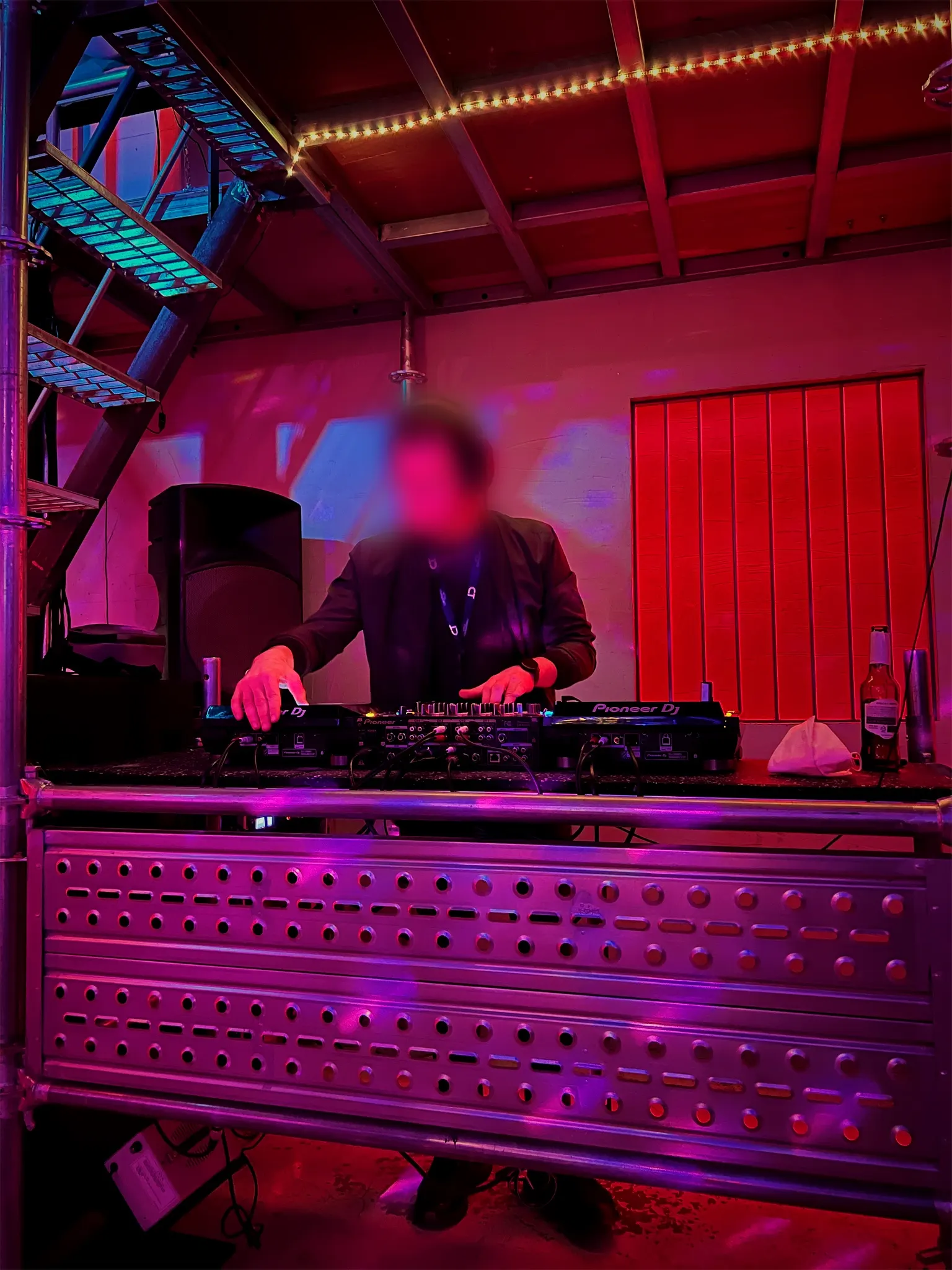
The Henz Club and Modeci share a building at 64 Wausan-ro. Modeci, on the fifth floor and the rooftop, opened in 2017 and books disco, house and techno from local and international DJs, usually from 10pm until 4am or 5am. For techno, vurt. is a concrete basement at 11 Dongmak-ro in Hapjeong (합정), open since 2014 and running most weekends until 6am or 8am. The newest room is Club Horn, at B1, 5 Jandari-ro, which opened on 10 October 2026 with German techno and space for about 300. Macaroni Funky Club, at 32 Yanghwa-ro 6-gil, plays soul, funk and disco and is the over 30 room of the area. Club FF puts live rock on first and DJs after. Club On-Air went on hiatus in July 2026.
Just northwest of the main drag, Yeonnam-dong (연남동) is a few blocks away and a different world. It found its identity in the 2010s when young professionals and creatives wanted somewhere the cocktail was made properly and you could hear the person across the table. By day it’s specialty coffee; by night the same small spaces become wine bars and cocktail rooms for a crowd in its late twenties and thirties. I used to end nights here after playing late sets in Hongdae, walking out of three hours in the booth into somewhere you could talk. It’s where the night slows down without ending. It’s also home to Channel 1969, at 35 Yeonhui-ro, with live bands, disco and punk, and one of my favourite rooms in the city.
Hongdae starts earlier than Itaewon: busy from about 11pm, peaking between midnight and 2am, with most big rooms winding down by 4am or 5am. Doors are cheap, from about ₩5,000 at student rooms to ₩20,000 at the deeper ones, and the dress is relaxed, though some doors enforce an unofficial age policy that skews younger than you’d expect. The Partying Traveler’s Hongdae guide is a useful companion if you want a longer shortlist.
Gangnam Runs on the Look and the Bottle
Gangnam became Korea’s symbol of wealth during the development boom of the 1970s and 80s, when the government moved offices south of the Han River and the money followed. PSY’s Gangnam Style gave the world a shorthand for it in 2012. The megaclubs that defined the area have been fading since Burning Sun, and why they faded is its own story. The Beats and Business piece covers how table service and minimum spend reshaped the district after that.
Going out here is about the look and the bottle. Buy a bottle or book a table and most Gangnam rooms will usually find room for you; turn up without one and many of them won’t feel welcoming. Wear proper shoes, nothing that reads as streetwear, and bring your passport, because doors here check hardest. The music leans commercial: EDM, hip hop and big room house, with a growing hard techno side.
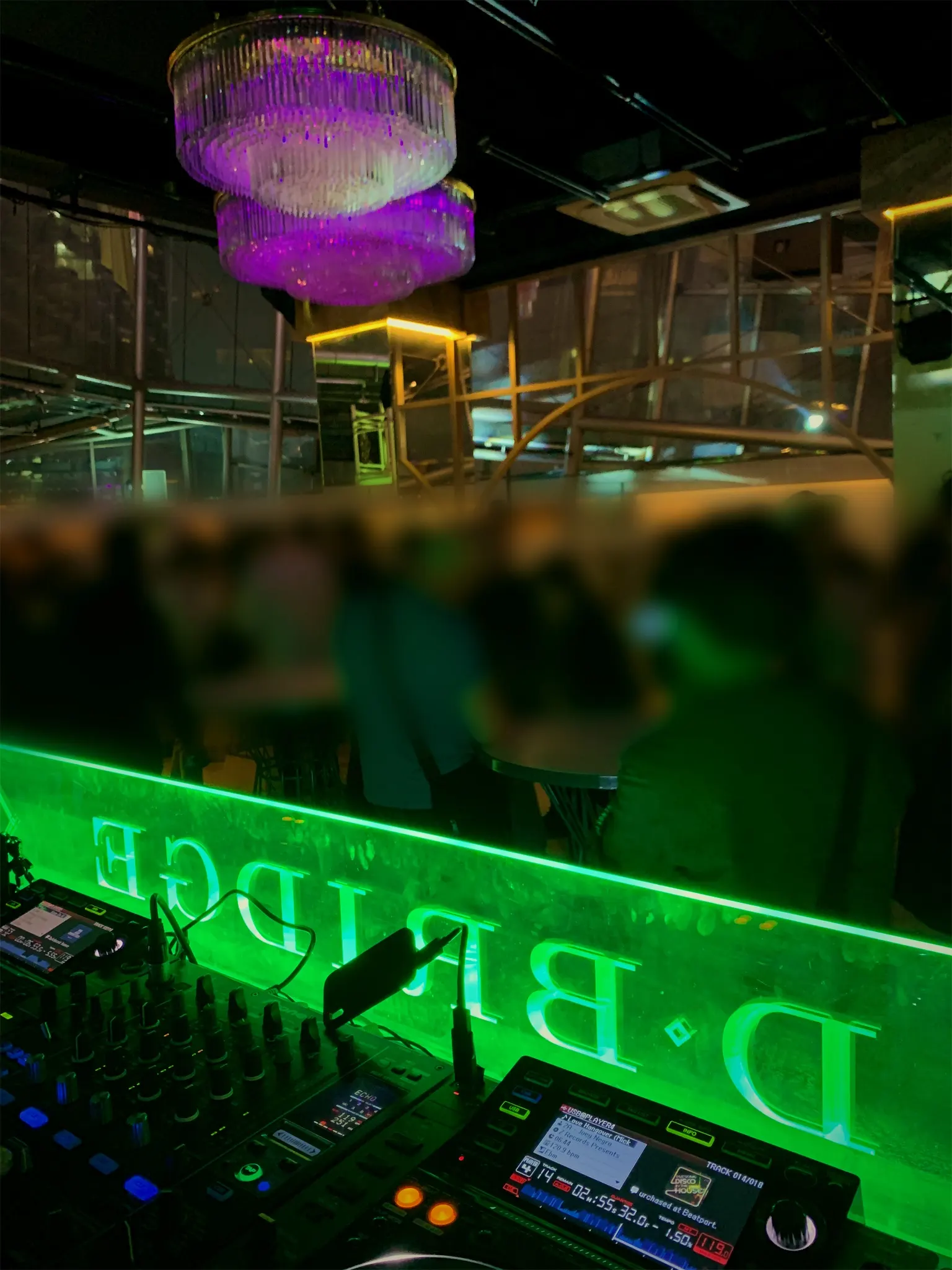
The rooms worth knowing in 2026 start with Lion Super Club, at 535 Dosan-daero, which opened in January 2026. Times is on Apgujeong-ro 54-gil, and Muse Seoul and Lowkey Seoul are both on Apgujeong-ro 46-gil. Ace sits on the old Race site by Sinsa Station. Luka in Sinsa (신사) is the hard techno and trance room. Frame Seoul in Cheongdam (청담) hosts OFFGRID’s house and techno nights. When the rest of the district closes, +82 is the after hours club.
Gangnam is really several neighbourhoods wearing the same label. Apgujeong (압구정) Rodeo Street went from a luxury shopping and plastic surgery corridor to a row of speakeasies, concept bars and designer cafes that turn into cocktail lounges after dark. Doors there are partly about what you’re wearing and partly about whether you’ve booked, and some of the best spots are deliberately unlisted. Cheongdam takes that further: fewer rooms, smaller crowds, much higher minimums, and private rooms where nobody wants their photo taken. The streets around Gangnam Station are the most accessible face of the district, with bigger, louder rooms, EDM and commercial house, and a crowd of young office workers, students and visitors who came to say they went clubbing in Gangnam. Taxis are easy to find all night, but the queues build after 4am.
Seongsu Has One Club and a Lot of Good Bars
Seongsu earned its Brooklyn of Seoul label the way Brooklyn did, by turning a district of shoe factories and auto repair shops into design studios, coffee roasters and galleries through the 2010s. By day it’s cafes and pop up stores, and on a Saturday afternoon there’s always a line outside some unmarked shop you’ve never heard of. If you want to see the next Seoul trend before it arrives, walk around here then.
At night it’s mostly wine bars, listening rooms and concept spaces where the playlist is chosen as carefully as the furniture. The big exception is UNDERCITY, a 300 capacity basement between Seongsu and Konkuk University stations that has run techno and house nights since 2025. Regular nights cost about ₩15,000 to ₩20,000; big bookings start at ₩20,000 in advance and can reach ₩45,000 at the door, so buy ahead and check the lineup first. Wander Seoul’s guide keeps a good list of the bars.
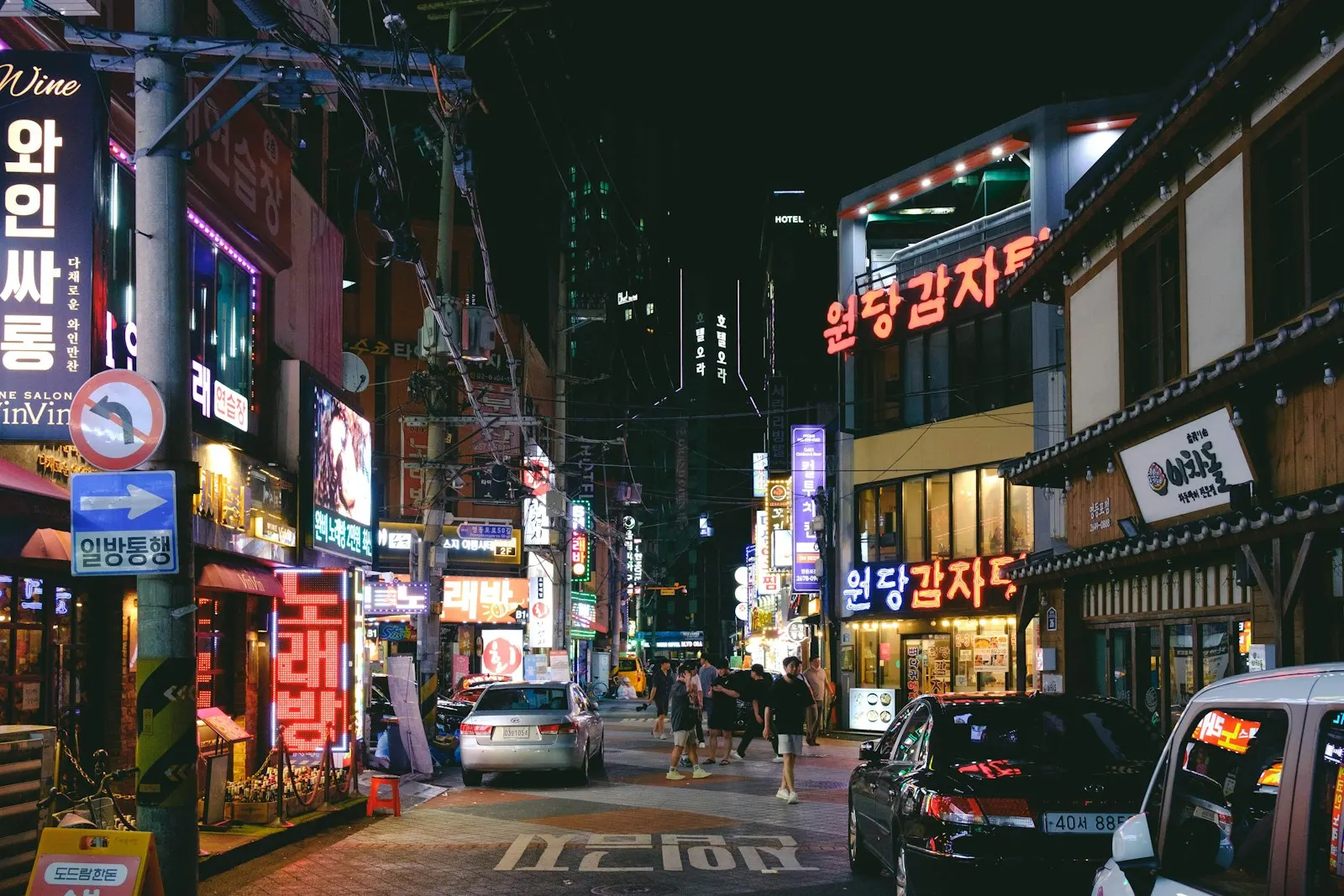
Just east, the streets around Konkuk University (건국대) run at a different frequency: cheap beer, chicken skewers, arcade games and a lot of students letting off a week of pressure at once. Nobody is thinking about the playlist, and the night tends to end with tteokbokki at 4am. Both areas are growing after dark. A 2025 study of Seoul’s night time economy, using business and living population data, named the Konkuk University area and Seongsu among the commercial districts growing at night, while Sinchon, Dongdaemun and Sindang were in relative decline. Seongsu Station is on Line 2; after the last train it’s an N bus or a taxi.
Euljiro, Jongno and Mullae Are for Small Rooms
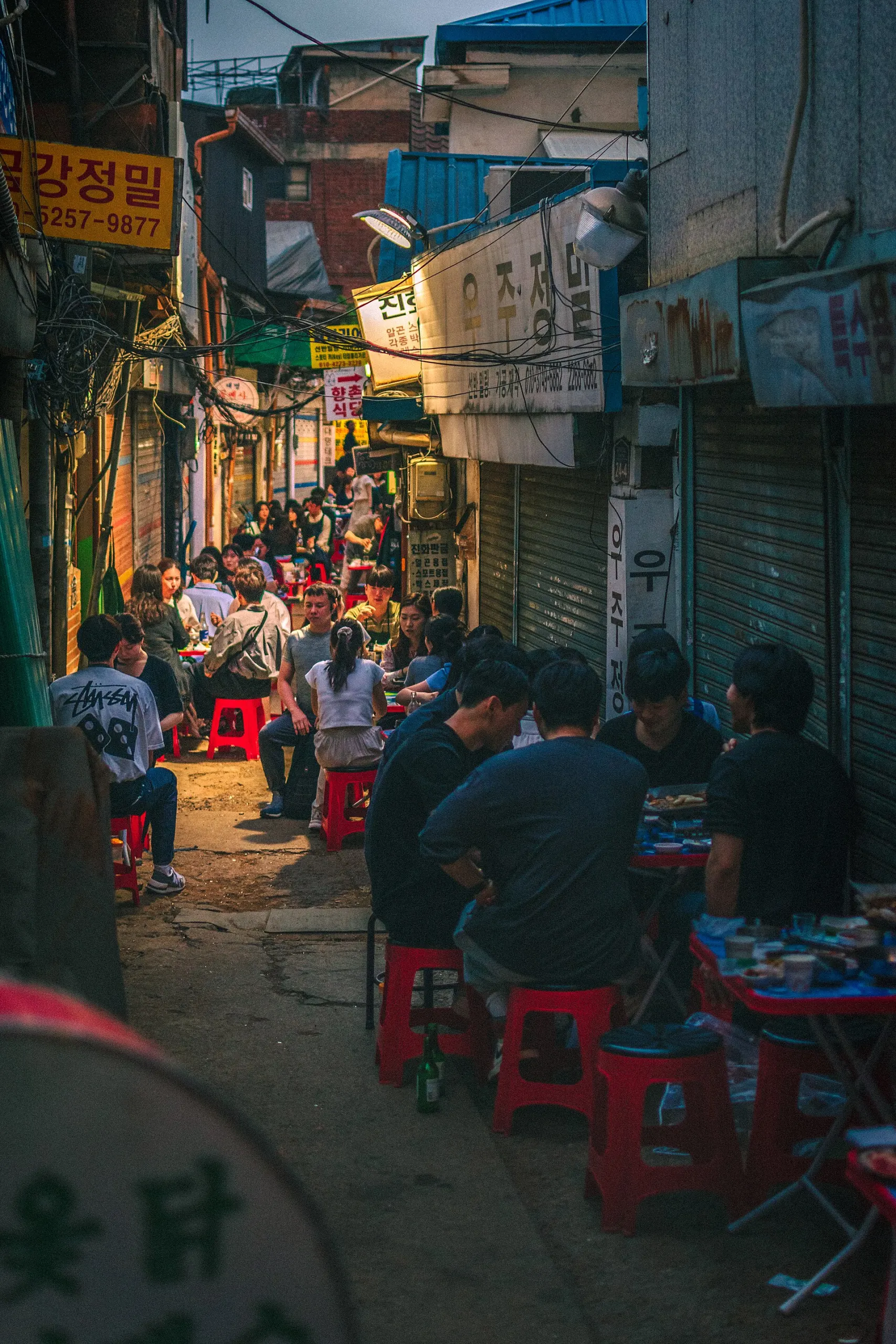
Euljiro was Seoul’s printing and metalwork district for most of the twentieth century, and the signs for welding shops and print houses are still up. A new generation of small bars opened in its alleys over the last decade precisely because of that texture: natural wine, makgeolli, vinyl on proper decks, and cocktail menus that draw on Korean food instead of New York or Tokyo. It feels like Seoul drinking in its own language. Start with the Hipjiro bars and the city’s vinyl listening bars.
These places are hard to find. There are often no signs, Naver Map works where Google doesn’t, and sometimes there’s a door code. Popular bars run waiting lists on weekends, and some need a Korean phone number to join one. The print shops still work on weekdays, so walk the print alleys in daylight too. For dancing, The Edge Seoul in Euljiro and The Opera in Dongdaemun had club nights listed this autumn. Euljiro 3-ga Station is on Lines 2 and 3, the most central stop in this guide, so getting home before the last train is easy.
Jongno runs alongside Euljiro and carries different history. It’s the heart of Joseon era Seoul and the home of Korea’s LGBTQ+ bar scene, centred on Jongno 3-ga (종로3가): unpretentious, affordable and run on community loyalty. The city’s two queer scenes have long worked differently. Han Yu-seok’s 2013 study in Seoul Studies (서울도시연구) found the bars of Itaewon’s fire station alley unusually open, with owners running gay and trans bars in plain view, and contrasted them with the more closed male queer spaces around Nakwon-dong (낙원동) in Jongno.
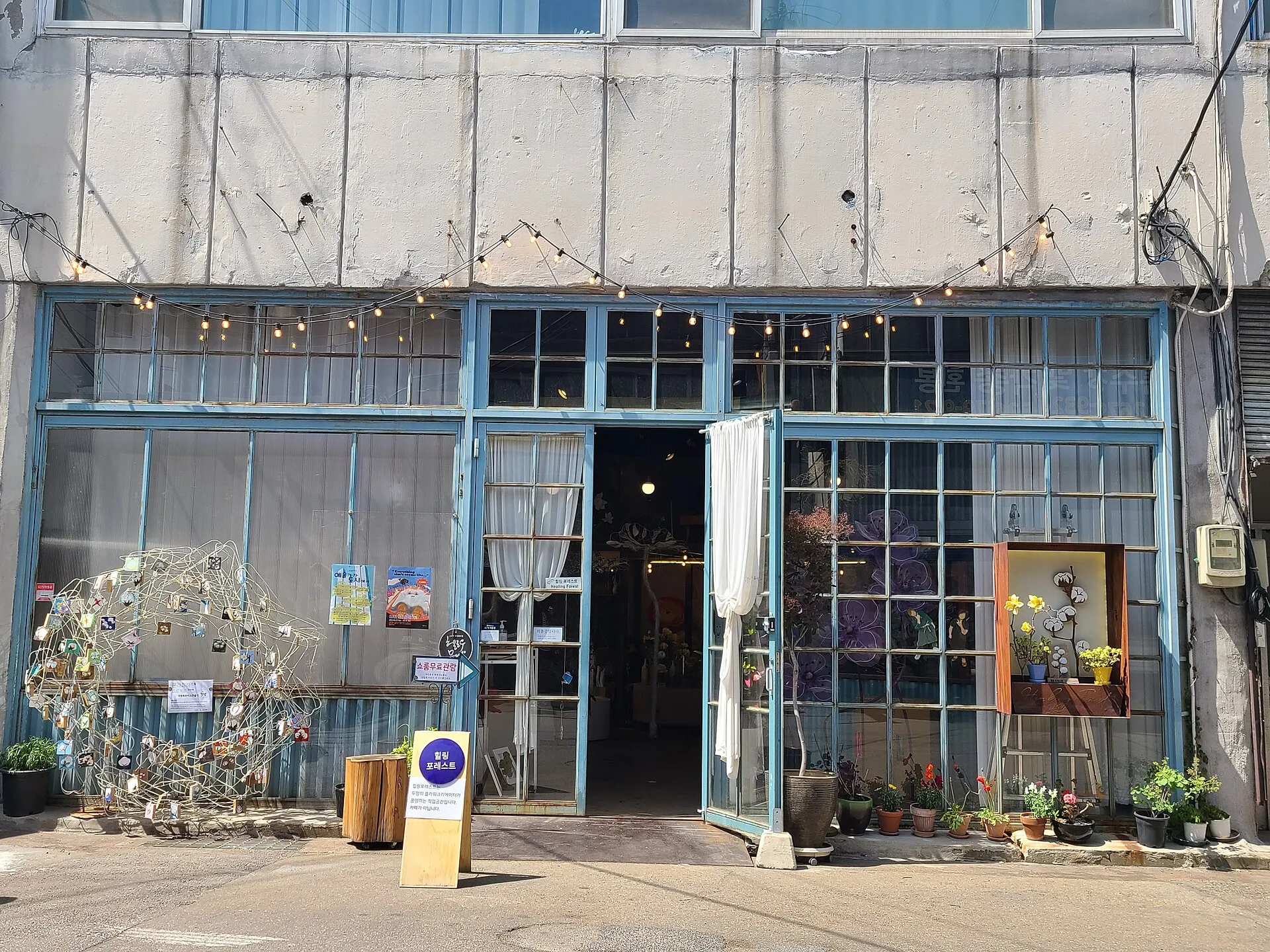
Mullae-dong (문래동), in Yeongdeungpo-gu in southwest Seoul, is the least polished neighbourhood in this guide. Welding shops still run during the day and you can smell hot metal in the air. Artists and musicians started moving in during the late 2000s because the rent made experimenting affordable, and some of the city’s most interesting bars and performance spaces sit between the workshops. Carry cash, get lost in the alleys on purpose, and remember the bars are guests in a working district.
Every room in this guide is on the map below, with what’s on over the next two weeks and Naver and Kakao links in each pin.
Seoul nightlife map
Every district on the site in one view. Zoom into a neighbourhood to see its streets, or use the area map inside each district guide.
Venues on this map: Cakeshop (케이크샵), B1, 134 Itaewon-ro; Blacklist (블랙리스트), 134 Itaewon-ro; Volnost (볼노스트), 142 Itaewon-ro; Seoul Community Radio (서울 커뮤니티 라디오), 22 Noksapyeong-daero 40na-gil; Coley (콜리), 214 Noksapyeong-daero; Southside Parlor (사우스사이드 팔러), 218 Noksapyeong-daero; Ring (링), 2F, 165-6 Itaewon-ro; Rack Seoul (랙), 2F, 4 Itaewon-ro 23-gil; Nué Seoul (누에), 2F, 45 Itaewon-ro 27ga-gil; Hamilton Hotel (해밀톤호텔), 179 Itaewon-ro; Prost (프로스트), 26 Itaewon-ro 27ga-gil; Glam (글램라운지), 26 Itaewon-ro 27ga-gil; Union (바유니온), 29 Bogwang-ro 59-gil; Pistil (피스틸), 9 Bogwang-ro 59-gil; Itaewon Station (이태원역), Itaewon-ro, Yongsan-gu (Line 6); Faust (파우스트), 3F, 7 Bogwang-ro 60-gil; Casa Corona (카사코로나), 7 Bogwang-ro 60-gil; Blank Site (블랭크 사이트), B2, 22 Bogwang-ro 60-gil; Nyapi (냐피), 187 Itaewon-ro; Flac (플랙), 2F, 5 Itaewon-ro 27ga-gil; Public (퍼블릭), B1, 192 Itaewon-ro; Teller (텔러), B1, 39 Usadan-ro; All That Jazz (올댓재즈), 216 Itaewon-ro; Bolero (볼레로), B1, 220 Itaewon-ro; Soap (소프 서울), B2, 217 Itaewon-ro; JJ Mahoney’s (제이제이 마호니스), Grand Hyatt Seoul, Grand Hyatt Seoul, 322 Sowol-ro; Stoked&stoned (스톡앤스톤드), 2F, 72 Daesagwan-ro; Vurt (버트), 11 Dongmak-ro; Modeci (모데시), 5F, 64 Wausan-ro; The Henz Club (헨즈클럽), B1, 64 Wausan-ro; Escape_bar, 16 Yonsei-ro 5ga-gil; Hongik Univ. Station (홍대입구역), Yanghwa-ro, Mapo-gu (Line 2, AREX, Gyeongui-Jungang); Lion Super Club (라이언), 1F, 535 Dosan-daero; Muse Seoul (뮤즈), B1, 71-1 Apgujeong-ro 46-gil; Frame Seoul (프레임), 36 Eonju-ro 170-gil; Luka (루카), B1, 46 Gangnam-daero 152-gil; The Edge Seoul (디 엣지), 8 Eulji-ro 12-gil; Jushindang (주신당), 399 Toegye-ro; Sewoon Sangga (세운상가), Sewoon Sangga, Jong-ro, Jongno-gu; Inhyeon Market (인현시장), Inhyeon Market, Eulji-ro 3-ga, Jung-gu; Seoul Art Space Mullae (문래예술공장), 5-4 Gyeongin-ro 88-gil; MH Live Hall (명화라이브홀), 30 Beodeunaru-ro; Yeongdeungpo Market (영등포시장), Yeongdeungpo Market, Yeongdeungpo-gu; Times Square (타임스퀘어), Times Square, 15 Yeongjung-ro, Yeongdeungpo-gu; Mullae Station (문래역), Mullae Station, Yeongdeungpo-gu (Line 2); UNDERCITY (언더시티), B1, 61 Seongsui-ro 22-gil; Seongsu Station (성수역), Seongsu Station, Seongdong-gu (Line 2); Kunst Kabinett Seoul, 21 Changgyeonggung-ro 35-gil; Space Nodeul K, 11 Hyunchung-ro; Eulji OB Bear (을지OB베어), 49-2 Chungmu-ro; Kockiri (코끼리), 46 Usadan-ro; Atdge Seoul (엣지서울), B1, 29 Bogwang-ro 59-gil, Yongsan-gu; Paper (페이퍼), Rooftop, 37 Itaewon-ro 27ga-gil, Yongsan-gu; Shelter (쉘터), 5F, 37 Itaewon-ro 27ga-gil, Yongsan-gu; Hertz (헤르츠), 1F, 21 Usadan-ro 14-gil, Yongsan-gu; Rosso (로쏘 서울), B1, 17 Daesagwan-ro 31-gil, Yongsan-gu; Cul Sec (큐섹), 1F, 242 Noksapyeong-daero, Yongsan-gu (Haebangchon side); RO Seoul (로서울), 1F, 19 Noksapyeong-daero 52-gil, Yongsan-gu; Lovehaus (러브하우스), B1, 6 Itaewon-ro 23-gil, Yongsan-gu; Grain Haus (그레인하우스), 1F, 40 Usadan-ro, Yongsan-gu; 232 (232), 232 Itaewon-ro, Yongsan-gu; Department.en (Den) (디파트먼트이엔), 1F, 48-22 Yeonhui-ro, Seodaemun-gu (Yeonhui-dong); Thila Ground (틸라 그라운드), 2 Tojeong-ro 9-gil, Mapo-gu (Sangsu); Chunhee (춘희), B1, 193 Seongmisan-ro, Mapo-gu (Yeonnam); Club FF (클럽FF), B1, 12 Wausan-ro 17-gil, Mapo-gu; Club Ocean (클럽오션), B2, 6 Jandari-ro, Mapo-gu; Rolling Hall (롤링홀), B1, Sinbo Bldg, 35 Eoulmadang-ro, Mapo-gu; Club Evans (클럽에반스), 2F, 63 Wausan-ro, Mapo-gu; Live Club Bbang (라이브클럽 빵), B1, 12 Wausan-ro 29-gil, Mapo-gu; ACE (formerly Race) (에이스 (구 레이스)), B1, 597 Gangnam-daero, Seocho-gu (Sinsa Station); Times (타임즈 압구정), B1, 25 Apgujeong-ro 54-gil, Gangnam-gu; Lowkey (로우키), B1, 75 Apgujeong-ro 46-gil, Gangnam-gu; Plus82 (+82) (플러스82), B1, 539 Dosan-daero, Gangnam-gu (Cheongdam); Graphic Hangang (그래픽 한강), 37-53 Apgujeong-ro 11-gil, Gangnam-gu (Jamwon Hangang Park); Ximxim Bar (심심), Rm 308, 3F Bldg B, S-Factory, 11 Yeonmujang 15-gil, Seongdong-gu; TCC Seoul (tcc), 1F, 302 Gwangnaru-ro, Seongdong-gu; Dumb Seoul (덤서울), 2F, 394 Ttukseom-ro, Seongdong-gu; Bar Piment (바피망), 3F, 32 Myeongdong 4-gil, Jung-gu; Objktt Record Bar (오브옉트 레코드바), 4F, 58 Myeongdong 8ga-gil, Jung-gu; FFF (FFF), 3F, 7 Hangang-daero 54-gil, Yongsan-gu (Samgakji); Zest (제스트), 1F, 26 Dosan-daero 55-gil, Gangnam-gu (Cheongdam); Alice Cheongdam (앨리스), B1, 47 Dosan-daero 55-gil, Gangnam-gu (Cheongdam); Bar Cham (참), 1F, 34 Jahamun-ro 7-gil, Jongno-gu (Seochon); M+MS (Malt + Mixology Space) (엠엠에스), 1F, 32-1 Dosan-daero 49-gil, Gangnam-gu (Sinsa); Le Chamber (르챔버), B1, 42 Dosan-daero 55-gil, Gangnam-gu (Cheongdam); Gong Gan (공간), 1F, 66-4 Yulgok-ro 3-gil, Jongno-gu (Anguk); Soko (소코), 47 Hannam-daero 20-gil, Yongsan-gu (Hannam); Pine & Co (파인앤코), B1, 33 Seolleung-ro 157-gil, Gangnam-gu (Apgujeong); Cobbler (코블러), 1F, 16 Sajik-ro 12-gil, Jongno-gu (Sajik-dong); Kiez (키즈), B1, 45 Dosan-daero 55-gil, Gangnam-gu (Cheongdam); Bar Tea Scent (바티센트), 1F, 16 Seolleung-ro 162-gil, Gangnam-gu (Cheongdam); Pussyfoot Saloon (푸시풋살룬), B1, 7-6 Daesagwan-ro 31-gil, Yongsan-gu (Hannam); Boogie Woogie (부기우기), 2F, 21 Hoenamu-ro, Yongsan-gu (Haebangchon side); Bar Swallow (바 스왈로), 1F, 38 Itaewon-ro 55ga-gil, Yongsan-gu (Hannam); Gaenari Whisky Hannam (개나리위스키 한남), 2F, 78 Itaewon-ro 54-gil, Yongsan-gu (Hannam); The Lion's Den Cheongdam (더라이온스덴 청담), B1, 7 Seolleung-ro 158-gil, Gangnam-gu (Cheongdam); d.still (디스틸), 1F, 10 Wausan-ro 15-gil, Mapo-gu (Sangsu); Antisocial Whisky Club (안티소셜위스키클럽), 2F, 43 Donggyo-ro, Mapo-gu (Mangwon); Brown Study (브라운스터디), 1F, 37 Wausan-ro 3-gil, Mapo-gu (Sangsu); Gu Seoul (구 서울), 2F, 82 Majang-ro, Jung-gu (Sindang); Bar Bam (바밤), 2F, 872 Gyeongin-ro, Yeongdeungpo-gu; Charles H. (포시즌스호텔 서울 찰스H), Four Seasons Hotel Seoul, B1, Four Seasons Hotel Seoul, 97 Saemunan-ro, Jongno-gu; The Timber House (파크하얏트 서울 더 팀버하우스), Park Hyatt Seoul, LL, Park Hyatt Seoul, 606 Teheran-ro, Gangnam-gu (Samseong); Bar 81 (시그니엘서울 바81), Signiel Seoul, 81F, Lotte World Tower, 300 Olympic-ro, Songpa-gu (Jamsil); The Library (서울신라호텔 더 라이브러리), The Shilla Seoul, 1F, The Shilla Seoul, 249 Dongho-ro, Jung-gu; The Distillers' Library (서울신라호텔 더 디스틸러스 라이브러리), The Shilla Seoul, 1F, The Shilla Seoul, 249 Dongho-ro, Jung-gu; 1914 Lounge & Bar (1914라운지&바), Josun Palace, 24F, Josun Palace, 231 Teheran-ro, Gangnam-gu (Yeoksam); Lounge & Bar (웨스틴조선서울 라운지앤바), The Westin Josun Seoul, Lobby, The Westin Josun Seoul, 106 Sogong-ro, Jung-gu; The Griffin (JW메리어트동대문스퀘어서울 더그리핀바), JW Marriott Dongdaemun Square, 11F, 279 Cheonggyecheon-ro, Jongno-gu; Privilege Bar (몬드리안서울이태원 프리빌리지 바), Mondrian Seoul Itaewon, Rooftop, Mondrian Seoul Itaewon, 23 Jangmun-ro, Yongsan-gu; Side Note Club (라이즈호텔 사이드노트클럽), RYSE Hotel, 15F, RYSE Hotel, 130 Yanghwa-ro, Mapo-gu; M29 (M29 페어몬트 앰버서더 서울), Fairmont Ambassador Seoul, 29F, Fairmont Ambassador Seoul, 108 Yeoui-daero, Yeongdeungpo-gu (Yeouido); Rooftop Bar Cloud (AC메리어트호텔 루프탑바클라우드), AC Hotel Seoul Gangnam, 21F, AC Hotel Seoul Gangnam, 10 Teheran-ro 25-gil, Gangnam-gu (Yeoksam); Mobo Bar (JW메리어트호텔서울 모보바), JW Marriott Hotel Seoul, 7F, JW Marriott Hotel Seoul, 176 Sinbanpo-ro, Seocho-gu (Banpo); Latitude 32 (라티튜드32), Sofitel Ambassador Seoul, 32F, Sofitel Ambassador Seoul, 209 Jamsil-ro, Songpa-gu (Jamsil); Marque d'Amour (마크다모르), L'Escape Hotel, 26F, L'Escape Hotel, 67 Toegye-ro, Jung-gu; H. Bar (에이치 바), Four Seasons Hotel Seoul, Four Seasons Hotel B1 (inside Charles H.), 97 Saemunan-ro; Peninsula Lounge & Bar (페닌슐라 라운지 앤 바), The Grand Lotte Seoul, The Grand Lotte Seoul 1F, 30 Eulji-ro; Moon Bar (문 바), Banyan Tree Club & Spa Seoul, Banyan Tree Club & Spa Seoul, 60 Jangchungdan-ro; WXYZ Bar (WXYZ 바), Aloft Seoul Myeongdong, Aloft Seoul Myeongdong 2F, 56 Namdaemun-ro; The Paris Bar (파리스 바), Grand Hyatt Seoul, Grand Hyatt Seoul, 322 Sowol-ro; Bar VOISIN (바 부아쟁), Hotel Naru Seoul MGallery, Hotel Naru Seoul 22F, 8 Mapo-daero; LUX BAR (럭스 바), Grand Walkerhill Seoul, Grand Walkerhill Seoul 16F, 177 Walkerhill-ro; Lobby Lounge & Bar (로비 라운지 앤 바), Grand InterContinental Seoul Parnas, Grand InterContinental Seoul Parnas 1F, 521 Teheran-ro; Hotel Cappuccino Rooftop Bar (호텔카푸치노 루프탑바), Hotel Cappuccino, Hotel Cappuccino rooftop, 155 Bongeunsa-ro; Hanuk (하눅), B1, 18 Samil-daero 19-gil, Jongno; Cham Jecheol (참제철), 133-10 Sajik-ro, Seochon; Bar Jiro (바지로), B1, 29 Pirundae-ro, Seochon; Omusa (오무사), 1 Pirundae-ro 9-gil, Seochon; Beopwon (법원), 33 Changdeokgung 1-gil, Bukchon; Wa-ok (와옥), 3-7 Bukchon-ro 5na-gil, Bukchon; Myeongdong Sookhee (명동 숙희), 7-9 Myeongdong 10-gil; Blue Hour Jazz Club (블루아워 재즈클럽), B1 to B2, 6 Samil-daero 15-gil, Jonggak; Mutual Sound Club (뮤추얼 사운드 클럽), 23 Jahamun-ro, Seochon; Seochon Blues (서촌블루스), 17-1 Jahamun-ro, Seochon; Slowhand (슬로우핸드), 1 Sajik-ro 12-gil, Seochon; Satz (재츠), 2F, 21 Daesagwan-ro 30-gil, Yongsan-gu; KSPO Dome (KSPO DOME (올림픽체조경기장)), 424 Olympic-ro, Songpa-gu; Olympic Hall (올림픽홀), 424 Olympic-ro, Songpa-gu; Ticketlink Live Arena (티켓링크 라이브 아레나), 424 Olympic-ro, Songpa-gu; Woori Art Hall (우리금융아트홀), 424 Olympic-ro, Songpa-gu; 88 Lawn, Olympic Park (88잔디마당), 424 Olympic-ro, Songpa-gu; Seoul Olympic Stadium (서울올림픽주경기장), 25 Olympic-ro, Songpa-gu; Jamsil Auxiliary Stadium (잠실종합운동장 보조경기장), 25 Olympic-ro, Songpa-gu; Seoul Land (서울랜드), 181 Gwangmyeong-ro, Gwacheon-si, Gyeonggi; Paradise City (파라다이스시티), 186 Yeongjonghaean-ro 321beon-gil, Yeongjong-gu, Incheon; Inspire Arena (인스파이어 아레나), 127 Gonghangmunhwa-ro, Yeongjong-gu, Incheon; KINTEX (킨텍스), 217-60 Kintex-ro, Ilsanseo-gu, Goyang-si, Gyeonggi; Gocheok Sky Dome (고척스카이돔), 430 Gyeongin-ro, Guro-gu; YES24 Live Hall (예스24 라이브홀), 20 Gucheonmyeon-ro, Gwangjin-gu; Blue Square Woori WON Banking Hall (블루스퀘어 우리WON뱅킹홀), 294 Itaewon-ro, Yongsan-gu; Jangchung Arena (장충체육관), 241 Dongho-ro, Jung-gu; Dongdaemun Design Plaza (DDP) (동대문디자인플라자), 281 Eulji-ro, Jung-gu; Nanji Hangang Park (난지한강공원), 162 Hangangnanji-ro, Mapo-gu; Oil Tank Culture Park (문화비축기지), 87 Jeungsan-ro, Mapo-gu; S-Factory (에스팩토리), 11 Yeonmujang 15-gil, Seongdong-gu; Incheon Munhak Stadium (인천문학경기장), Munhak-dong, Michuhol-gu, Incheon; Club Horn (클럽 혼), B1, 5 Jandari-ro, Mapo-gu; Macaroni Funky Club (마카로니펑키클럽), B1, 32 Yanghwa-ro 6-gil, Mapo-gu (Hapjeong); Channel 1969 (채널1969), 35 Yeonhui-ro, Mapo-gu (Yeonnam); Sinheung Market (신흥시장), Sinheung-ro, Yongsan-dong 2-ga, Yongsan-gu; Noksapyeong Station (녹사평역), Itaewon-ro, Yongsan-gu; Hills & Europa (힐스앤유로파), 2F, 35 Sinheung-ro, Yongsan-gu; The Living Room (더리빙룸), B1, 45-13 Yongsan-dong 2-ga, Yongsan-gu; Seoul Vinyl (서울바이닐), 2F, 30 Sinheung-ro, Yongsan-gu; Gil Bar (길바닥), 1F, Sinheung Market, Yongsan-dong 2-ga, Yongsan-gu; Vibed Boulevard (바이브드블러바드), 2F, 243-16 Hangang-ro 1-ga, Yongsan-gu; Mixd (믹스드), B1, 243-16 Hangang-ro 1-ga, Yongsan-gu; Social Haven (소셜해이븐), 9 Sinheung-ro, Yongsan-gu; Snail Record & Bar (스네일레코드앤바), 1F, 99-7 Sinheung-ro, Yongsan-gu; The Studio HBC (서브라이엇 해방촌), B1, Sinheung-ro 7-gil 1, Yongsan-gu; Lit Lounge (릿라운지), 1F, 34-65 Itaewon-dong, Yongsan-gu; Muse Seoul (뮤즈), B1, 71-1 Apgujeong-ro 46-gil; Frame Seoul (프레임), 36 Eonju-ro 170-gil; Times (타임즈 압구정), B1, 25 Apgujeong-ro 54-gil, Gangnam-gu; Lowkey (로우키), B1, 75 Apgujeong-ro 46-gil, Gangnam-gu; Zest (제스트), 1F, 26 Dosan-daero 55-gil, Gangnam-gu (Cheongdam); Alice Cheongdam (앨리스), B1, 47 Dosan-daero 55-gil, Gangnam-gu (Cheongdam); M+MS (Malt + Mixology Space) (엠엠에스), 1F, 32-1 Dosan-daero 49-gil, Gangnam-gu (Sinsa); Le Chamber (르챔버), B1, 42 Dosan-daero 55-gil, Gangnam-gu (Cheongdam); Pine & Co (파인앤코), B1, 33 Seolleung-ro 157-gil, Gangnam-gu (Apgujeong); Kiez (키즈), B1, 45 Dosan-daero 55-gil, Gangnam-gu (Cheongdam); Bar Tea Scent (바티센트), 1F, 16 Seolleung-ro 162-gil, Gangnam-gu (Cheongdam); The Lion's Den Cheongdam (더라이온스덴 청담), B1, 7 Seolleung-ro 158-gil, Gangnam-gu (Cheongdam); Lion Super Club (라이언), 1F, 535 Dosan-daero; Plus82 (+82) (플러스82), B1, 539 Dosan-daero, Gangnam-gu (Cheongdam); Spin (스핀), 663-17 Sinsa-dong, B1, Gangnam-gu; Candyman (캔디맨), 662-20 Sinsa-dong, B1, Gangnam-gu; Prism (압구정 프리즘), 661-14 Sinsa-dong, B1, Gangnam-gu; Club Garden (클럽가든), 661-11 Sinsa-dong, Gangnam-gu; Tech In (테크인), 652-3 Sinsa-dong, B1, Gangnam-gu; AB (에이비), 651-9 Sinsa-dong, B1, Gangnam-gu; Fantasy (판타지), 630-19 Sinsa-dong, B1, Gangnam-gu; Intro Hip Hop Museum (압구정힙합뮤지엄인트로), 662-17 Sinsa-dong, B1, Gangnam-gu; Garrison (게리슨), 661-13 Sinsa-dong, B1, Gangnam-gu; Cricket Seoul (크리켓서울), 646-15 Sinsa-dong, Gangnam-gu; Michiko Seoul (미치코서울 재즈라운지), 656 Sinsa-dong, 2F, Gangnam-gu; Bar Hailo (바 하일로), 647-24 Sinsa-dong, 3F, Gangnam-gu; Bar Musk (바 머스크), 630-21 Sinsa-dong, 1F, Gangnam-gu; Polestar (폴스타), 645-10 Sinsa-dong, B1, Gangnam-gu; Leon Seoul (레온서울), 662-1 Sinsa-dong, B1, Gangnam-gu; Deck52 (덱52), 655-6 Sinsa-dong, B1, Gangnam-gu; Chapter Three (챕터쓰리), 78-14 Cheongdam-dong, Gangnam-gu; Bar Geranium (바제라늄), 84-14 Cheongdam-dong, Gangnam-gu; Apgujeong Rodeo Station (압구정로데오역), Apgujeong-ro, Gangnam-gu; Mujeonghyeong (무정형), 58-1 Mullae-dong 2-ga, Yeongdeungpo-gu; Muyeom (무념), 49-21 Mullae-dong 2-ga, Yeongdeungpo-gu; Platz (플라츠), 14-38 Mullae-dong 2-ga, Yeongdeungpo-gu; Old Mullae (올드문래), 14-28 Mullae-dong 2-ga, Yeongdeungpo-gu; Janhyang (잔향), 14-48 Mullae-dong 2-ga, Yeongdeungpo-gu; Vinyl House (비닐하우스), 54-39 Mullae-dong 3-ga, Yeongdeungpo-gu; Hyeongje Jogak (형제조각), 58-65 Mullae-dong 3-ga, Yeongdeungpo-gu; TATD (티에이티디), 3F, 40-2 Mullae-dong 2-ga, Yeongdeungpo-gu; Mullae Chinchin (문래친친), 2F, 45-8 Mullae-dong 2-ga, Yeongdeungpo-gu; Como Wine Bar (꼬모 와인바), 11-37 Mullae-dong 4-ga, Yeongdeungpo-gu; Club Purple (클럽퍼플), 408-6 Seogyo-dong, B1, Mapo-gu; B1 Hongdae (B1 홍대), 407-4 Seogyo-dong, B1, Mapo-gu; Mons (몽스), 407-12 Seogyo-dong, Mapo-gu; Awesome (어썸), 363-6 Seogyo-dong, B1, Mapo-gu; Awesome Red (어썸레드), 363-11 Seogyo-dong, B1, Mapo-gu; Incle (인클), 407-24 Seogyo-dong, Mapo-gu; Sinkhole (싱크홀 홍대점), 363-9 Seogyo-dong, B1, Mapo-gu; Sabotage (사보타지), 407-17 Seogyo-dong, Mapo-gu; Club Bermuda (클럽 버뮤다), 361-12 Seogyo-dong, B1 to B2, Mapo-gu; Big Team (빅팀), 91-2 Sangsu-dong, B1, Mapo-gu; Aura 2 (아우라2), 363-14 Seogyo-dong, Mapo-gu; La Rosa (라로사), 358-38 Seogyo-dong, B1, Mapo-gu; Club Lucy (클럽루시), 414-3 Hapjeong-dong, B2, Mapo-gu; Brown (브라운), 394-20 Seogyo-dong, B1, Mapo-gu; Club Sharp (클럽샤프), 384-23 Mangwon-dong, B1, Mapo-gu; Feather (페더), 311-7 Sangsu-dong, B1, Mapo-gu; T12 (티12), 363-22 Seogyo-dong, B1, Mapo-gu; Jase (자세), 362-14 Seogyo-dong, 2F, Mapo-gu; Bitters (비터스), 358-96 Seogyo-dong, Mapo-gu; Thursday Party (썰스데이파티), 364-3 Seogyo-dong, Mapo-gu; Lester Burnham (레스터번햄), 93-68 Sangsu-dong, Mapo-gu; Sangsuri (상수리), 324-9 Sangsu-dong, B1, Mapo-gu; Munhak Salon Chogo (문학살롱 초고), 372-17 Hapjeong-dong, B1, Mapo-gu; B&B (B&B), 412-29 Hapjeong-dong, B1, Mapo-gu; Gyojiphap (교집합), 364-28 Hapjeong-dong, B1, Mapo-gu; Studio 4BPM Hapjeong (스튜디오포비피엠 합정), 367-41 Hapjeong-dong, Mapo-gu; Balah (발아), 388-25 Hapjeong-dong, 3F, Mapo-gu; Chaekbar (책바), 403-5 Mangwon-dong, 3F, Mapo-gu; Goose Coffee & Bar (구스커피앤바), 57-112 Mangwon-dong, Mapo-gu; Alcove (알코브), 57-206 Mangwon-dong, B1, Mapo-gu; Soap Coffee & Bar (소프커피앤바), 1F, 38-20 Yongsan-dong 2-ga, Yongsan-gu; Pet Sounds (펫사운즈), 3F, 278-8 Itaewon-dong, Yongsan-gu (Gyeongnidan); Roxy (록시), B1, 662 Itaewon-dong, Yongsan-gu (Gyeongnidan); Golmok Vinyl & Pub (골목바이닐앤펍), 2F 201, 557 Itaewon-dong, Yongsan-gu (Gyeongnidan); Salon de Muart (살롱드뮤아트), 2F, 226-6 Itaewon-dong, Yongsan-gu (Gyeongnidan); Sunset Mood (선셋무드), 4F, 226-6 Itaewon-dong, Yongsan-gu (Gyeongnidan); Dialogue (다이얼로그), B1, 44-18 Yongsan-dong 2-ga, Yongsan-gu; Karma (까르마), 2F, 46 Yongsan-dong 2-ga, Yongsan-gu; Lumen (루멘), 293-10 Itaewon-dong, Yongsan-gu (Gyeongnidan); Bandage (반창고), B1, 224-1 Itaewon-dong, Yongsan-gu (Gyeongnidan); Echi (에치), 1F 101, 630 Itaewon-dong, Yongsan-gu (Gyeongnidan); Rest (레스트), 1F, 580 Itaewon-dong, Yongsan-gu; Union B-Side (유니온비사이드), 1F, 564 Itaewon-dong, Yongsan-gu; Yeoinsook (이태원 여인숙), 1F, 350-3 Itaewon-dong, Yongsan-gu; Gyeongnidan Wine (경리단길와인), 1F, 630 Itaewon-dong, Yongsan-gu (Gyeongnidan); Pof (포프), 3F, 260-124 Itaewon-dong, Yongsan-gu; Seoul n Soul (서울앤쏘울), 1F, 1-508 Yongsan-dong 2-ga, Yongsan-gu; Springbok (스프링복), 2F, 1-46 Yongsan-dong 2-ga, Yongsan-gu (inside Sinheung Market); The Old Vic (올드빅), 1-489 Yongsan-dong 2-ga, Yongsan-gu; Calm (캄), 1-505 Yongsan-dong 2-ga, Yongsan-gu; Chakyung (차경), 2F, 1-82 Yongsan-dong 2-ga, Yongsan-gu; Pang Bang (방방), 1F and 2F, 1-684 Yongsan-dong 2-ga, Yongsan-gu; Gitana (히타나), 1F, 26-10 Yongsan-dong 2-ga, Yongsan-gu; Miam Miam (미암미암), 1F, 37-5 Yongsan-dong 2-ga, Yongsan-gu; TYMM (티와이엠엠), 2F 201, 38-11 Yongsan-dong 2-ga, Yongsan-gu; Frmr (프레이머), 4F, 20 Yongsan-dong 2-ga, Yongsan-gu; A Glass Of (어글라스오브), 1F 101, 19-1 Yongsan-dong 2-ga, Yongsan-gu; Ranke (랑케), 1F, Yongsan-dong 2-ga, Yongsan-gu; Genie Pub (지니펍 해방촌본점), 3F, 39-17 Yongsan-dong 2-ga, Yongsan-gu; Bar Inn (바인), B1, 1-463 Yongsan-dong 2-ga, Yongsan-gu; Teta Lounge Bar (테타라운지바), 6F 601, 130-34 Itaewon-dong, Yongsan-gu; OWL Lounge (OWL라운지), B1, 123-5 Itaewon-dong, Yongsan-gu; Mu Lounge (뮤라운지), B1, 119-9 Itaewon-dong, Yongsan-gu; Midnight Lounge Club (미드나잇라운지클럽), B1, 126-15 Itaewon-dong, Yongsan-gu; Hype Rooftop Hookah Lounge (하이프 루프탑 후카라운지), 3F, 34-16 Itaewon-dong, Yongsan-gu; Trap Lounge (트랩라운지), 2F, 124-6 Itaewon-dong, Yongsan-gu; 6081 Records Mixshop (6081 레코드 믹샵), 1F, 274-2 Itaewon-dong, Yongsan-gu; Ilsim Records (일심레코드), 119-25 Itaewon-dong, Yongsan-gu; Elosm (엘로즘), 151-24 Itaewon-dong, Yongsan-gu; Vinyl & Plastic (현대카드 바이닐앤플라스틱), 1F, 683-131 Hannam-dong, Yongsan-gu; TW Records (TW레코즈), 2F, 682-5 Hannam-dong, Yongsan-gu; Haviture Records (해빗츄어레코드), 2F, 682-13 Hannam-dong, Yongsan-gu; Soul Train (소울트레인), 1F, 118-17 Itaewon-dong, Yongsan-gu; Off the Record (오프더레코드), 2F, 128-4 Itaewon-dong, Yongsan-gu; Reserve Records (리저브), 5F, 78-13 Itaewon-dong, Yongsan-gu; The Sound Closet (더사운드클로젯), B1, 74-10 Itaewon-dong, Yongsan-gu; The Beatles Live Pub (더비틀즈 라이브펍), B1, 738-23 Hannam-dong, Yongsan-gu; Cotton Club Sounds Hannam (코튼클럽 사운즈한남), 5F, 657-128 Hannam-dong, Yongsan-gu; Blue Cat (블루캣), B1, 657-133 Hannam-dong, Yongsan-gu; Manhattan Records Seoul (맨하탄레코즈 서울), 1F, 368-7 Seogyo-dong, Mapo-gu; Nip Archive (닙아카이브), 360-21 Seogyo-dong, Mapo-gu; Metavox (메타복스), 2F, 360-18 Seogyo-dong, Mapo-gu; Gimbap Records (김밥레코즈), 3F, 176-6 Donggyo-dong, Mapo-gu; Peter Pan LP (피터판), 170-27 Donggyo-dong, Mapo-gu; Beluga Music (벨루가뮤직), 1F, 177-7 Donggyo-dong, Mapo-gu; Mosaic West (모자이크 웨스트), 1F, 351-2 Sangsu-dong, Mapo-gu; Beatroad Hapjeong (비트로드 합정), 3F, 369-7 Seogyo-dong, Mapo-gu; Terrific Jam (테리픽잼), 1F, 421-18 Mangwon-dong, Mapo-gu; Hongdae Nulpan (홍대널판), 1F, 421-30 Mangwon-dong, Mapo-gu; The Same Hapjeong (더세임 합정), 1-2F, 398-21 Hapjeong-dong, Mapo-gu; Ultra Super A (울트라슈퍼A), 1F, 412-23 Hapjeong-dong, Mapo-gu; Green Records (그린레코드), 371-12 Hapjeong-dong, Mapo-gu; Lulu Lala Records (룰루랄라레코드), 361-2 Hapjeong-dong, Mapo-gu; Living Stereo (리빙 스테레오), 2F, 318-2 Sangsu-dong, Mapo-gu; Unity Record Bar (유니티레코드바), 1F 106, 334-13 Sangsu-dong, Mapo-gu; Chuls Music (철스뮤직), 2F, 411-8 Hapjeong-dong, Mapo-gu; Motto (모토), 1F, 396-27 Seogyo-dong, Mapo-gu; Blue Monday (블루먼데이), 2F 201, 396-61 Seogyo-dong, Mapo-gu; LP Memory (LP 메모리), 2F, 387-1 Hapjeong-dong, Mapo-gu; Map (맵), 1F, 386-33 Hapjeong-dong, Mapo-gu; Rekoz Coffee & Bar (레코즈커피&Bar), B1, 2-78 Changjeon-dong, Mapo-gu; Supersonic (수퍼소닉), 3F 301, 387-13 Yeonnam-dong, Mapo-gu; Blues House (블루스하우스), 2F, 433-5 Hapjeong-dong, Mapo-gu; New All Jazz Lounge (뉴올재즈라운지), B1, 201-16 Donggyo-dong, Mapo-gu; Universe Label (우주레이블), 55-20 Mullae-dong 3-ga, Yeongdeungpo-gu; Hukez (후키즈(HUKEZ)), 28 Mullae-dong 2-ga, Yeongdeungpo-gu; Haebangeum (해방음), 1F, 42-18 Mullae-dong 2-ga, Yeongdeungpo-gu; Forest Live (숲세권 라이브), B1, 54-34 Mullae-dong 3-ga, Yeongdeungpo-gu; GBN Live House (지비엔라이브하우스), 54-41 Mullae-dong 3-ga, Yeongdeungpo-gu; Mullae Jazz In (문래재즈인), B1, 7-1 Mullae-dong 4-ga, Yeongdeungpo-gu; Pungwoldang (풍월당), 4-5F, 657-37 Sinsa-dong, Gangnam-gu; Plastic Music Bar (플라스틱뮤직바), 2F, 652-11 Sinsa-dong, Gangnam-gu; DM Lounge (디엠 라운지), B1, 663-23 Sinsa-dong, Gangnam-gu; Code Lounge Apgujeong (코드라운지 압구정), B1, 663-24 Sinsa-dong, Gangnam-gu; Muin Lounge (무인 라운지 압구정), B1, 664-15 Sinsa-dong, Gangnam-gu; V Lounge (브이라운지), 1F, 662-4 Sinsa-dong, Gangnam-gu; J Lounge Swing (제이라운지스윙), B1 3, 615 Sinsa-dong, Gangnam-gu; Cheongdam Swing (청담스윙), B2, 83-21 Cheongdam-dong, Gangnam-gu; Mate Jazz (메이트재즈), 19-36 Cheongdam-dong, Gangnam-gu; Flac (플랙), 2F, 5 Itaewon-ro 27ga-gil; Kunst Kabinett Seoul, 21 Changgyeonggung-ro 35-gil; Atdge Seoul (엣지서울), B1, 29 Bogwang-ro 59-gil, Yongsan-gu; Cul Sec (큐섹), 1F, 242 Noksapyeong-daero, Yongsan-gu (Haebangchon side); RO Seoul (로서울), 1F, 19 Noksapyeong-daero 52-gil, Yongsan-gu; Graphic Hangang (그래픽 한강), 37-53 Apgujeong-ro 11-gil, Gangnam-gu (Jamwon Hangang Park); Ximxim Bar (심심), Rm 308, 3F Bldg B, S-Factory, 11 Yeonmujang 15-gil, Seongdong-gu; Dumb Seoul (덤서울), 2F, 394 Ttukseom-ro, Seongdong-gu; Bar Piment (바피망), 3F, 32 Myeongdong 4-gil, Jung-gu; Objktt Record Bar (오브옉트 레코드바), 4F, 58 Myeongdong 8ga-gil, Jung-gu; Mutual Sound Club (뮤추얼 사운드 클럽), 23 Jahamun-ro, Seochon; Seochon Blues (서촌블루스), 17-1 Jahamun-ro, Seochon; Slowhand (슬로우핸드), 1 Sajik-ro 12-gil, Seochon; Satz (재츠), 2F, 21 Daesagwan-ro 30-gil, Yongsan-gu; Hills & Europa (힐스앤유로파), 2F, 35 Sinheung-ro, Yongsan-gu; Seoul Vinyl (서울바이닐), 2F, 30 Sinheung-ro, Yongsan-gu; Vibed Boulevard (바이브드블러바드), 2F, 243-16 Hangang-ro 1-ga, Yongsan-gu; Snail Record & Bar (스네일레코드앤바), 1F, 99-7 Sinheung-ro, Yongsan-gu; Michiko Seoul (미치코서울 재즈라운지), 656 Sinsa-dong, 2F, Gangnam-gu; Vinyl House (비닐하우스), 54-39 Mullae-dong 3-ga, Yeongdeungpo-gu; Pet Sounds (펫사운즈), 3F, 278-8 Itaewon-dong, Yongsan-gu (Gyeongnidan); Roxy (록시), B1, 662 Itaewon-dong, Yongsan-gu (Gyeongnidan); Golmok Vinyl & Pub (골목바이닐앤펍), 2F 201, 557 Itaewon-dong, Yongsan-gu (Gyeongnidan); Salon de Muart (살롱드뮤아트), 2F, 226-6 Itaewon-dong, Yongsan-gu (Gyeongnidan); 6081 Records Mixshop (6081 레코드 믹샵), 1F, 274-2 Itaewon-dong, Yongsan-gu; Ilsim Records (일심레코드), 119-25 Itaewon-dong, Yongsan-gu; Elosm (엘로즘), 151-24 Itaewon-dong, Yongsan-gu; Vinyl & Plastic (현대카드 바이닐앤플라스틱), 1F, 683-131 Hannam-dong, Yongsan-gu; TW Records (TW레코즈), 2F, 682-5 Hannam-dong, Yongsan-gu; Haviture Records (해빗츄어레코드), 2F, 682-13 Hannam-dong, Yongsan-gu; Soul Train (소울트레인), 1F, 118-17 Itaewon-dong, Yongsan-gu; Off the Record (오프더레코드), 2F, 128-4 Itaewon-dong, Yongsan-gu; Reserve Records (리저브), 5F, 78-13 Itaewon-dong, Yongsan-gu; The Sound Closet (더사운드클로젯), B1, 74-10 Itaewon-dong, Yongsan-gu; Blue Cat (블루캣), B1, 657-133 Hannam-dong, Yongsan-gu; Manhattan Records Seoul (맨하탄레코즈 서울), 1F, 368-7 Seogyo-dong, Mapo-gu; Nip Archive (닙아카이브), 360-21 Seogyo-dong, Mapo-gu; Metavox (메타복스), 2F, 360-18 Seogyo-dong, Mapo-gu; Gimbap Records (김밥레코즈), 3F, 176-6 Donggyo-dong, Mapo-gu; Peter Pan LP (피터판), 170-27 Donggyo-dong, Mapo-gu; Beluga Music (벨루가뮤직), 1F, 177-7 Donggyo-dong, Mapo-gu; Mosaic West (모자이크 웨스트), 1F, 351-2 Sangsu-dong, Mapo-gu; Beatroad Hapjeong (비트로드 합정), 3F, 369-7 Seogyo-dong, Mapo-gu; Terrific Jam (테리픽잼), 1F, 421-18 Mangwon-dong, Mapo-gu; Hongdae Nulpan (홍대널판), 1F, 421-30 Mangwon-dong, Mapo-gu; The Same Hapjeong (더세임 합정), 1-2F, 398-21 Hapjeong-dong, Mapo-gu; Ultra Super A (울트라슈퍼A), 1F, 412-23 Hapjeong-dong, Mapo-gu; Green Records (그린레코드), 371-12 Hapjeong-dong, Mapo-gu; Lulu Lala Records (룰루랄라레코드), 361-2 Hapjeong-dong, Mapo-gu; Living Stereo (리빙 스테레오), 2F, 318-2 Sangsu-dong, Mapo-gu; Unity Record Bar (유니티레코드바), 1F 106, 334-13 Sangsu-dong, Mapo-gu; Chuls Music (철스뮤직), 2F, 411-8 Hapjeong-dong, Mapo-gu; Motto (모토), 1F, 396-27 Seogyo-dong, Mapo-gu; Blue Monday (블루먼데이), 2F 201, 396-61 Seogyo-dong, Mapo-gu; LP Memory (LP 메모리), 2F, 387-1 Hapjeong-dong, Mapo-gu; Map (맵), 1F, 386-33 Hapjeong-dong, Mapo-gu; Rekoz Coffee & Bar (레코즈커피&Bar), B1, 2-78 Changjeon-dong, Mapo-gu; Supersonic (수퍼소닉), 3F 301, 387-13 Yeonnam-dong, Mapo-gu; Universe Label (우주레이블), 55-20 Mullae-dong 3-ga, Yeongdeungpo-gu; Hukez (후키즈(HUKEZ)), 28 Mullae-dong 2-ga, Yeongdeungpo-gu; Haebangeum (해방음), 1F, 42-18 Mullae-dong 2-ga, Yeongdeungpo-gu; Pungwoldang (풍월당), 4-5F, 657-37 Sinsa-dong, Gangnam-gu; Plastic Music Bar (플라스틱뮤직바), 2F, 652-11 Sinsa-dong, Gangnam-gu; LAD & Hall (라드앤홀), B1, 54-44 Mullae-dong 3-ga, Yeongdeungpo-gu; Strange Fruit (스트레인지프룻), B1, 330-15 Seogyo-dong, Mapo-gu; Kura (쿠라), 서울 마포구 노고산동 31-76 3층; Panjajip (판자집), 서울 서대문구 창천동 29-18 1층; Uo Dongden (우오동뎅), 서울 서대문구 창천동 57-63 1층; Cheongdam-dong Pojangmacha (청담동포장마차), 서울 서대문구 창천동 13-24 1층; Dart Pub Sinchon Sanghoe (다트펍 신촌상회), 서울 서대문구 창천동 52-58 아주빌딩 3층; House Lounge (하우스라운지), 서울 서대문구 창천동 52-79 지하1층; Gwangdae Pocha (광대포차), 서울 서대문구 창천동 52-63 1층; So U Odeng (소우오뎅), 서울 서대문구 창천동 52-122; Wagamama Pub (와가마마펍), 서울 서대문구 창천동 53-15 2층; Cozy Lounge (코지라운지), 서울 서대문구 창천동 52-85 2층; Steampunk Rock Live Pub (스팀펑크락 라이브펍), 서울 서대문구 창천동 52-83 지층; Hipjiro 39 Pocha (힙지로39포차), 서울 광진구 화양동 8-102 지하1층; 972 Bar (972바), 서울 광진구 화양동 9-72 지하1층; Juinmun Pocha (주인문포차), 서울 광진구 화양동 9-91 2-3층; Yakitori Naruto Konkuk (야키토리나루토 건대), 서울 광진구 화양동 5-50 1층; Kofuku (코후쿠), 서울 광진구 화양동 9-36 2층; Lounge 47 (라운지47), 서울 광진구 화양동 47-18 2층; Sinseon Suljip Dowon (신선술집도원), 서울 광진구 화양동 8-19 2-4층; Saemaeul 39 Undong Pocha (새마을39운동포차 건대제1본부), 서울 광진구 화양동 8-19 1층; Island Yuki Pub (아일랜드유끼펍), 서울 광진구 화양동 47-68 1층; Poman (포만), 서울 광진구 화양동 47-15 1층; Mix Lounge (믹스라운지), 서울 광진구 화양동 8-8 지하1층; Miyeol Honsul Bar (미열 왕십리 혼술바), 서울 성동구 행당동 1-19 지층; Yahwa Honsul Bar (야화 혼술바 왕십리점), 서울 성동구 행당동 1-87 지하1층; Camping Pocha Bulmeong Hanyang (왕십리술집 캠핑포차 불멍 한양대점), 서울 성동구 행당동 4-6 지하1층; Yakitori Dongjak Wangsimni (야키토리동작 왕십리역점), 서울 성동구 행당동 1-31 1층; Bom-ui Jeongwon Wangsimni (봄의정원 왕십리점), 서울 성동구 행당동 3-7 지하1층; Dangnabal Pocha Wangsimni (당나발포차 왕십리역점), 서울 성동구 행당동 19-59 1층; Gombanggu Pocha Wangsimni (곰방구 포차 왕십리본점), 서울 성동구 행당동 19-43 2층; Mujigae Maekju Wangsimni (무지개맥주 서울왕십리점), 서울 성동구 행당동 19-43 2층; Arigyegok Hanyang (아리계곡 왕십리한양대점), 서울 성동구 행당동 19-87 1-2층; Hoegi Hof (회기호프), 서울 동대문구 휘경동 319-1 지하1층; Imone Wang Pajeon (이모네왕파전), 서울 동대문구 휘경동 335-20 1-2층; Eonnine Pocha (언니네포차), 서울 동대문구 회기동 16-85 1층; Ori (오리), 서울 동대문구 회기동 45-49 지하1층; Flexville (플렉스빌), 서울 동대문구 회기동 45-77 지하; Yeonga Hof Sojubang (연가호프소주방), 서울 동대문구 회기동 16-91; Tomodachi (도모다찌), 서울 동대문구 회기동 19 2층; Juhyang Pocha (주향포차), 서울 동대문구 회기동 16-13 지하1층; Jjakttung Pocha (짝퉁포차), 서울 동대문구 회기동 42-37; Grace Bar (그레이스바), 서울 동대문구 회기동 60-60 2층; Honsul Bar N Hoegi (혼술바 엔 회기점), 서울 동대문구 회기동 81 1층; Daddy J (대디제이), 서울 성북구 안암동5가 101-46 지하1층; Gotham (Godam) (고담), 서울 성북구 안암동5가 103-21; Drogba (드록바), 서울 성북구 안암동5가 103-22 지하1층; Horangi Suljip (호랭이술집), 서울 성북구 안암동5가 103-25 지하1층; Makgeolli Jip (막걸리집), 서울 성북구 안암동5가 103-25 1층 101호; Goyeonjeon Pocha (고연전포차), 서울 성북구 안암동5가 102-9 지하1층; Ttaengjeon Jip (땡전집), 서울 성북구 안암동5가 102-28 2층; Dosun Honsul Bar (도순혼술바), 서울 성북구 안암동5가 93-15 지하1층; Wangdaegal Pocha (왕대갈포차), 서울 성북구 안암동5가 103-10; Bakgun Pocha (박군포차), 서울 성북구 안암동5가 103-35 1층; Makgeolli Changa (막걸리찬가), 서울 성북구 안암동5가 104-6 고려안암빌딩 지하1층; Byeori Bitnaneun Bame (별이빛나는밤에), 서울 관악구 봉천동 1666-38 지하1층; Luketae Pub (루케테펍), 서울 관악구 봉천동 851-33 4층; Yaksuteo Pocha (약수터포차), 서울 관악구 봉천동 1599-1 1층; Mephisto (메피스토), 서울 관악구 봉천동 1599-1 3층; Dangnagwi (당나귀), 서울 관악구 봉천동 860-52 1층; Imone Pocha (이모네포차), 서울 관악구 봉천동 860-52; Jongno Bindaetteok (종로빈대떡), 서울 관악구 봉천동 868-9 1층; Izakaya Yuri (이자카야 유리), 서울 관악구 봉천동 1667-30 1층; Dokkaebi Pocha (도깨비포차), 서울 관악구 봉천동 855-3 지하1층; Izakaya Honne (이자카야 혼네), 서울 관악구 봉천동 855-9 1층; 206 Pub (206펍), 서울 관악구 봉천동 62-3 2층; Janchijip Makgeolli (잔치집막걸리), 서울 동작구 흑석동 106-7 1층; Peojuma Pocha (퍼주마포차), 서울 동작구 흑석동 101-4 2층; Myeongdong Chicken Hof (명동치킨호프), 서울 동작구 흑석동 181-20 1층; Heukseok 181 (흑석181), 서울 동작구 흑석동 181-1 한신빌딩 1층 2호; Jangdokdae (장독대), 서울 동작구 흑석동 182-5 중앙타워빌 3층; Sul Gwangjang Hof Chicken (술광장호프치킨), 서울 동작구 흑석동 182-7; Golmok An (골목안), 서울 동작구 흑석동 181-11; Eongteori Maekjujip (엉터리맥주집), 서울 동작구 흑석동 181-16 2층; Yorijori Bunsik Pocha (요리조리분식포차), 서울 동작구 흑석동 50-24 1층; Hawaii Pocha (하와이포차), 서울 동작구 흑석동 6-10 2층; Liverpool Pub (리버풀펍), 서울 동작구 흑석동 184-9 1층; Chani Odeng (차니오뎅), 서울 종로구 동숭동 1-47 1층; Mindeulle Cheoreom (민들레처럼), 서울 종로구 동숭동 1-35 형원빌딩 5층; Musical Pub Curtain Call (뮤지컬펍 커튼콜), 서울 종로구 동숭동 1-66 아트포레스트 2층; Banjeo (반저), 서울 종로구 동숭동 1-49 동승빌딩 1층; Myeongnyun Pocha (명륜포차), 서울 종로구 명륜4가 18-5; Dalbit Maru (달빛마루), 서울 종로구 명륜4가 83-4 1층; Hofman-ui Iyagi (호프만의이야기), 서울 종로구 동숭동 1-85 1층; Daehakro Indoor Pocha (대학로실내포차), 서울 종로구 명륜2가 21-10 1층; In Saeng Maekju Daehakro (인쌩맥주 대학로점), 서울 종로구 동숭동 1-55 청민빌딩 1층; Master Highball Daehakro (마스타하이볼 대학로점), 서울 종로구 동숭동 1-61 2층; Daehan Maekjujip Daehakro (대한맥주집 대학로본점), 서울 종로구 명륜4가 70-4 1층; 25-Si Chicken Hof (25시치킨호프), 서울 마포구 대흥동 12-2 1층; Mister Rilla (미스터릴라), 서울 마포구 대흥동 2-72 2층; Neoseure (너스레), 서울 서대문구 대현동 90-3 2층; Oasis (오아시스), 서울 서대문구 대현동 56-36 2층; People N Joy Live Pub (피플엔조이라이브펍), 서울 서대문구 대현동 104-48 은하빌딩 9층; Samji Hof (삼지호프), 서울 마포구 노고산동 1-29 1층; Shiva Pub (쉬바펍), 서울 서대문구 창천동 2-45; Chueogin Pocha (추억인포차 본점), 서울 마포구 염리동 8-78 1층; Runner Pub Sinchon (러너펍 신촌점), 서울 서대문구 창천동 18-1; Sanullim 1992 (산울림1992), 서울 마포구 창전동 5-138; Miro Sikdang (미로식당), 서울 마포구 창전동 6-99 1층; Corner Pub (코너펍), 서울 마포구 서교동 364-6 1층; Juseom Juseom (주섬주섬), 서울 마포구 서교동 358-136 지층; Bulnabang (불나방), 서울 마포구 서교동 327-43 1층 101호; Sanjang (산장), 서울 마포구 서교동 360-22 1층; Seogyo Pocha (서교포차), 서울 마포구 서교동 407-28 1-3층; Gyodori (교도리), 서울 마포구 서교동 362-6 1층; Samgeori Pocha (삼거리포차), 서울 마포구 서교동 361-12 1-2층; Hyobong Pocha (효봉포차), 서울 마포구 서교동 360-21 1층; Nangman Pocha (낭만포차), 서울 마포구 서교동 345-20 2층; Courte Cafe (코르트), B1, 13 Dosan-daero 51-gil, Gangnam-gu (Apgujeong Rodeo); Courte Cafe (코르트), B1, 13 Dosan-daero 51-gil, Gangnam-gu (Apgujeong Rodeo).
Not Every Door Opens the Same Way
Door policies in Seoul run from clearly posted to entirely arbitrary. Age limits, dress codes and foreigner policies vary room by room, and some refusals have involved race or nationality. Korea’s human rights commission has spoken against that, but its rulings aren’t binding. Gangnam is the strictest, Hongdae’s doors can skew young, and Itaewon is the most relaxed about how you look. Don’t argue at the door. Go somewhere else, and if you want to report it, contact the National Human Rights Commission of Korea. Seoul has enough rooms that no single door matters.
There’s a quieter complication too. Whether customers may dance in a Korean bar depends on how the business is registered, which is why some bars post a no dancing sign. If in doubt, ask the staff before you start.
And the crowds have changed how the city manages its busiest nights. Itaewon and Hongdae now run crowd controls around Halloween, with one way streets and exit only routes, and real time crowd signs on Hongdae’s main streets on Friday and Saturday nights. Expect them, follow them, and don’t plan a Halloween weekend around squeezing into the busiest alley in town.
Before You Go: Trains, ID, Cover and Getting Home
Most clubs open between 10pm and midnight, fill between 1am and 3am, and on weekends many run until 6am or later. Eat and drink first, then arrive after midnight. The catch is the subway. The last train, 막차 (makcha), reaches the end of most lines around 1am on weeknights and around midnight on weekends and holidays, and the first train, 첫차 (cheotcha), runs from about 5:30am. Your own station’s last train leaves earlier than the terminal time, so check Naver Map or KakaoMap. In between, it’s an N night bus, which runs from 11pm to 6am for ₩2,500, a taxi, or staying out for the first train.
A Night Out in Seoul, Itemised
From our survey of 343 club goers
서울에서 하룻밤, 얼마나 쓸까
The ruleMost of the money goes on drinks and the ride home, not the door.
Fewer People Ride the Subway After Midnight
Weekday riders after midnight, Seoul Metro
자정 이후 지하철 이용객 감소
The ruleDown 23.7% since 2019. Hongik University is the second busiest station after midnight, just behind Gangnam. Plan the ride home before you go out.
Kakao T is the taxi app most Seoul taxis take calls through, and foreigners can register an international card. Uber also works here as Uber Taxi, hailing the same licensed fleet. Taxis add 20% from 10pm, 40% from 11pm to 2am and 20% from 2am to 4am, but split between three or four people a ride across town barely registers. Plan the gap between the last train and the first before you go out, not at 3am.
Entry and drinking follow the Youth Protection Act’s birth year rule, so you qualify from 1 January of the year you turn 19. In 2026 that means anyone born in 2007 or earlier. Carry your physical passport, or your ARC if you live here. Most doors won’t take a foreign driving licence or a photo of your passport on your phone.
Cover is roughly ₩10,000 to ₩25,000 at most clubs, sometimes with a drink included, and ₩35,000 to ₩50,000 or more for big international bookings in any district. Cards work almost everywhere, but carry some cash for small rooms and the odd door. There’s no tipping at bars or clubs.
Seoul is one of the safest big cities in the world to go out in. Petty crime is rare, the streets stay busy until dawn, and the main risks are ordinary ones: your own soju intake, your belongings in a packed room, and the taxi queue at 4am. Drinking outdoors is generally legal, which is why the convenience store table is a real Seoul institution, but some parks and public spaces are declared alcohol free zones, with fines of up to ₩100,000. Start at a GS25 table, then head in.
You don’t need Korean in Hongdae or Itaewon; door staff and bartenders are used to English. In Euljiro, Jongno and Mullae, expect to manage with a translation app and good manners. A polite annyeonghaseyo goes a long way, and thank you, 감사합니다 (gamsahamnida), and excuse me, 실례합니다 (sillyehamnida), do a lot of work. If you’re choosing where to stay, pick Hongdae to walk home from student bars, Itaewon or Haebangchon if your night ends at Cakeshop or Soap, and Gangnam only if bottle service is the plan.
Test Yourself
한국어 요약
서울 밤문화 한눈에 보기
처음 서울에서 밤을 보내는 분을 위해 지역, 시간, 귀가 방법만 짧게 정리했습니다.
- 지역: 홍대는 젊고 시끄럽고 저렴한 밤, 이태원과 해방촌, 경리단길은 외국인이 많은 언더그라운드 하우스와 테크노, 강남은 대형 클럽과 테이블 서비스입니다. 을지로, 종로, 연남동, 성수는 작은 바와 와인, 리스닝 바가 중심입니다.
- 시간: 대부분의 클럽은 밤 10시에서 자정 사이에 문을 열고, 새벽 1시에서 3시 사이에 가장 붐빕니다. 주말에는 새벽 6시 이후까지 이어지는 곳도 많습니다.
- 귀가: 막차는 평일 새벽 1시 무렵, 주말과 공휴일에는 자정 무렵 끊기고, 첫차는 새벽 5시 30분쯤 다닙니다. 그 사이에는 카카오 T 택시나 N 심야버스를 이용하세요.
잘못된 정보나 바뀐 날짜를 발견하셨나요? 연락 주시면 확인 후 바로 고치겠습니다. 현장에서 보고 들은 이야기도 언제나 환영합니다.
Frequently Asked Questions
What are the best neighbourhoods for nightlife in Seoul?
It depends on the night you want. Itaewon is the underground core, with house and techno rooms from Cakeshop in the west to Soap in the east, and it’s the best pick if you’re over 30 or came for the music. Hongdae is young, loud and cheap, with a few serious rooms such as Modeci, vurt. and Club Horn off the main strip. Gangnam is about the look and the bottle. Seongsu has the UNDERCITY techno basement and a lot of good bars, and Euljiro, Jongno and Mullae are for small rooms and records.
When do Seoul clubs get busy, and how do I get home?
Most clubs open between 10pm and midnight and are busiest between 1am and 3am; many run until 6am or later on weekends. The last subway reaches the end of most lines around 1am on weeknights and around midnight on weekends and holidays, and the first train runs from about 5:30am. In between, take an N night bus, a Kakao T taxi, or stay out for the first train.
What do I need to get into a Seoul club?
Your physical passport, or an ARC if you live in Korea, since most doors won’t accept a foreign driving licence or a photo on your phone. Entry goes by birth year, so in 2026 anyone born in 2007 or earlier can get in. Cover is usually ₩10,000 to ₩25,000, and ₩35,000 to ₩50,000 or more for big international bookings. Gangnam expects proper shoes and no streetwear; Hongdae and Itaewon are relaxed.
Is Seoul nightlife safe for foreigners?
Yes. Seoul is one of the safest big cities in the world for a night out, and the risks are ordinary ones: how much you drink, your belongings in a crowded room and the late taxi queue. Some doors do turn people away, occasionally over race or nationality; don’t argue, go somewhere else, and report it to the National Human Rights Commission of Korea if you want to.
Further Reading on The DJ Diaries
- Hongdae vs Itaewon vs Gangnam
- Hongdae vs Itaewon, night by night
- Itaewon After Dark
- The Fall of the Gangnam Megaclub
- Beats and Business: Seoul club culture at a crossroads
- The Seoul club map
- The Seoul nightlife FAQ
- 45 Korean words for a night out
- The Seoul scene in its own words
- The Korea DJ festival guide
- Sound Advice: hearing safety in loud rooms
- The unsung heroes who make you dance
- Dance music trends
Sources
KCI journal article on the Hongdae area and Hongik University’s art and design culture
Encyclopedia of Korean Culture, Itaewon
Seoul Museum of History, Euljiro’s printing and metalwork district
Yeongdeungpo-gu, Mullae Creative Village
Crack Magazine, Cakeshop profile
Resident Advisor, Soap reopens at 217 Itaewon-ro
Seven, interview with Marcus L on building Faust
Resident Advisor, South Korea guide
Resident Advisor, Seoul club listings
The Korea Herald, on subway last train times
Korea Legislation Research Institute, Youth Protection Act
Wikipedia, Burning Sun scandal
Wikipedia, 2022 Itaewon crowd crush
National Human Rights Commission of Korea
Seoul Metropolitan Government, night buses
Korea JoongAng Daily, 1am last trains return to some subway lines
Mixmag Asia, clubbing guide to Seoul
The Partying Traveler, Hongdae nightlife guide
Wander Seoul, Seoul nightlife guide
Written from Seoul, by someone who has been in the booth for more than twenty years. More on the site, or book a DJ.
Follow the rooms: Cakeshop on Instagram · Soap on Instagram · Faust on Instagram
Stay in the Loop
New writing on DJ culture, electronic music, and the Seoul underground, delivered when it matters.
More From The DJ Diaries
Play with the history
Four tools built from the same research as this site.