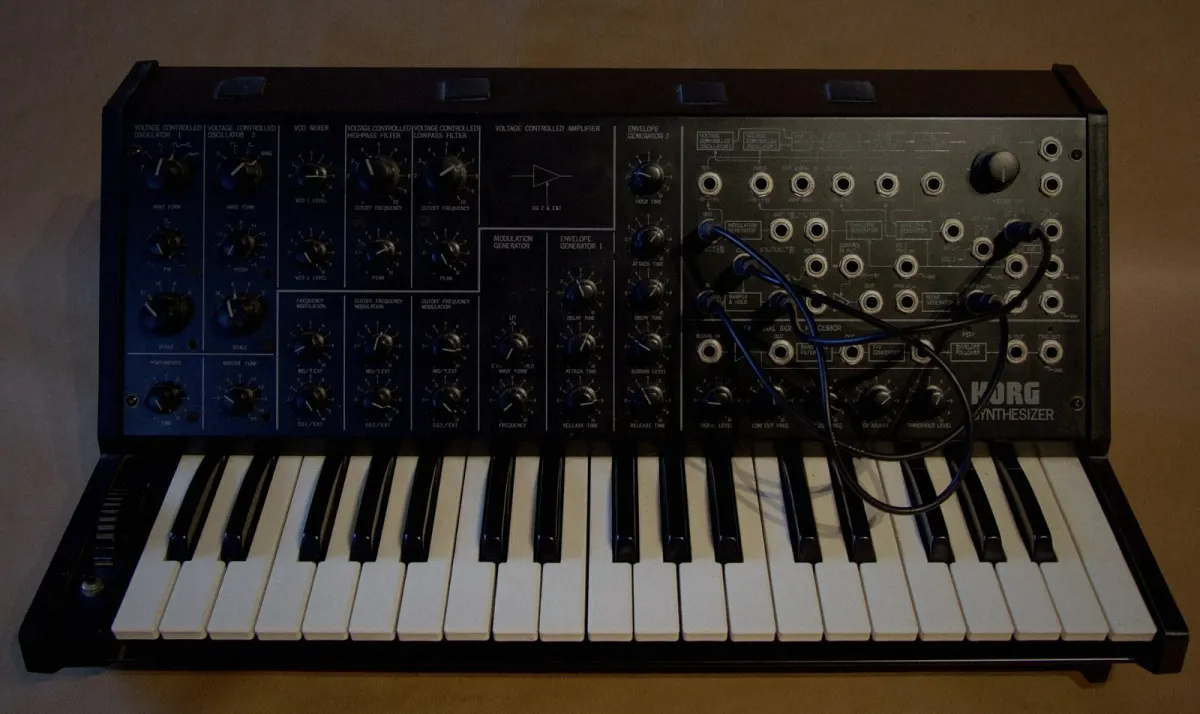
The MS-20 did not make sounds. It made you a sound designer. Nearly fifty years after its release, that distinction is still the reason producers keep one within arm’s reach.
Semi-Modular: The Clever Compromise
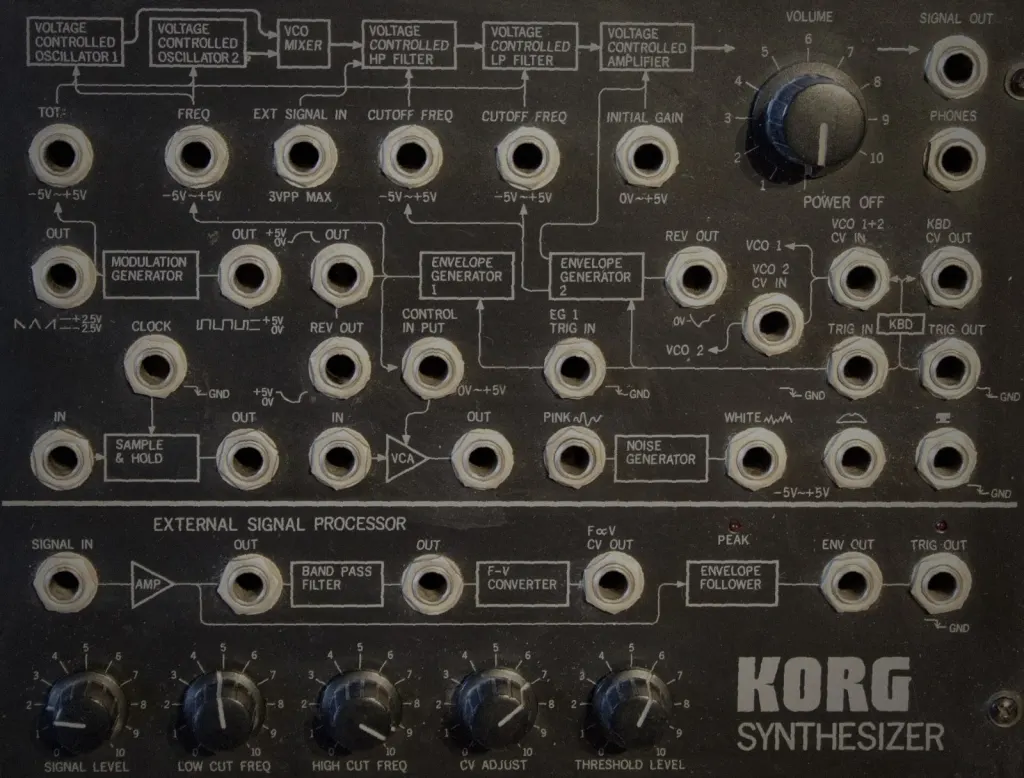
Korg released the MS-20 in 1978 as a semi-modular synthesizer. Fully modular systems required patching every signal path by cable; the MS-20 came pre-routed and playable out of the box, but exposed 22 patch points where you could interrupt the internal flow and rewire it in non-standard ways. Route an oscillator into the filter’s cutoff input and you get a self-modulating sweep tied to pitch. Feed the external input with a drum machine and the filter becomes a mangler. The hybrid design made it dramatically cheaper than the modular racks it imitated, a fraction of a Minimoog’s price at launch, while preserving the experimental flexibility that teaches synthesis properly: by physical cause and effect.
That Filter
The MS-20’s defining voice is its filter, aggressive, screaming at high resonance, unstable in the best way, and utterly unlike the polite warmth of American designs. Early units used a circuit Korg later revised, and the two revisions have their own cults. It is a rude sound, and rudeness dates well: it cut through cheap PA systems in 1979 and it cuts through crowded mixes in 2026. You can hear the machine’s DNA all over electro, EBM, and the harder ends of techno and house, any place a bassline needs teeth.
Who Used It
Because it was affordable, the MS-20 became the working musician’s experimental synth rather than the studio trophy. Daft Punk kept one close through their formative records; Aphex Twin and the IDM generation prized its unpredictability; and decades of post-punk, coldwave and techno producers built basslines on it precisely because it refused to behave. It was never anybody’s only synth. It was everybody’s honest one.
The Machine That Refused to Die
Korg discontinued the MS-20 in 1983, and the secondhand market spent thirty years bidding it upward until the company took the hint: the MS-20 Mini arrived in 2013 as a faithful, smaller reissue, followed by full-size remakes and module versions, one of the first and most successful moves in the analogue-reissue wave that Moog and the whole industry followed. The reissues sold enormously, to a generation raised on software who wanted one instrument that pushes back. Like the SP-404, the MS-20’s value turned out to be its friction: patch cables force decisions plugins never demand. Fifty years of noise, and the lesson holds, the synthesizers that survive are the ones that teach.
The MS-20 in a Working Setup Now
The easiest way to own the sound today is also the smallest. Korg announced the MS-20 Mini at NAMM in 2013, built by the same engineers at 86 percent of the original size, with MIDI and USB added. A full size kit followed in 2014 with both filter revisions on a switch. In 2020 Korg announced the MS-20 FS, a full size reissue that keeps the Rev1 and Rev2 choice, according to the instrument history. Behringer brought out a low cost clone, the K-2, in 2019. For anyone who will never touch a cable, the MS-20 also lives as software in the KORG Collection.
The part working DJs should care about is the external input. The MS-20 was built to process outside signals, and that is how I would use one in a booth, not as a keyboard. Send a drum machine, a vocal loop or a mixer channel into the external signal processor, then bring the filtered result back on a return. A straight house groove suddenly has a rude, resonant edge that you control by hand. My piece on the DJM mixer covers the send and return loop that makes this possible on a standard club setup.
How it sounds in a room is the warning. That high pass and low pass pair screams at high resonance, and a club system with real horns will punish a careless sweep. The peak that sounds exciting on headphones can land in the upper mids, where a loud room turns harsh fastest. Ride the resonance with one hand and the channel gain with the other. Keep an eye on the meters too, which is the whole argument of my piece on staying out of the red.
Why it still matters now is the same reason the reissues sold. A generation raised on plugins keeps discovering that one cable into the filter input teaches more than a menu does. Its voice also suits the harder end of the dancefloor that has come back in the last few years, from EBM basslines to acid tinged techno. I think about this when I play. The records that cut through a busy room almost always have something like that filter in them, a sound with an edge that does not apologise.
The MS-20 does not sound polite. It was never supposed to.
Frequently Asked Questions
What is the Korg MS-20?
The Korg MS-20 is a semi modular analogue synthesizer that Korg released in 1978. It came pre routed and playable out of the box, but exposed 22 patch points where you could interrupt the internal signal flow and rewire it. That hybrid design made it far cheaper than the modular racks it imitated while keeping the flexibility that teaches synthesis by physical cause and effect.
Why is the MS-20 filter so famous?
The MS-20 filter is famous because it is aggressive, screams at high resonance, and sounds nothing like the polite warmth of American designs. It cut through cheap PA systems in 1979 and still cuts through crowded mixes in 2026. Early units used a circuit Korg later revised, and both revisions have their own cults.
Who used the Korg MS-20?
Daft Punk kept an MS-20 close through their formative records, and Aphex Twin and the IDM generation prized its unpredictability. Decades of post punk, coldwave and techno producers built basslines on it precisely because it refused to behave. Because it was affordable, it became the working musician’s experimental synth rather than a studio trophy.
Is the Korg MS-20 still made?
Yes, in reissued form. Korg discontinued the original MS-20 in 1983, then released the MS-20 Mini in 2013 as a faithful, smaller reissue, followed by full size remakes and module versions. It was one of the first and most successful moves in the analogue reissue wave that Moog and the rest of the industry followed. At launch it cost a fraction of the price of the Minimoog.
Written from Seoul, by someone who has been in the booth for more than twenty years. More on the site, or book a DJ.
Watch and listen: Korg · Korg MS-20 in-depth guide
Stay in the Loop
New writing on DJ culture, electronic music, and the Seoul underground, delivered when it matters.
More From The DJ Diaries



Play with the history
Four tools built from the same research as this site.