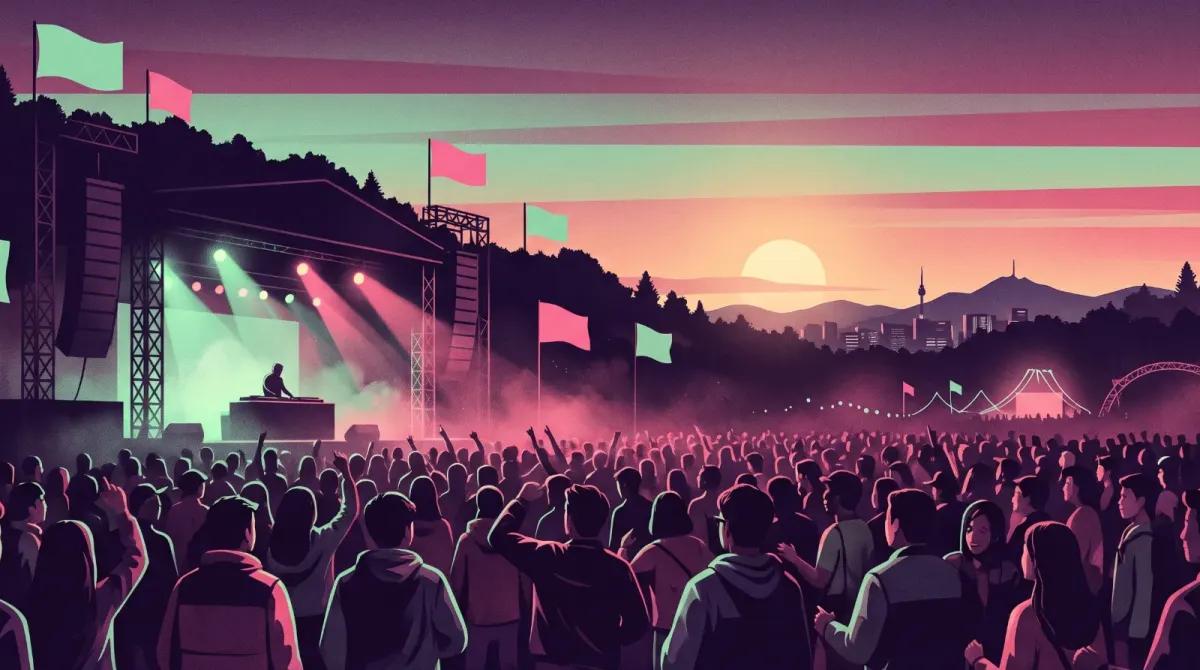
Moontribe has gathered under the full moon in the Southern California desert since 1993, with one sound system, no vending, and directions sent only to its mailing list. It describes itself as a gathering of friends, not a festival. It will never top an attendance chart, and it matters more to dance music than plenty of events a hundred times its size.
That’s the test I use. A festival’s importance is measured by what it made possible for the cities and cultures that followed, not by how many tickets it sold. By that standard the essential list is short, and half the biggest brands in the world aren’t on it. What follows runs from the festivals that set the template to the ones that never publish a lineup, plus the club nights people cross oceans for.
The Architects Set the Template
Awakenings, in Amsterdam, has been running since 1997 and is the prototype of the festival as architecture: warehouse rooms where 5,000 people feel sub bass properly, opening onto outdoor fields that change the whole experience. That balance of intimacy and scale is the one every large techno festival has borrowed since.
The Festivals That Changed Dance Music
Where they are, and what each one gave the rest of us
세계 댄스 뮤직 페스티벌의 기준
| Festival | Where | What it gave dance music |
|---|---|---|
| Awakenings | Amsterdam, since 1997 | Warehouse rooms opening onto fields |
| Movement | Hart Plaza, Detroit | Techno honouring its inventors at home |
| Dekmantel | Amsterdam’s forest | Curation as the headliner |
| Glastonbury | England | A rave settlement inside a rock festival |
| Sonar | Barcelona | Day conference, night spectacle |
| Tomorrowland and EDC | Boom, Belgium; Las Vegas | The production standard |
| Wonderfruit | Near Pattaya, Thailand | Art, sustainability and sound |
| Rainbow Disco Club | Japan | Capped capacity, selectors first |
| Fusion | Lärz, Germany, since 1997 | No sponsors, no lineup, ticket lottery |
| Moontribe | California desert, since 1993 | One sound system under the full moon |
How to read itThe top six set the models everyone else copies. The rest show the alternatives: Asia’s newer festivals and the ones that refuse to advertise.
Movement, on Hart Plaza each Memorial Day weekend, is the pilgrimage: techno’s birth city honouring its own inventors, with the founding generation still on the bill and the city’s history in the air. Dekmantel, in Amsterdam’s forest, made curation itself the headliner. It proved a festival could sell out on trust in its programming rather than on a poster of names, which is the residency logic at festival scale.
The Institutions Sell Scale, and Say So
Glastonbury earns its place for one part of the site: the dance areas that grew out of Britain’s rave settlement into a festival within the festival. It isn’t running in 2026, to rest the farmland, and returns in 2027. Sonar in Barcelona built the model of the festival as ideas venue, with day conferences, night spectacle and thirty years of premiering the future.
Tomorrowland and EDC are the spectacle empires, the production standard everyone else quotes, and they’re open about what they sell, which is scale rather than discovery. They’re the superstar economy’s twin capitals, in Belgium and Las Vegas. How far that production standard reaches was clear in July 2025, when fire destroyed most of Tomorrowland’s new main stage in Boom two days before opening. Nobody was hurt, and the festival went ahead as scheduled.
Asia Is Where the Growth Is
Coverage of essential festivals still looks mostly at one side of the world, and having played and attended across Asia, I’d call that a blind spot. Korea and Japan run festivals with production standards equal to anything on the big circuits, at lower ticket prices, with calmer and better behaved crowds. Wonderfruit, outside Pattaya, built Asia’s answer to the art festival model: sustainability first, literate about sound systems, and Thai in its bones. Rainbow Disco Club in Japan runs the boutique idea at its purest, with capped capacity, one perfect field and selectors over headliners.
The circuit runs deeper than those two. In Japan, The Labyrinth has run since 2001 in the mountains of Gunma on one grass floor and a carefully tuned Funktion-One rig, and its 2026 edition runs 10 to 12 October. Rural in Fukushima has grown since 2009 from a 500 person campout into a respected outdoor techno weekend, FFKT, the festival formerly known as TAICOCLUB, now runs at a seaside hotel on the Izu Peninsula, and MUTEK Japan brings audiovisual work to Tokyo on 20 to 23 November 2026.
Further south, Smoke Machine’s Organik has shown off Taiwan’s underground since 2012, now on a white sand peninsula on the north coast. Equation in Vietnam made its name as a rave inside Mỏ Luông Cave, and Shi Fu Miz in Hong Kong marks its tenth anniversary on 14 November 2026 in a lychee forest near Yuen Long. Wonderfruit returns to Pattaya on 3 to 7 December 2026 and is trying something smaller first, Wonderfruit Chapters in Kyoto in late October. China’s biggest brand remains Storm, a pure EDM spectacle.
Closer to home, The Air House adds an autumn edition with Verish on 24 and 25 October 2026 in Namyangju (남양주), and Korea’s calendar, from World DJ Festival to EDC Korea at Inspire, is where the global industry’s growth now points, for the reasons the Asian circuit essay lays out. I map that circuit festival by festival in my guide to Korea’s DJ festivals.
The Free Spirits Never Publish a Lineup
Some of the most loved festivals in the world keep their bill secret on purpose. Fusion, on a former Soviet military airfield at Lärz in northern Germany, has run since 1997 on what its organisers call holiday communism: no major sponsors, no advertising, no lineup in advance, and tickets sold by lottery to about 70,000 people. It takes a planned break in 2027 and returns in 2028. These festivals sell trust, not names.
Garbicz, on a clear lake in western Poland, grew out of the Bar25 and Kater Holzig crowd in 2013 and now holds about 11,000, again with no lineup announced. Waking Life, outside Crato in Portugal, runs without corporate sponsors. In the Catskills, Sustain-Release, founded by Aurora Halal and Zara Wladawsky in 2014, is a members only techno weekend at a summer camp, with the main stage in the basketball gym and a crowd that arrives by shuttle from Nowadays. Moontribe belongs in this company too, and it should be approached as the gathering it says it is.
Two more belong on the pilgrimage list. Movement returns to Hart Plaza in Detroit on 29 to 31 May 2027. And Making Time, the Philadelphia party Dave P started in 2000, has run a three day festival every September since 2021 at Fort Mifflin, a Revolutionary War fort on the Delaware River. Every festival named here has an entry in the Festival Atlas.
Summer Runs From the Adriatic to British Columbia
For years, one bay outside Tisno on Croatia’s Dalmatian coast has hosted a run of summer dance festivals. The Garden Festival, founded in 2006, made it famous, and when it ended in 2015, Love International took over its July slot with seven days of house and disco, boat parties and nights at Barbarella’s Discotheque. One small bay has carried more of the summer than most cities.
Defected Croatia arrived in 2016, when the label moved its party from Ibiza to the same site, and it closed after its tenth and final edition in summer 2026. Dekmantel Selectors also began in 2016 and returns in August 2027, and Dimensions has been at The Garden since 2021 after its years at a fort near Pula. Further north on the island of Pag, Sonus filled the clubs of Zrće Beach with techno from 2013 to 2025, but cancelled its 2026 edition and says it will return in 2027 at a new venue.
The circuit now stretches well beyond Croatia. Kala has run on the Albanian Riviera since 2018 with a hotel room in every ticket, and Glitch brings techno to Malta each August. In England, Houghton fills the woods of a Norfolk stately home with long DJ sets, and Lost Village dresses a Lincolnshire forest as an abandoned village.
On this side of the Pacific, Bass Coast, an independent, artist owned festival, takes over a riverside site in Merritt, British Columbia, each July, and Piknic Électronik has filled Montréal’s Parc Jean-Drapeau every summer Sunday since 2003. CRSSD plays San Diego’s waterfront twice a year, and Day Zero usually opens the year with one night in the jungle near Tulum. These are in the Festival Atlas too.
Some of the Best Weekends Are Club Nights
A festival isn’t the only way to have a great weekend. Some clubs and parties do more for dance music in a single Sunday than most festivals do in a summer, and they’re the ones people plan trips around. New York has the deepest bench.
Nowadays, a club and garden at 56-06 Cooper Avenue in Ridgewood, Queens, was founded by DJs Justin Carter and Eamon Harkin of Mister Saturday Night. The garden opened in October 2015 and the indoor club in late 2017, on an SBS Slammer sound system, and phones aren’t allowed on the dance floor. Its Nonstop parties went weekly in late 2023 and run from Saturday night into Sunday afternoon, into Monday on long weekends, and in 2024 the club signed a ten year lease. The same pair run Mister Sunday, the open air afternoon party that launched on Memorial Day weekend 2011 at Gowanus Grove in Brooklyn, with Four Tet as the first guest, and has lived in the Nowadays backyard since 2015. Its 2026 season runs every Sunday from 3pm to 9pm between 10 May and 1 November, with guests including Theo Parrish, Floating Points, Optimo and Soul Summit on a newly upgraded floor.
Two more New York rooms keep the phones away. Signal, at 175 Morgan Avenue in East Williamsburg, was founded by Nicholas Spector of the Golden Record parties; it held preview nights in early 2025 and opened on 10 May 2025. Reports put it at 210 inside, on a d&b audiotechnik system, playing underground house, techno and disco. Basement opened on 10 May 2019 beneath Knockdown Center, a former 1903 glass factory at 52-19 Flushing Avenue in Maspeth, Queens, founded by Tea Abashidze and GeGa Japaridze, with Rebekah and DVS1 on the first weekend. You enter through brick tunnels once used to heat the building; the main room holds about 500 on Funktion-One sound with a 360 degree lighting rig, photos and video aren’t allowed, and a second room, Studio, added house in 2022.
The sound system lineage starts with The Loft, which began on 14 February 1970 when David Mancuso held a Love Saves the Day party at his home at 647 Broadway in Manhattan. It ran as an invitation only private party with no alcohol sold, and its audiophile system, designed with engineer Alex Rosner around Klipschorn speakers, shaped club sound worldwide. Mancuso played whole records without beatmatching, and he died in 2016. Parties continue in New York, but control of the name has been in a federal trademark lawsuit since 2025. Despacio carries the idea on tour. Created by James Murphy of LCD Soundsystem and David and Stephen Dewaele of Soulwax, with engineer John Klett, it premiered at the Manchester International Festival in 2013: seven custom speaker stacks about 3.3 metres tall around a circular floor, McIntosh amplifiers delivering close to 50,000 watts, vinyl only, slower tempos and sets that often run eight hours. It played all weekend at Portola in San Francisco in September 2026 (McIntosh on Despacio).
In Canada, Stereo is a Montreal afterhours club at 858 Sainte-Catherine Street East in the Village. DJ and producer Angel Moraes founded it with partners in 1998 and built its analogue sound system himself, taking New York’s Paradise Garage as his model. It survived arson fires in 2008 and 2009 and was rebuilt as a room within a room. The afterhours floor serves no alcohol, opens around 2am, holds about 700 and keeps going into daylight.
In Germany, Panorama Bar is the upstairs room of Berghain, the club that opened in 2004 in a former 1953 power station in Friedrichshain. It holds about 1,500, leans toward house and disco while the main room below plays techno, and has run a Studio-Akustik line array since 2017. Photography is banned and phone cameras get stickers. In 2026 Berghain placed 21st in DJ Mag’s Top 100 Clubs (official site). Open Ground sits in a converted Second World War bunker six metres underground at Alte Freiheit 25 in Wuppertal. Led by Markus Riedel, formerly of Hard Wax, with Hard Wax founder Mark Ernestus advising, it opened in December 2023 after about seven years of planning, runs a custom Funktion-One system upgraded in early 2026, tapes cameras, and entered DJ Mag’s Top 100 Clubs in 2026.
And two clubs show what a dance floor can mean under pressure. Bassiani opened in 2014 under Tbilisi’s Dinamo Arena football stadium, with its main floor in a disused swimming pool holding about 1,200. It bans photography, runs a strict door, and hosts Horoom nights for the queer community. After armed police raids in May 2018, thousands held a protest rave outside parliament; in late 2024 it closed for 40 days in solidarity with anti government protests, and it marked its 12th anniversary in July 2026. K41, written as ∄, is a techno club in a 19th century former brewery at Kyrylivska Street 41 in Kyiv’s Podil district. It opened in November 2019 with a queer friendly crowd, a strict door and taped cameras. When Russia invaded in February 2022 it sheltered about 200 people, then reopened in October 2022 with daytime parties to fit the curfew, and its Community Fund has raised more than £700,000 for the war effort. Parties were still running in 2026.
For anyone in Seoul, these rooms are a reminder of the tradition our own clubs, Faust, Cakeshop and the rest, belong to.
Independent Festivals Are Fragile, and Spectacle Has Its Place
The festivals I admire most are also the easiest to lose. Waking Life published its full accounts after losing about €400,000 in 2023. Defected Croatia has run its last edition, Sonus sat out 2026, and even Fusion and Glastonbury build in fallow years. The independent model runs on thin margins and goodwill, and a single bad year can end it.
That’s also the fairest case for the spectacle empires. They deliver awe reliably and anonymously, and they have the money to survive a burned stage. The architect festivals, Awakenings, Dekmantel, Movement and Rainbow Disco Club, deliver membership instead: smaller fields where the crowd is part of the programming and the economics favour music over pyrotechnics. Both are legitimate. Only one will change what you listen to for the next five years, and it’s never the one with the fireworks budget.
How to Choose One
The filter I’d apply, learned from playing and attending both tiers, starts with one question: do you want a lineup or a place? Some festivals are a lineup that happens to be somewhere; others are a location that happens to have music. Buying the wrong one is the most common festival mistake. For a side by side view, see festival DNA compared.
Dates to Know, October 2026 Onward
Next editions and planned breaks for festivals in this article
다가오는 페스티벌 일정
| Festival | Where | Next |
|---|---|---|
| The Labyrinth | Gunma, Japan | 10 to 12 Oct 2026 |
| The Air House, autumn | Namyangju, Korea | 24 and 25 Oct 2026 |
| Wonderfruit Chapters | Kyoto, Japan | Late Oct 2026 |
| Shi Fu Miz | Near Yuen Long, Hong Kong | 14 Nov 2026 |
| MUTEK Japan | Tokyo | 20 to 23 Nov 2026 |
| Wonderfruit | Near Pattaya, Thailand | 3 to 7 Dec 2026 |
| Movement | Detroit | 29 to 31 May 2027 |
| Glastonbury | England | Returns 2027 |
| Dekmantel Selectors | Tisno, Croatia | Aug 2027 |
| Sonus | Croatia, new venue | Returns 2027 |
| Fusion | Lärz, Germany | Break in 2027, back 2028 |
The ruleAsia fills the autumn. The big summer names are already on 2027 and 2028.
Then check the site before the bill. Distance between stages, sound bleed, shade and toilets decide how much music you see, and a perfect lineup on a bad site is a worse day than a decent lineup on a good one.
Finally, treat weather as a structural fact. Korean and Japanese summer festivals are monsoon season events, and the Mediterranean ones are heat events, so plan for the climate rather than the forecast. For a first festival, a city edge event such as World DJ Festival at Seoul Land in Gwacheon is an easier start than a remote camping weekend.
Frequently Asked Questions
What are the most important dance music festivals in the world?
The essential dance music festivals are measured by what they made possible, not by attendance. Awakenings in Amsterdam, running since 1997, set the template of warehouse rooms opening onto outdoor fields. Movement on Hart Plaza in Detroit is the techno pilgrimage, and Dekmantel in Amsterdam made curation itself the headliner.
Are Tomorrowland and EDC worth going to?
They’re worth it if you want spectacle, because they deliver awe reliably and anonymously. Tomorrowland and EDC set the production standard everyone else quotes, and they’re open about selling scale rather than discovery. Smaller architect festivals such as Awakenings, Dekmantel and Movement offer membership instead, and those are the ones more likely to change what you listen to.
What are the best dance music festivals in Asia?
Wonderfruit outside Pattaya is Asia’s answer to the art festival model, and Rainbow Disco Club in Japan runs the boutique idea at its purest. The Labyrinth in Gunma, Organik in Taiwan and Shi Fu Miz in Hong Kong are the smaller names worth the trip. Korea adds World DJ Festival (Korean) and EDC Korea at Inspire. Festivals in Korea and Japan match the production of the big global brands at lower ticket prices, with calmer crowds.
How do you choose which music festival to go to?
Decide first whether you’re buying a lineup or a location, because the two produce very different days. Then check the site layout, the distance between stages, shade and toilets, since those decide how much of the bill you see. Treat weather as structural rather than luck: East Asian summer festivals fall in monsoon season.
Further Reading
- Awakenings: official site of the Amsterdam techno festival
- Movement: official site of the Detroit festival on Hart Plaza
- Dekmantel: official site of the Amsterdam Bos festival
- Glastonbury Festival: official site
- Sonar: official site of the Barcelona festival of music and technology
- The Festival Atlas on The DJ Diaries
- Pentaport 2026 Review: a first hand account of Korea’s biggest rock festival
Sources
Awakenings, About, on the festival’s history since 1997
Movement, festival guide, Hart Plaza and Memorial Day weekend
Tomorrowland, festival welcome page
McIntosh, Despacio powered by McIntosh
Newsis, World DJ Festival 2026 (Korean)
Korea JoongAng Daily, EDC Korea to take place in Incheon in October
Written from Seoul, by someone who has been in the booth for more than twenty years. More on the site, or book a DJ.
Stay in the Loop
New writing on DJ culture, electronic music, and the Seoul underground, delivered when it matters.
More From The DJ Diaries
Play with the history
Four tools built from the same research as this site.