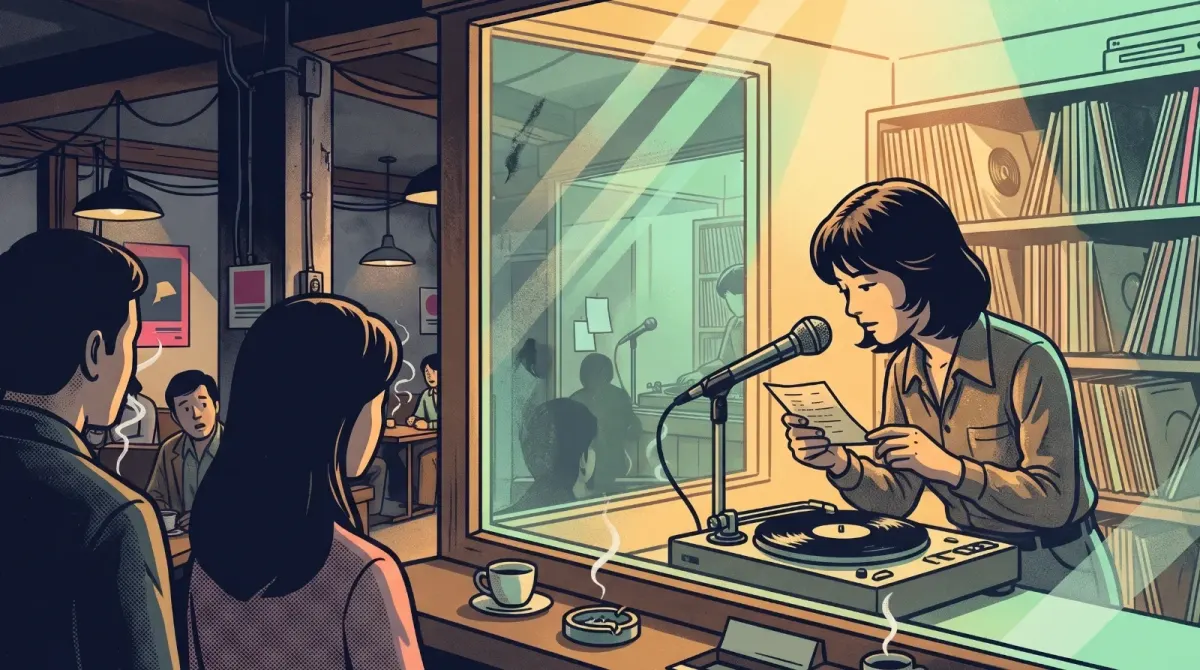
Every account of the Korean music dabang (음악다방, eumak dabang), including the ones I’ve written on this site, describes a man in the booth. Female dabang DJs barely appear at all. The requests came from everyone, and a great many of them were written by women. The voice that read them out, for decades, was almost always a man’s.
That struck me as worth checking rather than repeating. So I went looking for the women, and I want to report both what I found and what I couldn’t find, because the shape of the gap is part of the answer.
A note on method, since it matters here. This is desk research in Korean and English press, not an interview. I haven’t spoken to anyone named below. Where I’m inferring, I say so.
One of the Only Female Dabang DJs on Record
Her name is Seol Hyo-suk. In January 1980 she was a customer at Mua (무아음악감상실), a music listening room in Changdong (창동), Masan (마산), on the south coast. The manager invited her to try the microphone. She turned it down, then did it anyway. The room reacted well enough that she was offered the job, and she took it.
The detail that makes her story worth an article rather than a footnote comes from the same Gyeongnam Domin Ilbo feature: Changdong at that time had more than thirty music venues and somewhere between seventy and eighty working DJs. She was the first woman among them.
One in eighty. In a city, in a boom, in the format’s best decade.
She worked the booths for about a decade. Her audience, in an industrial port city, was substantially women factory workers from the Masan Free Export Zone (마산수출자유지역), some paying their siblings’ school fees, who by her account came in because there was nowhere else to go after a hard shift. She made a point of reading their requests. In 1989 she moved into broadcasting as a radio writer and host. In 2005 she came back to the decks in Changwon music cafes. Since 2016 she has run her own room, a music cafe called Sogul (소굴) in Masanhappo-gu (마산합포구).
Forty six years after a manager offered a customer the microphone, she owns the booth.
Seol Hyo-suk, from 1980 to today
The first woman among 70 to 80 working DJs in Changdong, Masan
| When | What happened |
|---|---|
| January 1980 | A customer at a music listening room in Changdong, Masan; offered the microphone, then the job |
| About a decade later, 1989 | Moves into broadcasting as a radio writer and host |
| 2005 | Returns to the decks in Changwon music cafes |
| Since 2016 | Runs her own music cafe, Sogul, in Masanhappo-gu |
How to read itThe story runs top to bottom.
The Coda Nobody Would Have Predicted
There’s a detail at the end of her story that made me sit up, because it belongs to a different article on this site entirely.
She ran a YouTube channel, 설다방, Seol Dabang, and built it to around six thousand subscribers before copyright problems stalled it. Read that against what she spent her working life doing. For decades she played records she owned, in a room, to people in front of her, and that was simply the job. The moment the same act moved onto a platform, the records stopped being hers to play.
I’ve written at length about what DJs gave up when libraries became licences. Her career is that argument with a person attached to it.
Why Were There So Few Female Dabang DJs?
Here I have to be careful, because this is where the sources thin out. I’m not a historian of Korean labour or gender. What follows is inference, clearly labelled, from what the record does show.
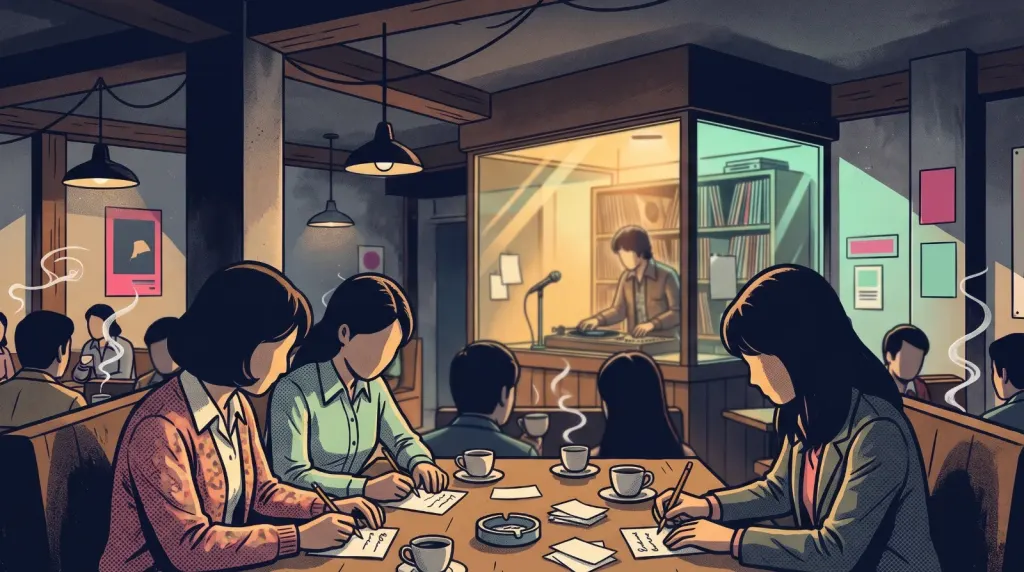
The dabang DJ job was public, late, and performative. It meant a young person, usually unmarried, working evenings in a room full of strangers, holding a microphone and having opinions in public. In the Korea of the sixties and seventies, that description carried a social cost that fell very differently on a woman than on a man.
The job was also a career ladder into broadcasting. The broadcast DJ generation it produced, the names Korean coverage lists as the era’s stars, is overwhelmingly male. That suggests the filter operated at the entry point rather than only at the top.
And there’s the ordinary mechanism of any closed trade: the booths were filled by recommendation. Local histories of the era describe dabang owners scouting popular DJs and competing hard to land them. That’s a hiring system that reproduces whoever is already in it.
None of which is a documented finding. It’s what the surrounding evidence suggests, and I’d rather say that plainly than dress inference up as history.
What the Silence Actually Tells Us
The absence is itself the most interesting result of this search, and I want to state it precisely rather than dramatically.
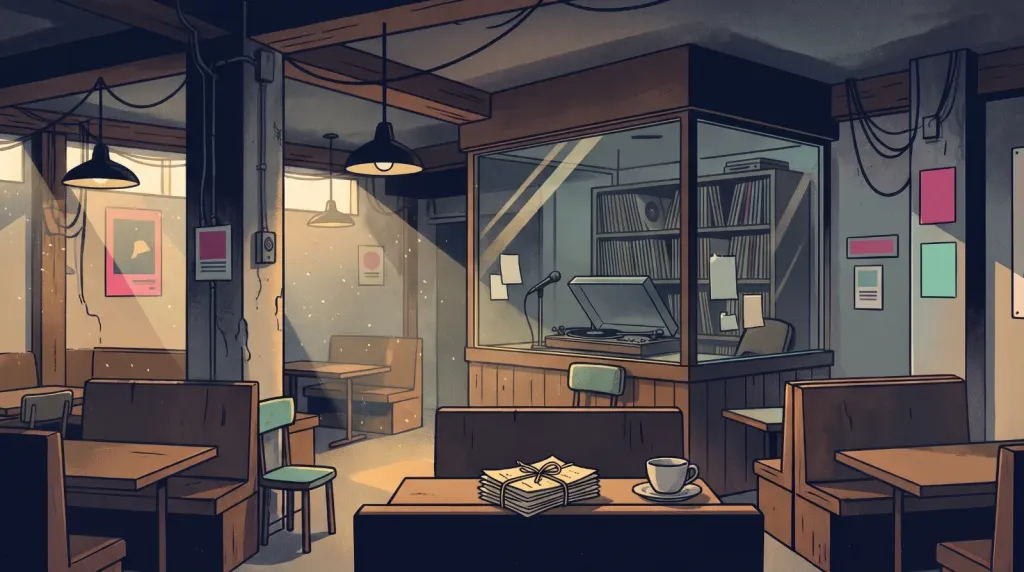
It’s not that no women worked the booths. It’s that the record of them barely exists in a searchable form. Seol Hyo-suk is documented because a regional newspaper wrote a feature about her in 2025, forty five years after she started. If that reporter hadn’t gone to Masan, I’d have found nothing at all. I’d have written a very different and less accurate article about a job that was simply closed to women.
So I’d conclude there were almost certainly others, in Busan and Gwangju and Daegu and Seoul. Their careers ended without anyone writing them down. Korean pop culture history is well served for its male stars and thin on everyone else, and that thinness isn’t evidence of absence.
Which is also the argument for doing this now. The women who worked those booths are in their sixties and seventies. Some of them are still running rooms, as Seol is. There’s a window here, and it’s not a wide one.
If You Know One
This is the part of the article that’s a request rather than a conclusion.
If you worked a dabang or a music listening room as a woman, or your mother or aunt or teacher did, I’d like to talk to you, and I’ll write it properly. The same goes for anyone who remembers a woman in a booth in any Korean city, in any decade. A first name and a venue is enough to start with.
I’d rather this article get corrected than stay incomplete. It’s the kind of history that only exists if somebody bothers to ask while there’s still someone to ask.
FAQ
Were there female DJs in Korean music dabang?
Yes, but they were extremely rare. The best documented is Seol Hyo-suk, who began at a Masan music listening room in January 1980 and was, according to regional press, the first woman among roughly seventy to eighty DJs working in that city’s Changdong district at the time. The historical record for women in the format is very thin overall.
Who was Korea’s first female music dabang DJ?
There’s no verified national answer, which is itself part of the story. Seol Hyo-suk is documented as Masan’s first female DJ, starting in January 1980, and remains one of very few named women from the era. She later worked in radio and now runs her own music cafe in Masanhappo-gu.
Why were dabang DJs almost all men?
No single documented reason exists, but the surrounding evidence points to several: the job was public, late night and performative in an era when that carried a heavier social cost for women. It functioned as a pipeline into a broadcasting industry that was itself overwhelmingly male. Booths were filled largely by personal recommendation, which tends to reproduce the existing workforce.
What happened to Korea’s women DJs from that era?
Mostly they went undocumented. The one well recorded career, Seol Hyo-suk’s, moved from the booth into radio writing and presenting in 1989, back to cafe DJing in 2005, and into venue ownership in 2016. How many others had comparable careers is unknown, because regional and gendered pop culture history in Korea has been recorded far less thoroughly than the careers of the era’s male stars.
Sources and Further Reading
The one documented career. Gyeongnam Domin Ilbo’s feature on Seol Hyo-suk, Masan’s first female DJ, is the source for everything specific in this article and is worth reading in full.
Context on how the booths were staffed. A local history of Anyang’s music dabang describes owners scouting popular DJs and competing hard to land them in the seventies. That’s the hiring system this article argues kept the trade closed. Busan’s cultural archive on the Gwangbok-dong DJs and Jeonnam Ilbo on the Gwangju scene give the regional picture, and both are almost entirely male.
What the Record Does Not Show
Where the women would be, if anyone had looked. Regional newspaper archives and municipal culture archives are where this history survives, if it survives at all. Seoul History Archive (서울역사아카이브) and the equivalent local archives in Busan, Daegu, Gwangju and Masan are the obvious places to search. Seoul Institute, Seoul in Photographs holds photography of the rooms themselves. If you’re a researcher rather than a reader, that’s where I’d start.
The other end of the story. Korea now exports women DJs and producers at a level the 1980s couldn’t have imagined. Our guide to the current scene is full of them. That’s not a straight line from Seol Hyo-suk’s booth, but it’s the same country.
Read next: the last music dabang DJ · the request slip as a messaging system · how the booth became the club · owning your records versus renting them
Picture Credits
Present day photographs
The DJ Diaries.
Hanok windows lit at night
Photo: Unsplash.
Historical images on this site are used under the licence stated for each file. KOGL Type 1 is the Korean public sector open licence permitting commercial use and adaptation with attribution; public domain items carry no restriction. If you hold rights in any image here and believe it has been used in error, get in touch and it will be removed.
Written from Seoul by The DJ Diaries, in Seoul since 2002 and in the booth for thirty years. More on the site, or book a DJ.
Stay in the Loop
New writing on DJ culture, electronic music, and the Seoul underground, delivered when it matters.
More From The DJ Diaries


Play with the history
Four tools built from the same research as this site.