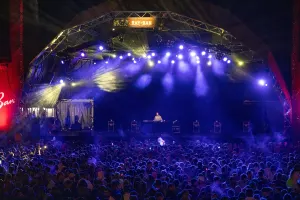
The number from my first properly paid gig is still in my head. I won’t say what it was, because the context doesn’t matter, but I remember the feeling: part satisfaction, part something more uneasy. The number had set a reference point that was going to be hard to walk back from, and I was starting to understand that the money side of DJing is complicated in ways nobody had warned me about.
Most DJs find the money conversation uncomfortable, and most writing about it either reduces it to tactics or ignores the pressures that make the tactics hard to use. Fees are set mostly by supply: there are more DJs than slots in almost every market, so the price drifts down. What you control is how distinct you are, whether you build a residency, when you bring in an agent, and which well paid gigs you turn down.
Fees Follow Supply, Not Effort
DJ fees cover a wider range than most people outside the industry expect. A DJ playing an opening set at a small club in a mid size city might earn fifty to a hundred dollars. A DJ with a regional following playing headline slots at medium venues might earn five hundred to two thousand. A DJ with an international profile playing major festivals can command five figure fees.
The Money Grew. The Nights Didn’t.
Global electronic music industry value, and average events per venue
시장은 커졌지만, 공연 수는 줄었다
How to read itThe industry grew 7% in 2025 to a record value, while the average venue ran slightly fewer events. More money, spread across fewer nights.
Where you fall in that range comes down to reputation, demand, scarcity and the economics of the market you play in. Reputation is the factor you control most over time, and it’s the slowest to build. The force pushing fees lower than they might be is simple: most markets have more DJs than slots, and when supply exceeds demand, prices fall.
The global numbers don’t change that. The 2026 IMS Business Report put the electronic music industry at a record $15.1 billion in 2025, up 7%, yet the average venue ran 140 events that year, down from 144. Growth at the top of the business doesn’t create more Saturday slots at the bottom.
Undercutting Is a Symptom of Too Many DJs
The most common complaint among working DJs is some version of “other DJs are taking gigs for less than they’re worth, and it drags everyone down.” It’s true in the narrow sense and more complicated in the broad one.
A DJ who takes a gig below the going rate is often making a rational choice. They have less leverage than established DJs, and a cheap gig does more for their development than no gig. What drives fees down is a structural oversupply of DJs and a promoter culture that keeps testing how low the market will go. The individual answer is to become distinct and in demand enough that the downward pressure stops applying to you, which is the case for building a reputation on performance rather than on price.
Set Your Rate From Both Ends
Most DJs set their rates by asking what other DJs at their level charge, or by working out what their time and preparation are worth. Both are valid. Benchmarking is practical because DJ fees are partly set by shared expectations within a scene. The cost approach matters because DJing costs money: your music library, preparation time, equipment upkeep and travel should all inform what you’re willing to accept.

If you play in Korea as a freelancer, the promoter or company paying you will usually withhold tax from the fee, so agree up front whether the figure you’re quoting is before or after that deduction. That’s the whole of what I can usefully tell you, because I’m a DJ and not your accountant. A tax accountant (세무사, semusa) can tell you how it applies to you.
A Residency Pays More Than It Looks
A residency, a recurring booking at the same venue, usually weekly or monthly, is the most valuable structure most working DJs never chase hard enough. The predictable income is useful. The deep knowledge of one room and one crowd is more useful. The local audience that follows you specifically is the most useful of all.
Four Ways to Make the Month Work
What each kind of booking pays, and what it costs you
DJ 일정, 네 가지 방법
| Route | What it pays | What it builds | The catch |
|---|---|---|---|
| Residency | Steady, every week or month | A room and a following | Slow to land |
| One off headline | Higher, irregular | Reach | No relationship with the room |
| Agent booked | More and better gigs | Leverage | 10 to 15 percent, and only once demand is high |
| Off brief work | Often the best money | Very little | Can blur your sound |
The ruleOne residency at a steady fee for fifty two weeks is more reliable than twelve one off headline bookings for the same total.
The best DJs I know who built sustainable local careers without national or international touring all did it through residencies. One residency paying a steady fee fifty two weeks a year is more reliable than twelve one off headline bookings at the same total, and it builds a musical and social relationship with a room that one offs never do.
Get an Agent When You’re Turning Work Down
A booking agent’s offer is simple. They have relationships with promoters, they handle the admin of booking conversations, and they take 10 to 15 percent of the fee for the bookings they bring in. The case for one is that their contacts and negotiating can win more and better bookings than you would on your own, enough to make the commission worth it.

The case for waiting is that agents work best once your inbound enquiries already exceed what you can manage. An agent who takes you on while demand is low has little leverage on your behalf. If you’re handling your own bookings well and the volume is sustainable, keep doing that until you’re regularly turning work down.
The Gig You Shouldn’t Take
There’s a category of gig that pays adequately or well but asks you to play music well outside your artistic identity: the wedding circuit, corporate events, covers bars. These usually pay better than underground club slots, and the people there want specific, familiar music rather than your selection.
I’ve taken some of these and found them fine: professionally done, reasonably paid, a perfectly good use of a Saturday night when I had nothing else on. I’ve also found that doing them too often blurred my own sense of what I was doing and why, and getting back to the music I care about took longer than the money had been worth.
That’s a personal calculation, and it depends on where you are in your career, what your finances need and how sturdy your artistic identity is. There’s no universal answer. Make the decision on purpose, rather than taking every gig that pays and then wondering why your music feels diluted.
Test Yourself
Frequently Asked Questions
How much do DJs get paid?
Fees range enormously. Local openers might earn fifty to a hundred dollars a gig, regional headliners with established followings five hundred to two thousand, and DJs with international profiles playing major venues and festivals five figure fees. The variables are reputation, demand, scarcity within your genre and region, and the economics of the market you play in.
Do DJs need booking agents?
Agents become valuable once a DJ is playing regularly and inbound enquiries exceed what they can manage, or where an agent’s promoter relationships open doors direct approaches wouldn’t. Agents typically take 10 to 15 percent of fees. If you’re managing your own bookings well, that can stay the right approach until you’re regularly turning work down.
What is a DJ residency and is it worth it?
A residency is a recurring booking at the same venue, usually weekly or monthly. It gives predictable income, deep knowledge of one room and crowd, and a loyal local audience over time. For working DJs without national or international touring plans, a long residency is often the most valuable structure available.
Should DJs take gigs that pay well but don’t fit their artistic identity?
It’s a personal calculation that depends on your finances and how established your identity is. Commercial and corporate events often pay better than underground club slots. Taking them occasionally is usually fine; doing it often can blur your sense of what you’re doing and why. Make the decision deliberately rather than by default.
Further Reading
- What it costs to hire a DJ in Seoul
- How DJs get booked
- The residency model and how clubs build identity
- Social media for DJs
- Wikipedia: an overview of the disc jockey profession and how it has changed
- Wikipedia: what booking and talent agents do for performers
- Musicians’ Union: the UK union for musicians and DJs, with guidance on fees and contracts
- Wikipedia: the gig economy and the freelance work patterns DJs share with it
Sources
Billboard, a DJ finance guide for producers
Dancecult: Journal of Electronic Dance Music Culture, on working DJs and artistic identity
Written from Seoul, by someone who has been in the booth for more than twenty years. More on the site, or book a DJ.
Stay in the Loop
New writing on DJ culture, electronic music, and the Seoul underground, delivered when it matters.
More From The DJ Diaries



Play with the history
Four tools built from the same research as this site.