The Minimoog proved that you didn’t need a room full of cables to make electronic music. Every synthesizer you have ever touched, hardware or software, descends from that one decision.
It won by taking things away: fewer connections, a fixed signal path, a keyboard on the front. More than fifty years later, the same trade still shapes how producers think about sound, and how a bass line behaves on a club system.
From Laboratory to Instrument
Robert Moog’s original synthesizer, developed through the early 1960s, was a modular system: separate units on a rack, patched together with cables, enormous, expensive and nearly impossible to move. Only universities, research studios and wealthy musicians could own one, and playing it was closer to operating equipment than performing.
Minimoog Model D
Robert Moog's team folded a wall of modules into one instrument you could carry
- Type
- Monophonic synthesizer
- Launched
- 1970, condensed from the modular system in 1969 and 1970
- Changed
- Took synthesis out of the laboratory and onto the stage
- Made
- Over 12,000 between 1970 and July 1981
- Today
- Reissued in 2016 and again from 2022. Moog has belonged to inMusic since June 2023
The machinesTen instruments on The DJ Diaries, from 1970 to 2006, drawn to scale. Tap a dot to read its story.
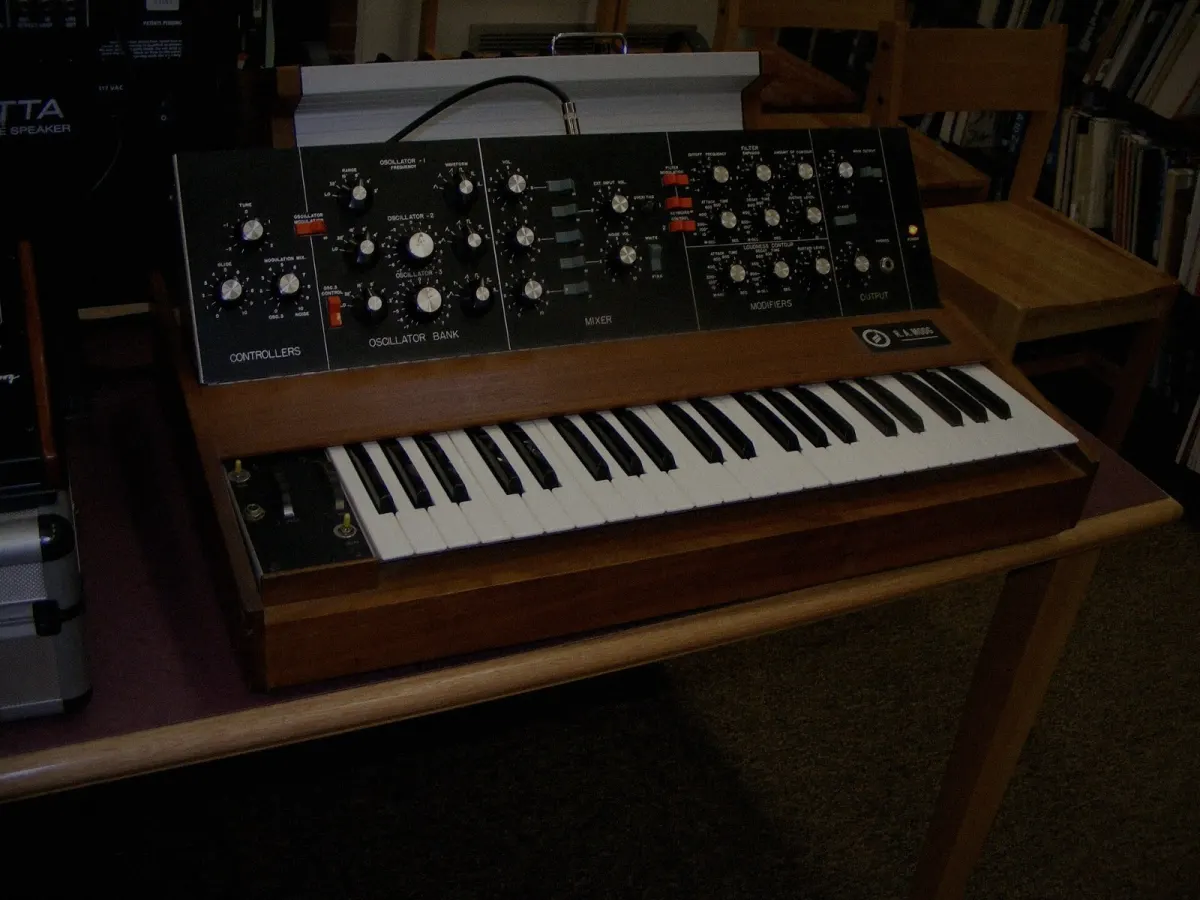
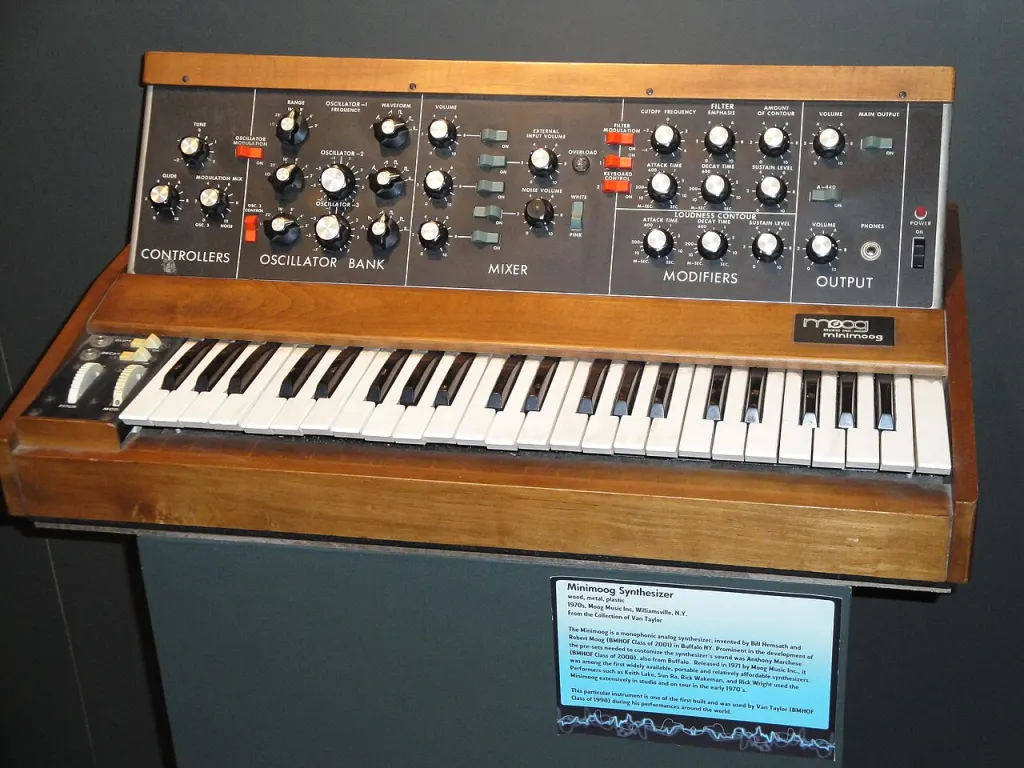
In 1969 and 1970, Moog’s team, engineer Bill Hemsath prominent among them, condensed the system into the Minimoog Model D: three oscillators, the ladder filter, an amplifier and envelopes, all internally wired into a fixed architecture with a keyboard on the front. You lost the ability to patch arbitrary connections. You gained an instrument a musician could carry to a gig, understand in an afternoon, and play with two hands.
The Sound of the Seventies
Over 12,000 were made between 1970 and the end of production in July 1981, a small number for an object that changed so much. Keith Emerson toured it, Rick Wakeman stacked it in capes, and Stevie Wonder built whole albums around it, Music of My Mind and Innervisions putting the Minimoog’s lead and bass voices at the centre of Black American music.
That fat, slightly unstable low end, a side effect of oscillators that drifted agreeably out of tune, became the reference bass sound of funk. From funk it passed to everything: Parliament’s synth lines, the boogie era, and eventually the West Coast producers who made Minimoog style leads the sound of G funk.
The Dance Music Inheritance
Dance music’s debt is direct. The Minimoog normalised the idea of the synthesizer as a performance instrument rather than studio furniture, the precondition for everything in the cities that built electronic music.
Its architecture, oscillators into filter into amplifier, became the mental model taught to every producer since, the grammar that the MS-20 complicated and the DX7 briefly overthrew. And its filter, the 24 dB Moog ladder, remains the most copied circuit in music technology, cloned in silicon and software so thoroughly that most producers use a Moog filter weekly without knowing it.
The Long Afterlife
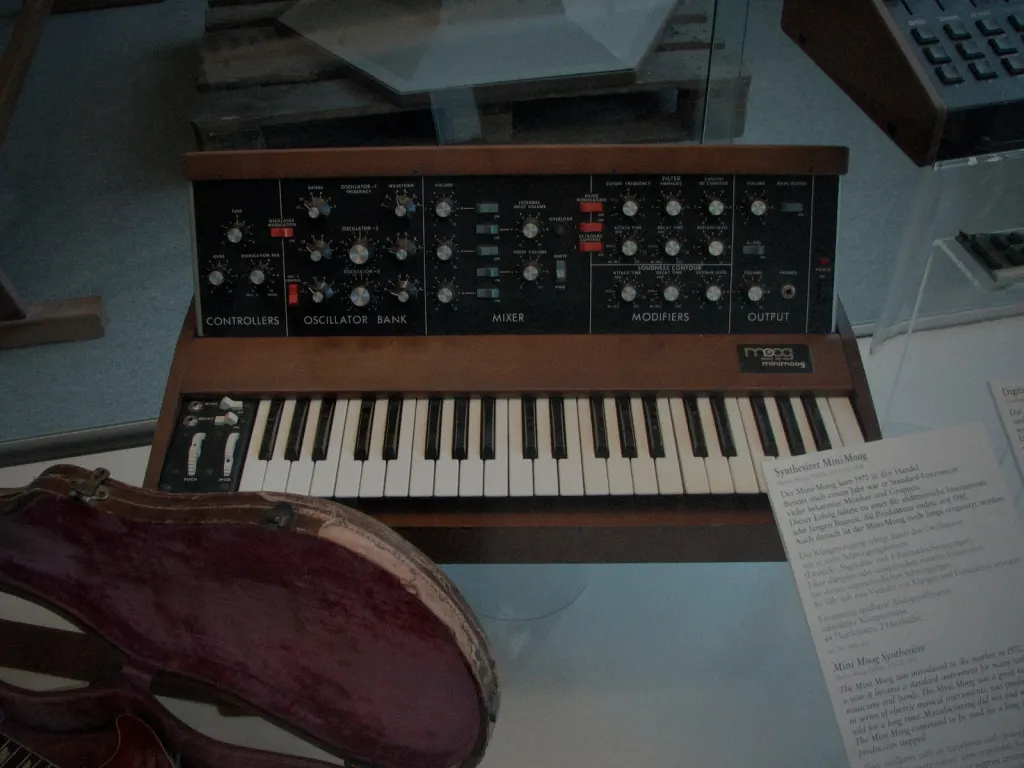
The instrument outlived its own discontinuation more thoroughly than any synth in history. It stayed coveted secondhand through the 1980s and 1990s, was reissued by a revived Moog Music in 2016, a run that used up its parts within about a year, then brought back again in 2022, and has been modelled by every serious plugin company.
The Minimoog, 1970 to Now
Every production run and successor
미니무그, 1970년부터 지금까지
| When | Machine | What happened |
|---|---|---|
| 1970 | Minimoog Model D | Production begins |
| July 1981 | Minimoog Model D | Production ends after over 12,000 |
| 2002 to 2015 | Minimoog Voyager | The successor, over 14,000 sold |
| 2016 | Model D reissue | Parts ran out within about a year |
| 2022 | Model D reissue | Back in production |
| June 2023 | Moog Music | Acquired by inMusic |
| June 2025 | Messenger | Launched at US$799 |
How to read itThe successor outsold the original, and the original keeps coming back anyway.
The revival isn’t nostalgia economics but the same argument that keeps vinyl and character hardware alive: constraints with personality outperform infinite options without one. More than half a century on, three oscillators and a ladder filter still end arguments.
Even its successor proves the point. The Minimoog Voyager, made from 2002 to 2015, shipped more than 14,000 units, slightly more than the original. Portability won, and the Minimoog is what winning looked like.
What the Model D Does in a Room Today
The Model D is still on Moog’s current lineup in 2026, which would have sounded absurd in 1981, and it keeps the three oscillators and the ladder filter described above. The company itself changed hands in June 2023, when Moog Music was acquired by inMusic. For a working musician the ownership story matters less than the fact that the instrument still exists as hardware, not only as a plugin. Under inMusic, Moog also launched the Messenger in June 2025, priced at US$799 at launch, a two oscillator mono synth with a sub oscillator that Moog describes as carrying the DNA of the Model D and the Voyager.
On a club system, a Minimoog bass line lives mostly in the mid bass, not the deep sub. The drifting oscillators and the driven filter add harmonics above the fundamental, and those harmonics are what let you hear the line on a small bar speaker or a phone. On a big rig with proper subs, the same line gains weight underneath and keeps its bite on top. That’s why 1970s funk bass still translates in a room built for house. My piece on sound systems and the architecture of the dancefloor goes into why the low mids decide so much of a night.
In a booth, the Model D’s descendants turn up constantly without anyone announcing them. There’s the rubbery lead on a boogie record, the fat mono bass under a funk edit, and the filter sweep a producer automates across a long build. The ladder filter is the thread through all of it. It’s also the reason a good filter on a mixer or a plugin can feel musical rather than clinical, because so many of them were designed with that sound as the target.
What changed in the last few years is price and access, not sound. A producer can buy a convincing emulation for the cost of a modest night out, and most do. The hardware argument still holds, for one reason. A fixed instrument with a keyboard forces decisions in real time, which is closer to DJing than to editing on a screen. You commit to a sound, you play it, and the room hears the choice.
Portability won in 1970. Playability is what keeps it alive.
Frequently Asked Questions
What’s the Minimoog?
The Minimoog Model D is a synthesizer that Robert Moog’s team, with engineer Bill Hemsath prominent among them, condensed from his modular system in 1969 and 1970. It has three oscillators, the ladder filter, an amplifier and envelopes, all wired into a fixed architecture with a keyboard on the front. Musicians lost free patching but gained an instrument they could carry to a gig and understand in an afternoon.
Why was the Minimoog so important?
The Minimoog was important because it made the synthesizer a performance instrument rather than studio furniture. Its architecture of oscillators into filter into amplifier became the mental model taught to every producer since, the grammar that the Korg MS-20 later complicated. Its 24 dB ladder filter remains the most copied circuit in music technology.
How many Minimoogs were made?
Over 12,000 Minimoogs were made between 1970 and the end of production in July 1981. That’s a small number for an instrument that shaped funk, the boogie era and later G funk. A revived Moog Music reissued the Minimoog in 2016 and again in 2022, and its successor, the Minimoog Voyager, sold more than 14,000 between 2002 and 2015.
Which musicians made the Minimoog famous?
Keith Emerson toured with the Minimoog, Rick Wakeman stacked it into his setup, and Stevie Wonder built whole albums around it, including Music of My Mind and Innervisions. Its fat, slightly unstable low end became the reference bass sound of funk and passed into Parliament’s synth lines. West Coast producers later made Minimoog style leads the sound of G funk.
Sources
Trevor Pinch and Frank Trocco, Analog Days, Harvard University Press
Bob Moog Foundation, Minimoog prototype exhibit at the Moogseum, November 2025
US patent 3,475,623, the Moog ladder filter
MusicRadar, Moog is ending production of the Minimoog Model D, June 2017
MusicRadar, the Minimoog Model D returns, 2022
MusicRadar, Moog acquired by inMusic, 2023
MusicTech, Moog Messenger features, pricing and availability, May 2025
Written from Seoul, by someone who has been in the booth for more than twenty years. More on the site, or book a DJ.
Watch and listen: Moog Music · Minimoog Model D demo, Sweetwater
Stay in the Loop
New writing on DJ culture, electronic music, and the Seoul underground, delivered when it matters.
More From The DJ Diaries



Play with the history
Four tools built from the same research as this site.